Organisational Resilience: The CEO's Blueprint for Building a Business That Thrives Through Disruption
Resilience Is No Longer About Survival—It's About Sustainable Advantage
Not long ago, resilience was associated with crisis management. Organisations built contingency plans for unlikely events and hoped they would never need them.
Today, disruption is no longer the exception—it is the operating environment.
Economic volatility, technological advances, geopolitical tensions, cybersecurity threats, supply chain disruptions, climate-related events, and changing employee expectations have transformed the business landscape. The question is no longer whether disruption will occur, but how prepared organisations are to respond.
Some organisations emerge stronger from uncertainty. Others lose momentum, talent, customers, and market share.
The difference is rarely luck.
It is organisational resilience.
Resilient organisations do more than recover. They adapt, innovate, and continue creating value while others are reacting. They build leadership teams capable of making confident decisions, cultures that embrace change, governance that accelerates action, and capabilities that prepare people for an uncertain future.
At Gestaldt, we believe resilience is not a programme or a policy. It is an organisational capability that must be intentionally designed, developed, and sustained.
Why Resilience Has Become a Strategic Priority
The pace of change has accelerated beyond traditional planning cycles.
Business models evolve faster.
Customer expectations change continuously.
Technology reshapes entire industries.
Employees expect greater flexibility, purpose, and development.
Boards are demanding greater oversight of organisational risk and long-term sustainability.
In this environment, organisations that rely solely on annual strategic planning risk falling behind.
Resilient organisations embed adaptability into the way they lead, decide, collaborate, and execute.
The Seven Characteristics of Highly Resilient Organisations
1. Leadership Creates Confidence During Uncertainty
Employees look to leaders for clarity, consistency, and confidence when uncertainty increases.
Resilient leaders communicate openly, make informed decisions despite incomplete information, and provide direction without pretending to have every answer.
Leadership behaviour shapes organisational resilience more than any policy.
Related Reading:Executive Team Alignment: Why Your Leadership Team Is Holding Your Business Back (And How to Fix It)
2. Culture Encourages Adaptability
A resilient culture values learning over blame.
Employees feel safe to challenge assumptions, test new ideas, and respond quickly when circumstances change.
Cultures built on trust and accountability recover faster because people focus on solving problems rather than protecting themselves.
Related Reading:The Invisible Fuel of Business Growth: How Leadership Culture Drives Organisational Success
3. Strategy Remains Flexible
Long-term vision should remain stable.
Execution should remain adaptable.
Resilient organisations regularly review assumptions, monitor external trends, and adjust priorities without abandoning their strategic direction.
Flexibility is a sign of disciplined leadership—not indecision.
4. Governance Enables Fast Decisions
In times of disruption, slow governance becomes a competitive disadvantage.
Decision rights should be clear, escalation pathways defined, and accountability transparent.
Governance exists to accelerate informed decisions, not create unnecessary bureaucracy.
5. Capability Is Continuously Developed
Skills become outdated more quickly than ever before.
Resilient organisations invest in leadership development, digital capability, change management, and continuous learning.
Preparing people for future challenges is more effective than reacting after disruption occurs.
6. Execution Remains Disciplined
Resilience is not achieved through planning alone.
It depends on consistent execution.
High-performing organisations translate strategic priorities into measurable action while maintaining focus, accountability, and momentum.
Related Reading:Why Strategy Execution Fails: The 7 Hidden Barriers Most CEOs Never See
7. Performance Is Measured Beyond Financial Results
Revenue and profitability remain essential.
However, resilient organisations also monitor:
Leadership effectiveness
Employee engagement
Innovation capacity
Customer trust
Decision-making speed
Change readiness
Organisational agility
These indicators provide early warning signs long before financial performance is affected.
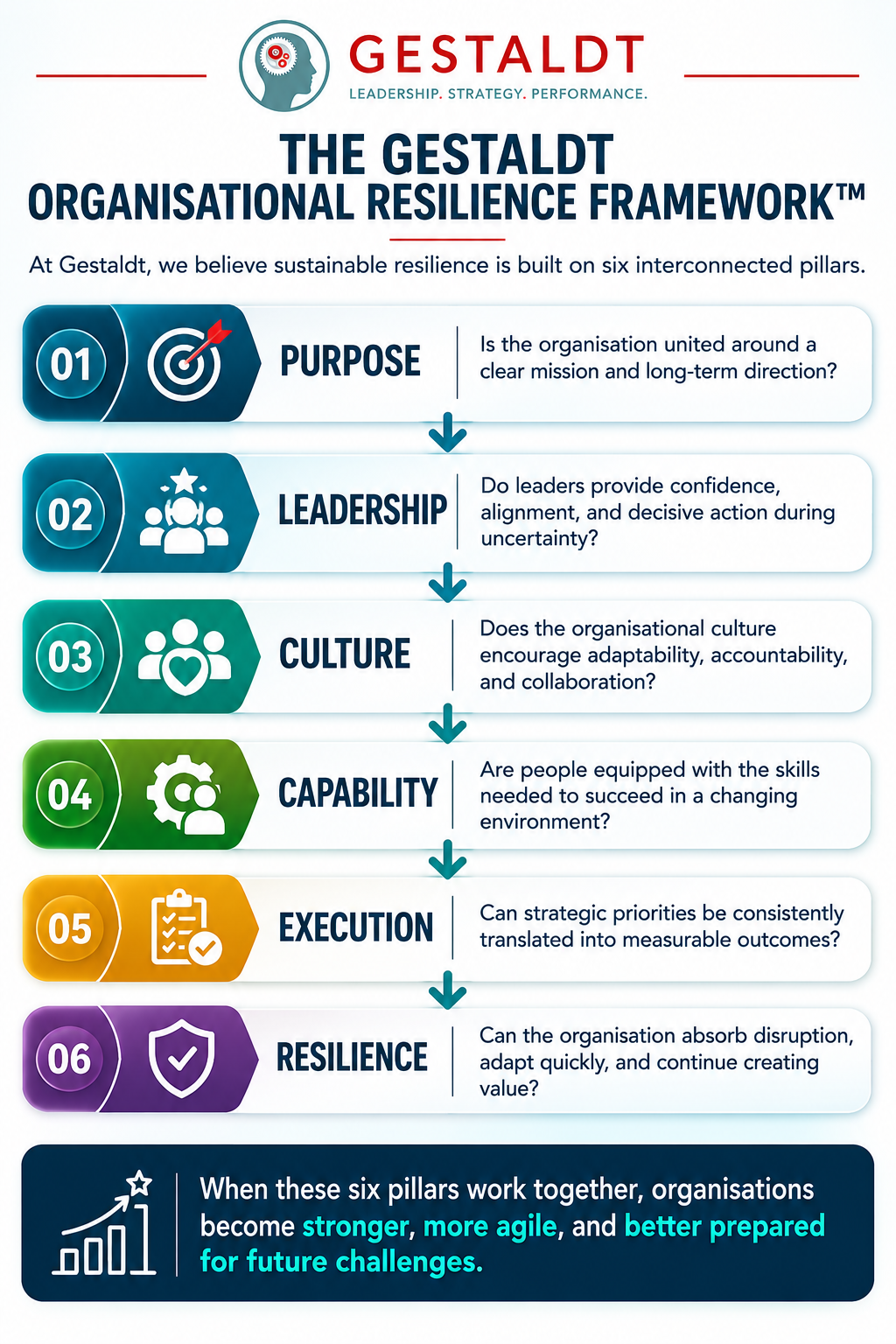
The Gestaldt Organisational Resilience Framework™
Executive Resilience Scorecard
Rate each statement from 1 (Strongly Disagree) to 5 (Strongly Agree).
Leaders communicate consistently during uncertainty.
Strategic priorities remain clear during change.
Employees embrace innovation and continuous improvement.
Decision-making is timely and well governed.
Learning and capability development are ongoing priorities.
Cross-functional collaboration is strong.
Strategic initiatives are executed effectively.
The organisation adapts quickly to market changes.
We measure organisational health beyond financial results.
We are confident in our ability to respond to future disruption.
Results
40–50: Your organisation demonstrates strong resilience.
30–39: Opportunities exist to strengthen organisational adaptability.
Below 30: Your organisation may be vulnerable to future disruption.
Executive Case Study
A diversified services organisation approached Gestaldt after experiencing repeated disruptions caused by changing market conditions and internal restructuring.
Although financial performance remained stable, executive leaders recognised growing signs of organisational fatigue:
Slower decision-making.
Declining employee engagement.
Increased turnover among key talent.
Difficulty executing strategic initiatives.
Gestaldt conducted an organisational resilience assessment and identified weaknesses in leadership alignment, governance, and capability development.
Working closely with the executive team, we introduced a resilience roadmap that strengthened leadership communication, clarified decision rights, and embedded continuous learning across the organisation.
Within twelve months, the organisation experienced:
Faster responses to market opportunities.
Improved executive collaboration.
Higher employee engagement.
Greater confidence in strategic execution.
Increased organisational agility.
Resilience became a competitive advantage rather than a defensive capability.
Five Questions Every CEO Should Ask
How quickly can our organisation adapt when conditions change?
Do our leaders inspire confidence during uncertainty?
Are we investing enough in future capability?
Does our governance accelerate or delay strategic decisions?
Would our employees describe our organisation as adaptable?
The answers reveal how prepared your organisation is for tomorrow's challenges.
The Future Belongs to Resilient Organisations
No organisation can predict every disruption.
But every organisation can improve its ability to respond.
Resilience is not built in moments of crisis. It is built through deliberate leadership, strong culture, effective governance, capable people, disciplined execution, and a commitment to continuous improvement.
Organisations that invest in resilience today will be better positioned to innovate, grow, and create lasting value tomorrow.
Ready to Strengthen Your Organisation's Resilience?
If your organisation is navigating uncertainty, preparing for transformation, or seeking sustainable growth, resilience should be at the centre of your leadership agenda.
Request an Organisational Resilience Assessment
Gestaldt's confidential assessment evaluates:
Leadership resilience.
Executive alignment.
Organisational culture.
Governance effectiveness.
Capability development.
Strategy execution.
Organisational agility.
Change readiness.
Together, we'll identify the strengths that will carry your organisation forward and the barriers that may be limiting future performance.