

When Growth Starts Breaking the Business: The CEO's Guide to Scaling Without Losing Control
Rapid growth can expose weaknesses that remained invisible when an organisation was smaller. Discover the six organisational barriers that make growth harder—and how CEOs can build structures, leadership and capabilities that scale without sacrificing speed, accountability or performance.

Growth Can Hide Problems—Until Suddenly It Can't
Growth looks like success.
More customers. More employees. More revenue. More locations. More products.
Then, almost imperceptibly, the organisation starts behaving differently.
Decisions take longer.
Meetings multiply.
Customers receive inconsistent experiences.
Departments create their own priorities.
Senior leaders become involved in operational details.
Managers spend more time coordinating than leading.
And the organisation that once moved quickly begins to feel strangely heavy.
This is the paradox of growth:
The organisation can become more successful while becoming less effective.
The problem isn't necessarily poor leadership or a weak strategy.
Often, the organisation has simply outgrown the structures that made it successful in the first place.
At Gestaldt, we believe sustainable growth requires more than expanding revenue or headcount. Organisations must evolve their leadership, structure, governance, culture, capability and execution at the same pace as their strategy.
Otherwise, yesterday's operating model becomes tomorrow's growth constraint.
The Hidden Cost of Organisational Complexity
Complexity doesn't arrive with a warning.
It accumulates.
One additional approval process seems harmless.
One new reporting requirement seems reasonable.
One additional management layer appears necessary.
One more strategic initiative feels manageable.
But eventually the organisation reaches a tipping point.
Employees need permission to act.
Leaders spend their time coordinating.
Information becomes fragmented.
Accountability becomes blurred.
And customers experience the consequences.
This is why organisational design matters.
Gestaldt's existing work on organisational design highlights the same fundamental issue: structures designed for stability can struggle when organisations need speed, adaptability and innovation.
The CEO's challenge is therefore not simply:
"How do we grow?"
It is:
"How do we grow without allowing complexity to grow faster than value?"
Six Warning Signs Your Organisation Has Outgrown Its Operating Model
1. Decisions Keep Moving Up the Hierarchy
Here's the first red flag.
Managers who once made decisions independently now need executive approval.
Executives become involved in increasingly operational matters.
The CEO's calendar fills with issues that should have been resolved several levels below.
This is often mistaken for strong executive oversight.
It isn't.
It can be a sign that decision rights haven't evolved with organisational scale.
What to Ask
Which decisions are reaching the executive team that shouldn't?
If the answer is "too many," your governance model may be constraining growth.
Practical Tip
Map your 20 most frequent high-impact decisions and identify who currently makes each one. Look for unnecessary escalation.
2. The Organisation Has More People—But Less Accountability
Growth often creates functional silos.
Sales owns customers.
Operations owns delivery.
Finance owns budgets.
Technology owns systems.
HR owns people.
Each function may perform well independently.
Yet nobody owns the end-to-end outcome.
That is where accountability starts to disappear.
Customers don't experience departments.
They experience the organisation.
A scalable operating model therefore needs clear ownership across organisational boundaries.
Practical Tip
For each major customer or strategic outcome, identify one accountable executive—not a committee.
3. Meetings Become the Operating System
This one is easy to miss.
When organisations become more complex, meetings multiply.
Weekly meetings.
Steering committees.
Transformation forums.
Performance reviews.
Project meetings.
Executive committees.
Soon, employees spend their working lives discussing work rather than doing it.
Meetings aren't inherently bad.
But excessive coordination is often evidence of structural problems.
Ask Yourself
If we cancelled 20% of our meetings tomorrow, what decisions or activities would actually stop?
The answer can reveal where the organisation has become unnecessarily dependent on coordination.
Practical Tip
Audit recurring meetings by asking:
What decision does this meeting make?
Who actually needs to attend?
What happens if the meeting disappears?
If the answer is unclear, redesign it.
4. Your High Performers Are Becoming Organisational Shock Absorbers
This is a dangerous growth pattern.
The organisation relies on a handful of exceptional people to keep everything moving.
They know who to call.
They understand the informal processes.
They solve cross-functional problems.
They compensate for structural weaknesses.
And because they are successful, leadership may not realise how dependent the organisation has become on them.
Until one leaves.
Then the cracks appear.
This is why leadership capability and succession planning matter to scalability.
Gestaldt's Leadership Pipeline Framework™ addresses this challenge by moving organisations from identifying critical capability gaps through assessment, development, deployment, evaluation and sustained leadership readiness.
Practical Tip
Ask:
"If our three most capable problem-solvers left tomorrow, what would break?"
Your answer is a useful measure of organisational dependency.
5. Growth Has Created More Priorities Than the Organisation Can Execute
This is where ambition becomes a liability.
As organisations grow, every function sees new opportunities.
Digital transformation.
New markets.
Customer experience.
AI.
Talent.
Operational efficiency.
Innovation.
ESG.
New products.
The list keeps growing.
But organisational capacity doesn't automatically grow at the same rate.
When everything becomes a priority, strategic focus disappears.
Gestaldt's existing work on strategy execution highlights the importance of converting strategic priorities into measurable action rather than allowing organisations to remain trapped in planning mode.
Practical Tip
Ask your executive team to identify the three outcomes that matter most over the next 12 months.
Then identify what you will deliberately stop, defer or deprioritise.
Focus is a growth capability.
6. The Organisation Is Scaling Faster Than Its Leadership Capability
Revenue can grow quickly.
Leadership capability usually doesn't.
This creates a dangerous gap.
A company that once had 50 employees may now have 500.
Yet leadership practices remain designed for a 50-person organisation.
Communication becomes fragmented.
Managers are promoted without sufficient preparation.
Executive roles become more complex.
Decision-making becomes slower.
Culture becomes harder to maintain.
This is why leadership development cannot be treated as an occasional intervention.
It must evolve alongside organisational complexity.
The Gestaldt Scalable Organisation Framework™
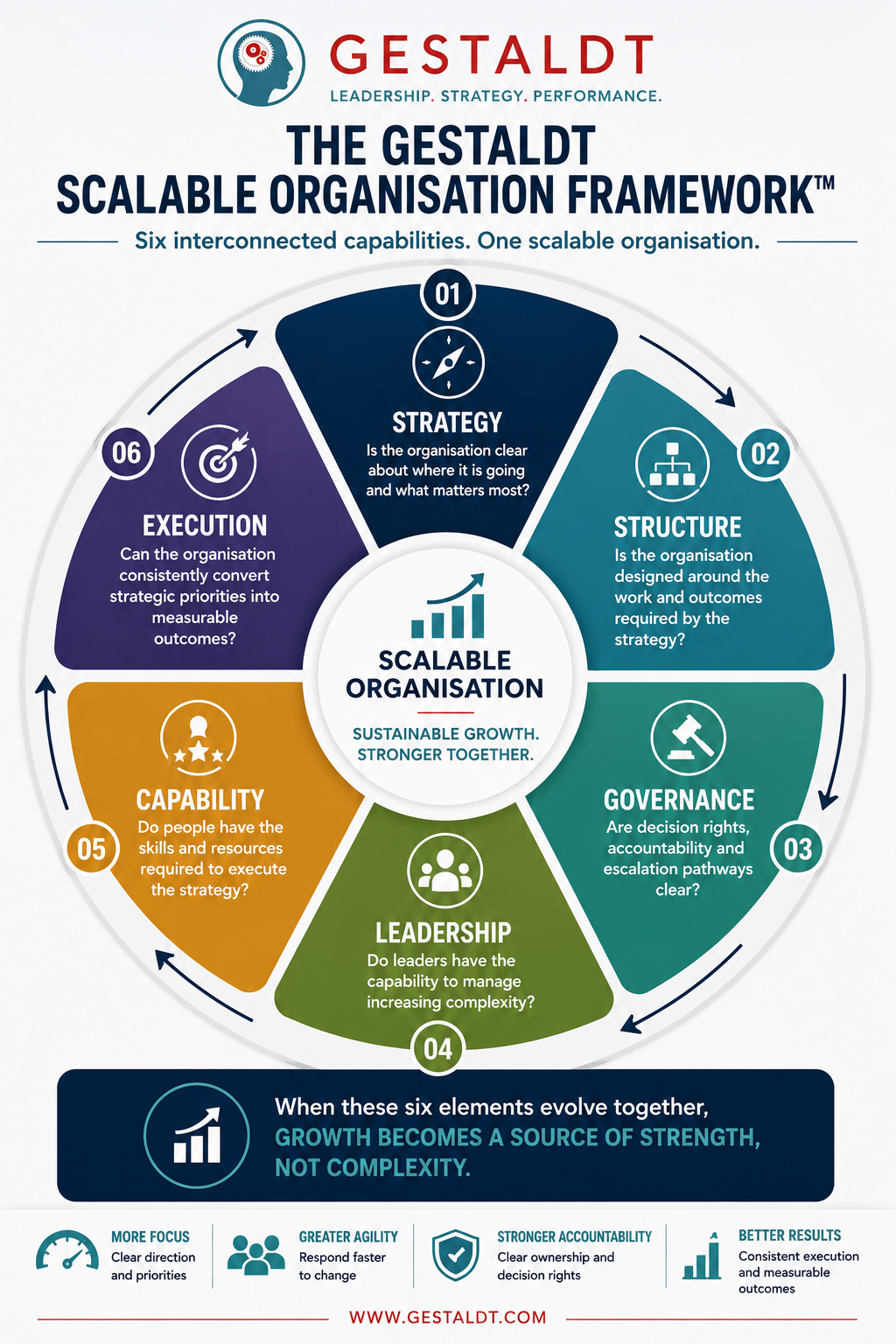
The Gestaldt Scalable Organisation Framework™ shows how strategy, structure, governance, leadership, capability, and execution work together to create a more agile, accountable, and scalable organisation.
The Scalability Stress Test
How scalable is your organisation?
Rate each statement from 1 (Strongly Disagree) to 5 (Strongly Agree).
Decision-making remains fast as the organisation grows.
Roles and responsibilities are clearly defined.
Strategic priorities are understood across the organisation.
Leaders have sufficient authority to make decisions.
Our structure supports cross-functional collaboration.
Accountability remains clear as complexity increases.
Our leadership pipeline is strong enough to support future growth.
We can add customers without proportionally increasing organisational complexity.
Our governance enables rather than slows execution.
Our operating model can adapt as strategy changes.
Your Score
40–50 — Scalable
Your organisation has strong foundations for sustainable growth.
30–39 — Emerging complexity
Your current operating model may soon begin constraining performance.
Below 30 — Growth risk
Structural and leadership issues may already be limiting scalability.
The CEO's Growth Trap: Fixing Symptoms Instead of the System
When growth slows, CEOs often look for an immediate answer.
Hire more people.
Add technology.
Restructure.
Launch another initiative.
Increase sales.
Cut costs.
But these interventions can treat symptoms without addressing the underlying system.
For example:
Slow decisions → add another approval process.
The result?
Even slower decisions.
Poor accountability → create another reporting dashboard.
The result?
More reporting but not necessarily better ownership.
Weak collaboration → create another committee.
The result?
More coordination.
The better question is:
What about the way our organisation is designed is producing this outcome?
That shift—from fixing symptoms to understanding the system—is one of the most important transitions a growing organisation can make.
Organisational Design Is a Strategic Decision
Organisational design is sometimes treated as an HR exercise.
It shouldn't be.
Structure determines:
Who makes decisions.
Where information flows.
How resources are allocated.
Who owns outcomes.
How quickly teams respond.
How effectively strategy is executed.
In other words:
Organisation design determines how strategy becomes reality.
This is particularly important in volatile markets, where slow-moving organisations can struggle to respond quickly. Gestaldt's current Insights content similarly emphasises organisational agility, simplified decision-making and capability building as important drivers of sustainable growth.
A Better Way to Think About Scaling
Don't ask:
"How do we build a bigger version of the organisation we have today?"
Ask:
"What organisation will our next stage of strategy require?"
That distinction changes everything.
Your future organisation may require:
Fewer management layers.
Greater decision authority.
New leadership capabilities.
Different customer-facing structures.
More cross-functional teams.
New governance mechanisms.
Different performance measures.
The goal isn't simply to replicate today's organisation at a larger scale.
It is to design the organisation for tomorrow's strategy.
Five Questions Every CEO Should Ask Before the Next Growth Phase
1. What has become unnecessarily complicated?
Look beyond organisational charts.
Examine processes, meetings, approvals and decision pathways.
2. Where does accountability become blurred?
Find the points where multiple functions share responsibility but nobody owns the outcome.
3. Which decisions are unnecessarily centralised?
Identify where senior leaders are acting as bottlenecks.
4. What capabilities will the next stage of growth require?
Don't develop people for today's organisation alone.
5. Can our current operating model execute our future strategy?
If the answer is no, redesign before growth exposes the weakness.
From Growth to Scalable Performance
Growth is not the finish line.
It is a test.
It tests leadership.
It tests culture.
It tests governance.
It tests capability.
It tests whether the organisation can maintain execution as complexity increases.
The organisations that scale successfully understand a simple principle:
Growth requires organisational evolution.
The structure that worked at one stage may become a constraint at the next.
The leadership practices that worked when the organisation was smaller may no longer be sufficient.
The governance mechanisms that created control may eventually create friction.
The challenge for CEOs is knowing when to evolve—and what to change.
Is Your Organisation Designed for Its Next Stage of Growth?
If growth is creating slower decisions, greater complexity, unclear accountability or increasing pressure on your leadership team, the problem may not be your strategy.
It may be the organisation's ability to support it.
Request a Gestaldt Organisational Scalability Assessment
Gestaldt can help your executive team assess:
Organisational structure
Operating model effectiveness
Leadership capability
Decision rights
Governance
Accountability
Strategic alignment
Organisational complexity
Future capability requirements
Execution capacity
The objective isn't simply to restructure.
It is to design an organisation capable of delivering your next stage of growth.
Assess Your Organisation's Scalability

Why High-Performing Organisations Suddenly Stop Growing: The CEO's Blind Spot
Why do successful organisations suddenly lose momentum? Discover the seven hidden organisational barriers that silently stall growth, reduce performance, and prevent strategy execution—and learn how executive leaders can regain competitive advantage.

Success Can Become Your Greatest Risk
Growth is exciting.
Revenue increases.
New markets open.
The workforce expands.
Customers multiply.
Confidence rises.
Then something changes.
The organisation isn't in crisis—but it isn't accelerating either.
Projects take longer to complete.
Decisions slow down.
Innovation loses momentum.
Departments begin protecting their own priorities.
Top performers quietly leave.
Customer satisfaction starts to decline.
The business still appears healthy from the outside, yet internally, leaders know something isn't right.
For many CEOs, this is the most dangerous stage of organisational growth—not because the problems are visible, but because they are hidden beneath the surface.
The instinctive response is often to develop a new strategy, restructure the organisation, or invest in new technology. Yet in many cases, the real issue isn't the strategy itself. It's the organisation's ability to execute, adapt, and grow in alignment.
At Gestaldt, we've found that sustained growth depends on more than a strong business plan. It requires leadership alignment, a healthy organisational culture, effective governance, and the ability to translate strategic intent into consistent action.
Let's explore the seven hidden barriers that quietly prevent high-performing organisations from reaching their next level of success.

1. Leadership Alignment Is Only Skin Deep
"We're aligned."
Most executive teams believe they are.
Yet when asked individually about the organisation's top priorities, success measures, or strategic risks, their answers often differ.
Alignment is more than agreeing during a strategy session. It means leaders consistently communicate the same vision, make decisions using the same principles, and reinforce the same priorities throughout the organisation.
When alignment is weak, mixed messages filter through the business, creating confusion, duplicated effort, and competing priorities.
Questions Every CEO Should Ask
Can every executive clearly articulate the organisation's top three strategic priorities?
Are leaders making decisions using the same criteria?
Does every business unit understand how its work contributes to the strategy?
Without alignment at the top, execution breaks down across the organisation.
2. Culture Quietly Rejects the Strategy
Organisations rarely fail because of poor strategies.
They fail because everyday behaviours don't support those strategies.
A company may aspire to become more innovative while rewarding risk avoidance.
It may seek greater collaboration while maintaining siloed structures.
It may promote accountability while tolerating inconsistent performance.
These contradictions create friction between intention and execution.
As Peter Drucker famously said:
"Culture eats strategy for breakfast."
A healthy organisational culture doesn't happen by chance. It is intentionally shaped by leadership behaviours, governance structures, and shared values.
Related Reading:The Invisible Fuel of Business Growth: How Leadership Culture Drives Organisational Success
3. Complexity Has Replaced Clarity
As organisations grow, complexity grows with them.
More products.
More meetings.
More reporting.
More approvals.
More initiatives.
Before long, employees spend more time managing processes than creating value.
One of the biggest threats to sustained growth isn't competition—it's organisational complexity.
High-performing organisations simplify relentlessly.
They identify what matters most, eliminate unnecessary work, and focus resources on the initiatives that create the greatest strategic value.
4. Middle Managers Become the Missing Link
Middle managers are often expected to implement strategic change without being meaningfully involved in shaping it.
This creates a disconnect between executive intent and operational reality.
Employees don't execute strategy because executives communicate it.
They execute it because managers translate it into daily priorities.
Organisations that consistently outperform invest heavily in developing middle leadership capability, communication skills, and change leadership.
5. Growth Has Outpaced Leadership Capability
Many organisations invest heavily in systems and technology but overlook leadership capability.
The skills required to lead a 100-person organisation differ significantly from those needed to lead a 5,000-person enterprise.
Leadership development cannot remain static while the organisation evolves.
Future-ready organisations continuously strengthen executive capability in:
Strategic thinking
Decision-making
Change leadership
Innovation
Collaboration
Emotional intelligence
Without leadership growth, organisational growth inevitably slows.
6. You're Measuring Yesterday Instead of Tomorrow
Most executive dashboards focus on lagging indicators.
Revenue.
Profit.
Market share.
Operational costs.
While essential, these metrics reveal what has already happened.
Leading organisations also monitor indicators that predict future performance.
Examples include:
Leadership alignment
Employee engagement
Innovation pipeline
Customer advocacy
Decision-making speed
Organisational agility
Change readiness
These measures provide early warning signs long before financial performance begins to decline.
7. You're Solving Symptoms Instead of Root Causes
Revenue slows.
So marketing budgets increase.
Employee turnover rises.
So salaries increase.
Projects fail.
So governance becomes more bureaucratic.
Often these interventions address symptoms rather than underlying organisational issues.
True transformation begins by identifying root causes.
Leadership.
Culture.
Capability.
Governance.
Execution.
These are the systems that determine long-term organisational performance.
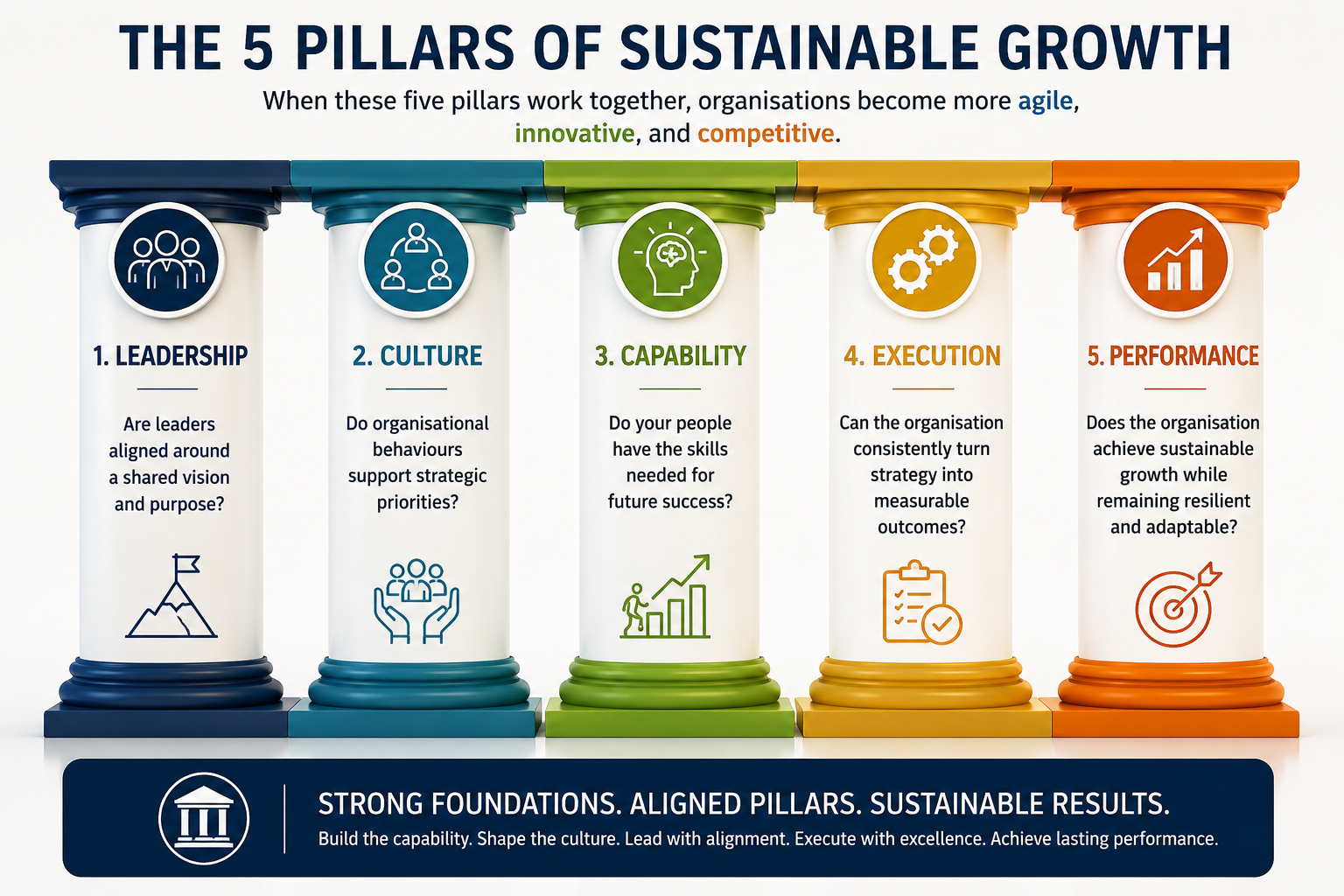
The Gestaldt Growth Performance Model™
At Gestaldt, we believe sustainable business growth depends on five interconnected pillars:
Executive Self-Assessment
Is Your Organisation Quietly Losing Momentum?
Score your organisation from 1 (Strongly Disagree) to 5 (Strongly Agree):
Our executive team consistently communicates the same priorities.
Employees understand how their work contributes to our strategy.
Our culture encourages accountability and innovation.
We execute strategic initiatives on time.
We measure leading indicators, not only financial results.
Leaders adapt quickly to change.
Our middle managers actively drive transformation.
Decision-making is fast and effective.
Leadership capability keeps pace with organisational growth.
Our strategy consistently translates into measurable business results.
Your Score
40–50: Your organisation is well positioned for sustainable growth.
30–39: Warning signs are emerging. Small issues may become significant barriers if left unaddressed.
Below 30: Your organisation may be experiencing hidden execution challenges that require immediate attention.
Sustainable Growth Isn't an Accident
The organisations that outperform their competitors over decades share one common characteristic.
They don't simply develop better strategies.
They build organisations capable of executing them.
For CEOs, the greatest blind spot is often assuming that growth challenges originate in the market.
More often than not, the answers lie within the organisation itself.
Leadership alignment.
Culture.
Capability.
Governance.
Execution.
These are the true drivers of sustainable performance.
Ready to Discover What's Holding Your Organisation Back?
Growth challenges rarely resolve themselves.
The sooner hidden barriers are identified, the sooner meaningful transformation can begin.

Request a Complimentary Executive Growth Diagnostic
In a confidential executive consultation, Gestaldt will help you assess:
Leadership alignment
Strategy execution capability
Organisational culture
Governance effectiveness
Change readiness
Leadership capability
Performance barriers
Together, we'll identify the issues limiting your organisation's growth and develop practical strategies to unlock its full potential.
👉 Schedule your Executive Growth Diagnostic today and take the first step towards sustainable organisational success.

Why Strategy Execution Fails: The 7 Hidden Barriers Most CEOs Never See
Most business leaders don't struggle with strategy—they struggle with execution. Discover the seven hidden barriers that prevent organisations from turning ambitious plans into measurable results, and learn how CEOs can close the gap between strategy and performance.

The Strategy Illusion
Every year, leadership teams invest substantial time and resources into strategic planning. Executive retreats are held, vision statements are refined, objectives are agreed upon, and ambitious targets are set.
Yet months later, many organisations find themselves asking the same question:
"Why aren't we seeing the results we expected?"
The truth is that most organisations don't have a strategy problem. They have an execution problem.
Research consistently shows that the majority of strategic initiatives fail to achieve their intended outcomes. While strategies often look impressive on paper, execution breaks down when organisations fail to align leadership, culture, governance, capabilities, and accountability.
At Gestaldt, we've observed a recurring pattern across industries: the barriers that derail execution are often invisible to leadership until performance begins to suffer.
Here are the seven hidden barriers that prevent strategy from becoming reality.
Barrier 1: Leadership Teams Are Not Truly Aligned
The Silent Killer of Strategic Success
Many executive teams believe they are aligned because they attended the same planning sessions and approved the same strategic objectives.
However, alignment is not agreement.
True alignment means leaders share a common understanding of priorities, outcomes, responsibilities, risks, and decision-making principles.
When executives interpret strategy differently, organisations experience:
Conflicting priorities
Mixed messages to employees
Departmental silos
Slower decision-making
Resource misallocation
The result is confusion throughout the organisation.
Key Question
Can every member of your executive team clearly articulate the organisation's top three strategic priorities in exactly the same way?
If not, execution risks are already emerging.
Related Reading:
Read our article on leadership culture and organisational performance:
The Invisible Fuel of Business Growth: How Leadership Culture Drives Organisational Success
Barrier 2: Culture Is Working Against the Strategy
Strategy Doesn't Fail—Culture Rejects It
One of the most underestimated barriers to execution is organisational culture.
A company may have a brilliant growth strategy, but if its culture discourages innovation, collaboration, accountability, or change, execution stalls.
As management expert Peter Drucker famously observed:
"Culture eats strategy for breakfast."
Many organisations attempt transformation while maintaining behaviours that reward the status quo.
Signs of cultural resistance include:
Fear of failure
Risk avoidance
Low accountability
Resistance to change
Internal politics
Without cultural alignment, even the most sophisticated strategies struggle to gain traction.
Related Reading:
Explore how organisational culture influences performance and growth in:
The Invisible Fuel of Business Growth: How Leadership Culture Drives Organisational Success
Barrier 3: Too Many Priorities Create Strategic Paralysis
When Everything Is Important, Nothing Is Important
Leadership teams often attempt to tackle too many strategic initiatives simultaneously.
Growth initiatives.
Digital transformation.
Culture change.
Talent development.
ESG commitments.
Customer experience improvements.
Operational excellence.
While each initiative may be valuable, pursuing too many priorities creates organisational overload.
Employees become confused about where to focus their efforts.
Resources become diluted.
Momentum disappears.
High-performing organisations understand the power of focus.
They identify a small number of critical priorities and align resources accordingly.
Practical Reality
If your organisation currently has more than five major strategic initiatives competing for attention, execution complexity is likely increasing significantly.
Barrier 4: Accountability Is Unclear
The Ownership Gap
One of the most common execution failures occurs when responsibility is shared by everyone and owned by no one.
Strategic objectives frequently appear on executive dashboards without clear accountability structures.
Questions leaders should ask include:
Who owns this initiative?
What outcomes are expected?
How will progress be measured?
What happens if milestones are missed?
When accountability is unclear:
Decisions are delayed
Deadlines slip
Problems remain unresolved
Progress becomes difficult to track
Successful organisations establish clear ownership and measurable outcomes at every level of execution.
Barrier 5: Middle Management Is Excluded From the Strategy
The Forgotten Layer of Execution
Many strategies fail because executives focus on designing the strategy but neglect the people responsible for delivering it.
Middle managers translate strategy into operational reality.
They shape employee engagement.
They manage performance.
They drive adoption.
Yet they are often informed rather than involved.
This creates a disconnect between strategic intent and operational execution.
The organisations that execute effectively actively engage middle management throughout the strategy lifecycle.
They become champions of change rather than passive recipients of directives.

Barrier 6: Organisations Underestimate Change Fatigue
People Can Only Absorb So Much Change
Today's workforce is navigating unprecedented levels of disruption.
Digital transformation.
Economic uncertainty.
Hybrid work.
Artificial intelligence.
Market volatility.
Leadership changes.
Employees are being asked to adapt continuously.
Many executives underestimate the cumulative impact of change fatigue.
When organisations launch multiple initiatives without considering employee capacity, engagement declines and resistance increases.
Symptoms include:
Lower productivity
Increased turnover
Reduced innovation
Change resistance
Burnout
Effective execution requires organisations to manage change as carefully as they manage strategy.
Related Reading:
Explore how leaders can navigate uncertainty in:
Thriving Amid Uncertainty: How C-Suite Leaders Can Navigate Economic Volatility
Barrier 7: Progress Is Measured Too Late
What Gets Measured Gets Managed
Many organisations rely exclusively on lagging indicators such as:
Revenue growth
Profitability
Market share
Customer retention
While important, these metrics reveal problems after they occur.
Successful strategy execution requires leading indicators that provide early warning signals.
Examples include:
Employee engagement scores
Leadership alignment metrics
Change adoption rates
Customer sentiment
Project milestone completion
By monitoring leading indicators, executives can identify execution risks before they impact business performance.
A Framework for Closing the Execution Gap
At Gestaldt, we believe successful execution requires alignment across five critical dimensions:
The Gestaldt Strategy Execution Framework™
Leadership Alignment
Do leaders share a common understanding of priorities and outcomes?
Culture Alignment
Do organisational behaviours support strategic objectives?
Capability Alignment
Do employees possess the skills required for execution?
Governance Alignment
Are decision-making processes clear and effective?
Accountability Alignment
Are responsibilities clearly defined and measured?
When these five dimensions operate in harmony, strategy moves from aspiration to achievement.
The Cost of Ignoring Execution
Poor execution doesn't simply delay results.
It creates measurable business consequences:
Lost revenue opportunities
Increased operating costs
Talent attrition
Customer dissatisfaction
Competitive disadvantage
Reduced investor confidence
Perhaps most importantly, repeated execution failures erode trust in leadership.
Employees become sceptical.
Stakeholders lose confidence.
Future transformation efforts become increasingly difficult.
The CEO's Challenge
The organisations that outperform their competitors are not necessarily those with the most innovative strategies.
They are the organisations that consistently execute.
The challenge for today's leaders is not creating another strategic plan.
It is identifying the hidden barriers preventing existing strategies from succeeding.
The sooner those barriers become visible, the sooner organisations can unlock sustainable growth.
Ready to Discover What's Blocking Your Strategy?
Many execution challenges remain hidden until performance begins to suffer.
Gestaldt helps executive teams identify the barriers preventing strategy from translating into measurable business results.
Request a Strategy Execution Diagnostic
Our consultants will help you assess:
✔ Leadership alignment
✔ Organisational culture
✔ Governance effectiveness
✔ Change readiness
✔ Accountability structures
✔ Execution capability
Schedule a confidential consultation and discover where your strategy may be breaking down before it impacts performance.

Global Partnerships: How South African Firms Can Tap Foreign Capital and Expertise
Global partnerships are unlocking new growth opportunities for South African firms. Discover how to attract foreign capital, access global expertise, and scale your business internationally.

Big opportunities rarely knock twice—and in today’s interconnected world, they don’t even knock locally.
South African businesses are no longer limited by borders. Capital flows across continents, expertise travels through digital channels, and partnerships are formed in boardrooms thousands of kilometres away. The real question isn’t if global opportunities exist—it’s whether local firms are ready to seize them.
Think of global partnerships as opening a window in a stuffy room. Fresh air flows in—new ideas, funding, innovation, and access to markets that once felt out of reach.
In this guide, you’ll learn how South African companies can attract foreign capital, build meaningful international partnerships, and leverage global expertise to scale sustainably.
1. Why Global Partnerships Are No Longer Optional
Here’s the reality: staying local in a global economy is a risky strategy.
Emerging markets like South Africa are increasingly integrated into global trade systems. According to the World Bank, foreign direct investment (FDI) remains a critical driver of economic growth in developing economies.
Companies that engage in international partnerships gain access to:
Larger capital pools
Advanced technologies
Global distribution networks
Business leader Richard Branson once said, “Business opportunities are like buses—there’s always another one coming.” But in global markets, the best ones move fast.
Practical Tip:
Assess your business model for scalability—global partners look for companies that can grow beyond local constraints.
For strategic groundwork, explore:
Strategic Decision-Making in the Digital Age
https://gestaldt.com/strategic-decision-making-in-the-digital-age/
2. Understanding the Types of Foreign Capital Available
Not all capital is created equal—and choosing the right type can make or break a partnership.
South African firms can access several funding avenues:
Venture capital from global investors
Private equity partnerships
Development finance institutions
Strategic corporate investors
Institutions like the International Finance Corporation actively invest in African businesses, focusing on sustainable growth.
Research shows that Africa’s startup ecosystem attracted over $5 billion in funding in recent years, highlighting growing global investor interest.
Investor Ray Dalio emphasises, “The most important thing is to know how to deal well with not knowing.” That applies perfectly when navigating funding landscapes.
Practical Tip:
Match your funding needs with investor expectations—growth-stage firms should target equity partners, while infrastructure projects may benefit from development finance.
3. Accessing Global Expertise Without Relocating
You don’t need to move your business overseas to think globally.
Digital transformation has made it possible to collaborate with international experts in real time. Companies across South Africa are leveraging global talent through virtual teams, advisory boards, and strategic consultants.
Tech giants like Google and Microsoft have enabled cloud-based collaboration that breaks geographical barriers.
According to a report by Gestaldt Digital Consultants, companies that integrate global talent outperform peers in innovation by up to 35%.
Management thinker Peter Drucker once said, “The best way to predict the future is to create it.” Access to global expertise helps businesses do exactly that.
Practical Tip:
Build an international advisory network—even a small group of global experts can provide outsized strategic value.

4. Building Trust Across Borders
Let’s be honest—cross-border partnerships can be tricky.
Different cultures, regulations, and business practices can create friction if not managed carefully. Trust becomes the foundation of any successful global partnership.
Organisations like the World Economic Forum highlight that transparency and governance are key to sustaining international collaborations.
A study by Harvard Business Review found that companies with strong cross-cultural competence are significantly more likely to succeed in global ventures.
Leadership expert Erin Meyer notes, “What’s polite in one culture may be rude in another.”
Practical Tip:
Invest in cultural intelligence training for leadership teams before entering international partnerships.
5. Leveraging Trade Agreements and Market Access
Here’s a hidden advantage many businesses overlook: trade agreements.
South Africa is part of key agreements like the African Continental Free Trade Area (AfCFTA), which opens access to a market of over 1.3 billion people.
Additionally, partnerships with firms in regions like the United States and the European Union can unlock preferential trade benefits.
According to the United Nations, intra-African trade could increase by over 50% with full AfCFTA implementation.
Economist Ngozi Okonjo-Iweala highlights, “Trade has the power to drive inclusive growth and reduce poverty.”
Practical Tip:
Work with trade specialists to identify which agreements apply to your industry and target markets.
6. Turning Partnerships Into Long-Term Growth Engines
A partnership is just the beginning—the real value lies in long-term collaboration.
Successful South African firms don’t just secure funding; they build ecosystems. They co-develop products, share knowledge, and expand into new markets alongside their partners.
Companies supported by firms like PwC often report stronger long-term performance when partnerships are strategically aligned.
Futurist Amy Webb explains, “The future is built through decisions, not chance.”
Practical Tip:
Set clear KPIs for partnerships—measure success beyond capital, including knowledge transfer and market expansion.
For long-term strategic resilience, read:
Future-Proofing Organisations: Scenario Planning for 2027–2030
https://gestaldt.com/future-proofing-organisations-scenario-planning-2027-2030/
Conclusion: Thinking Beyond Borders
Global partnerships are no longer a luxury for South African firms—they’re a necessity for growth, innovation, and resilience.
In this article, we explored why international collaboration matters, the types of foreign capital available, how to access global expertise, the importance of trust, and how trade agreements unlock new markets.
The world is more connected than ever. The businesses that thrive will be the ones that think beyond borders, build meaningful partnerships, and embrace the flow of global opportunity.
So, open that window. Let the world in—and take your business further than you ever imagined.

Organisational Design for Growth: From Flat Hierarchies to Agile Structures
Organisational design shapes growth. Learn how agile structures help organisations move beyond rigid hierarchies to scale faster and execute better.

As markets become more volatile and customer expectations evolve faster than ever, many organisations are discovering a hard truth: growth is no longer constrained by strategy alone — it is constrained by structure.
Hierarchies built for stability struggle in environments that demand speed, adaptability, and innovation. Flat structures promise flexibility but often lack clarity and accountability. The real opportunity lies in agile organisational design — structures that balance empowerment with execution.
For South African organisations preparing for the next phase of growth, organisational design has become a strategic lever, not an HR afterthought.
Why Organisational Design Matters More Than Ever
Organisational design determines how decisions are made, how work flows, and how quickly teams respond to change. In periods of uncertainty, poorly designed structures amplify friction, slow execution, and erode accountability.
This challenge closely mirrors insights from From Strategy to Execution: Closing the Gap in Organisations, where misalignment between strategy and structure often derails even the best plans.
Well-designed organisations enable:
Faster decision-making
Clear ownership and accountability
Better collaboration across functions
Scalable growth without complexity overload
The Limits of Traditional Hierarchies
Traditional hierarchical models were designed for predictability, not disruption. While they provide clarity and control, they often:
Slow decision-making
Create silos between functions
Distance leadership from customers and frontline realities
In fast-moving environments, these limitations can undermine resilience — a theme explored in Global Economic Headwinds: How South African Businesses Can Stay Resilient.
Key insight: Control may create order, but agility creates momentum.
Flat Structures: Freedom Without Direction?
In response, many organisations experimented with flat hierarchies. While flatter structures can increase autonomy and innovation, they also introduce new risks:
Unclear decision rights
Role ambiguity
Accountability gaps
Without clear governance, flat models can struggle to scale. Growth requires more than freedom — it requires coordination.
This balance between empowerment and clarity reflects leadership shifts discussed in The Evolving Role of Leadership in 2026: From Control to Empowerment.
Agile Structures: The Best of Both Worlds
Agile organisational design blends structure with flexibility. Rather than rigid hierarchies or total flatness, agile models focus on:
Small, cross-functional teams
Clear outcomes and decision ownership
Rapid feedback and iteration
These structures allow organisations to respond quickly to change while maintaining strategic alignment.
Agility at the organisational level supports the foresight-driven thinking outlined in Strategic Foresight 2026: Turning Reflection into Action.
Practical takeaway: Agile structures prioritise speed and accountability.

Designing Around Value, Not Functions
One of the most powerful shifts in organisational design is moving from functional silos to value streams. Instead of organising around departments, agile organisations organise around:
Customer journeys
Products or services
Strategic priorities
This approach improves collaboration, reduces handovers, and aligns teams directly with outcomes. It also strengthens execution — a recurring challenge highlighted in From Insight to Impact: Building Resilient Strategies for a Volatile Economy.
Leadership’s Role in Agile Design
Agile structures fail without agile leadership. Leaders must shift from directing work to enabling performance.
Effective leaders in agile organisations:
Clarify purpose and priorities
Set guardrails rather than rules
Trust teams to make decisions
This people-centred approach reinforces lessons from The Human Side of Transformation: Keeping Purpose Alive Amid Change.
Leadership truth: Structure enables agility — leadership sustains it.
The South African Growth Context
For South African organisations, agile design is particularly critical. Economic volatility, infrastructure constraints, and skills shortages demand structures that can adapt quickly without losing focus.
Agile organisational models also support:
SME scalability
Innovation under constraint
Faster response to regulatory and market shifts
These priorities align with future-focused themes in Designing the Future: Strategic Priorities for South African Leaders in 2026.
From Structure to Sustainable Growth
Organisational design is not a one-time exercise. As strategy evolves, structures must evolve with it.
Growth-ready organisations:
Review design regularly
Experiment with pilot teams
Adjust governance as scale increases
In doing so, they avoid the trap of structural rigidity and build resilience into the operating model itself.
Conclusion
Growth in today’s environment demands more than ambition — it demands the right organisational design. Moving beyond rigid hierarchies and ineffective flat models toward agile structures enables speed, accountability, and innovation at scale.
For organisations serious about sustainable growth, organisational design is no longer optional. It is a strategic capability — one that determines whether strategy remains on paper or comes to life in execution.

Leadership Lessons from Africa’s Fastest-Growing Startups
Africa’s fastest-growing startups are redefining leadership. Learn key lessons from visionary founders who turn challenges into innovation and impact.

What do Africa’s fastest-growing startups have in common? It’s not just bold ideas or big funding—it’s the leaders steering them. From Lagos to Nairobi to Cape Town, visionary founders are rewriting the playbook for leadership in emerging markets.
Think of Africa’s startup ecosystem as a wildfire—rapid, unpredictable, and unstoppable. In the past decade, the continent has produced some of the world’s most dynamic ventures, from fintech powerhouses like Flutterwave and Chipper Cash to health-tech and agritech innovators.
But behind every successful startup is a leader who turns uncertainty into opportunity. This article explores the leadership lessons driving Africa’s entrepreneurial boom—insights that established executives and aspiring founders alike can apply to build resilient, high-growth organisations.
1. Lead with Purpose, Not Just Profit
African startups are proving that purpose fuels profit. Founders are solving real-world problems—access to finance, energy, and healthcare—while building sustainable businesses.
Take M-Pesa, for example. What started as a mobile payment solution for Kenya’s unbanked population is now a global model for financial inclusion.
Quote: “We didn’t set out to create a fintech revolution; we wanted to solve a problem.” — Nick Hughes, M-Pesa co-founder
Tip: Anchor your leadership around purpose. When teams believe in the “why,” they’ll push harder, innovate faster, and stay committed longer.
2. Adaptability Is the New Competitive Advantage
In Africa’s fast-changing markets, agility isn’t optional—it’s survival. Leaders who can pivot quickly and make data-informed decisions thrive even amid volatility.
During the pandemic, Nigerian edtech firm uLesson pivoted from in-person tutoring to a fully digital learning platform, doubling its user base within a year.
Statistic: According to Partech Africa, startups that adapted business models during crises grew 1.5x faster than those that didn’t.
Tip: Build adaptability into your company DNA—create flexible strategies, decentralised teams, and rapid feedback loops.
3. Empower Your Team and Trust Local Talent
African startup leaders understand that success is a team sport. The best founders hire smart, local talent who understand the nuances of their markets.
Flutterwave’s CEO, Olugbenga Agboola, attributes the company’s success to empowering employees to take ownership and make decisions.
Tip: Delegate authority, not just tasks. Give teams autonomy to solve problems, experiment, and lead from within. Empowered teams move faster and innovate more.
4. Build Resilience Through Resourcefulness
Limited resources don’t stop African founders—they spark creativity. Many successful startups thrive because leaders turn constraints into innovation.
For instance, Twiga Foods in Kenya built a tech-enabled supply chain to connect farmers directly with retailers, cutting waste and costs in a fragmented market.
Quote: “Africa teaches you to do more with less—and that’s the ultimate startup advantage.” — Peter Njonjo, Twiga Foods CEO
Tip: Encourage a culture of problem-solving and frugality. Constraints can drive your team to find smarter, more efficient solutions.

5. Prioritise Community and Collaboration
Unlike in some hyper-competitive markets, African startups often win by collaborating. Partnerships with governments, NGOs, and corporates create shared value and open doors to scale.
Yoco, a South African fintech company, built partnerships with local banks to bring digital payment solutions to small businesses, helping expand financial inclusion while growing its customer base.
Statistic: Ecosystem collaboration has helped African startups raise over $6.5 billion in 2022, a 55% increase from the previous year (Disrupt Africa).
Tip: Look beyond competition. Build alliances that amplify your reach, credibility, and impact.
6. Stay Customer-Centric—Always
African entrepreneurs know that customer empathy drives loyalty and innovation. Leaders who listen closely to their users adapt products faster and build lasting relationships.
Example: South Africa’s SweepSouth continually refines its home services app based on direct feedback from users and domestic workers—turning insights into better customer experiences.
Tip: Implement continuous feedback mechanisms—user surveys, social media monitoring, and in-app analytics—to keep customer needs at the heart of your growth strategy.
7. Scale with Vision, Not Chaos
Growth is thrilling—but without structure, it can unravel. Successful African startups scale by balancing entrepreneurial hustle with disciplined execution.
Andela, for instance, transformed from a talent-matching startup into a global tech network by refining its processes and leadership systems at every stage.
Tip: Build scalable frameworks early—clear communication channels, decision-making structures, and measurable goals. Vision without structure breeds burnout.
Conclusion: Redefining Leadership for a New Era
Africa’s fastest-growing startups are more than business success stories—they’re leadership case studies. Their founders show that purpose, adaptability, empowerment, and community aren’t buzzwords; they’re the foundations of sustainable growth.
As global investors increasingly turn their eyes toward Africa, one thing is clear: leadership, not luck, will define the continent’s next wave of innovation.
“The future of business leadership is being written in Africa—by those who dare to reimagine what’s possible.” - Thapelo Mahlangu, Gestaldt Consulting Group MD.