

The Accountability Crisis: Why Organisational Performance Stalls Even When Everyone Is Busy
Your organisation isn't failing because people aren't working hard. It's failing because accountability is unclear. Learn why accountability breaks down, how it impacts organisational performance, and the leadership practices that create high-performing organisations.

Everyone Is Working Hard—So Why Isn't the Organisation Moving Faster?
Walk through almost any organisation and you'll find people who are busy.
Meetings are full.
Calendars are packed.
Projects are underway.
Emails never stop.
Performance dashboards are updated weekly.
Yet despite all this activity, many organisations struggle to achieve meaningful progress.
Strategic initiatives are delayed.
Customer issues persist.
Innovation slows.
Budgets overrun.
Deadlines are missed.
When leaders investigate, the explanation is often the same:
"We need people to be more accountable."
But accountability isn't something leaders can demand. It is something organisations must design.
The highest-performing organisations don't rely on heroic individuals to deliver results. They create systems where ownership is clear, expectations are understood, decisions are made with confidence, and people are empowered to act.
At Gestaldt, we believe accountability is one of the strongest predictors of sustainable organisational performance. When accountability is embedded in leadership, culture, governance, and execution, organisations move faster, collaborate better, and achieve better outcomes.
Why Accountability Has Become a Strategic Priority
Today's organisations operate in an environment of constant change.
Artificial intelligence is reshaping industries.
Customer expectations continue to rise.
Hybrid work has changed how teams collaborate.
Economic uncertainty requires faster, more confident decision-making.
In this environment, organisations cannot afford ambiguity.
When accountability is weak, decision-making slows, priorities become confused, and strategic initiatives lose momentum.
Strong accountability creates clarity, trust, and confidence throughout the organisation.
Seven Reasons Accountability Breaks Down
1. Ownership Is Unclear
Many strategic initiatives have multiple stakeholders but no single owner.
When responsibility is shared without clarity, progress slows.
Every major initiative should have one accountable leader.
2. Priorities Constantly Change
Employees cannot be accountable for moving targets.
When leadership frequently changes priorities, focus disappears and accountability weakens.
Consistency creates confidence.
3. Leaders Avoid Difficult Conversations
Accountability requires honest feedback.
Avoiding underperformance sends a message that expectations are optional.
High-performing organisations address issues early, respectfully, and constructively.
4. Decision Rights Are Undefined
When people don't know who can approve, decide, or escalate, work stalls.
Clear governance removes uncertainty and empowers action.
5. Success Measures Are Vague
Employees cannot deliver what hasn't been clearly defined.
Objectives should be measurable, visible, and linked to organisational strategy.
6. Culture Rewards Activity Instead of Outcomes
Being busy should never be confused with creating value.
Organisations should celebrate results, collaboration, innovation, and learning—not simply effort.
7. Leaders Model Inconsistent Behaviour
Employees notice when executives fail to uphold the standards they expect from others.
Leadership credibility is the foundation of accountability.
People follow what leaders do more than what they say.
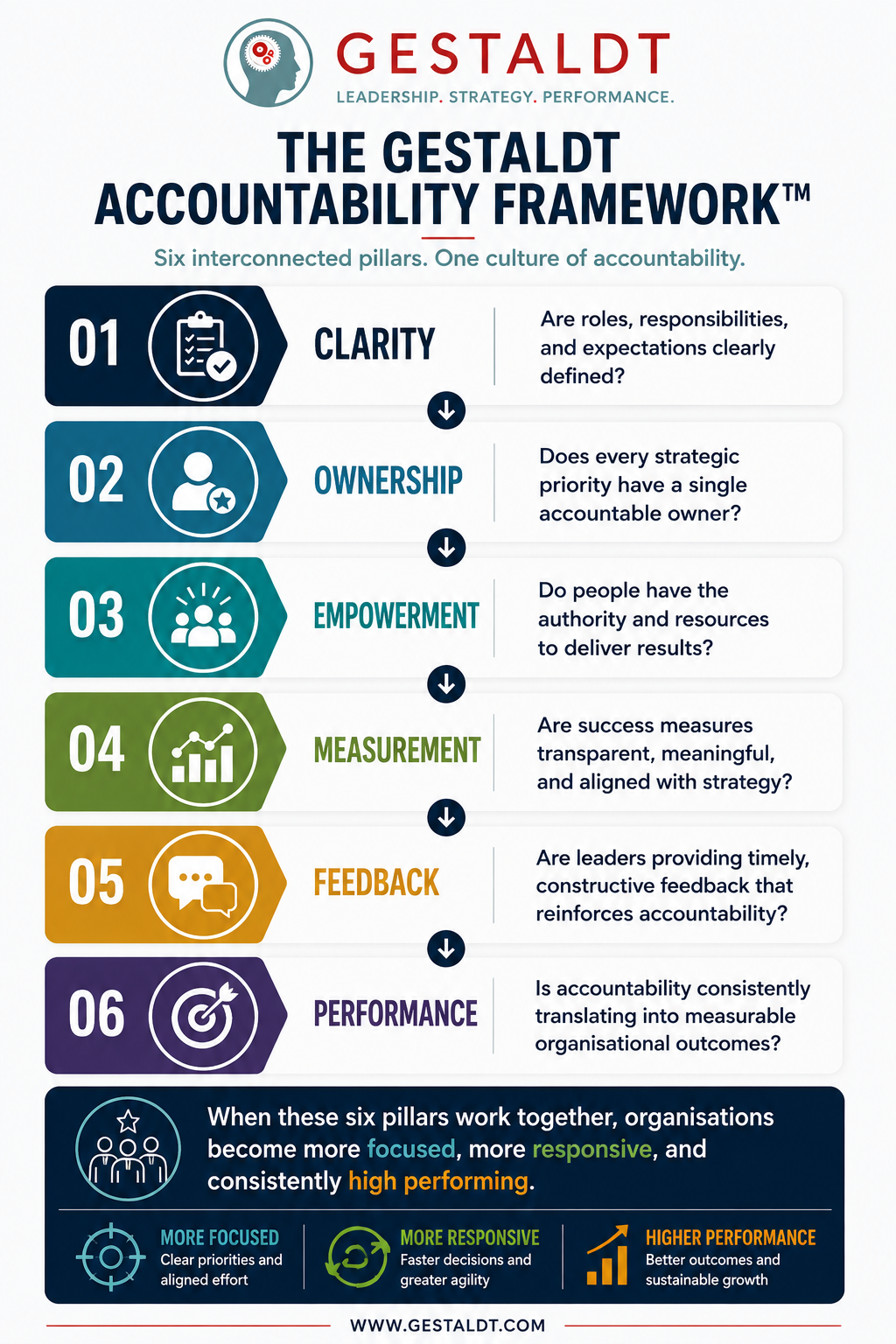
The Gestaldt Accountability Framework™
Executive Accountability Scorecard
Rate each statement from 1 (Strongly Disagree) to 5 (Strongly Agree).
Everyone understands their role in delivering strategy.
Major initiatives have clear owners.
Leaders make expectations explicit.
Employees have authority to make appropriate decisions.
Performance measures are aligned with business priorities.
Feedback is timely and constructive.
Accountability is applied consistently at every level.
Leaders model the behaviours they expect.
Teams collaborate effectively to achieve outcomes.
We celebrate results rather than activity.
Results
40–50: Accountability is a strategic strength.
30–39: Some accountability gaps may be limiting execution.
Below 30: Organisational performance is likely being affected by unclear ownership and inconsistent leadership.
Executive Case Study
A growing professional services firm approached Gestaldt after repeatedly missing strategic milestones despite having a highly capable workforce.
Our assessment revealed:
Overlapping responsibilities across senior leaders.
Inconsistent performance measures.
Delayed decisions due to unclear ownership.
A culture where teams were busy but not always aligned.
Using the Gestaldt Accountability Framework™, we helped redesign governance, clarify decision rights, and introduce organisation-wide accountability practices.
Within nine months, the organisation reported:
Faster delivery of strategic initiatives.
Improved cross-functional collaboration.
Clearer executive accountability.
Higher employee engagement.
Greater confidence in leadership.
The transformation was not driven by asking people to work harder. It was achieved by creating clarity about who was responsible for what.
Five Questions Every CEO Should Ask
Does every strategic initiative have one accountable owner?
Are our leaders modelling accountability every day?
Can employees explain how their work contributes to organisational strategy?
Are performance measures focused on outcomes or activity?
Would our customers notice if accountability improved?
These questions often reveal whether accountability is embedded in the organisation—or simply expected.
Accountability Is the Engine of Execution
Strategies succeed because people take ownership.
Transformation succeeds because leaders remain accountable.
Culture strengthens because expectations are consistently reinforced.
Organisations become resilient because accountability creates confidence, trust, and disciplined execution.
The organisations that outperform their competitors are not necessarily those with the smartest people or the largest budgets. They are those where accountability is woven into every aspect of leadership and organisational life.
Ready to Strengthen Accountability Across Your Organisation?
If your organisation is experiencing slow execution, unclear ownership, or inconsistent performance, it may be time to examine how accountability is designed—not just discussed.
Request an Organisational Accountability Assessment
Gestaldt's confidential assessment evaluates:
Leadership accountability.
Role clarity.
Decision rights.
Governance effectiveness.
Performance measurement.
Feedback culture.
Strategy execution.
Organisational alignment.
Together, we'll identify the barriers limiting accountability and develop practical strategies that improve execution, strengthen leadership, and accelerate organisational performance.
👉 Request Your Organisational Accountability Assessment Today

Decision Paralysis in the C-Suite: Why Great Leaders Make Slow Decisions (And How to Regain Strategic Agility)
Slow executive decision-making can cost organisations millions in missed opportunities, delayed execution, and declining competitiveness. Learn why decision paralysis develops, how it affects organisational performance, and the practical steps CEOs can take to build faster, more confident leadership teams.

The Cost of Waiting
A competitor launches a new product. Your organisation has the capability to respond, but approval takes weeks.
A customer requests a customised solution. Sales is ready, operations is willing, but leadership can't reach a decision.
A promising acquisition is identified. Due diligence is complete, yet the executive team delays. By the time a decision is made, the opportunity has disappeared.
These situations are more common than many leaders admit.
Organisations rarely lose their competitive edge because of one poor decision. More often, they lose it because of slow decisions.
In an environment defined by economic uncertainty, technological disruption, and rapidly changing customer expectations, speed has become a strategic advantage. Yet many executive teams are trapped in decision paralysis—where caution, complexity, and competing priorities delay action until opportunities are lost.
At Gestaldt, we have found that decision paralysis is rarely caused by a lack of intelligence or experience. It is usually a symptom of deeper organisational issues: unclear governance, misaligned leadership, risk-averse cultures, and ineffective decision-making processes.
The organisations that thrive are not those that make perfect decisions. They are the ones that make timely, informed, and accountable decisions.
Why Decision Speed Is Now a Competitive Advantage
Business cycles have accelerated dramatically.
Markets change in months rather than years.
Artificial intelligence reshapes industries almost overnight.
Customer expectations evolve continuously.
Regulatory landscapes shift with increasing frequency.
In this environment, organisations that hesitate risk becoming irrelevant.
Strategic agility is no longer a desirable leadership quality—it is an organisational necessity.
Research has consistently shown that organisations with effective decision-making processes outperform their peers in profitability, innovation, and long-term growth. They respond more quickly to market opportunities, allocate resources more effectively, and build greater confidence across their workforce.
Decision speed, however, should never be confused with recklessness. The objective is not faster decisions at any cost, but better decisions made without unnecessary delay.
Seven Hidden Causes of Decision Paralysis
1. Too Many Decisions Reach the Executive Team
Not every decision requires CEO approval.
When executives become involved in operational issues, strategic discussions become crowded with matters that should have been resolved elsewhere.
This creates bottlenecks, delays implementation, and distracts leaders from long-term priorities.
Executive Reflection
Are your executives making strategic decisions—or operational ones?
2. Governance Is Unclear
Who owns the decision?
Who provides input?
Who has final authority?
Without clearly defined governance, decisions circulate endlessly between committees, departments, and executives.
Good governance accelerates action by providing clarity, not bureaucracy.
3. Leaders Are Misaligned
When executives have different interpretations of organisational priorities, decision-making slows.
Instead of evaluating options against shared objectives, discussions become negotiations between competing interests.
Alignment transforms debate into productive decision-making.
4. Fear of Failure Overrides Strategic Thinking
High-performing organisations encourage calculated risk-taking.
Risk-averse organisations avoid difficult decisions altogether.
The result is stagnation.
Leaders must create an environment where informed experimentation is encouraged and learning is valued.
5. Data Overload Creates Analysis Paralysis
Modern organisations have access to unprecedented amounts of information.
The challenge is no longer obtaining data—it is knowing which data matters.
Executives who wait for perfect information often miss the opportunity to act.
The goal is to make decisions using the best available evidence, recognising that uncertainty will always exist.
6. Accountability Is Diffused
When everyone is responsible, no one is responsible.
Without clear ownership, decisions are delayed, implementation weakens, and momentum fades.
Accountability should be explicit at every stage of the decision-making process.
7. Organisational Culture Rewards Consensus Over Progress
Consensus has value, but it should not become a prerequisite for every decision.
Healthy executive teams encourage debate, seek diverse perspectives, and then commit to a clear course of action.
Progress requires confidence, not unanimity.
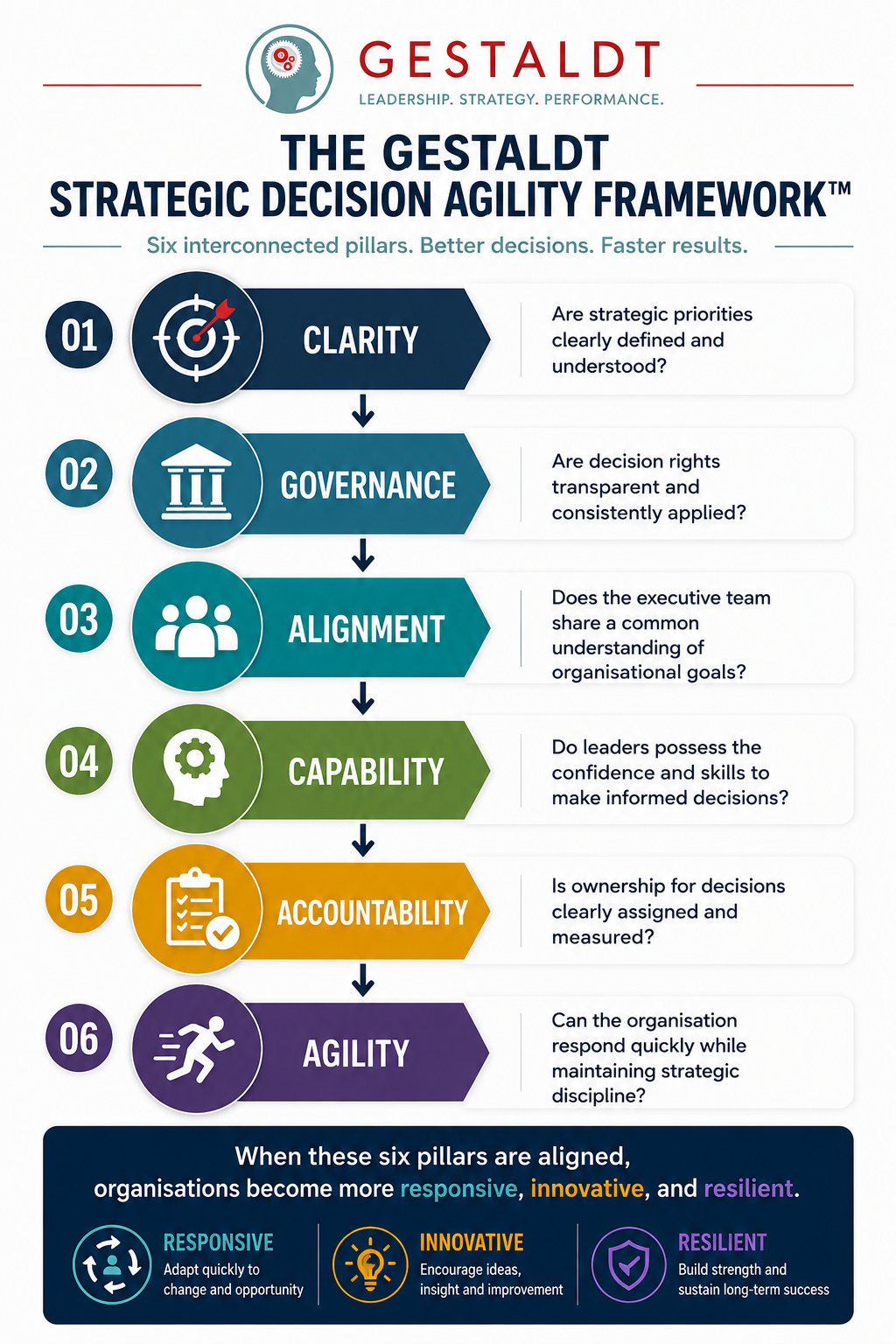
The Gestaldt Strategic Decision Agility Framework™
At Gestaldt, we believe high-quality decision-making is built on six interconnected pillars.
Executive Decision Agility Scorecard
Rate each statement from 1 (Strongly Disagree) to 5 (Strongly Agree).
Strategic priorities are clearly understood.
Decision rights are well defined.
Executive meetings result in timely decisions.
Leaders are comfortable making decisions with incomplete information.
Accountability for implementation is clear.
Governance supports rather than delays execution.
Departments collaborate effectively.
Decision-making is transparent.
We learn from decisions, whether successful or not.
Our organisation adapts quickly to change.
Results
40–50: Your organisation demonstrates strong decision agility.
30–39: Decision-making processes may be slowing performance.
Below 30: Decision paralysis is likely affecting strategic execution and organisational growth.
Case Study: Breaking the Decision Bottleneck
A large services organisation approached Gestaldt after a major transformation programme had stalled. Although the strategy was clear, executive meetings had become increasingly lengthy, decisions were repeatedly revisited, and implementation timelines continued to slip.
Our assessment identified three root causes:
Over-centralised decision-making.
Unclear governance and decision rights.
Inconsistent alignment on strategic priorities.
Gestaldt worked with the executive team to redesign governance structures, clarify accountability, and establish a disciplined decision-making framework.
Within nine months, the organisation reported:
Faster executive decision cycles.
Reduced project delays.
Greater cross-functional collaboration.
Improved confidence in leadership.
Stronger execution of strategic initiatives.
The organisation did not succeed because it made more decisions. It succeeded because it made better decisions, faster.
Five Questions Every CEO Should Ask
Before your next executive meeting, consider these questions:
Which decisions genuinely require executive attention?
Are our governance structures enabling or delaying action?
Do our leaders share the same understanding of strategic priorities?
Are we waiting for perfect information instead of acting on good evidence?
Does our culture reward informed action or excessive caution?
Your answers may reveal hidden constraints on organisational performance.
Strategic Agility Is a Leadership Capability
Markets will continue to change.
Technology will continue to evolve.
Uncertainty will remain.
The organisations that succeed will not be those with the most detailed plans. They will be those whose leaders can make confident, timely, and accountable decisions in the face of complexity.
Strategic agility is not about reacting faster than everyone else. It is about building an organisation where leadership, governance, culture, and execution work together to enable decisive action.
For CEOs, this is no longer simply a leadership skill. It is a strategic advantage.
Ready to Improve Executive Decision-Making?
If your organisation is experiencing delayed execution, prolonged decision cycles, or leadership misalignment, it may be time to evaluate how decisions are made.
Request a Strategic Decision Agility Assessment
Gestaldt's confidential executive assessment examines:
Decision-making effectiveness.
Leadership alignment.
Governance and decision rights.
Strategic clarity.
Organisational agility.
Accountability structures.
Strategy execution capability.
Together, we'll identify the barriers slowing your organisation and develop practical strategies to improve executive effectiveness and organisational performance.

Sustainability Meets Profit: How ESG Drives Competitive Advantage in Emerging Markets
Discover how ESG strategies turn sustainability into profit in emerging markets. Learn how environmental, social, and governance practices drive competitive advantage, attract investors, and fuel long-term growth.

What if the biggest growth opportunity in emerging markets isn’t cheap labor or untapped consumers—but sustainability?
For years, ESG was treated like a compliance checklist. Today, it’s more like a compass guiding companies toward resilience and long-term profit. In fast-growing economies, where volatility and opportunity collide, businesses that embed environmental, social, and governance principles into their core strategy aren’t just “doing good”—they’re outperforming.
In this article, you’ll learn how ESG creates measurable competitive advantage in emerging markets, backed by data, real-world examples, and practical steps you can implement right away.
1. ESG Is No Longer a “Nice-to-Have” — It’s a Growth Engine
Here’s the reality: investors are watching.
According to the World Bank, emerging markets will drive over 65% of global economic growth by 2030. At the same time, global sustainable investments surpassed $30 trillion, as reported by the Global Sustainable Investment Alliance.
Capital flows where risk is managed—and ESG reduces risk.
Larry Fink, CEO of BlackRock, famously stated: “Climate risk is investment risk.”
Why this matters:
Companies with strong ESG performance often enjoy lower cost of capital, higher valuations, and stronger investor confidence.
A study by MSCI found that companies with high ESG ratings showed lower volatility during market downturns.
Practical Tip:
Start by conducting a simple ESG materiality assessment to identify which sustainability factors matter most to your stakeholders.
2. Environmental Innovation Cuts Costs and Unlocks New Revenue
Sustainability doesn’t drain profits—it protects margins.
Take Unilever. Its Sustainable Living Brands have grown 69% faster than the rest of the business and delivered 75% of company growth in recent years.
In emerging markets, resource scarcity is common. Efficient energy use, water management, and waste reduction translate directly into cost savings.
According to the International Finance Corporation, climate-smart investments in emerging markets could generate over $23 trillion in opportunities by 2030.
As Paul Polman, former CEO of Unilever, said: “Businesses cannot succeed in societies that fail.”
Practical Tip:
Audit your top three operational expenses and explore renewable energy, circular supply chains, or waste reduction programs to cut costs and enhance brand perception.
3. Social Impact Builds Brand Trust in Volatile Markets
In emerging markets, trust is currency.
Companies operating in regions with regulatory instability or economic inequality must earn legitimacy beyond compliance.
Look at Safaricom in Kenya. Its mobile money platform, M-Pesa, transformed financial inclusion for millions, strengthening both social impact and profitability.
According to Edelman’s Trust Barometer, 81% of consumers say trust influences purchasing decisions.
Indra Nooyi, former CEO of PepsiCo, once said: “Performance with purpose is the new competitive advantage.”
Why this works:
Social initiatives reduce reputational risk, increase customer loyalty, and improve employee engagement.
Practical Tip:
Align one core product or service with a measurable social outcome—such as financial inclusion, education access, or community development.
4. Strong Governance Attracts Global Capital
Here’s the unglamorous truth: governance makes or breaks investment deals.
Emerging markets often struggle with regulatory unpredictability. Transparent governance structures send a powerful signal to international investors.
The Organisation for Economic Co-operation and Development highlights that firms with strong governance frameworks enjoy greater access to foreign investment.
Warren Buffett of Berkshire Hathaway put it bluntly: “It takes 20 years to build a reputation and five minutes to ruin it.”
Companies with clear board oversight, anti-corruption policies, and transparent reporting often outperform peers in emerging economies.
Practical Tip:
Adopt globally recognized reporting standards such as IFRS Sustainability Disclosure Standards or align reporting with investor expectations to increase credibility.
5. ESG Strengthens Resilience in High-Risk Environments
Emerging markets can be unpredictable—currency swings, supply chain disruptions, climate shocks.
ESG-ready companies are better prepared.
Research from Gestaldt Market Research shows that companies integrating sustainability into operations experience improved long-term performance and risk mitigation.
For example, businesses investing in renewable energy are less exposed to fossil fuel price volatility.
As Al Gore, former U.S. Vice President and climate advocate, stated: “Sustainability is the new growth strategy.”
Practical Tip:
Map your top five business risks and evaluate how ESG integration can reduce exposure.
6. ESG Differentiation Wins Competitive Positioning
Standing out in crowded emerging markets isn’t easy.
But sustainability creates distinction.
According to Nielsen, 73% of global consumers say they would change consumption habits to reduce environmental impact.
Brands that communicate authentic ESG commitments often capture premium pricing and stronger loyalty.
Consider how Patagonia built a fiercely loyal customer base through environmental activism and transparency.
Simon Sinek famously said: “People don’t buy what you do; they buy why you do it.”
Practical Tip:
Develop a transparent ESG storytelling strategy. Share measurable outcomes—not just promises.

Internal Resources to Expand Your Strategy
Deepen your approach with these related guides:
Learn how to build resilience in Risk Management Frameworks for Emerging Economies
Discover innovation insights in SME Innovation Labs: How Small Firms Can Build Big Ideas with Limited Budget
Conclusion: The Future of Profit Is Sustainable
The old narrative said sustainability costs money. The new reality? Sustainability creates value.
In emerging markets—where volatility meets opportunity—ESG is not just ethical positioning. It’s strategic positioning.
Environmental efficiency reduces costs. Social trust builds loyalty. Governance transparency attracts capital. Together, they form a powerful competitive moat.
The companies that win tomorrow won’t just chase short-term margins—they’ll build long-term resilience.
Sustainability and profit aren’t rivals. They’re partners.
And in emerging markets, that partnership might just be your greatest competitive advantage.