
Your organisation may not be losing competitive advantage because it makes the wrong decisions. It may be losing because it takes too long to make the right ones.
Somewhere in your organisation, an important decision is waiting.
A strategic investment requires approval. A customer problem needs intervention. A transformation initiative cannot proceed without executive direction. A business unit is waiting for clarity on resources, priorities or accountability.
The issue has been discussed.
The risks have been evaluated.
Several meetings have taken place.
Yet no decision has been made.
Meanwhile, employees continue working around the uncertainty. Project timelines slip. Costs accumulate. Customers become frustrated, and opportunities that once appeared attractive begin to disappear.
The organisation is busy, but progress has stalled.
This is the Decision Velocity Gap: the difference between how quickly an organisation needs to make and implement important decisions and how quickly its management systems actually allow those decisions to happen.
Think of strategy execution as a high-performance vehicle.
Strategic ambition provides the destination. Organisational capabilities provide the engine. Financial and human resources supply the fuel.
But decision-making is the transmission.
Without an effective mechanism for converting executive judgement into coordinated action, even a powerful engine cannot deliver the desired performance.
For CEOs and executive teams, this presents an uncomfortable possibility:
The greatest constraint on your organisation's performance may not be its strategy, people or resources. It may be the way decisions are made.
Research suggests this is not a minor management inconvenience.
In a Global Survey of 1,259 participants conducted in 2018, only 20% of respondents said their organisations excelled at decision-making. More than half reported spending over 30% of their working time making decisions, while 61% believed most of that time was used ineffectively.
Although these findings are historical rather than a current benchmark, they illustrate the scale of the challenge.
More recent academic evidence also supports examining speed as an organisational performance factor. A 2024 meta-analysis covering 127 studies found positive overall associations between firm performance and decision speed, implementation speed and competitive response speed.
The lesson is not that every decision should be made immediately.
It is that organisations must become better at making timely, informed and accountable decisions that translate into action.
This article examines six causes of the Decision Velocity Gap and introduces the proposed Gestaldt Decision Velocity and Execution Effectiveness Framework™, a practical approach to improving organisational responsiveness without sacrificing decision quality or governance.
1. The Approval Bottleneck: When Every Decision Needs Someone Higher Up
If routine operational decisions consistently reach the CEO's desk, the organisation may have an authority problem disguised as good governance.
Many businesses develop approval structures with legitimate intentions.
Senior executives want to protect financial resources, manage risk, maintain consistency and ensure strategic alignment.
As organisations grow, however, approval requirements can accumulate.
What begins as a reasonable control mechanism can become a complex system in which managers require multiple authorisations before acting.
A procurement decision needs departmental approval, financial approval and executive approval.
An operational improvement requires consultation across several functions.
A customer service exception moves through multiple management levels.
Each approval may appear defensible in isolation.
Collectively, they can create significant delays.
The hidden cost of excessive escalation
Consider a regional operations manager who identifies an opportunity to improve service delivery by adjusting team schedules.
The proposed change is low-cost, reversible and within existing staffing limits.
Yet the manager must seek approval from several senior leaders.
By the time approval arrives, the immediate operational problem may have worsened.
The organisation has preserved formal control but sacrificed responsiveness.
This pattern can also create executive overload.
Senior leaders become involved in decisions that could be resolved closer to the point of execution.
As a result, they have less capacity to focus on major strategic choices.
Distinguish governance from unnecessary permission
Good governance does not require every decision to be centralised.
It requires decisions to be made by appropriately authorised people, within clear boundaries, using relevant information and suitable controls.
Executives should differentiate decisions according to their strategic significance, risk and reversibility.
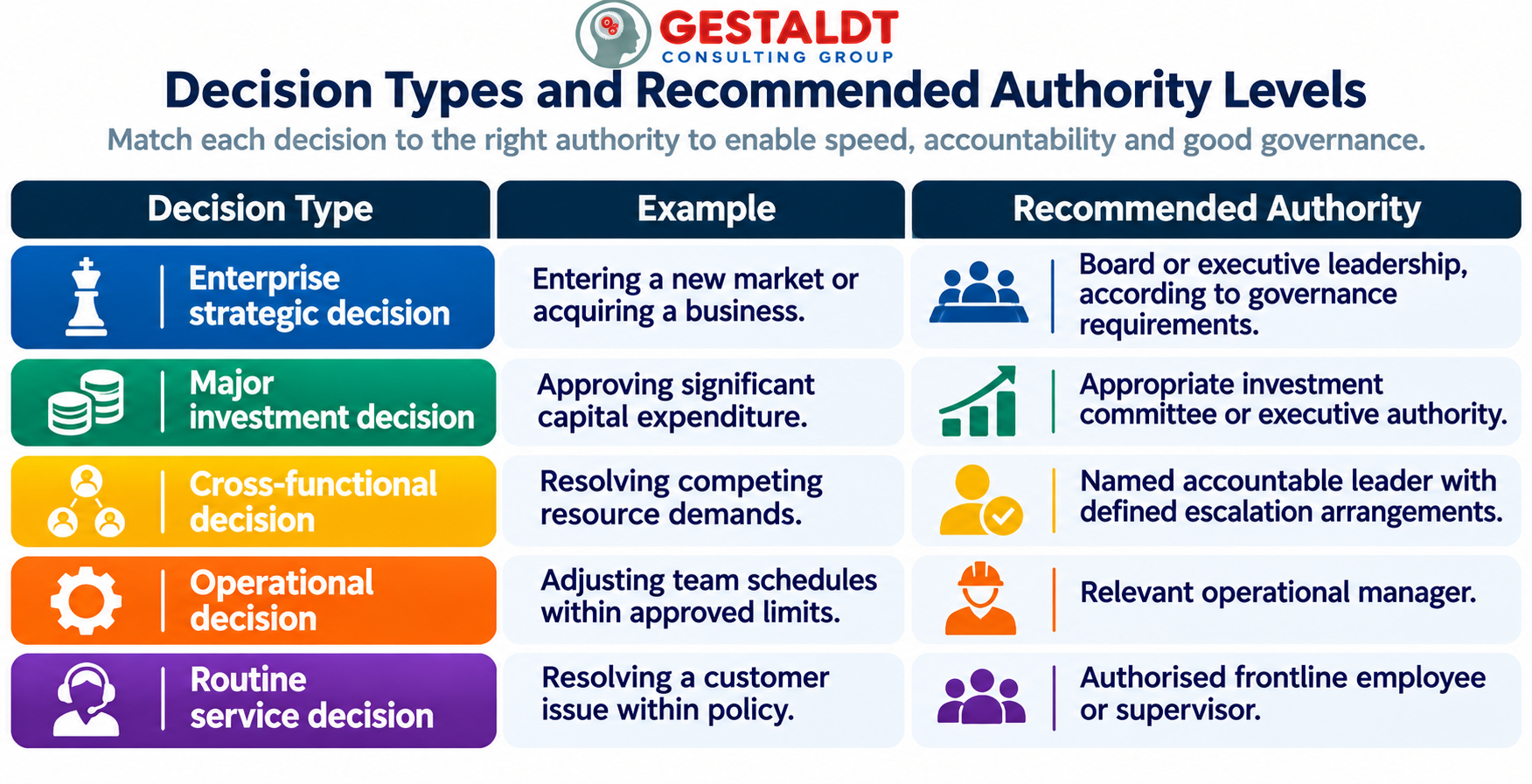
The objective is to reserve senior executive attention for decisions that genuinely require it.
Practical tip: Review the 20 decisions most frequently escalated to your executive team. Identify which could be delegated safely through clearer authority limits, decision criteria and escalation rules.
The executive lesson: Strong governance should enable responsible action, not make routine action unnecessarily difficult.
2. The Accountability Maze: When Everyone Has Input but Nobody Owns the Decision
A decision involving ten stakeholders can still be effective. A decision with no clear owner rarely is.
Cross-functional collaboration is essential in complex organisations.
Major decisions often require financial, operational, commercial, technological and regulatory perspectives.
However, involving multiple stakeholders does not mean that everyone should possess equal decision-making authority.
When decision roles are unclear, organisations can fall into an accountability maze.
Teams debate recommendations without knowing who has final authority.
Stakeholders assume that consultation provides veto power.
Managers repeatedly seek consensus, even when consensus is neither required nor realistic.
The result is delayed action and diluted accountability.
Why decision ownership matters
Imagine a company considering a new digital customer service platform.
Technology evaluates system integration.
Finance assesses the investment.
Operations examines implementation requirements.
Sales considers customer implications.
Risk and compliance review regulatory concerns.
Each function has a legitimate contribution.
But who makes the final decision?
Without an agreed decision owner, the organisation may experience repeated meetings, competing recommendations and unresolved disagreements.
Clarify decision roles before deliberation begins
A rapid approach illustrates the importance of distinguishing decision roles, including who recommends, provides input, agrees where required, decides and performs.
Gestaldt's proposed framework builds on the broader principle of decision-role clarity without replacing or claiming ownership of any methodology.
A practical decision accountability structure should answer:
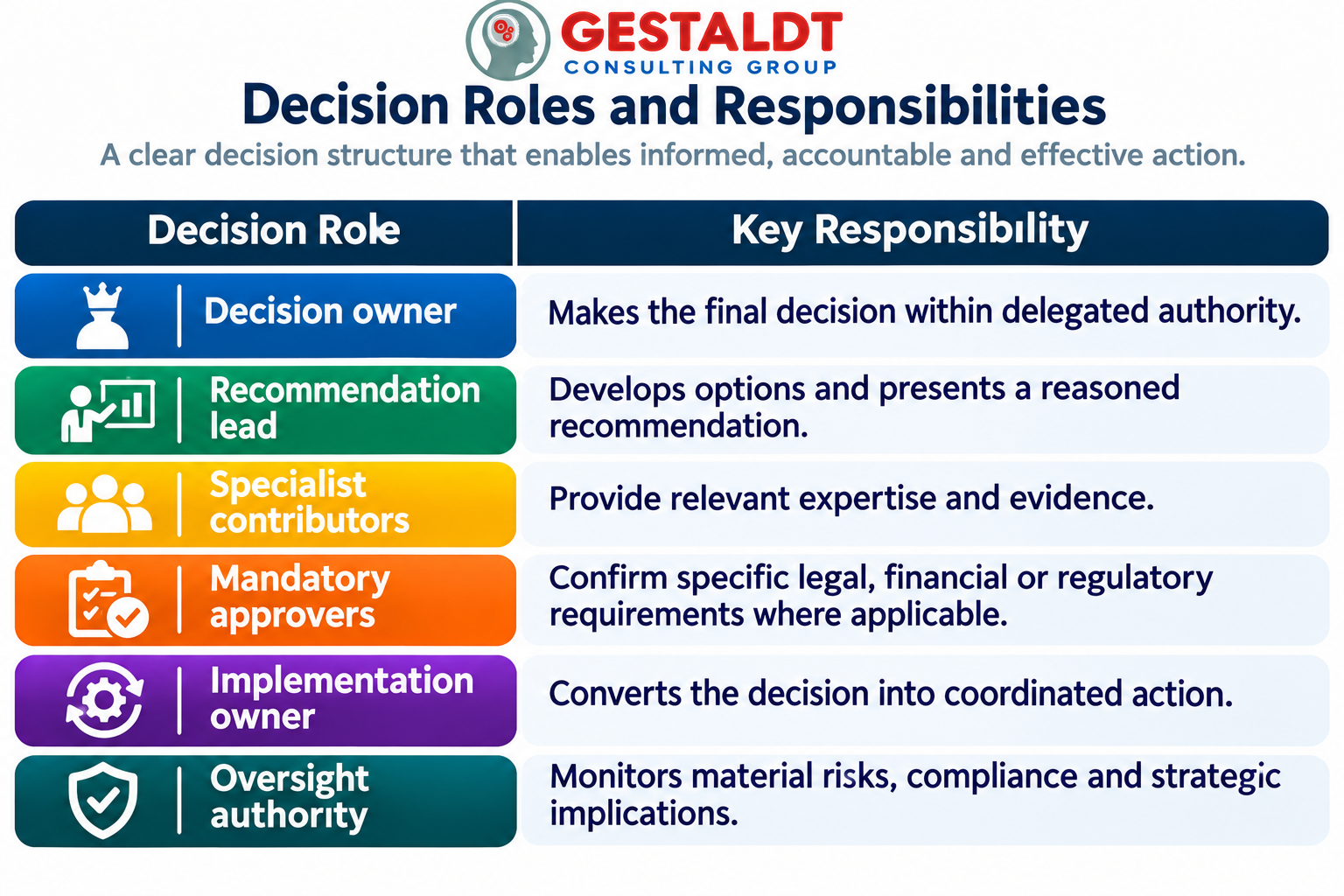
These responsibilities may be combined where appropriate.
The critical requirement is clarity.
Avoid consensus becoming an unintended requirement
Consultation can improve decision quality.
But requiring universal agreement can allow unresolved preferences to prevent necessary action.
Executives should distinguish between stakeholders whose approval is mandatory and those whose views should inform the decision.
Both deserve appropriate consideration, but they perform different functions.
Practical tip: For each major strategic decision, identify one accountable decision owner before the first formal decision meeting. Specify who provides input, whose approval is mandatory and who will implement the outcome.
The executive lesson: Collaboration should improve decisions, not eliminate accountability for making them.
3. The Information Paralysis Trap: When More Analysis Produces Less Action
Sometimes the biggest obstacle to making a decision is the belief that one more report will remove all uncertainty.
Modern executives have access to more information than previous generations of business leaders could easily obtain.
Financial dashboards, customer analytics, operational systems, market intelligence and artificial intelligence tools can provide extensive decision support.
Yet more information does not automatically produce better decisions.
In some organisations, decision-makers repeatedly request additional analysis because they are uncomfortable acting without complete certainty.
A proposal moves from one review to another.
New scenarios are developed.
Further data is requested.
The decision deadline moves.
Eventually, the organisation may possess an impressive collection of reports without having taken meaningful action.
Why perfect information is rarely available
Business decisions are made under uncertainty.
Market conditions change.
Customer preferences evolve.
Competitors respond.
Economic assumptions become outdated.
Even sophisticated analytical models cannot eliminate every unknown.
The objective should therefore be to obtain sufficient information for a responsible decision, rather than pursuing unattainable certainty.
This requires judgement.
Match analysis to decision risk
Not all decisions deserve the same level of investigation.
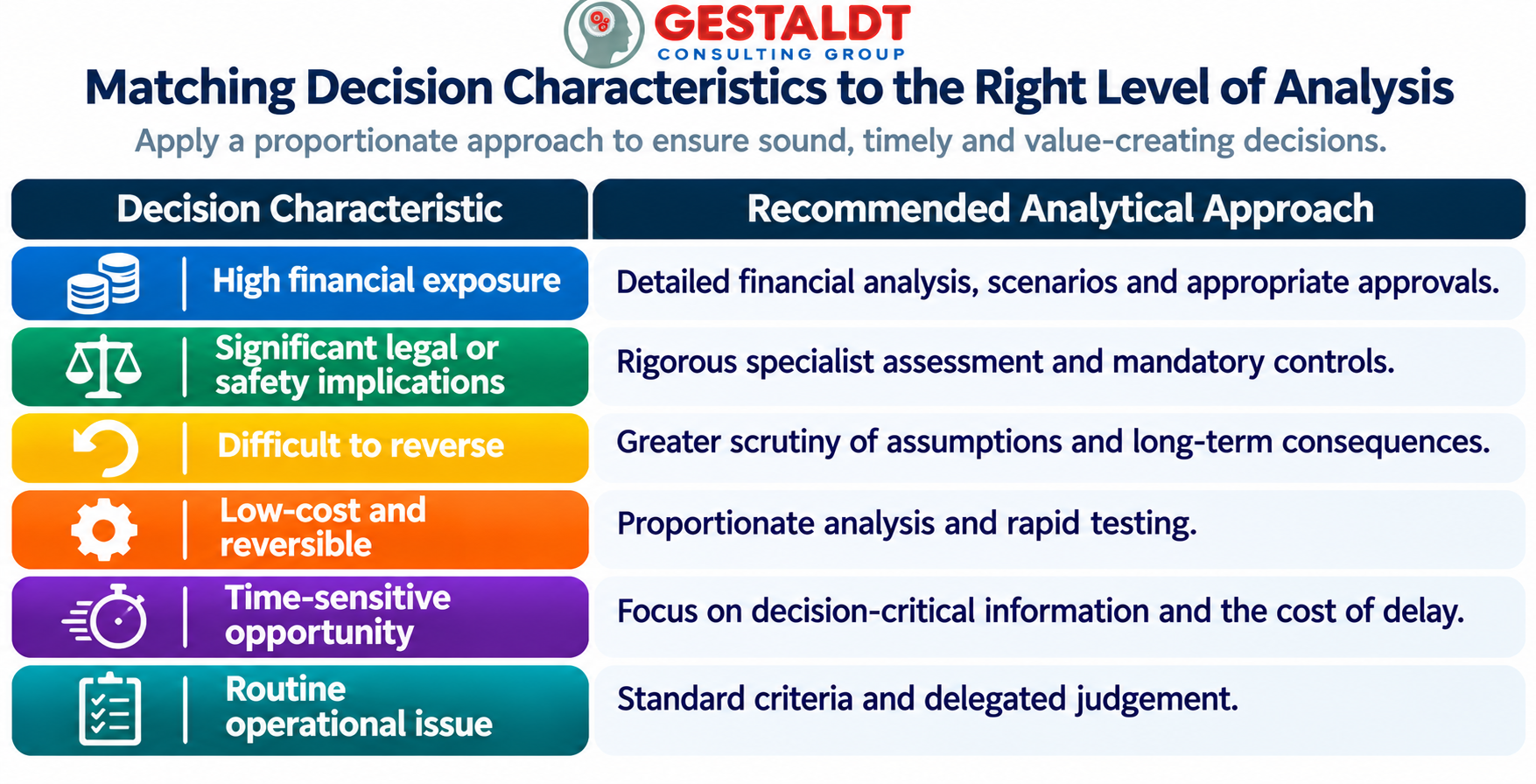
A low-risk decision that can be reversed should not necessarily follow the same process as a major acquisition.
Equally, executives should not accelerate high-consequence decisions merely to improve a speed metric.
Define the evidence threshold
Before commissioning further analysis, decision-makers should ask:
What specific uncertainty remains?
Could resolving it materially change the decision?
What evidence would be sufficient?
How long will obtaining that evidence take?
What is the cost of waiting?
These questions help distinguish useful analysis from unnecessary delay.
Practical tip: Introduce a one-page decision brief for significant but recurring management decisions. Require a clear problem statement, viable options, critical evidence, key risks, recommendation and decision deadline.
The executive lesson: Effective decision-making is not about knowing everything. It is about knowing enough to act responsibly.
4. The Meeting-to-Decision Disconnect: When Discussions Multiply but Decisions Disappear
A full executive calendar is not evidence of an effective leadership team.
Meetings are necessary for coordination, governance and collective judgement.
But many organisations confuse the frequency of discussion with the quality of decision-making.
Executive committees review the same unresolved matters repeatedly.
Management teams receive lengthy presentations without a clear decision request.
Participants leave meetings with different interpretations of what was agreed.
Actions are assigned without deadlines or accountable owners.
At the next meeting, the discussion begins again.
The organisation has invested substantial leadership time without converting that investment into progress.
What the research reveals
Analysis of decision meetings reported that only 37% of survey respondents considered their organisations' decisions both high-quality and timely.
This finding reinforces the importance of designing meetings around the decisions they are intended to produce.
Redesign meetings around outcomes
Every decision-oriented meeting should distinguish between four purposes:
Inform: Share information that does not require a decision.
Explore: Examine a problem or develop possible responses.
Decide: Select an option and authorise action.
Review: Evaluate implementation and determine whether intervention is needed.
Confusion emerges when participants expect a decision but the meeting is organised merely to exchange information.
Introduce a decision-ready agenda
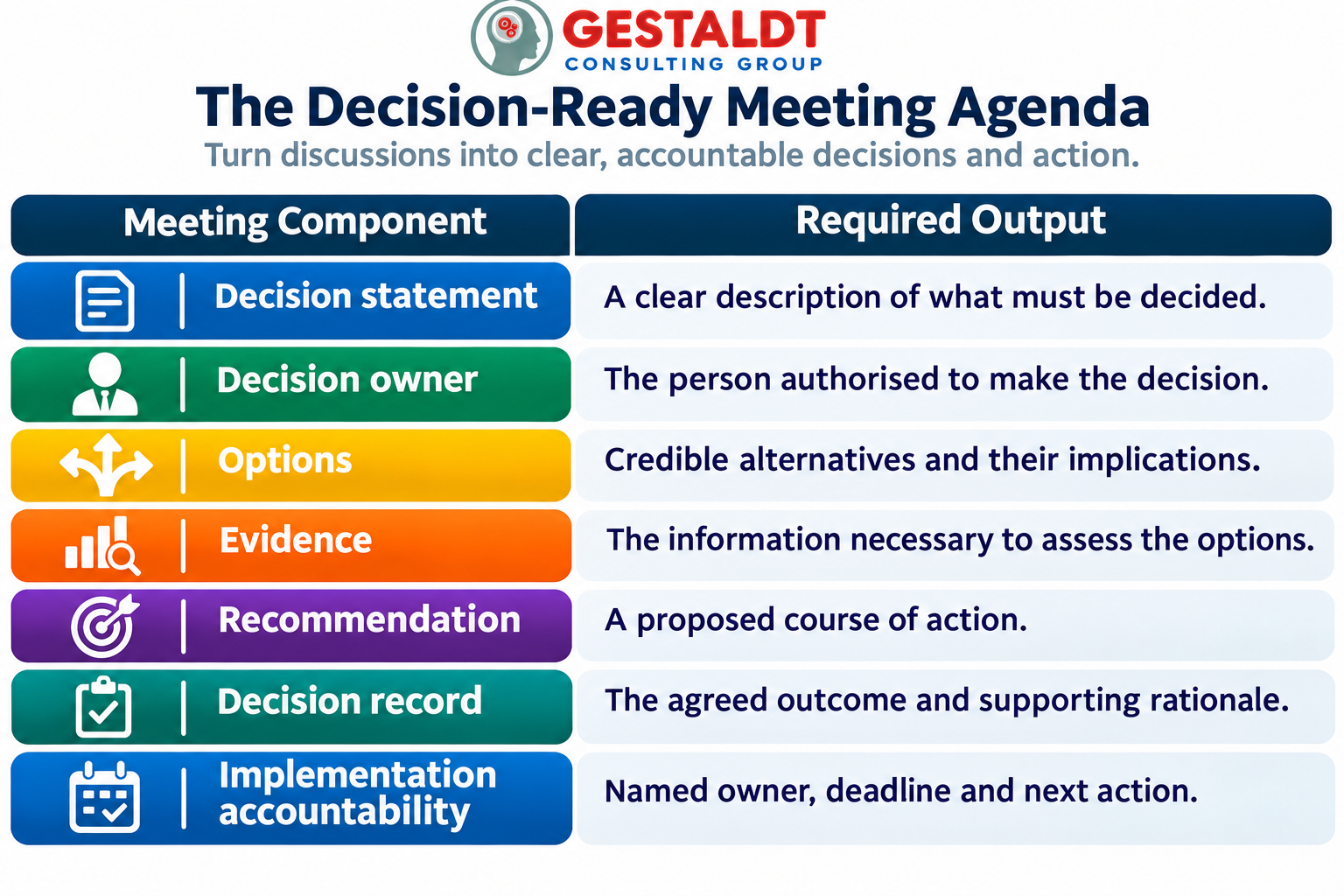
This approach also improves follow-through.
A decision that is not recorded, communicated and assigned for implementation can easily become another unresolved management discussion.
Practical tip: Audit the last four executive committee meetings. Count how many agenda items required decisions, how many decisions were actually made and how many remained unresolved without a defined next step.
The executive lesson: The value of a decision meeting lies in the clarity and quality of the action it enables.
5. The Execution Handover Gap: When Decisions Are Made but Nothing Changes
A decision can be approved on Monday and still be operationally invisible on Friday.
Decision-making does not end when an executive says yes.
The decision must be communicated, translated into action, supported with resources and implemented by accountable teams.
This is where another organisational weakness frequently appears.
Executives believe an issue has been resolved because a decision was recorded.
Operational managers may still be unclear about what the decision means, who must act or which resources are available.
Departments interpret the outcome differently.
Implementation dependencies remain unresolved.
The decision exists, but execution has not begun.
Decision speed is not execution speed
Consider an executive committee approving a new customer service operating model.
The decision is made quickly.
However, the organisation has not clarified revised responsibilities, training requirements, technology dependencies or implementation funding.
Operational teams cannot proceed effectively.
The organisation has improved the speed of approval without improving the speed of execution.
This distinction is important.
A 2024 meta-analysis of 127 studies found positive overall associations with firm performance for decision speed, implementation speed and response speed. The findings support considering these as related but distinct organisational capabilities.
Build the decision-to-action connection
Every material decision should produce a clear implementation commitment.
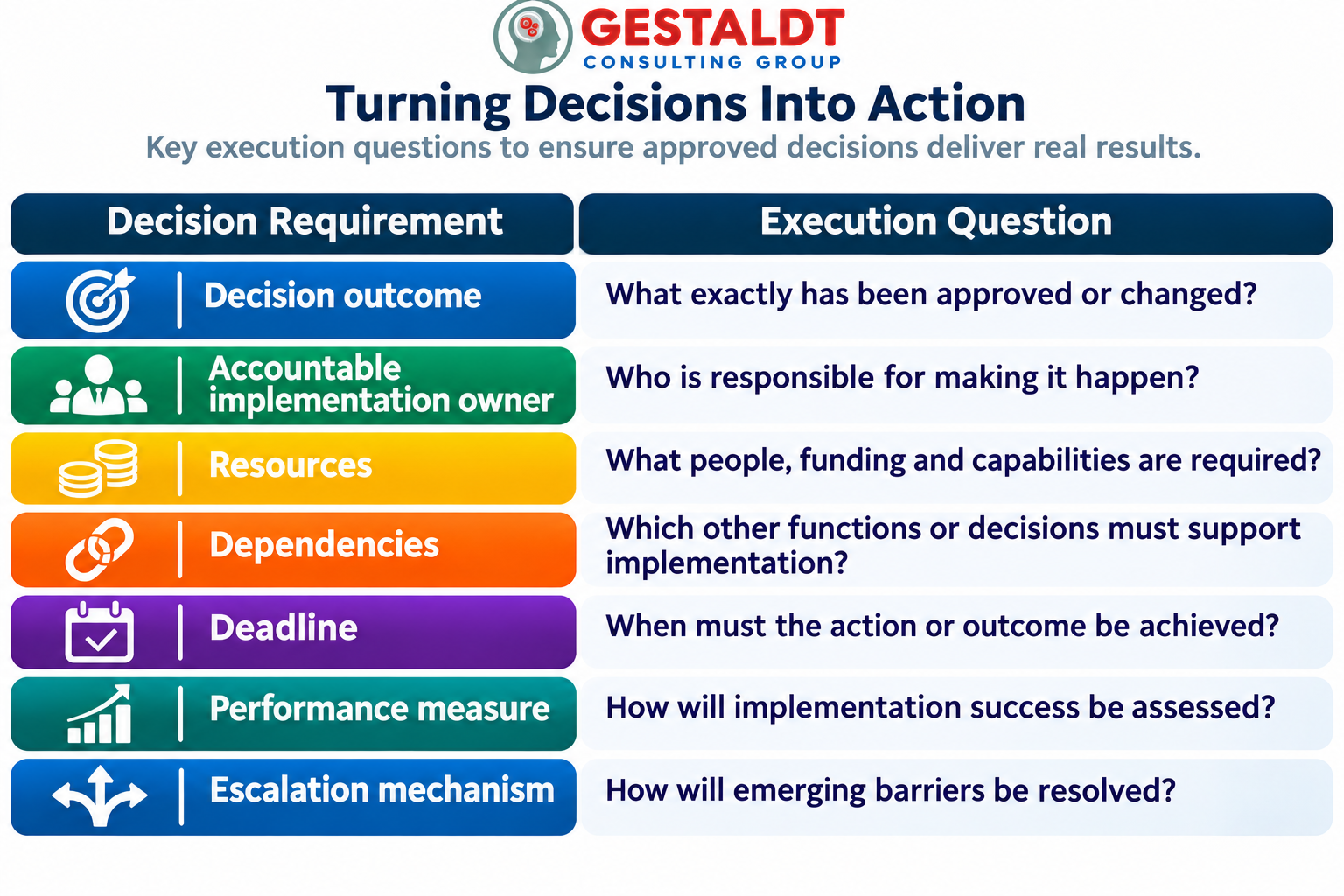
These elements create continuity between executive intent and operational delivery.
Close the feedback loop
Implementation owners should be able to report whether the decision is producing its intended results.
If assumptions prove incorrect, leadership must be willing to adjust the approach.
This connects decision effectiveness with benefits realisation, the subject of the previous Gestaldt Insights article.
The ultimate objective is not simply to make a decision faster.
It is to improve the organisation's ability to turn decisions into measurable business outcomes.
Practical tip: Require every significant executive decision to include a named implementation owner, agreed first action and follow-up review date before the matter is considered closed.
The executive lesson: A decision creates value only when it leads to effective action.
6. The Leadership Behaviour Barrier: When Organisational Culture Rewards Delay
An organisation's decision-making culture is often shaped less by its formal policies than by how its leaders respond when someone makes a difficult call.
Executives may publicly encourage empowerment, accountability and agility.
Yet employees observe what happens when decisions produce imperfect outcomes.
Are managers supported when they make reasonable decisions using available evidence?
Or are they criticised for taking initiative without escalating every uncertainty?
Are leaders willing to make difficult trade-offs?
Or do they postpone decisions to avoid conflict and accountability?
These behaviours influence whether managers act confidently or seek unnecessary approval.
How risk avoidance becomes organisational delay
Imagine a manager authorised to resolve a customer problem.
The manager knows the appropriate response but fears being criticised if the outcome is questioned.
Instead of acting, the manager escalates the matter.
Senior leadership receives another routine issue.
The customer waits.
Over time, employees learn that escalation feels safer than ownership.
The organisation develops a culture of permission-seeking.
This is not necessarily caused by a lack of capability.
It may reflect the incentives and consequences embedded in the management environment.
Build disciplined decision confidence
Executives should establish a culture in which managers are expected to exercise judgement within clear boundaries.
That requires:
Explicit decision authority and risk limits.
Access to relevant information.
Appropriate training and support.
Constructive review of decisions and outcomes.
Accountability for unreasonable inaction as well as poor decisions.
Leadership willingness to make and communicate difficult trade-offs.
Empowerment should not mean abandoning oversight.
It should mean giving capable people the authority and support to act responsibly.
Reward decision quality, not merely decision outcomes
A sound decision can produce an unfavourable outcome because of circumstances beyond the decision-maker's control.
Conversely, a poorly reasoned decision may occasionally succeed through luck.
Executives should therefore assess both the quality of the decision process and the results achieved.
Practical tip: Review how leadership responds to unsuccessful but well-reasoned decisions. Use structured learning reviews to distinguish poor judgement, inadequate controls and unavoidable uncertainty.
The executive lesson: Organisations become more decisive when leaders create the conditions for responsible judgement.
Introducing the Gestaldt Decision Velocity and Execution Effectiveness Framework™
The Decision Velocity Gap cannot be closed by simply telling managers to make decisions faster.
It requires an integrated approach to decision authority, information quality, governance, leadership behaviour and execution accountability.
The proposed Gestaldt Decision Velocity and Execution Effectiveness Framework™ brings these requirements together through six interconnected dimensions.
The Six Dimensions
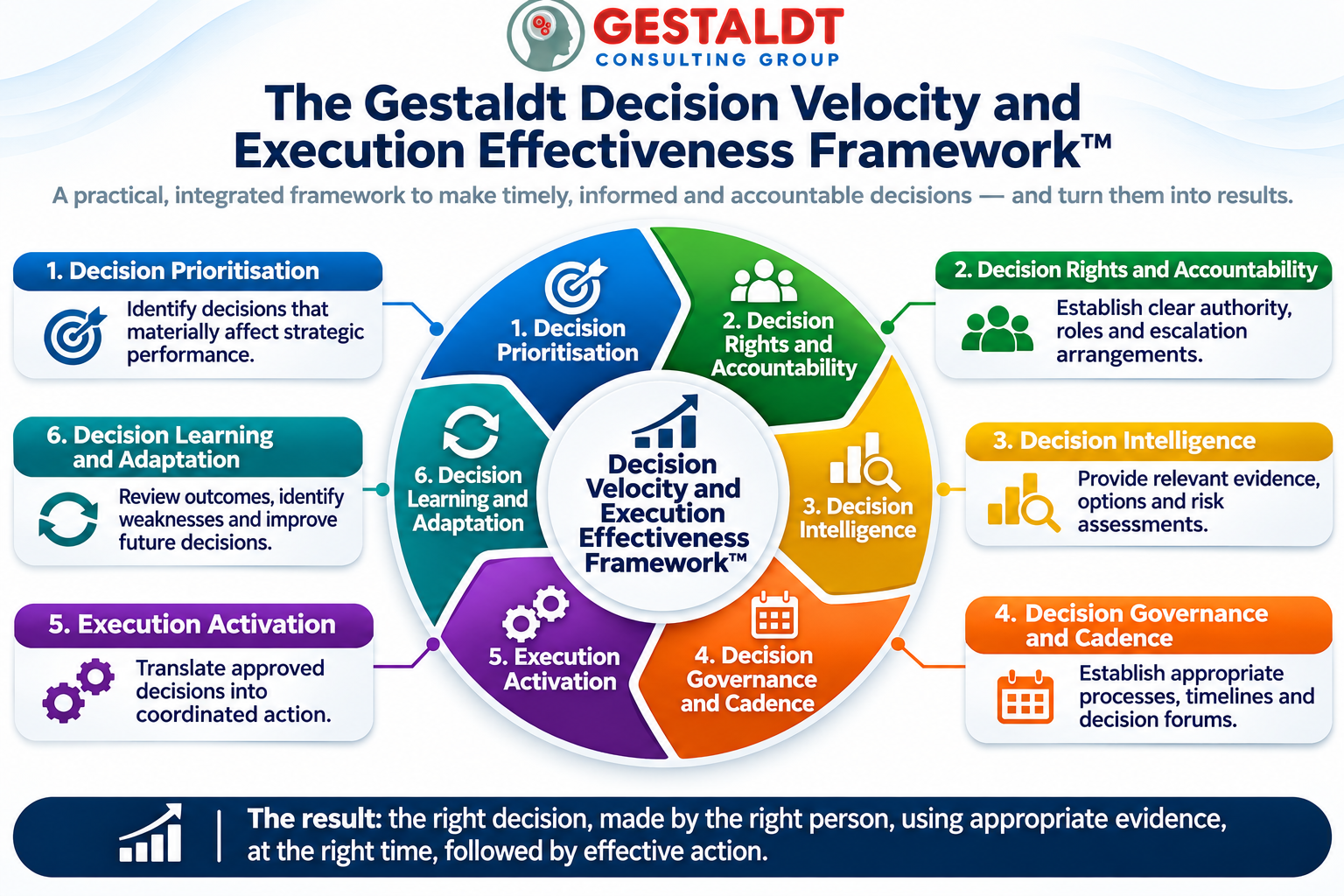
The framework is a proposed executive management model, not a scientifically validated diagnostic instrument.
Its purpose is to help organisations examine how decision-making affects strategy execution and organisational performance.
How the Framework Works
Decision Prioritisation directs management attention towards choices with the greatest strategic significance.
Decision Rights and Accountability ensure that responsibility for making decisions is explicit.
Decision Intelligence provides sufficient evidence to support informed judgement.
Decision Governance and Cadence establish appropriate processes and timeframes.
Execution Activation connects decisions with resources, responsibilities and implementation.
Decision Learning and Adaptation help organisations improve decision quality and responsiveness over time.
Together, these dimensions create a continuous management cycle.
The objective is not speed at any cost.
It is the right decision, made by the right person, using appropriate evidence, at the right time, followed by effective action.
The CEO's Decision Velocity Diagnostic
Interpreting the Results
The score bands are illustrative and should be used to guide management discussion rather than as a validated measure.
Executives should also examine the individual statements.
An organisation may make decisions quickly but struggle to implement them.
Another may have strong analytical processes but excessive approval requirements.
Both can experience a significant Decision Velocity Gap.
A 90-Day Executive Roadmap to Improve Decision Velocity
Organisations do not need to redesign every management process simultaneously.
A focused 90-day programme can establish stronger decision-making discipline and identify opportunities for improvement.
Days 1–30: Diagnose Decision Bottlenecks
Objective: Understand where and why decisions are delayed.
Identify a representative sample of significant strategic, cross-functional and operational decisions.
Examine how each decision moves through the organisation.
Document:
Who initiates the decision.
Who provides information.
Who has final authority.
How many approvals are required.
How long the decision takes.
Whether the outcome is implemented effectively.
Pay particular attention to recurring escalations and decisions that repeatedly return to executive committees.
Expected output: A decision bottleneck assessment identifying delays, unclear authority and unnecessary process complexity.
Days 31–60: Redesign Decision Rights and Governance
Objective: Remove avoidable friction without weakening controls.
Clarify decision ownership.
Review delegated authority limits.
Simplify unnecessary approval requirements.
Improve the structure of executive decision meetings.
Establish decision deadlines and escalation arrangements.
Introduce standard decision briefs for important recurring decisions.
Ensure that risk, financial and regulatory requirements remain appropriately addressed.
Expected output: A clearer decision accountability model and improved governance processes for priority decisions.
Days 61–90: Embed Decision-to-Execution Discipline
Objective: Convert faster decisions into stronger organisational performance.
Introduce a decision register for material strategic and cross-functional decisions.
Track decision turnaround times and implementation progress.
Review whether approved decisions are producing their intended operational outcomes.
Establish structured learning reviews for significant decisions.
Refine authority limits and decision processes using the evidence gathered.
Expected output: A repeatable decision effectiveness system connecting executive judgement with operational action.
The first 90 days should establish stronger management practices. Sustainable improvement will require continued leadership attention and adaptation.
The Executive Decision Velocity Dashboard: What CEOs Should Measure
Organisations should monitor decision-making effectiveness with the same seriousness applied to project delivery and financial performance.
However, decision metrics must reflect the type, risk and complexity of the decisions being assessed.
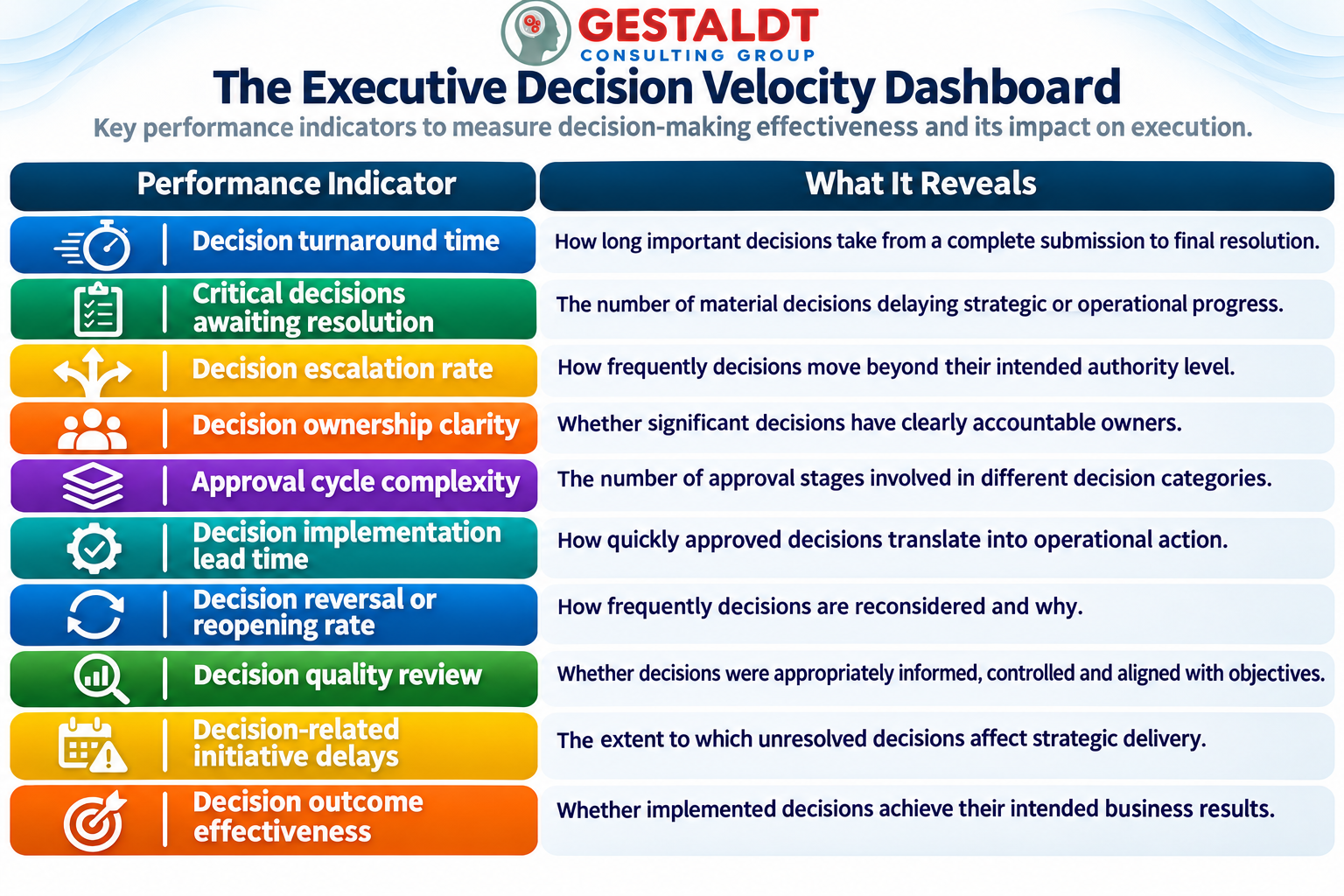
A Practical Decision Velocity Calculation
A simple starting point is to measure decision turnaround time.
Decision Turnaround Time = Date and Time of Final Decision − Date and Time of Complete Decision Submission
For example, suppose five comparable operational decisions take:
2 working days.
4 working days.
3 working days.
8 working days.
3 working days.
The average turnaround time is:
(2 + 4 + 3 + 8 + 3) ÷ 5 = 4 working days
This provides a baseline for improvement.
However, the average alone may conceal important delays.
Executives should also examine the longest outstanding decisions, the distribution of turnaround times and the reasons for exceptions.
A decision that takes eight days may be entirely appropriate if it involves material risk or mandatory regulatory review.
The objective is to identify unnecessary delays, not to impose arbitrary speed targets.
The Hidden Economics of Decision Delay
Slow decision-making can create costs that are not immediately visible in conventional financial reports.
Consider a hypothetical company implementing a productivity improvement initiative.
The initiative is expected to generate R12 million in annual operating benefits once fully operational.
Assuming the benefits accrue evenly, the estimated monthly benefit is:
R12 million ÷ 12 = R1 million per month
If an avoidable decision bottleneck delays implementation by three months, the organisation could defer approximately:
R1 million × 3 months = R3 million in expected benefits
This is an illustrative opportunity-cost calculation, not an actual financial loss.
The true impact depends on when benefits would otherwise have started, how they accrue, whether delayed benefits are eventually recovered and what additional costs or risks arise.
Nevertheless, the example demonstrates an important principle.
Decision delays can affect not only management efficiency but also the timing and value of strategic outcomes.
For CFOs and investment committees, this suggests that decision-making effectiveness should be considered part of strategic value assurance.
For CEOs, it reinforces the need to examine decision bottlenecks alongside resource constraints, capability gaps and execution risks.
From Decision Speed to Decision Effectiveness
Improving decision velocity is not simply about reducing approval times.
A fast but poorly informed decision can destroy value.
A carefully considered decision can also destroy value if it arrives too late.
Effective executive leadership requires balancing four elements:
Speed: Was the decision made when it was needed?
Quality: Was the decision supported by appropriate evidence and judgement?
Accountability: Was responsibility for the decision and its implementation clear?
Execution: Did the decision produce the intended action and business outcome?
These elements are interconnected.
Speed without quality creates unnecessary risk.
Quality without timeliness can result in missed opportunities.
Accountability without authority creates frustration.
Decisions without execution create the appearance of progress without meaningful results.
The strongest organisations seek to improve all four.
This requires leaders to examine not only individual decisions but also the organisational systems through which decisions are made.
Conclusion: Strategy Moves at the Speed of Organisational Decisions
A compelling strategy cannot compensate indefinitely for a slow decision-making system.
Organisations may possess ambitious growth plans, capable employees, strong technologies and sufficient financial resources.
Yet strategic execution will struggle when important decisions remain trapped in approval processes, unclear accountability structures, endless analysis and recurring management meetings.
The Decision Velocity Gap emerges when the organisation's need for timely action exceeds its ability to make and implement responsible decisions.
Closing that gap requires more than urgency.
It requires clarity.
Clarity about which decisions matter.
Clarity about who has authority.
Clarity about the information needed.
Clarity about when decisions must be made.
And clarity about who is responsible for turning those decisions into results.
As management thinkers Paul Rogers and Marcia Blenko argued in their Harvard Business Review article, Who Has the D?, decision roles are fundamental to organisational performance.
Their central insight remains highly relevant: when responsibility for important decisions is unclear, organisational performance suffers.
For CEOs and executive teams, the challenge is therefore not to demand faster decisions indiscriminately.
It is to design an organisation capable of making sound decisions at the pace its strategy requires.
Because strategic ambition creates direction, but timely decisions create movement.
And in an increasingly demanding business environment, the ability to turn informed judgement into decisive action may become one of an organisation's most valuable competitive capabilities.
Is Slow Decision-Making Holding Back Your Organisation's Performance?
Your strategy may be sound. Your people may be capable. Your resources may be sufficient. But if critical decisions take too long, execution will suffer.
At Gestaldt Consulting Group, we focus on strengthening the connection between strategy, leadership effectiveness, organisational capability and measurable business performance.
Organisations can improve execution by examining decision rights, accountability, management processes, operational dependencies and leadership practices.
The first step is understanding where decision-making friction is preventing progress.
Turn Executive Decisions Into Measurable Business Results
Are your leadership teams making the right decisions at the right time—and translating them into effective action?
Connect with Gestaldt Consulting Group to explore how stronger decision governance, management accountability and organisational alignment can support improved strategy execution.
Explore Gestaldt Consulting Group
Better Insights. Stronger Leaders. Lasting Impact.