
Your organisation may be celebrating project success while quietly losing the business value those projects were supposed to create.
The new technology platform has gone live. The transformation programme has reached its final milestone. The project team has delivered within the approved budget. Executives receive a completion report showing that the initiative has achieved its objectives.
The project is declared a success.
But six months later, a different picture begins to emerge.
Employees are still using old processes. Productivity improvements have not materialised. Customer complaints remain unchanged. Operating costs are higher than anticipated, and the financial benefits promised in the original business case are difficult to demonstrate.
The project was completed.
The value was not realised.
This is the benefits realisation gap: the disconnect between delivering a strategic initiative and achieving the measurable business outcomes that justified the investment.
Think of strategic investment as planting an orchard.
Approving the investment is like acquiring the land. Delivering the project is like planting the trees. But planting trees does not guarantee a harvest.
The organisation must still provide the right conditions, nurture the investment, monitor progress and ensure that the expected results materialise.
Too often, businesses celebrate the planting and assume the harvest will follow.
For CEOs, CFOs and transformation executives, this creates a fundamental strategic risk.
An organisation can have an impressive record of project delivery while producing disappointing returns on its strategic investments.
The Project Management Institute (PMI) recognises this distinction in its Benefits Realization Management Framework, which emphasises identifying expected benefits, delivering them during execution and sustaining them after projects have transitioned into normal business operations.
The implication is clear: project delivery and business value creation are related, but they are not the same thing.
Understanding why the gap emerges is essential for organisations seeking stronger strategy execution, improved investment accountability and sustainable business performance.
This article examines six critical causes of the benefits realisation gap and introduces the proposed Gestaldt Benefits Realisation and Value Assurance Framework™, a practical approach to connecting strategic investments with measurable organisational results.
1. The Completion Illusion: When Project Success Is Mistaken for Business Success
What if your project dashboard is green, but your business results are red?
Many organisations evaluate strategic initiatives using familiar project management measures:
Was the project delivered on time?
Was expenditure within the approved budget?
Were the agreed deliverables completed?
Did the project meet its technical specifications?
Was the implementation successfully concluded?
These measures are important.
They provide insight into delivery efficiency, project discipline and implementation performance.
However, they do not necessarily establish whether the organisation has achieved the intended business value.
The difference between outputs, outcomes and benefits
Consider an organisation investing in a new customer relationship management system.
The project team successfully implements the technology, migrates customer information and trains employees.
From a project delivery perspective, the initiative may be complete.
However, the business case promised improved customer retention, faster sales conversion and stronger revenue growth.
Those outcomes depend on how effectively employees use the system and whether the new processes improve customer and commercial performance.
The distinction can be illustrated as follows:
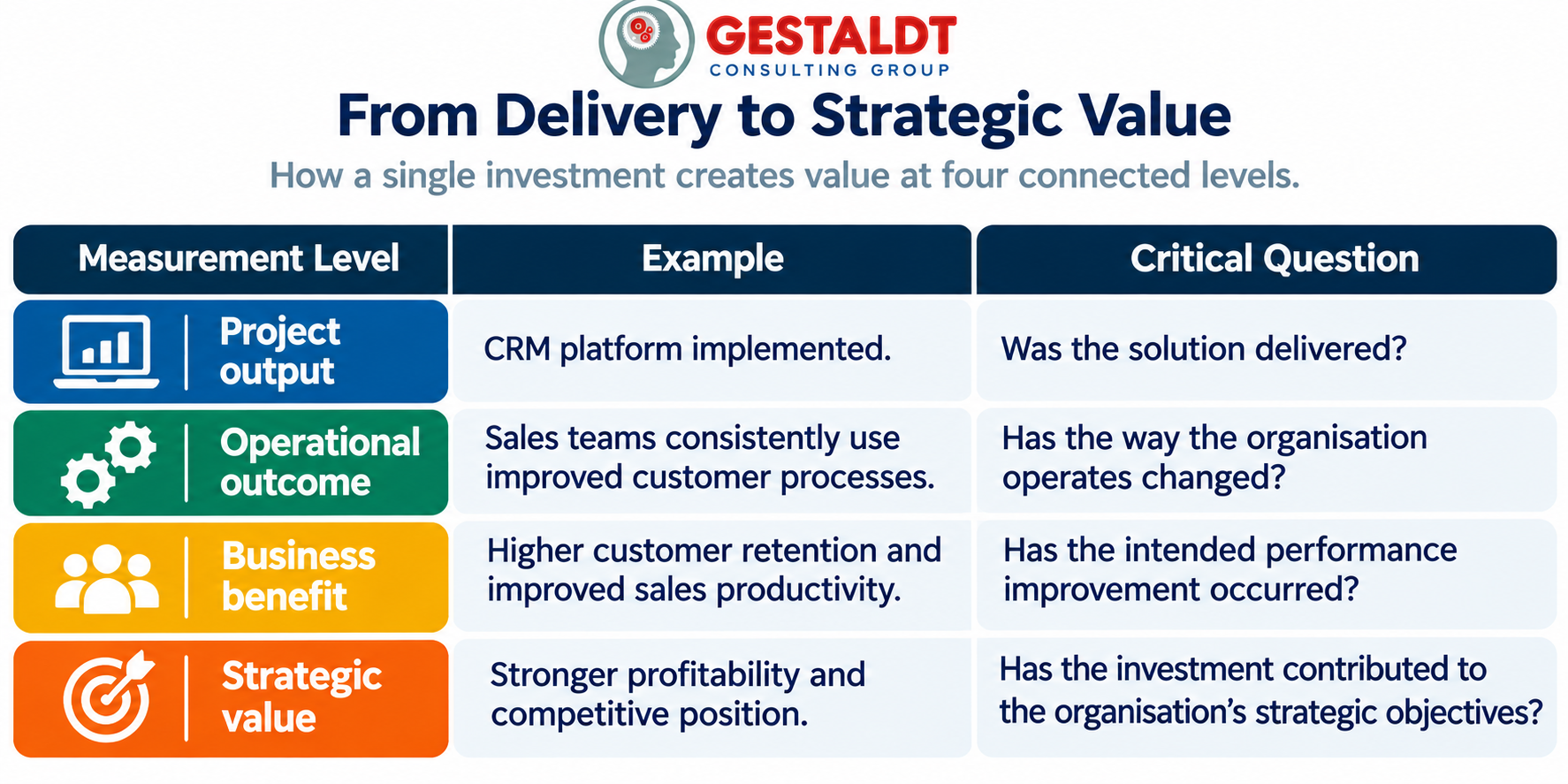
A project can succeed at the first level and underperform at the remaining three.
This is not necessarily evidence of poor project management.
It may indicate that the organisation has not adequately managed the transition from delivery to value creation.
Why the completion illusion persists
Project completion is relatively easy to observe.
Executives can see whether a system has been installed, a facility constructed or a process redesigned.
Business benefits are often more difficult to measure.
They may emerge gradually, depend on behavioural change or be influenced by economic conditions and other organisational initiatives.
Consequently, project completion becomes a convenient substitute for business success.
The risk is that executives receive reassuring delivery reports while the organisation's underlying performance remains unchanged.
What CEOs should do differently
Every strategic initiative should have two distinct success assessments:
Delivery success: Did the organisation implement the agreed solution effectively?
Value success: Did the implemented solution produce the intended business outcomes?
Both matter, but they answer different questions.
Practical tip: Introduce a benefits realisation section into every major project dashboard. Report project milestones alongside business outcome indicators, and continue monitoring those indicators after implementation.
The executive principle: A completed project is not automatically a successful strategic investment.
2. The Business Case Trap: When Promised Benefits Disappear After Approval
The most optimistic document in an organisation may be the business case that nobody revisits.
Before approving major investments, executives typically require a compelling business justification.
The business case may promise reduced costs, higher productivity, increased revenue, improved service quality or stronger organisational capabilities.
These projected benefits help decision-makers assess whether the proposed investment is worthwhile.
Yet once funding is approved, management attention often shifts towards project schedules, procurement, implementation milestones and budget control.
The original business case becomes a historical approval document rather than an active management instrument.
This creates a significant weakness.
The organisation may carefully monitor what it spends without maintaining equivalent discipline over what it expects to gain.
A business case should remain a living investment commitment
The UK Department of Finance's guidance on benefits management recommends establishing baseline measurements, defining how benefits will be monitored, identifying ownership and avoiding double-counting benefits across initiatives.
These practices matter because financial and operational assumptions can change substantially during implementation.
For example, a company may approve an automation initiative on the assumption that it will reduce manual processing time by 30%.
During implementation, additional system integration costs emerge.
Employees require more extensive training than anticipated.
Customer demand also changes.
The original benefits forecast may no longer reflect the operating environment.
If the business case is not reviewed, the organisation risks evaluating the investment against outdated assumptions.
Make benefits measurable from the beginning
Every significant benefit should be defined through a structured benefits profile.
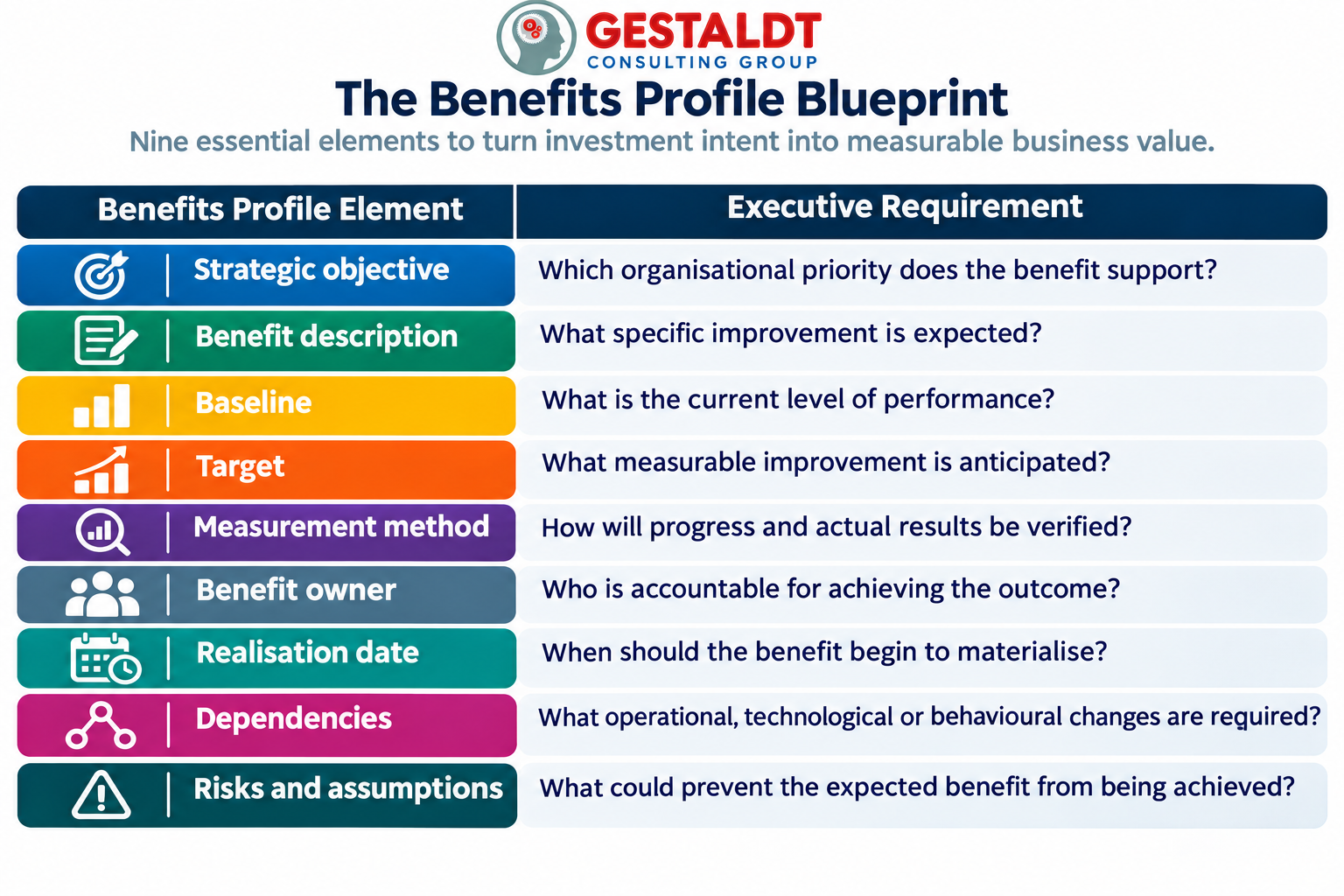
This approach transforms the business case into a practical instrument for investment management.
It also makes assumptions more transparent.
A projected financial benefit should not be treated as certain simply because it appears in an approved investment proposal.
Review assumptions as conditions change
Executives should revisit benefits forecasts at important decision points.
If a benefit is no longer realistic, the organisation should determine whether to redesign the initiative, adjust the investment, change its implementation approach or discontinue further expenditure.
This is particularly important when several strategic initiatives compete for scarce resources.
Practical tip: Require every major investment proposal to include a benefits register with named owners, measurable baselines, targets and review dates. Reassess the register at each major investment or delivery decision.
The executive principle: The business case should guide value creation throughout the investment lifecycle, not merely secure initial approval.
3. The Ownership Vacuum: When Everyone Delivers but Nobody Owns the Benefits
Projects usually have project managers. But who is accountable for the business value after the project team leaves?
This question exposes one of the most persistent weaknesses in strategic investment management.
A project manager may be accountable for delivering an agreed solution within approved constraints.
A technology team may be responsible for ensuring that a system functions correctly.
A transformation office may monitor milestones and implementation risks.
However, the intended business benefits often depend on operational leaders changing how their departments work.
When accountability for those outcomes is unclear, benefits can fall into an organisational vacuum.
Why project ownership is not the same as benefits ownership
Consider a manufacturing company investing in new production equipment.
The engineering team installs the machinery.
The project manager confirms that implementation is complete.
The supplier provides technical training.
Yet the expected productivity improvement depends on production scheduling, maintenance practices, employee proficiency and operational supervision.
Those activities may sit outside the project team's direct control.
If no operational leader is accountable for coordinating them, the organisation may never achieve the anticipated improvement.
PMI's research on benefits ownership and accountability highlights the importance of clear responsibility, cooperation and sustained attention to benefits beyond project delivery.
Establish distinct but connected responsibilities
A practical governance arrangement should distinguish between several roles.
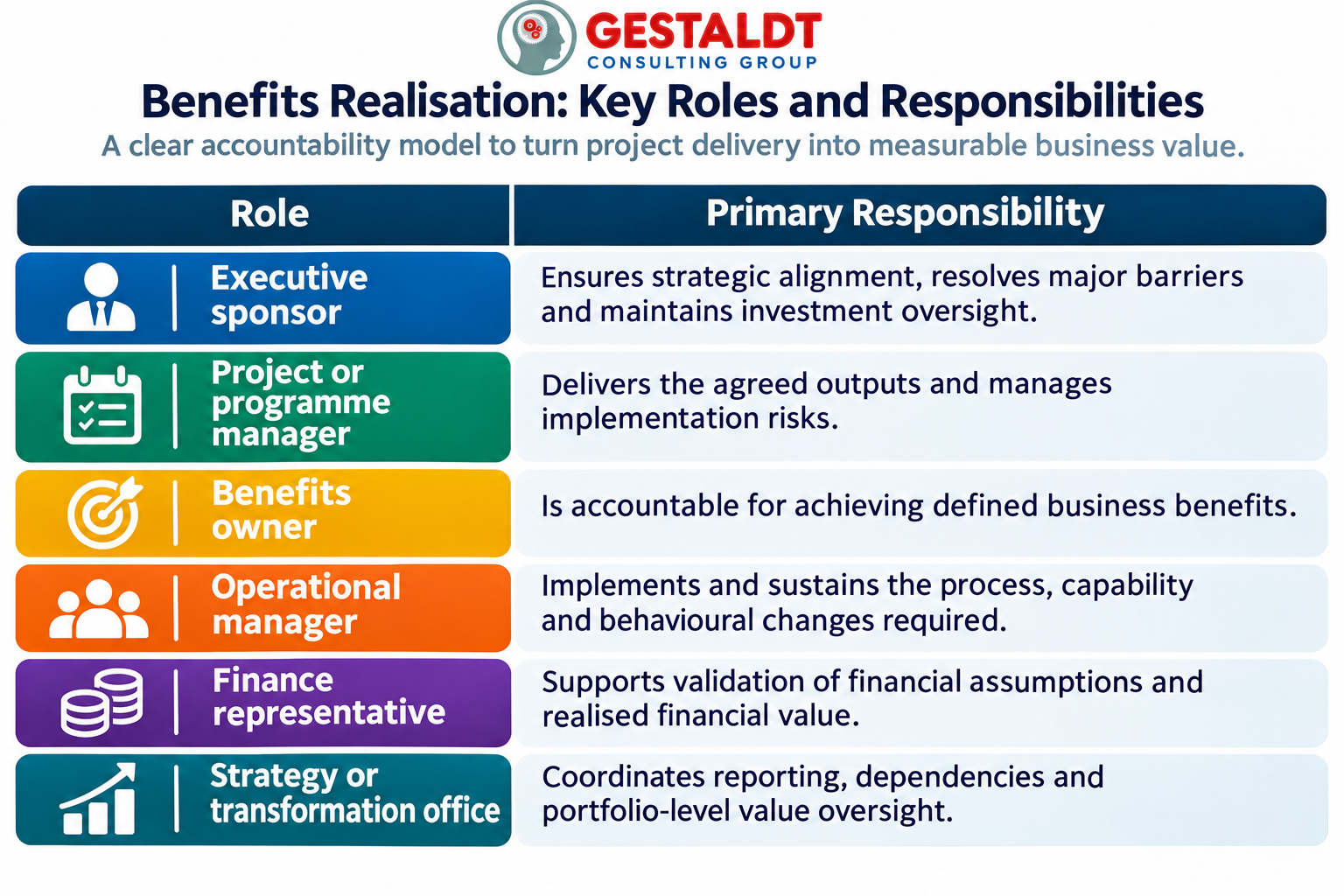
In smaller organisations, one person may perform several of these roles.
The important requirement is that responsibility remains explicit.
Accountability must extend beyond handover
Benefits ownership should be assigned before investment approval.
The benefits owner should participate in developing the business case, validating assumptions and defining the operational changes required.
That ownership should continue through implementation and after project closure.
This avoids the common situation in which responsibility is transferred to operational management only when the project is already complete.
Practical tip: For every major strategic initiative, identify a named executive sponsor and business benefits owner. Require both to confirm that the expected outcomes, measurement arrangements and operational responsibilities are understood.
The executive principle: If nobody owns the benefit, nobody can be reliably held accountable for achieving it.
4. The Adoption Failure: Why New Systems and Processes Do Not Automatically Improve Performance
Technology can be implemented in weeks or months. Changing the way an organisation works may take considerably longer.
Many strategic investments depend on changes in employee behaviour.
A new digital platform must be adopted.
A redesigned process must be followed.
A new operating model requires different decisions and responsibilities.
A customer service initiative may demand stronger collaboration between departments.
Without these changes, the organisation may possess a new capability without using it effectively.
This is where benefits realisation becomes closely connected to organisational change management.
Implementation is an event; adoption is a process
Imagine an organisation introducing an automated procurement platform.
The system is successfully deployed, and employees receive initial training.
However, managers continue approving purchases through informal channels.
Suppliers still submit documents outside the platform.
Employees use spreadsheets because they find the new workflow unfamiliar.
The technology exists, but the operating model has not changed sufficiently.
The organisation may therefore fail to realise the anticipated improvements in processing time, compliance and procurement visibility.
The problem is not simply technical.
It involves leadership behaviour, process discipline, employee capability and organisational accountability.
Identify the conditions required for value creation
For each strategic initiative, executives should distinguish between the delivered solution and the changes necessary to produce benefits.
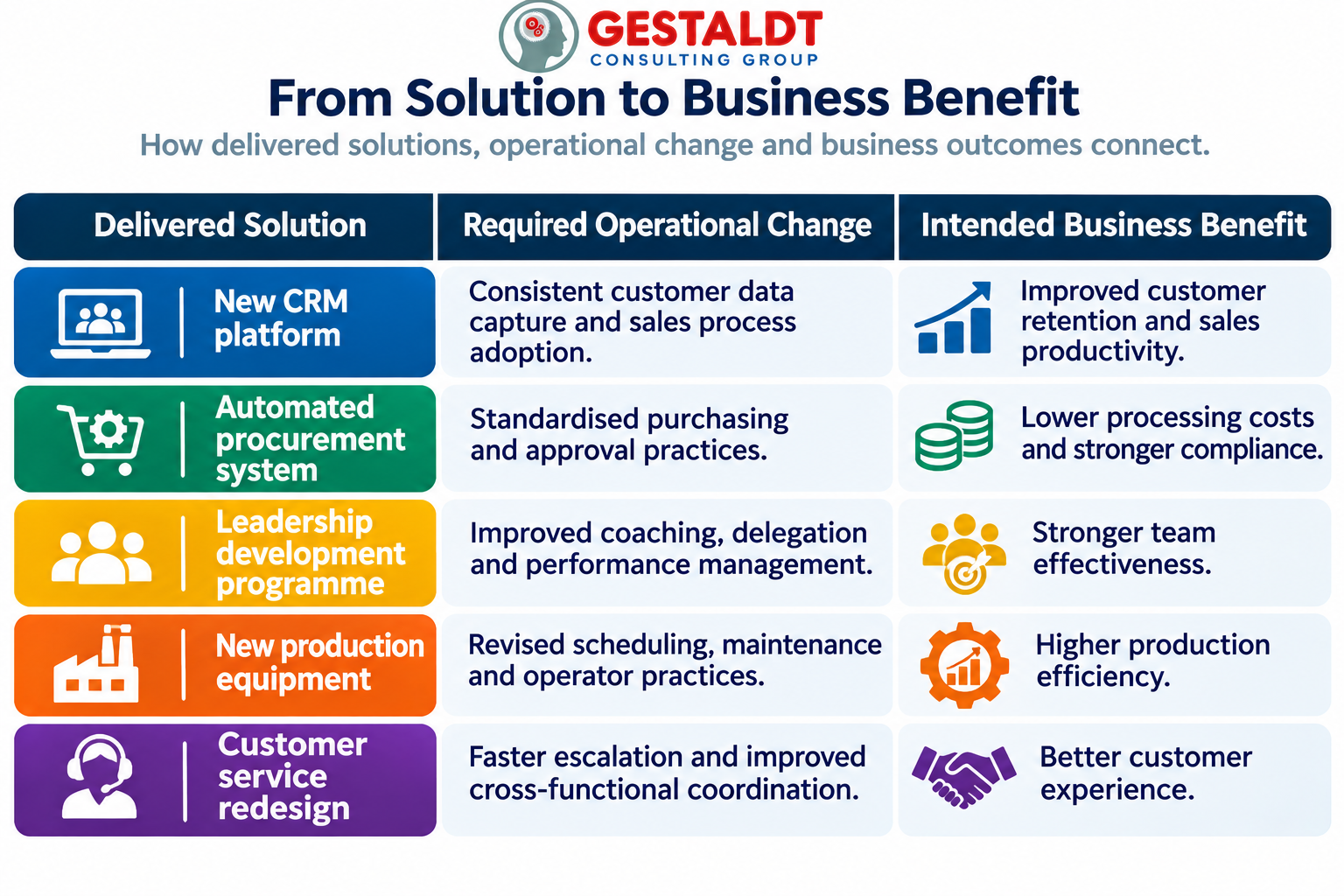
The value of an initiative often depends on the strength of these connections.
Management capability matters
Middle managers are particularly important during this stage.
They translate new requirements into daily activities, reinforce expectations, coach employees and identify barriers to adoption.
This connects directly with the challenge examined in the previous Gestaldt Insights article, The Middle Management Squeeze: Why Strategy Breaks Down Between the Boardroom and the Frontline.
An organisation cannot assume that employees will change how they work simply because a new process has been announced.
Managers need sufficient authority, capacity and capability to support the transition.
Practical tip: Include adoption indicators in every benefits realisation plan. Measure meaningful usage, process compliance, employee readiness and operational performance rather than relying exclusively on training attendance or system deployment.
The executive principle: Business benefits emerge when delivered capabilities are converted into sustained operational change.
5. The Measurement Blind Spot: When Organisations Cannot Prove the Value They Created
If your organisation cannot distinguish between projected savings and realised savings, it may be overstating the success of its strategic investments.
Benefits measurement is more complicated than tracking expenditure.
An initiative may reduce processing time without reducing costs.
A technology investment may increase employee productivity without creating additional revenue.
A customer experience programme may improve satisfaction while profitability remains unchanged.
These outcomes can still be valuable.
However, they must be described and measured accurately.
Not every improvement is a financial saving
Consider a process automation initiative that reduces the time required to complete a task.
Before implementation, employees spend 1,000 hours per month performing the activity.
After implementation, the same work requires 700 hours.
The organisation has released 300 hours of capacity each month.
That is a measurable operational improvement.
But it is not automatically a cash saving.
The financial effect depends on what happens to the released capacity.
If the organisation reduces overtime expenditure, there may be a direct financial benefit.
If employees use the time to process additional customer requests, the benefit may be increased service capacity.
If the released time is not productively redeployed, the anticipated economic value may not materialise.
This distinction is particularly important for CFOs evaluating transformation investments.
Differentiate benefit categories
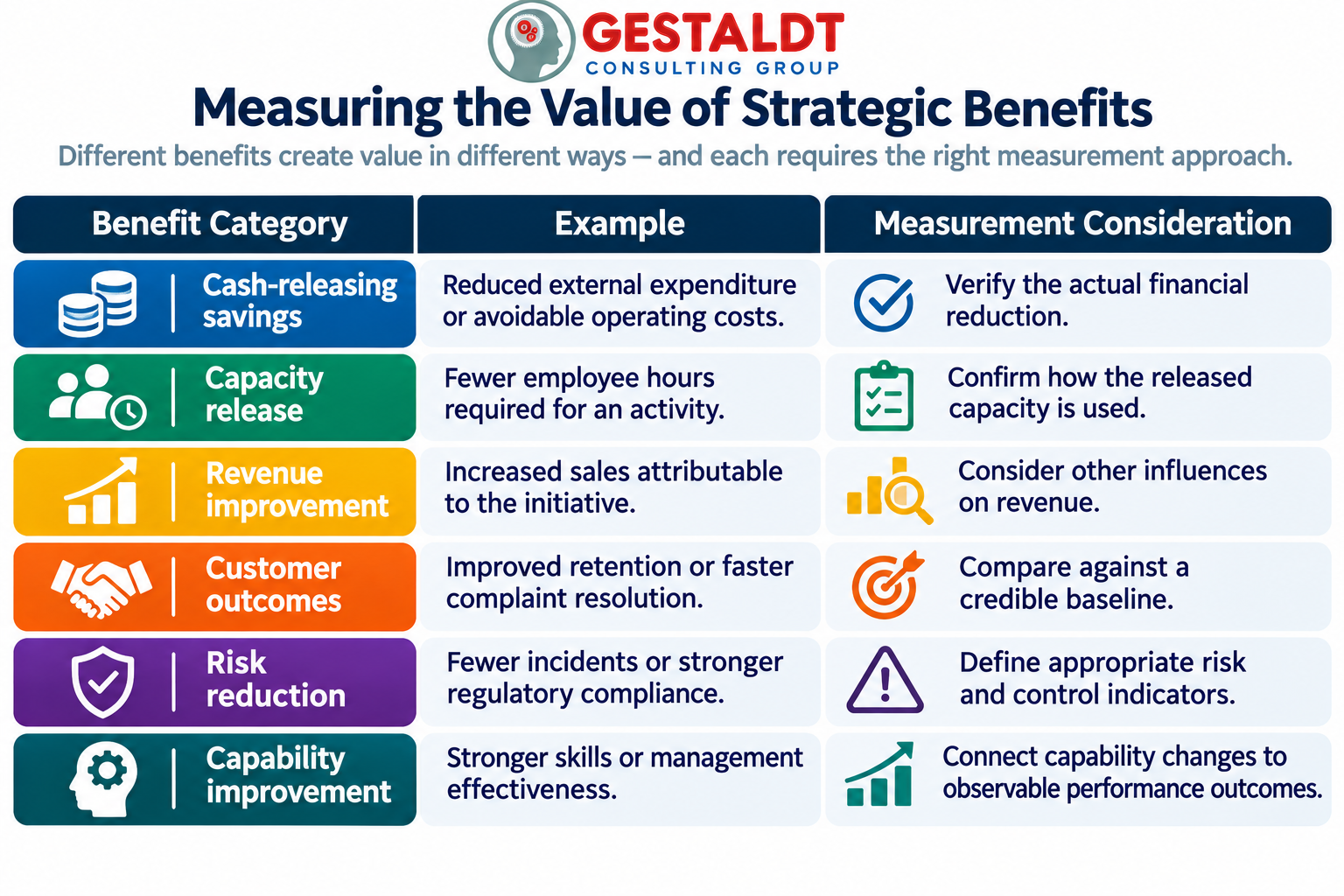
The measurement approach should reflect the nature of the benefit.
Not every benefit can be converted reliably into monetary terms.
Equally, organisations should avoid presenting qualitative improvements as financial returns without defensible assumptions.
Establish credible baselines and attribution
A benefits baseline describes the organisation's position before an intervention.
Without a baseline, executives may struggle to determine whether performance improved.
Measurement should also consider attribution.
For example, if revenue increases after implementing a new sales system, the organisation should examine whether the increase resulted from the system, market conditions, pricing changes or other commercial initiatives.
Where feasible, comparisons with similar business units, phased rollouts or other evaluation methods can strengthen confidence in the findings.
Prevent double-counting
Strategic initiatives frequently share benefits.
A digital transformation programme and a customer service improvement initiative may both contribute to reduced service costs.
If each claims the full value of the improvement, portfolio-level benefits may be overstated.
Executives should establish consistent rules for allocating shared benefits and reconciling financial outcomes.
Practical tip: Ask Finance and operational benefits owners to jointly validate the five largest benefits claimed by your organisation's strategic portfolio. Confirm the baseline, calculation method, supporting evidence and whether the benefit has actually materialised.
The executive principle: Value must be demonstrated through credible evidence, not merely reported through optimistic forecasts.
6. The Post-Project Accountability Gap: Why Benefits Disappear After the Project Closes
The moment a project closes may be the moment benefits realisation needs the greatest attention.
Many organisations operate with a clear project lifecycle.
An initiative is approved, planned, executed and formally closed.
The project team moves on to other assignments.
Management attention shifts to the next strategic priority.
However, the expected business benefits may only begin to emerge after implementation.
A new technology platform may require several months of operational stabilisation.
A leadership development programme may need sustained application before performance improves.
A redesigned operating model may take time to produce measurable efficiency gains.
If monitoring stops when the project closes, the organisation may lose visibility of the investment precisely when value creation should be accelerating.
Separate project closure from benefits closure
The two events should be treated differently.
Project closure confirms that agreed deliverables and handover requirements have been completed.
Benefits closure confirms that expected benefits have been assessed, outcomes documented and any remaining responsibilities appropriately resolved.
The UK Government's guidance on benefits management emphasises continuing benefits oversight through the transition into business-as-usual operations, including after project delivery.
This reflects a critical management principle: the investment lifecycle extends beyond the project lifecycle.
Introduce post-implementation value reviews
Organisations should establish review points appropriate to the nature of the investment.
For example:
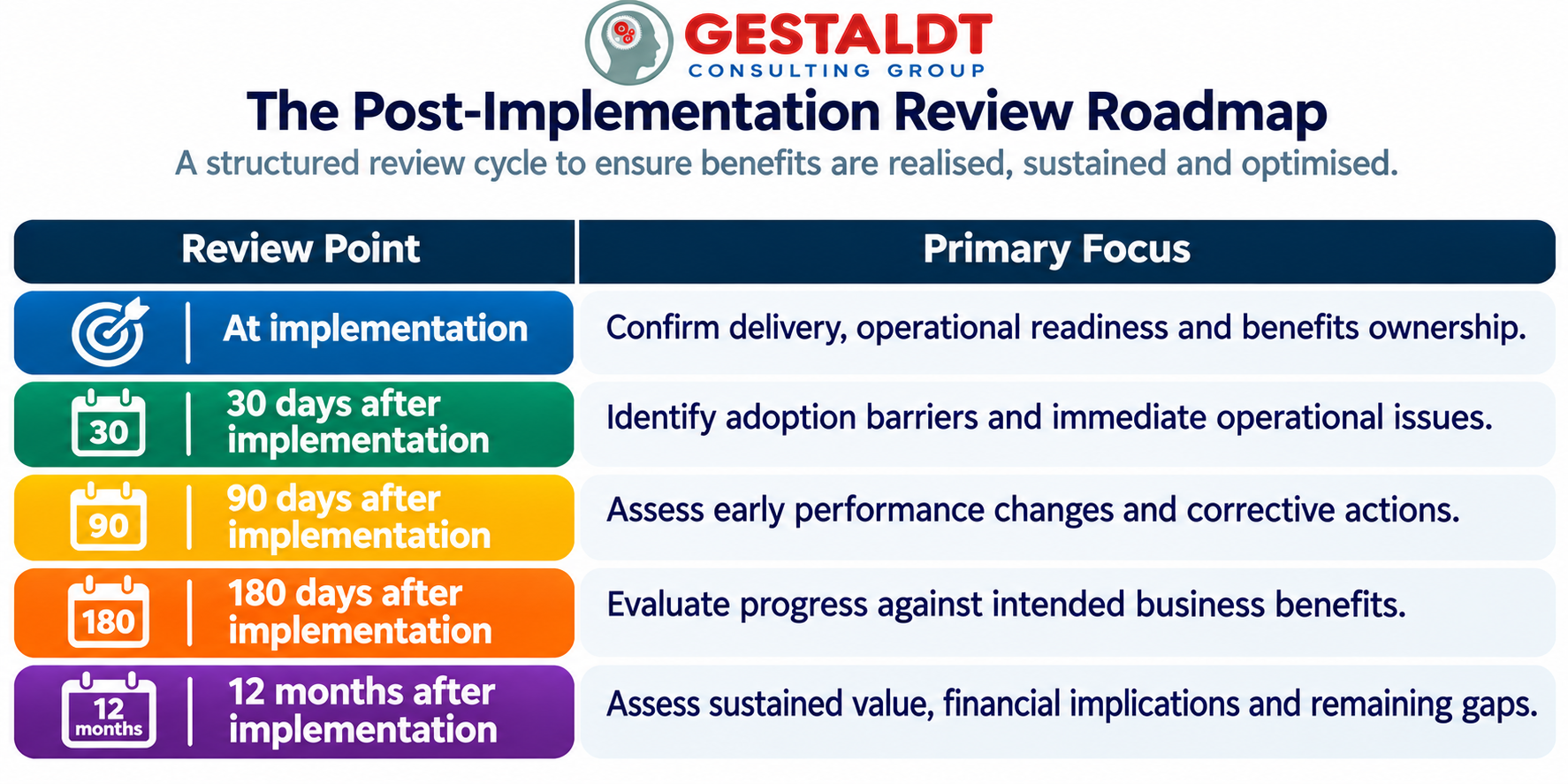
These intervals are illustrative.
Some benefits emerge within weeks, while others require several years.
The review schedule should reflect the expected benefits profile and business context.
Make corrective action part of governance
A benefits review should not simply explain why targets were missed.
It should determine what the organisation will do next.
Possible responses include additional employee development, process redesign, operational support, technology adjustments or changes to resource allocation.
Where the expected value is no longer achievable, executives should be willing to reconsider further investment.
Practical tip: Require every major project closure report to include an approved post-implementation benefits plan, named operational owner, review schedule and agreed escalation process for underperformance.
The executive principle: Closing the project should not mean closing accountability for the investment.
Introducing the Gestaldt Benefits Realisation and Value Assurance Framework™
The benefits realisation gap cannot be closed through better project reporting alone.
It requires a management approach that connects strategic intent, investment decisions, operational change, performance measurement and sustained accountability.
The proposed Gestaldt Benefits Realisation and Value Assurance Framework™ brings these requirements together through six interconnected dimensions.
The Six Dimensions of Value Assurance
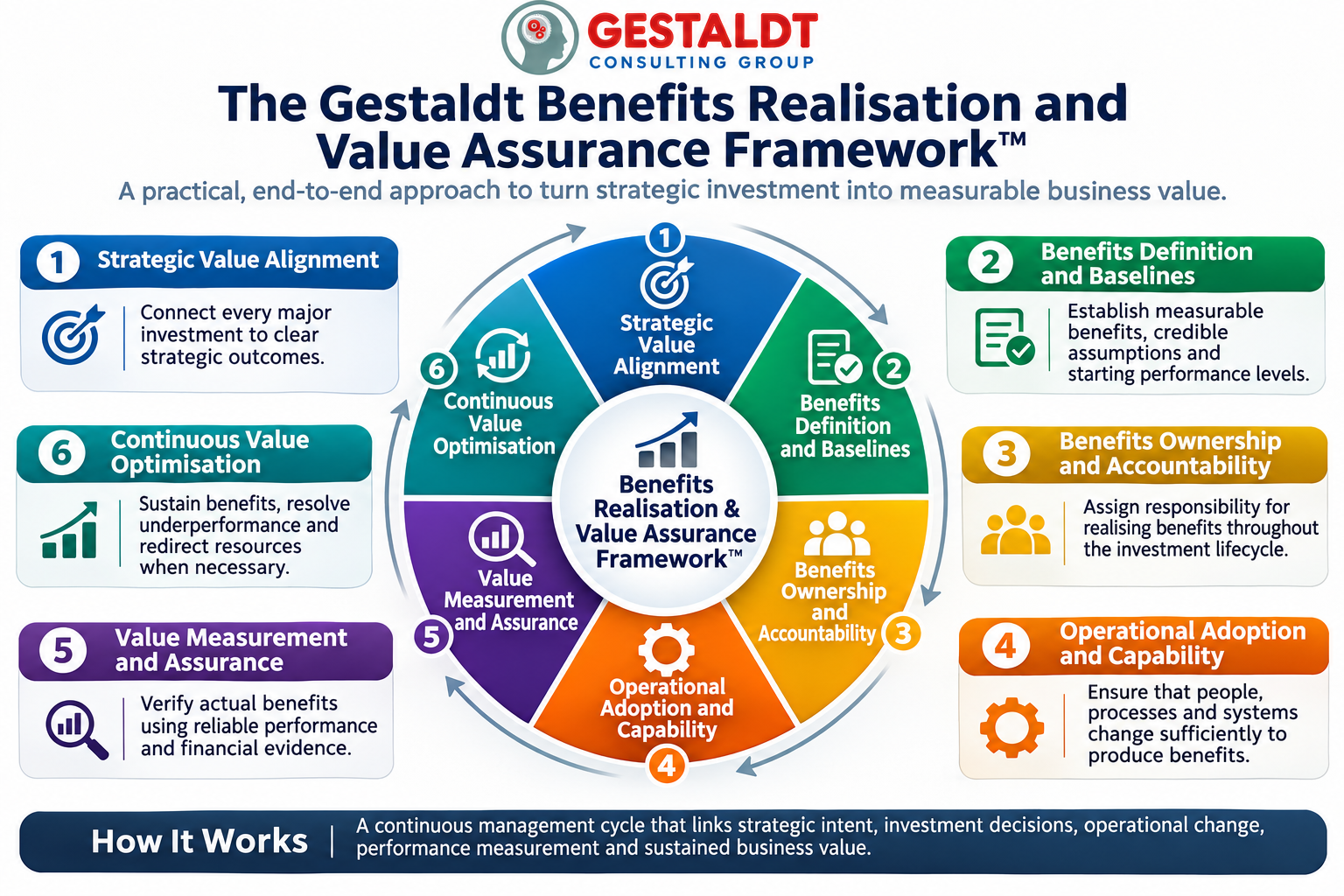
The framework is designed as a practical executive management model rather than a scientifically validated diagnostic instrument.
Its value lies in helping leadership teams examine the complete journey from investment approval to measurable business results.
How the Framework Works
The six dimensions should operate as a continuous management cycle.
Strategic Value Alignment establishes why an investment is necessary.
Benefits Definition and Baselines clarify what success looks like.
Benefits Ownership and Accountability identify who must deliver the intended outcomes.
Operational Adoption and Capability ensure that the organisation can use the delivered solution effectively.
Value Measurement and Assurance determine whether the expected results have materialised.
Continuous Value Optimisation supports corrective action, sustained improvement and informed future investment decisions.
Together, these dimensions shift executive attention from the question:
“Have we completed the project?”
To the more commercially important question:
“Has the investment created the business value we expected, and what must we do to improve the result?”
The CEO's Benefits Realisation Diagnostic
Before approving another major transformation initiative, executives should examine whether their organisation has the discipline required to realise value from existing investments.
Interpreting the Results
These score bands are illustrative and intended to guide executive discussion, not provide a validated assessment.
The individual weaknesses identified are more important than the overall score.
An organisation may have strong project governance while lacking credible benefits measurement.
Another may define benefits clearly but fail to establish operational accountability.
Both situations can create significant investment risk.
A 90-Day Executive Roadmap to Close the Benefits Realisation Gap
Closing the benefits realisation gap does not require an organisation to redesign its entire project management system immediately.
A focused 90-day initiative can establish stronger investment visibility and accountability.
Days 1–30: Establish the Value Baseline
Objective: Determine whether strategic investments are delivering their intended benefits.
Select a representative portfolio of major strategic initiatives, including recently completed projects.
Review the original business cases, projected benefits, delivery reports and available performance information.
Identify which benefits have been achieved, which remain uncertain and which appear to be underperforming.
Determine whether each benefit has a clear owner, measurement method and supporting evidence.
Expected output: A strategic investment benefits register highlighting value gaps, measurement weaknesses and accountability concerns.
Days 31–60: Strengthen Ownership and Measurement
Objective: Establish clear responsibility for business value.
Assign or confirm benefits owners.
Validate baselines and measurement methods.
Work with Finance and operational leaders to distinguish forecast, realised and unverified benefits.
Identify the operational changes required to unlock outstanding value.
Review whether current governance arrangements provide adequate visibility of benefits performance.
Expected output: An improved benefits management approach supported by defined owners, credible indicators and agreed review arrangements.
Days 61–90: Introduce Value Assurance Governance
Objective: Embed benefits realisation into executive decision-making.
Establish regular benefits reviews for major strategic initiatives.
Integrate benefits indicators into existing executive dashboards.
Agree corrective actions for underperforming investments.
Introduce post-implementation value reviews.
Ensure that future investment proposals demonstrate clear strategic alignment, credible benefits assumptions and operational readiness.
Expected output: A repeatable executive value assurance process linking investment decisions with measurable organisational outcomes.
The first 90 days should establish stronger management discipline. Full benefits realisation may take considerably longer, depending on the nature of the investment.
The Executive Benefits Realisation Dashboard: What CEOs Should Measure
A benefits realisation dashboard should provide more than a summary of completed projects.
It should show whether strategic investments are creating the outcomes the organisation expected.
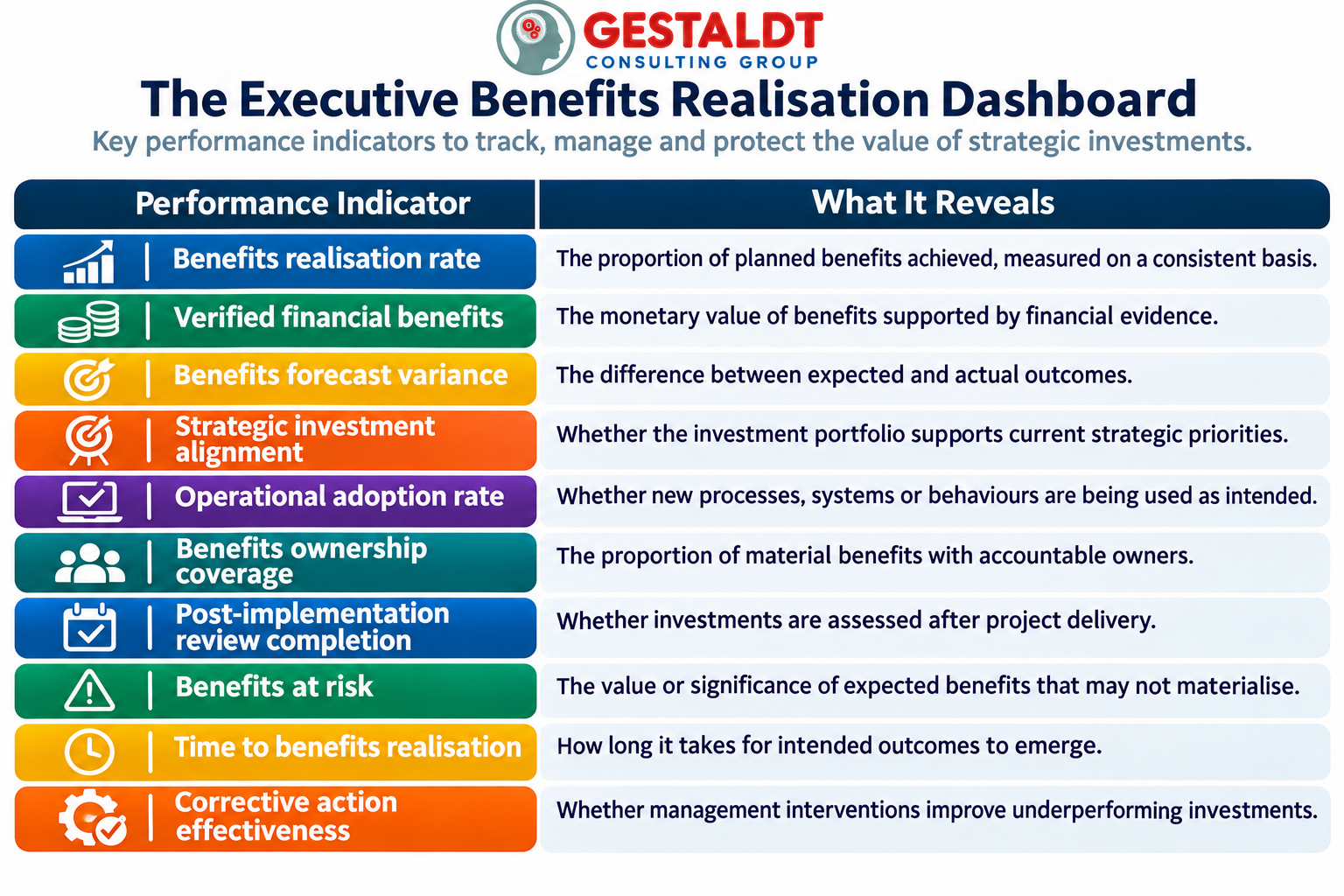
A simple benefits realisation calculation
For an individual quantitative benefit:
Benefits Realisation Rate (%) = (Verified Actual Benefit ÷ Planned Benefit) × 100
For example, suppose an initiative was expected to generate annual operating cost savings of R10 million.
After the agreed measurement period, Finance verifies actual annual savings of R6.5 million.
The benefits realisation rate is:
(R6.5 million ÷ R10 million) × 100 = 65%
This indicates that 65% of the planned annual savings have been achieved.
The organisation must now determine why the remaining 35% has not materialised.
Possible causes could include incomplete process adoption, implementation delays, changes in operating conditions or unrealistic original assumptions.
The calculation should compare benefits over the same period and on the same basis. It should not be applied indiscriminately across different financial and non-financial benefits.
The purpose is not merely to calculate a percentage.
It is to support better management decisions.
From Project Governance to Investment Value Governance
The most important shift CEOs can make is to stop treating benefits realisation as an administrative activity attached to project management.
It is a core component of strategic investment governance.
Traditional project governance focuses on delivering approved initiatives effectively.
Investment value governance asks whether those initiatives remain worthwhile, whether expected benefits are being achieved and whether resources should continue to be committed.
The distinction becomes particularly important when organisations face constrained budgets, competing strategic priorities and growing pressure to demonstrate returns.
Consider two initiatives.
The first is progressing according to schedule but has limited evidence that its intended benefits remain achievable.
The second has experienced implementation delays but is demonstrating strong operational adoption and credible potential for substantial business value.
A governance process focused exclusively on delivery milestones may favour the first initiative.
A value-oriented governance process will examine both investments more carefully before determining where resources should be allocated.
This does not mean ignoring delivery discipline.
It means recognising that delivery performance is one dimension of investment success.
Executives should also consider strategic relevance, expected value, realised benefits, remaining costs, risk and organisational capacity.
Five Questions Every Investment Committee Should Ask
Before approving, extending or closing a major strategic initiative, decision-makers should ask:
Strategic relevance: Does this investment still support a critical organisational priority?
Value credibility: Are the expected benefits realistic, measurable and supported by evidence?
Operational readiness: Can the organisation adopt and sustain the changes required?
Accountability: Who is responsible for achieving the business outcomes?
Investment discipline: Should we continue, adjust, accelerate, defer or discontinue the initiative based on its expected value?
These questions help establish a stronger connection between strategy formulation, investment decisions and organisational performance.
They also encourage executives to distinguish between commitment to an initiative and commitment to the value the initiative was intended to create.
That distinction is essential.
Sometimes, protecting shareholder and stakeholder value requires changing direction rather than continuing an investment simply because substantial resources have already been committed.
Conclusion: The Real Measure of Strategic Success Is Value Created
Organisations do not invest in transformation programmes, technology platforms, operating models or capability development simply to complete projects.
They invest because they expect better business outcomes.
They want stronger profitability, improved productivity, more satisfied customers, better employee performance, reduced risk and greater competitive advantage.
Yet these outcomes do not materialise automatically when a project reaches its final milestone.
They require deliberate management.
The benefits realisation gap emerges when organisations focus on delivery without maintaining equivalent discipline over business value.
It widens when business cases are not revisited, benefits ownership is unclear, operational adoption is weak, performance measurement is unreliable and accountability disappears after project closure.
Closing the gap requires a different executive mindset.
Strategic investments must be evaluated not only by what they deliver, but by what they change and the value those changes produce.
This means strengthening the connection between strategy, governance, leadership, operational capability and measurable performance.
It also means recognising that the completion of a project is often the beginning of benefits realisation rather than its conclusion.
The organisations that create lasting value are not necessarily those that complete the most projects. They are those that consistently convert strategic investment into meaningful business outcomes.
For CEOs and executive teams, the question is therefore not simply:
How many strategic initiatives have we successfully completed?
The more important question is:
How much measurable business value have those initiatives actually created?
Because in the end, strategy is not judged by the number of projects delivered.
It is judged by the results those investments make possible.
Is Your Organisation Delivering Projects or Creating Measurable Business Value?
Completing strategic initiatives is important. Realising their intended benefits is what makes the investment worthwhile.
If your organisation is investing in transformation, technology, operational improvement or capability development without clear visibility of the business value being achieved, it may be time to strengthen your approach to benefits realisation.
At Gestaldt Consulting Group, we focus on helping organisations improve the connection between strategic intent, organisational capability, execution discipline and business performance.
Through structured assessment, strategic alignment and performance improvement, organisations can identify the barriers preventing their investments from delivering meaningful results.
Turn Strategic Investment Into Measurable Business Value
Are your strategic initiatives producing the outcomes your organisation expected?
Connect with Gestaldt Consulting Group to explore how stronger benefits realisation, execution governance and organisational alignment can support sustainable business performance.
Explore Gestaldt Consulting Group
Better Insights. Stronger Leaders. Lasting Impact.