The Leadership Pipeline Is Broken: Why Your Next Generation of Leaders May Not Be Ready
Your Biggest Leadership Risk May Be Sitting Just Below the Executive Team
Here's an uncomfortable question for every CEO:
If three of your senior leaders left tomorrow, who would be ready to replace them?
Not who has potential.
Not who has been with the organisation longest.
Not who performs exceptionally well in their current role.
Who is genuinely ready to lead?
For many organisations, the answer is uncomfortable.
There may be plenty of talented employees, but very few people prepared to take on significantly greater leadership responsibility.
That distinction matters.
A strong individual contributor isn't automatically a strong manager. A successful manager isn't automatically an effective executive. And a high-performing executive isn't necessarily prepared to lead an organisation through its next phase of complexity.
Yet organisations frequently treat leadership development as a collection of training courses rather than as a strategic capability.
That is where the problem begins.
The leadership pipeline is often allowed to develop organically until a critical position suddenly becomes vacant.
Then the scramble begins.
External recruitment.
Emergency appointments.
Extended vacancies.
Loss of institutional knowledge.
Disruption to teams.
And, sometimes, the wrong person is promoted simply because they're available.
For CEOs, this isn't merely a people issue.
It is a business continuity, execution and growth issue.
Leadership Succession Is No Longer an HR Issue
Succession planning has traditionally been associated with HR.
But leadership capability directly affects:
Strategy execution
Organisational resilience
Employee retention
Innovation
Decision-making
Culture
Customer experience
Business continuity
Growth
That makes leadership succession a boardroom issue.
Gestaldt's own work in leadership development and management development reflects this broader connection: leadership capability must be aligned with organisational objectives rather than treated as standalone training.
The question isn't simply:
"Who could replace this executive?"
The better question is:
"What leadership capabilities will the organisation need next—and where will they come from?"
1. Your Best Performer May Not Be Your Best Future Leader
This is one of the most expensive assumptions organisations make.
Someone who consistently delivers exceptional individual results is often viewed as the obvious candidate for promotion.
But leadership changes the job.
The skills that made someone successful yesterday may not be the skills required tomorrow.
A technical expert may struggle with:
Delegation
Coaching
Conflict
Strategic thinking
Influence
Cross-functional collaboration
Ambiguity
Change leadership
Promotion without preparation can therefore create two problems simultaneously:
You lose a great performer and gain an unprepared manager.
The CEO Question
Before promoting someone, ask:
"What evidence do we have that this person can lead at the next level?"
Not potential.
Evidence.
Practical Tip
Assess future leaders against the capabilities required at the next level—not simply their performance in their current role.
2. The Middle-Management Gap Is Becoming a Strategic Risk
The executive team creates strategic direction.
Frontline teams deliver the customer experience.
But between them sits one of the most important layers in the organisation:
middle management.
These leaders translate strategy into everyday behaviour.
They interpret priorities.
Allocate resources.
Coach employees.
Resolve conflict.
Make decisions.
And determine whether strategic initiatives actually gain traction.
If middle managers are overwhelmed, underdeveloped or disconnected from executive priorities, the strategy-execution chain breaks.
This is particularly important as organisations become more complex.
A CEO cannot personally translate strategy for thousands of employees.
The leadership pipeline must do it.
Practical Tip
Treat middle-management capability as a strategic investment rather than a training expense.
3. Leadership Development Often Starts Too Late
Here's the trap.
Organisations identify someone as a future leader when the organisation suddenly needs one.
By then, it's already too late.
Leadership capability takes time to develop.
Future leaders need opportunities to:
Lead projects
Manage difficult situations
Make decisions
Work across functions
Manage budgets
Develop people
Navigate ambiguity
Learn from failure
A leadership programme alone cannot create these experiences.
Development happens when learning and responsibility increase together.
The Leadership Development Equation
Leadership capability = Knowledge + Experience + Feedback + Accountability
Remove any one of these and development becomes incomplete.
Practical Tip
Start developing future leaders before the organisation needs them.
4. Your Leadership Pipeline May Be Reinforcing the Wrong Behaviours
Here's where things get interesting.
Organisations don't develop leaders through training alone.
They develop leaders through what they reward, promote and tolerate.
If promotions consistently go to people who:
Protect their own departments
Avoid difficult decisions
Prioritise short-term results
Resist change
Hoard information
Micromanage teams
then the organisation is effectively teaching everyone that these behaviours lead to success.
Your leadership pipeline therefore becomes a mirror of your organisational culture.
This is why leadership development and culture cannot be separated.
As Gestaldt's existing work on organisational culture highlights, culture influences how people behave, collaborate and make decisions—even when nobody is watching.
Practical Tip
Examine your last ten promotions.
Ask:
"What behaviours did we actually reward?"
The answer may tell you more about your leadership culture than your values statement does.
5. Future Leaders Need Different Capabilities
The next generation of leaders will operate in an environment defined by uncertainty, technology and complexity.
Technical competence will remain important.
But it won't be enough.
Future-ready leaders will need to demonstrate capability in:
Strategic Thinking
Seeing beyond immediate operational problems.
Decision-Making
Making informed decisions despite incomplete information.
Digital Fluency
Understanding how technology, AI and data affect business models and performance.
Emotional Intelligence
Building trust, managing conflict and leading diverse teams.
Change Leadership
Helping people navigate uncertainty without losing momentum.
Collaboration
Working across organisational boundaries rather than protecting functional territory.
Adaptive Leadership
Adjusting leadership style to changing circumstances.
The leadership pipeline must therefore evolve alongside the organisation.
6. The CEO's Blind Spot: Potential Isn't the Same as Readiness
Many organisations identify "high-potential" employees.
That's useful.
But potential is only the beginning.
There is a critical difference between:
Potential
"This person could become an excellent leader."
and
Readiness
"This person can successfully lead at the next level now."
Confusing the two creates succession risk.
A high-potential employee may require another two or three years of experience before taking on a critical leadership role.
That isn't failure.
It's development planning.
Practical Tip
Classify your leadership pipeline into three categories:
Ready Now
Can assume the role with minimal transition support.
Ready Soon
Requires targeted development and experience.
Future Potential
Requires longer-term development.
This creates a much more realistic picture of organisational readiness.
7. Succession Planning Should Start With the Future—Not Today's Org Chart
Traditional succession planning often begins with existing positions.
CEO.
CFO.
COO.
HR Director.
Business Unit Head.
Then organisations ask who could replace each person.
A more strategic approach starts elsewhere.
Ask:
What will our organisation look like in three to five years?
What capabilities will it require?
How will technology change leadership roles?
Which markets will matter?
What new risks will executives need to manage?
What capabilities will become obsolete?
Only then should you identify the leaders capable of meeting those requirements.
This changes succession planning from replacement planning into future capability planning.
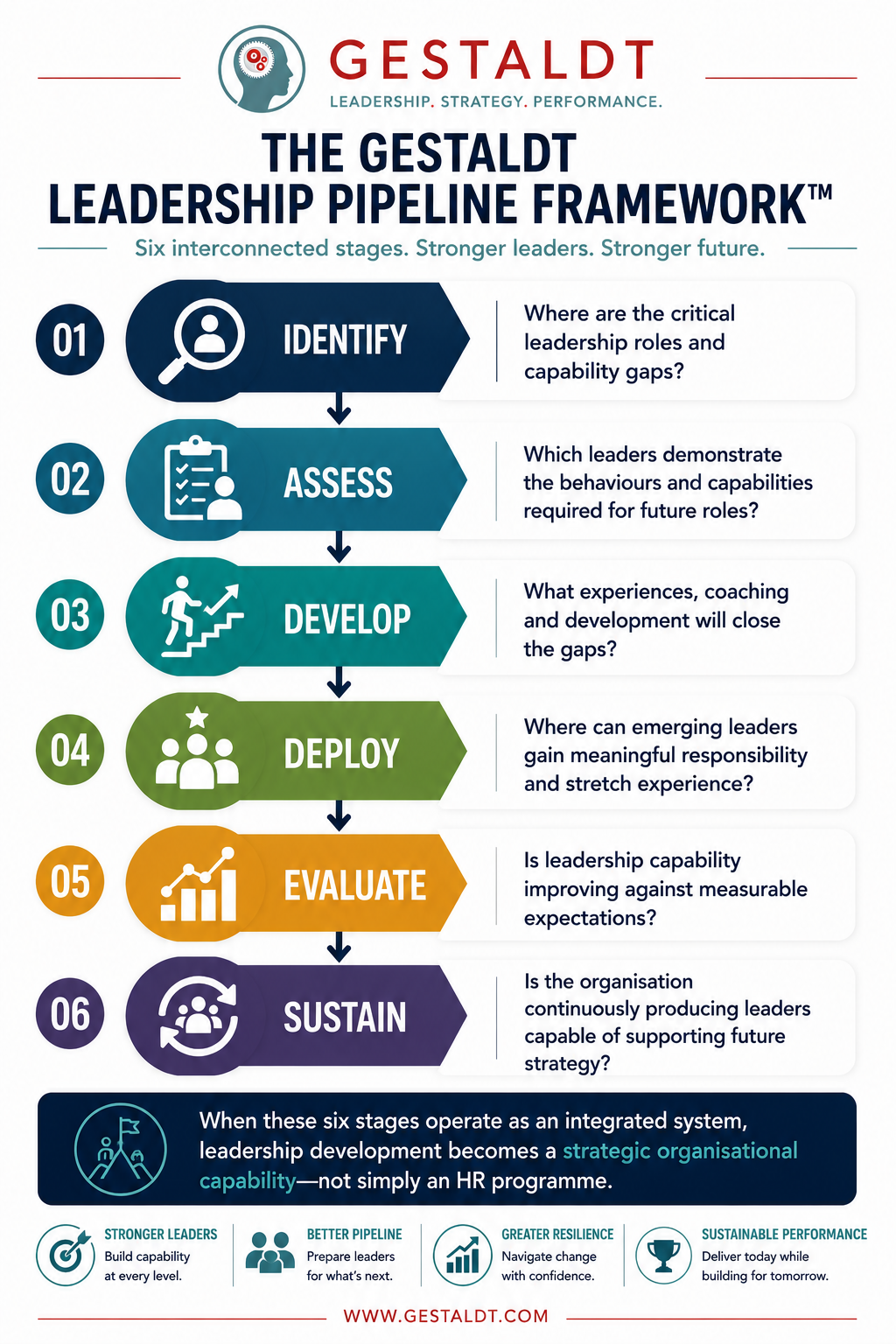
The Gestaldt Leadership Pipeline Framework™
At Gestaldt, we believe sustainable leadership capability is built through six interconnected stages:
Is Your Leadership Pipeline Ready?
Use this quick executive diagnostic.
Rate each statement from 1 (Strongly Disagree) to 5 (Strongly Agree).
We know which leadership roles are critical to future strategy.
We have identified successors for critical positions.
Our succession plans are based on future capability requirements.
We know which potential successors are ready now.
Emerging leaders receive meaningful stretch assignments.
Leadership development is linked directly to business strategy.
Middle managers receive sufficient leadership development.
Leaders receive regular feedback and coaching.
We actively monitor leadership capability gaps.
Our organisation could withstand the unexpected departure of several senior leaders.
Your Score
40–50: Leadership strength
Your organisation has the foundations of a robust leadership pipeline.
30–39: Development opportunity
Some capability and succession gaps could become significant as the organisation evolves.
Below 30: Strategic leadership risk
Your organisation may be relying too heavily on a small number of established leaders.
That creates vulnerability.
The Leadership Pipeline Should Be a Competitive Advantage
Think about what happens when a competitor loses its CEO.
Or a CFO unexpectedly departs.
Or a critical business-unit leader resigns.
One organisation panics.
The other activates a succession plan.
The difference isn't necessarily talent.
It's preparation.
A mature leadership pipeline gives an organisation something incredibly valuable:
continuity.
It protects institutional knowledge.
Accelerates transitions.
Reduces disruption.
Strengthens employee confidence.
And allows organisations to keep executing strategy even when leadership changes.
That is why succession planning should never be treated as an administrative exercise.
It is an investment in organisational resilience.
A Strong Leadership Pipeline Changes the Culture
There's another benefit that is often overlooked.
When employees can see how leadership opportunities are created, assessed and earned, the organisation becomes more developmental.
People understand what good leadership looks like.
Managers become coaches.
High performers see a future.
Capability becomes something the organisation actively builds rather than something it hopes to find in the market.
And that can have a powerful effect on retention.
Instead of asking:
"How do we retain our best people?"
leaders can begin asking:
"How do we create an organisation where our best people can see themselves building their future?"
That's a very different proposition.
What CEOs Should Do Next
If you believe your organisation has a leadership pipeline problem, don't start with another generic leadership course.
Start with diagnosis.
Step 1: Identify critical roles
Which positions would create the greatest business disruption if suddenly vacant?
Step 2: Define future capabilities
What will those roles require three to five years from now?
Step 3: Assess your internal pipeline
Who is ready?
Who is developing?
Where are the gaps?
Step 4: Build targeted development plans
Combine coaching, mentoring, stretch assignments, exposure and formal learning.
Step 5: Measure readiness
Don't measure training attendance.
Measure capability.
Step 6: Review the pipeline regularly
Succession planning should evolve as strategy evolves.
The Real Leadership Question Isn't "Who Comes Next?"
It's:
"Are we deliberately building the leaders our future strategy requires?"
Because leadership succession isn't about predicting who will leave.
It's about preparing the organisation for whatever comes next.
The companies that build deep leadership capability won't simply have replacements waiting in the wings.
They will have a continuous supply of leaders capable of navigating complexity, developing people, executing strategy and creating sustainable value.
That is what makes a leadership pipeline a competitive advantage.
Is Your Organisation Building Tomorrow's Leaders Today?
A leadership gap rarely appears overnight.
It develops quietly through unplanned promotions, limited development opportunities, weak succession processes and over-reliance on a handful of senior leaders.
By the time the gap becomes visible, the business may already be feeling the consequences.
Request a Leadership Pipeline & Succession Assessment
Gestaldt can help your organisation assess:
Critical leadership roles
Succession readiness
Leadership capability gaps
High-potential talent
Middle-management capability
Future leadership requirements
Development priorities
Succession risk
The objective isn't simply to identify replacements.
It's to build a leadership pipeline capable of delivering your organisation's future strategy.