When Growth Starts Breaking the Business: The CEO's Guide to Scaling Without Losing Control

Growth Can Hide Problems—Until Suddenly It Can't
Growth looks like success.
More customers. More employees. More revenue. More locations. More products.
Then, almost imperceptibly, the organisation starts behaving differently.
Decisions take longer.
Meetings multiply.
Customers receive inconsistent experiences.
Departments create their own priorities.
Senior leaders become involved in operational details.
Managers spend more time coordinating than leading.
And the organisation that once moved quickly begins to feel strangely heavy.
This is the paradox of growth:
The organisation can become more successful while becoming less effective.
The problem isn't necessarily poor leadership or a weak strategy.
Often, the organisation has simply outgrown the structures that made it successful in the first place.
At Gestaldt, we believe sustainable growth requires more than expanding revenue or headcount. Organisations must evolve their leadership, structure, governance, culture, capability and execution at the same pace as their strategy.
Otherwise, yesterday's operating model becomes tomorrow's growth constraint.
The Hidden Cost of Organisational Complexity
Complexity doesn't arrive with a warning.
It accumulates.
One additional approval process seems harmless.
One new reporting requirement seems reasonable.
One additional management layer appears necessary.
One more strategic initiative feels manageable.
But eventually the organisation reaches a tipping point.
Employees need permission to act.
Leaders spend their time coordinating.
Information becomes fragmented.
Accountability becomes blurred.
And customers experience the consequences.
This is why organisational design matters.
Gestaldt's existing work on organisational design highlights the same fundamental issue: structures designed for stability can struggle when organisations need speed, adaptability and innovation.
The CEO's challenge is therefore not simply:
"How do we grow?"
It is:
"How do we grow without allowing complexity to grow faster than value?"
Six Warning Signs Your Organisation Has Outgrown Its Operating Model
1. Decisions Keep Moving Up the Hierarchy
Here's the first red flag.
Managers who once made decisions independently now need executive approval.
Executives become involved in increasingly operational matters.
The CEO's calendar fills with issues that should have been resolved several levels below.
This is often mistaken for strong executive oversight.
It isn't.
It can be a sign that decision rights haven't evolved with organisational scale.
What to Ask
Which decisions are reaching the executive team that shouldn't?
If the answer is "too many," your governance model may be constraining growth.
Practical Tip
Map your 20 most frequent high-impact decisions and identify who currently makes each one. Look for unnecessary escalation.
2. The Organisation Has More People—But Less Accountability
Growth often creates functional silos.
Sales owns customers.
Operations owns delivery.
Finance owns budgets.
Technology owns systems.
HR owns people.
Each function may perform well independently.
Yet nobody owns the end-to-end outcome.
That is where accountability starts to disappear.
Customers don't experience departments.
They experience the organisation.
A scalable operating model therefore needs clear ownership across organisational boundaries.
Practical Tip
For each major customer or strategic outcome, identify one accountable executive—not a committee.
3. Meetings Become the Operating System
This one is easy to miss.
When organisations become more complex, meetings multiply.
Weekly meetings.
Steering committees.
Transformation forums.
Performance reviews.
Project meetings.
Executive committees.
Soon, employees spend their working lives discussing work rather than doing it.
Meetings aren't inherently bad.
But excessive coordination is often evidence of structural problems.
Ask Yourself
If we cancelled 20% of our meetings tomorrow, what decisions or activities would actually stop?
The answer can reveal where the organisation has become unnecessarily dependent on coordination.
Practical Tip
Audit recurring meetings by asking:
What decision does this meeting make?
Who actually needs to attend?
What happens if the meeting disappears?
If the answer is unclear, redesign it.
4. Your High Performers Are Becoming Organisational Shock Absorbers
This is a dangerous growth pattern.
The organisation relies on a handful of exceptional people to keep everything moving.
They know who to call.
They understand the informal processes.
They solve cross-functional problems.
They compensate for structural weaknesses.
And because they are successful, leadership may not realise how dependent the organisation has become on them.
Until one leaves.
Then the cracks appear.
This is why leadership capability and succession planning matter to scalability.
Gestaldt's Leadership Pipeline Framework™ addresses this challenge by moving organisations from identifying critical capability gaps through assessment, development, deployment, evaluation and sustained leadership readiness.
Practical Tip
Ask:
"If our three most capable problem-solvers left tomorrow, what would break?"
Your answer is a useful measure of organisational dependency.
5. Growth Has Created More Priorities Than the Organisation Can Execute
This is where ambition becomes a liability.
As organisations grow, every function sees new opportunities.
Digital transformation.
New markets.
Customer experience.
AI.
Talent.
Operational efficiency.
Innovation.
ESG.
New products.
The list keeps growing.
But organisational capacity doesn't automatically grow at the same rate.
When everything becomes a priority, strategic focus disappears.
Gestaldt's existing work on strategy execution highlights the importance of converting strategic priorities into measurable action rather than allowing organisations to remain trapped in planning mode.
Practical Tip
Ask your executive team to identify the three outcomes that matter most over the next 12 months.
Then identify what you will deliberately stop, defer or deprioritise.
Focus is a growth capability.
6. The Organisation Is Scaling Faster Than Its Leadership Capability
Revenue can grow quickly.
Leadership capability usually doesn't.
This creates a dangerous gap.
A company that once had 50 employees may now have 500.
Yet leadership practices remain designed for a 50-person organisation.
Communication becomes fragmented.
Managers are promoted without sufficient preparation.
Executive roles become more complex.
Decision-making becomes slower.
Culture becomes harder to maintain.
This is why leadership development cannot be treated as an occasional intervention.
It must evolve alongside organisational complexity.
The Gestaldt Scalable Organisation Framework™
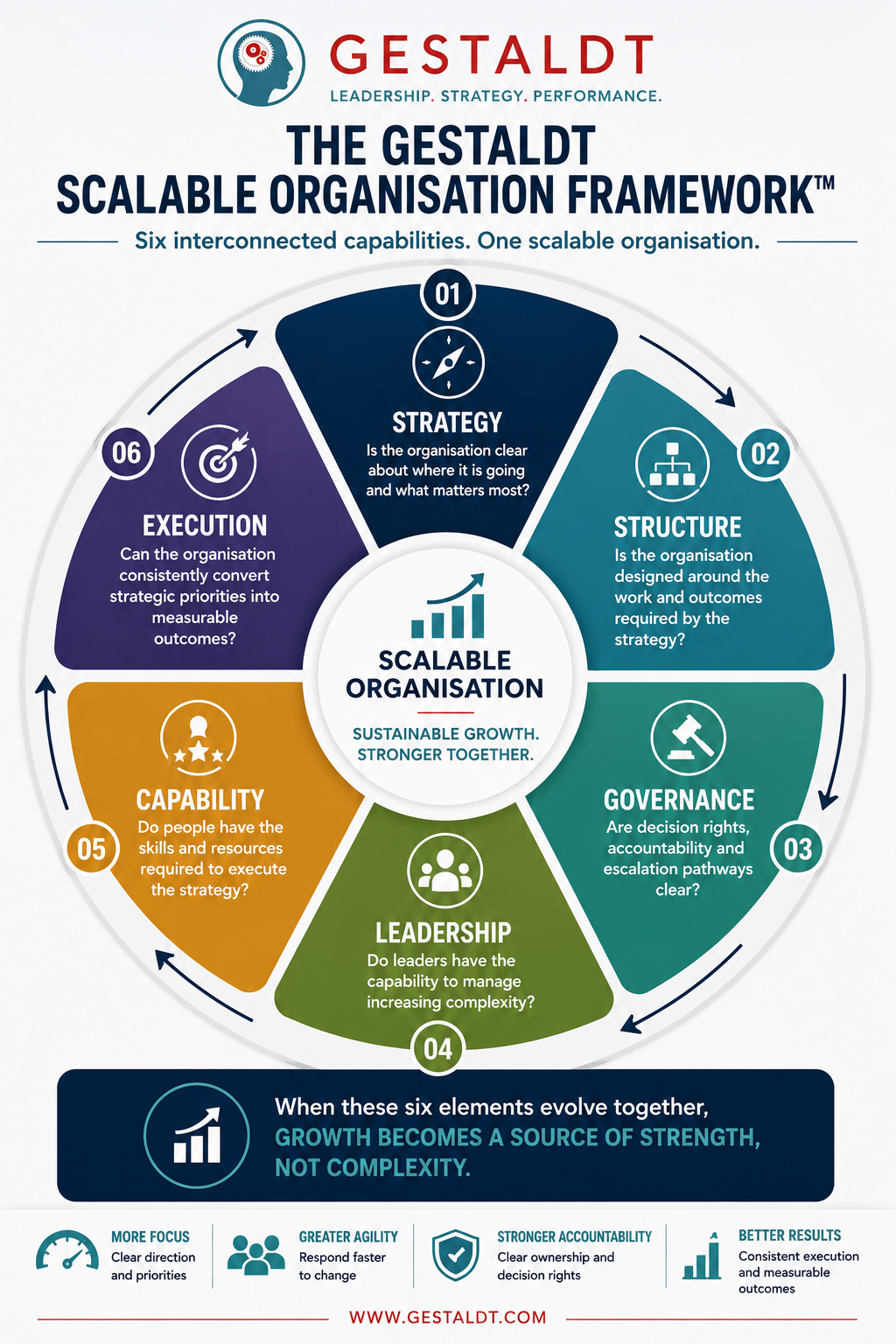
The Gestaldt Scalable Organisation Framework™ shows how strategy, structure, governance, leadership, capability, and execution work together to create a more agile, accountable, and scalable organisation.
The Scalability Stress Test
How scalable is your organisation?
Rate each statement from 1 (Strongly Disagree) to 5 (Strongly Agree).
Decision-making remains fast as the organisation grows.
Roles and responsibilities are clearly defined.
Strategic priorities are understood across the organisation.
Leaders have sufficient authority to make decisions.
Our structure supports cross-functional collaboration.
Accountability remains clear as complexity increases.
Our leadership pipeline is strong enough to support future growth.
We can add customers without proportionally increasing organisational complexity.
Our governance enables rather than slows execution.
Our operating model can adapt as strategy changes.
Your Score
40–50 — Scalable
Your organisation has strong foundations for sustainable growth.
30–39 — Emerging complexity
Your current operating model may soon begin constraining performance.
Below 30 — Growth risk
Structural and leadership issues may already be limiting scalability.
The CEO's Growth Trap: Fixing Symptoms Instead of the System
When growth slows, CEOs often look for an immediate answer.
Hire more people.
Add technology.
Restructure.
Launch another initiative.
Increase sales.
Cut costs.
But these interventions can treat symptoms without addressing the underlying system.
For example:
Slow decisions → add another approval process.
The result?
Even slower decisions.
Poor accountability → create another reporting dashboard.
The result?
More reporting but not necessarily better ownership.
Weak collaboration → create another committee.
The result?
More coordination.
The better question is:
What about the way our organisation is designed is producing this outcome?
That shift—from fixing symptoms to understanding the system—is one of the most important transitions a growing organisation can make.
Organisational Design Is a Strategic Decision
Organisational design is sometimes treated as an HR exercise.
It shouldn't be.
Structure determines:
Who makes decisions.
Where information flows.
How resources are allocated.
Who owns outcomes.
How quickly teams respond.
How effectively strategy is executed.
In other words:
Organisation design determines how strategy becomes reality.
This is particularly important in volatile markets, where slow-moving organisations can struggle to respond quickly. Gestaldt's current Insights content similarly emphasises organisational agility, simplified decision-making and capability building as important drivers of sustainable growth.
A Better Way to Think About Scaling
Don't ask:
"How do we build a bigger version of the organisation we have today?"
Ask:
"What organisation will our next stage of strategy require?"
That distinction changes everything.
Your future organisation may require:
Fewer management layers.
Greater decision authority.
New leadership capabilities.
Different customer-facing structures.
More cross-functional teams.
New governance mechanisms.
Different performance measures.
The goal isn't simply to replicate today's organisation at a larger scale.
It is to design the organisation for tomorrow's strategy.
Five Questions Every CEO Should Ask Before the Next Growth Phase
1. What has become unnecessarily complicated?
Look beyond organisational charts.
Examine processes, meetings, approvals and decision pathways.
2. Where does accountability become blurred?
Find the points where multiple functions share responsibility but nobody owns the outcome.
3. Which decisions are unnecessarily centralised?
Identify where senior leaders are acting as bottlenecks.
4. What capabilities will the next stage of growth require?
Don't develop people for today's organisation alone.
5. Can our current operating model execute our future strategy?
If the answer is no, redesign before growth exposes the weakness.
From Growth to Scalable Performance
Growth is not the finish line.
It is a test.
It tests leadership.
It tests culture.
It tests governance.
It tests capability.
It tests whether the organisation can maintain execution as complexity increases.
The organisations that scale successfully understand a simple principle:
Growth requires organisational evolution.
The structure that worked at one stage may become a constraint at the next.
The leadership practices that worked when the organisation was smaller may no longer be sufficient.
The governance mechanisms that created control may eventually create friction.
The challenge for CEOs is knowing when to evolve—and what to change.
Is Your Organisation Designed for Its Next Stage of Growth?
If growth is creating slower decisions, greater complexity, unclear accountability or increasing pressure on your leadership team, the problem may not be your strategy.
It may be the organisation's ability to support it.
Request a Gestaldt Organisational Scalability Assessment
Gestaldt can help your executive team assess:
Organisational structure
Operating model effectiveness
Leadership capability
Decision rights
Governance
Accountability
Strategic alignment
Organisational complexity
Future capability requirements
Execution capacity
The objective isn't simply to restructure.
It is to design an organisation capable of delivering your next stage of growth.