AI Isn't the Strategy: Why Most Organisations Are Struggling to Turn AI Investment Into Business Value

Your Organisation May Have an AI Problem That Technology Can't Solve
AI has moved from the technology department into the boardroom.
CEOs are asking how it will reshape their workforce.
CFOs want to understand the return on investment.
COOs want productivity gains.
CMOs are experimenting with generative AI.
HR leaders are considering how jobs and capabilities will change.
Boards want to know whether competitors are moving faster.
And across the organisation, employees are already using AI—sometimes officially, sometimes unofficially.
The technology is moving quickly.
But organisations aren't.
McKinsey's 2025 research found that 88% of respondents said their organisations were using AI in at least one business function, while only 7% reported that AI had been fully scaled across the organisation.
That gap tells us something important.
AI adoption is not the same as AI transformation.
Buying technology is relatively easy.
Creating an organisation capable of using it effectively is much harder.
And that is where many AI strategies are beginning to break down.
The AI Adoption Trap
Here's the uncomfortable truth:
Your organisation doesn't need another AI pilot. It needs an AI operating model.
Many organisations are running multiple experiments simultaneously.
Marketing has one.
HR has another.
IT has several.
Customer service is testing a chatbot.
Finance is experimenting with automation.
Executives are using AI assistants.
Everyone is busy.
Yet the organisation isn't necessarily becoming more intelligent, productive or competitive.
This creates what we might call the AI Adoption Trap:
More experimentation → more activity → more technology → little organisational change.
The problem isn't a lack of enthusiasm.
It's a lack of integration.
AI needs to connect to strategy, leadership, governance, people, processes and measurable business outcomes.
Otherwise, it remains a collection of disconnected tools.
1. Your AI Strategy May Be Starting With Technology Instead of Business Problems
This is where many organisations go wrong.
They discover a powerful AI capability and then ask:
"What can we use this for?"
A stronger strategic question is:
"What business problem are we trying to solve?"
That distinction matters.
AI can potentially:
Reduce operating costs.
Improve customer experience.
Accelerate decision-making.
Increase productivity.
Strengthen forecasting.
Improve knowledge management.
Accelerate innovation.
Create new products and services.
But not every AI application creates meaningful value.
McKinsey's research found that organisations achieving the strongest AI impact are more likely to pursue transformative ambitions, redesign workflows and scale AI faster.
The CEO Question
Which three business outcomes could AI materially improve over the next 12–24 months?
Start there.
Not with the technology.
Practical Tip
Create an AI opportunity map that ranks potential use cases according to business value, feasibility, risk and strategic importance.
2. AI Cannot Transform a Process That Was Already Broken
Here's a common misconception:
Automation automatically creates efficiency.
It doesn't.
If an organisation has a fragmented, bureaucratic or inefficient process, adding AI may simply make the bad process faster.
The organisation hasn't transformed.
It has automated complexity.
Before introducing AI, ask:
Why does this process exist?
Who owns it?
Where are the bottlenecks?
Which steps add value?
Which steps exist because of historical decisions?
Where are customers experiencing friction?
Then ask:
"If we redesigned this process from scratch using AI capabilities, what would it look like?"
That's a transformation question.
3. Leadership Is the Missing AI Capability
AI transformation is often presented as a technology challenge.
Increasingly, it's a leadership challenge.
Executives need to decide:
Where AI should be used.
Where it should not be used.
Which capabilities need to be developed.
Which processes should be redesigned.
How investment should be prioritised.
What risks are acceptable.
How performance should be measured.
Deloitte's research found that C-suite leaders need to redefine aspects of their roles around GenAI while maintaining alignment between technical and business leadership.
The CEO doesn't need to become an AI engineer.
But the CEO does need enough understanding to ask the right strategic questions.
Practical Tip
Create an AI leadership agenda with five standing questions:
Where are we creating value?
Where are we reducing risk?
What capabilities are we building?
What work should be redesigned?
What evidence shows that AI is improving performance?
4. Your Workforce Isn't Resisting AI—It May Be Resisting Uncertainty
This distinction is critical.
When employees hesitate to adopt AI, leadership may describe them as resistant to change.
But employees may actually be asking:
Will my role change?
Will my skills remain valuable?
How will performance be measured?
What am I allowed to use AI for?
Who is accountable when AI gets something wrong?
Will AI replace my job?
Those aren't resistance questions.
They're organisational design questions.
Deloitte's research identified talent and skills as major barriers to GenAI adoption and found that only 22% of surveyed leaders considered their organisations highly or very highly prepared to address talent-related GenAI issues.
Practical Tip
Don't launch AI adoption without a workforce transition plan covering skills, roles, communication, training, governance and leadership expectations.
5. Governance Can Either Accelerate AI—or Kill It
Here's the balancing act.
Too little governance creates risk.
Too much governance creates paralysis.
Organisations need enough control to protect:
Data
Privacy
Intellectual property
Customers
Employees
Reputation
Regulatory compliance
But governance must also enable responsible experimentation.
Deloitte's 2025 research found regulatory compliance had become a leading barrier to GenAI deployment, while many organisations were still taking more than a year to establish mature governance foundations.
The answer isn't to eliminate governance.
It's to make governance proportionate, clear and fast.
Practical Tip
Create three AI governance categories:
Green: Low-risk use cases that employees can use within clear guidelines.
Amber: Higher-risk applications requiring review.
Red: Applications requiring executive or specialist approval.
This gives employees clarity without creating unnecessary bureaucracy.
6. AI Transformation Fails When Nobody Owns the Outcome
This is perhaps the most important issue.
Who owns AI?
The CIO?
The CTO?
The Chief Digital Officer?
The CEO?
The business units?
The answer cannot simply be "IT."
AI changes how the business works.
Therefore, accountability must sit across the organisation.
Technology leaders should own technology architecture.
Risk leaders should own risk controls.
HR should help lead workforce transformation.
But business leaders must own the business outcomes.
Otherwise AI becomes another technology programme rather than a transformation agenda.
The Gestaldt AI Transformation Framework™
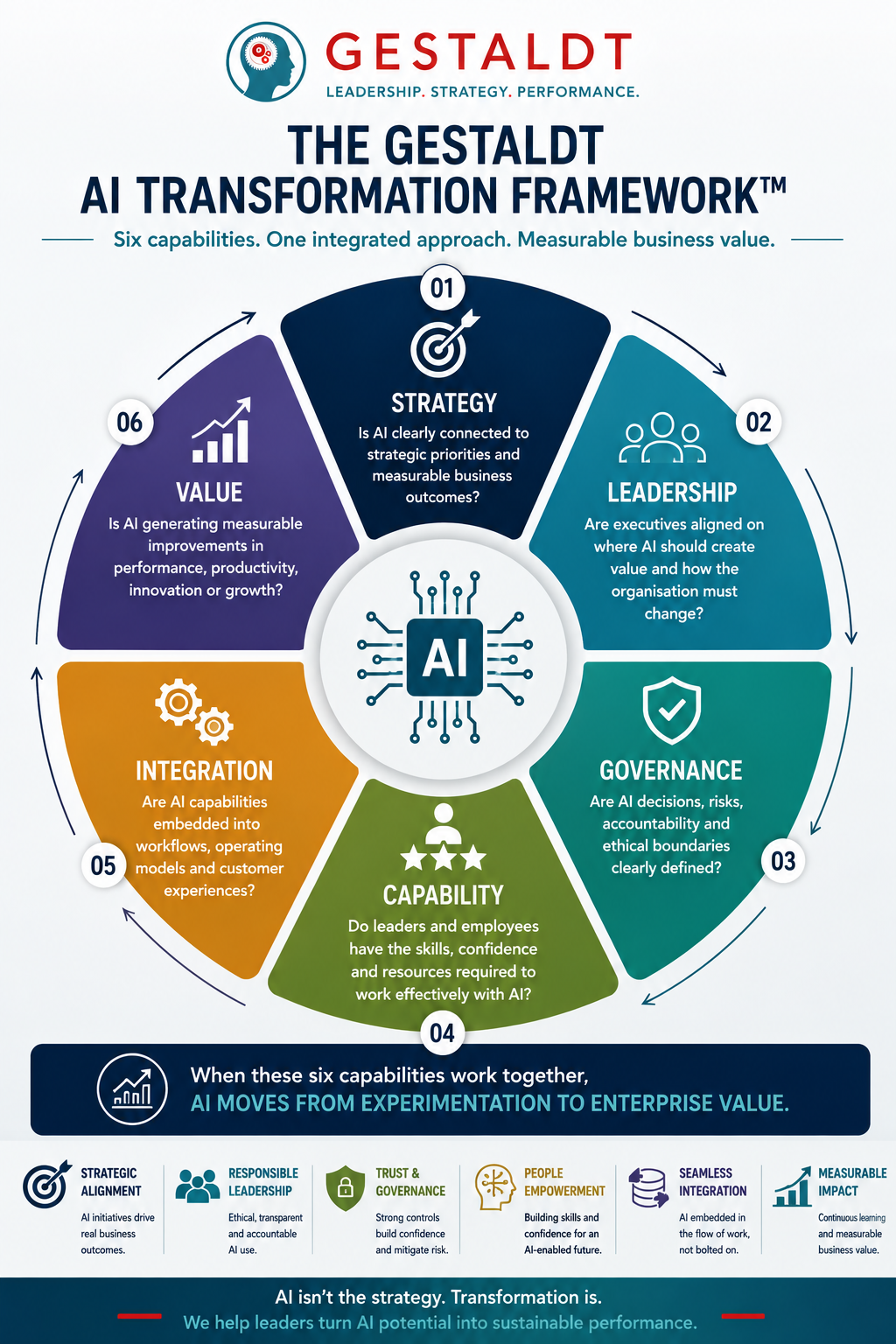
The Gestaldt AI Transformation Framework™ connects strategy, leadership, governance, capability, integration and value to help organisations turn AI potential into sustainable business performance.
The AI Transformation Readiness Test
Your executive team can use the following quick diagnostic.
Rate each statement from 1 (Strongly Disagree) to 5 (Strongly Agree).
Our AI initiatives are directly linked to strategic priorities.
We have identified the business problems where AI can create the greatest value.
The executive team has a shared AI vision.
AI decision rights and governance are clearly defined.
Employees understand how AI will affect their roles.
We are actively developing AI-related capabilities.
Our core workflows are being redesigned rather than simply automated.
AI initiatives have clear business owners.
We measure AI according to business outcomes rather than activity.
We have a clear roadmap for scaling successful AI initiatives.
Your Score
40–50 — AI-ready organisation
Your organisation has strong foundations for scaling AI strategically.
30–39 — Emerging readiness
You have promising foundations, but gaps may prevent consistent enterprise-wide value.
Below 30 — Transformation risk
Your organisation may be investing in AI faster than it is building the capabilities required to use it effectively.
The Difference Between AI Adoption and AI Transformation
The distinction is simple.
AI Adoption
Employees use AI tools.
AI Transformation
The organisation changes how work gets done because of AI.
That could mean:
Redesigning customer journeys.
Rebuilding operating processes.
Changing decision-making.
Creating new products.
Redefining roles.
Developing new leadership capabilities.
Changing performance measures.
Reallocating resources.
The technology is only the catalyst.
The organisation is the transformation.
The CEO's Five AI Questions
Before approving another AI initiative, ask:
1. What business outcome will this change?
If the answer is unclear, reconsider the investment.
2. What process or operating model must change?
AI rarely creates sustainable value when the organisation refuses to change the way work is done.
3. Who owns the business result?
Technology ownership isn't enough.
4. What capabilities will our people need?
Adoption depends on confidence as much as technology.
5. How will we know it worked?
Define measurable outcomes before launching the initiative.
Don't Build an AI Portfolio. Build an AI-Powered Organisation.
This is the strategic shift CEOs need to make.
The goal isn't to have the most AI tools.
It isn't to run the most pilots.
It isn't to announce the biggest AI investment.
The real competitive advantage comes from building an organisation that can identify opportunities, make disciplined decisions, redesign work, develop people and scale what works faster than competitors.
That is an organisational capability.
And capabilities are built deliberately.
AI Will Reward Organisations That Can Change
Technology is accelerating.
The organisations that benefit most won't necessarily be those with the biggest technology budgets.
They will be those capable of changing quickly enough to capture the value technology creates.
McKinsey's 2026 research describes AI, economic uncertainty, geopolitical fragmentation and changing workforce expectations as forces reshaping how organisations create value and sustain performance.
The strategic question for CEOs is therefore no longer:
"Should we adopt AI?"
That question has largely been answered.
The better question is:
"Are we organisationally capable of turning AI into sustainable competitive advantage?"
That is the question that belongs in the boardroom.
Is Your Organisation Ready to Turn AI Into Business Value?
If your organisation is investing in AI but struggling to move beyond pilots, isolated experiments or productivity improvements, the problem may not be your technology.
It may be your strategy, leadership, governance, capability or operating model.
Request a Gestaldt AI Transformation Readiness Assessment
Gestaldt can help your executive team assess:
AI strategic alignment
Executive readiness
AI governance
Workforce capability
Operating-model implications
Workflow redesign
Change readiness
Accountability
AI scaling capability
Business-value measurement
The objective isn't simply to help your organisation adopt AI.
It is to build the organisational capability required to turn AI into measurable business performance.