

The Performance Blind Spot: How CEOs Can Detect Business Problems Earlier
The Gestaldt Performance Intelligence Framework™ connects Strategy, Leadership, Workforce, Organisation, Enablement, and Execution into one integrated system—helping leaders turn organisational capability into measurable, sustainable performance.

Your Dashboard May Be Telling You the Truth—and Still Hiding the Problem
A business can hit its revenue target while losing customers.
It can increase productivity while exhausting its managers.
It can deliver quarterly profit while its pipeline weakens.
It can complete transformation projects while adoption remains poor.
It can report strong employee performance while critical capabilities are quietly disappearing.
And by the time the financial numbers reveal the problem, the organisation may already be paying the price.
This is the performance blind spot.
Many leadership teams are excellent at measuring what happened but less effective at detecting what is likely to happen next.
Think of it like driving a car by looking only in the rear-view mirror.
The mirror is useful. You absolutely need it.
But it cannot tell you what is around the next corner.
That is why CEOs need a performance system that combines lagging indicators with leading indicators—financial results with the operational, customer, workforce and strategic signals that influence future performance.
Gestaldt has long highlighted this distinction, noting that organisations often rely heavily on lagging measures while stronger performance-management systems also monitor critical process inputs early enough to influence outcomes.
The challenge is particularly relevant now. Survey, based on 4,454 CEOs across 95 countries and territories, found that CEOs are balancing short-term threats with longer-term reinvention, while major shifts in technology, AI, geopolitics and business models continue to reshape the competitive environment.
The question for leaders is therefore not simply:
"How did we perform?"
It is:
"What is today's performance telling us about tomorrow?"
1. The Numbers Can Look Healthy Right Before the Warning Signs Become Obvious
Here's the trap: financial performance is essential, but it is often late.
Revenue, profit, EBITDA and cash flow tell leadership whether value has already been created.
They don't always tell you why performance is changing—or whether the current trajectory is sustainable.
Imagine three companies reporting identical quarterly revenue.
Company A has:
growing customer retention;
improving sales conversion;
strong employee engagement;
rising productivity;
a healthy innovation pipeline.
Company B has:
stable retention;
declining sales conversion;
rising employee turnover;
slower decision-making;
weakening pipeline quality.
Company C has:
declining retention;
heavy discounting;
growing operational costs;
increasing absenteeism;
stalled strategic initiatives.
Their financial statements may look similar today.
Their future situations are not.
This is why a sophisticated performance system distinguishes between outcomes and drivers.
Research found that only 32% of executives said their performance-management approach enabled timely, high-quality talent decisions about high and low performers.
The quote that matters
Satya Nadella, CEO of Microsoft, described the distinction between current performance and future performance through what he called “performance metrics” and “power metrics”, with the latter focused on leading indicators such as usage and customer satisfaction.
Practical Tip
For every major financial KPI, identify at least one leading indicator that influences it.
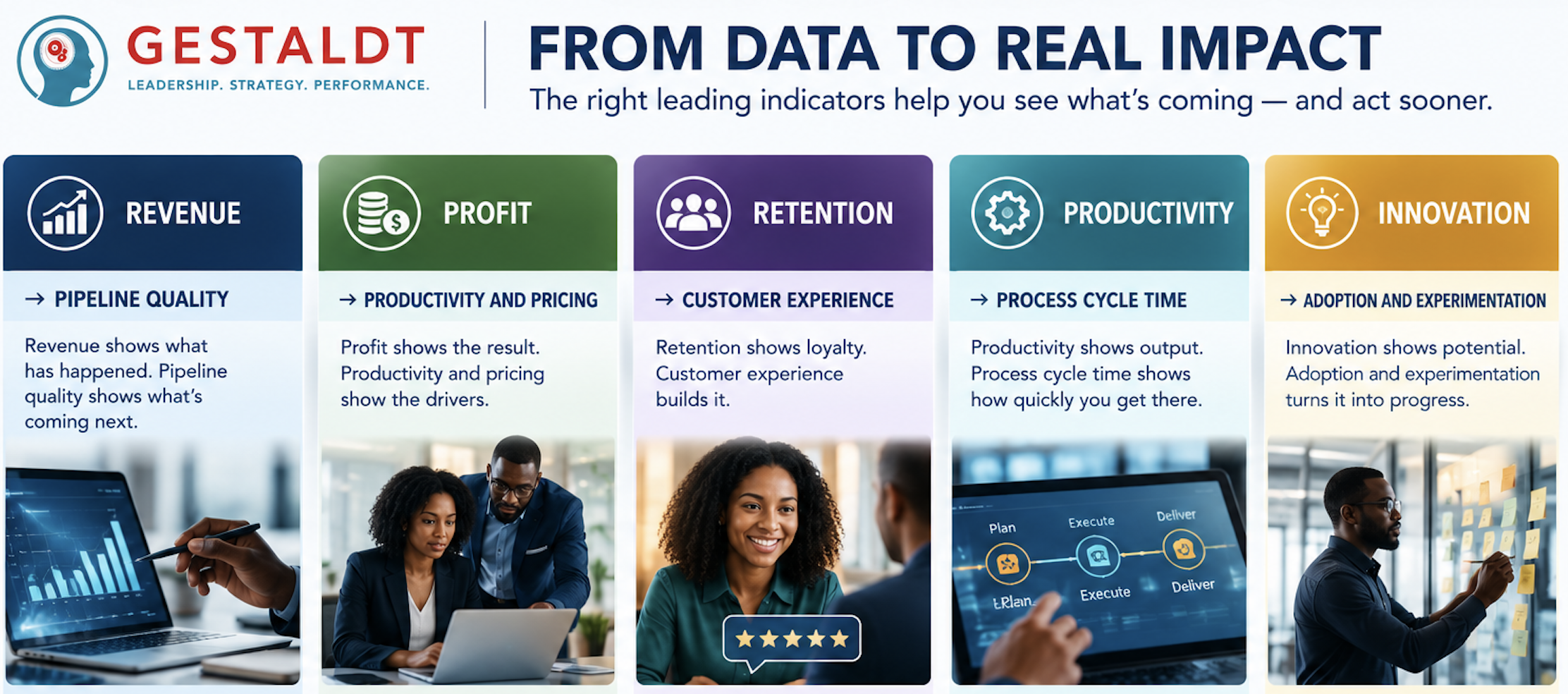
Don't throw away the financial measures.
Add the signals that explain where they are heading.
2. Stop Asking "Are We On Target?" and Start Asking "What's Moving?"
A target tells you where you want to go. A leading indicator tells you whether the system is moving in the right direction.
This distinction can completely change an executive dashboard.
Consider customer retention.
A traditional dashboard might show:
Annual retention: 91%
That looks reassuring.
But a more diagnostic dashboard might also show:
customer complaints +18%;
response time +11%;
renewal conversations delayed;
NPS declining;
service escalations increasing.
Suddenly, the 91% figure looks less reassuring.
The organisation isn't necessarily in trouble.
But the drivers of future retention are moving.
That is the information executives need early.
Gestaldt's research on performance management specifically recommends combining lagging indicators with process inputs so organisations can respond before variations damage output or quality.
The quote that matters
Tufan Erginbilgiç, CEO of Rolls-Royce, has described performance improvement as part of strategy implementation and emphasised the importance of a granular strategy that makes performance visible throughout the organisation.
Practical Tip
Review your executive dashboard and classify every KPI as:
Lagging: tells us what happened.
Leading: signals what is likely to happen.
Diagnostic: helps explain why it is happening.
If most of your dashboard is lagging, you have a reporting system.
You may not yet have a performance-management system.
3. Your Strategy Needs a Performance Translation Layer
A strategy fails when it stays at the level of ambition.
"Become more customer-centric."
"Expand internationally."
"Improve productivity."
"Accelerate innovation."
"Build a digital organisation."
These statements may be strategically sound.
But they are not yet measurable enough to drive behaviour.
The missing layer is translation.
For example:
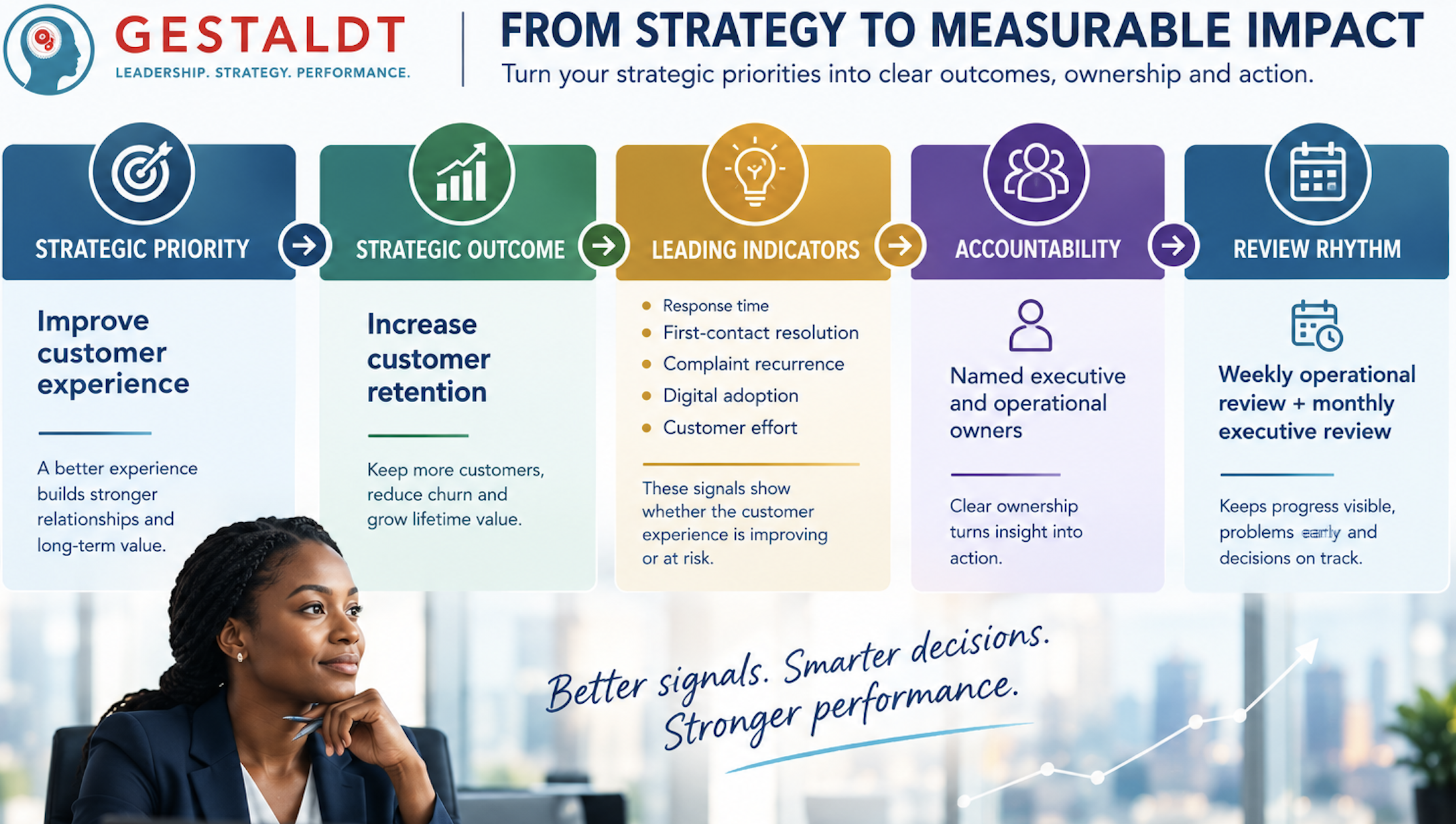
Now strategy has become executable.
Gestaldt's 2025 research on strategy found that only one in five companies surveyed believed they had a high-quality strategy, while stronger performers were distinguished by their ability to mobilise execution behind strategic choices.
The quote that matters
Erginbilgiç argues that a “granular strategy” becomes a tool for alignment and engagement because people can see their role in transformation.
Practical Tip
For every strategic priority, complete this sentence:
"We will know this strategy is working when..."
Then identify:
the desired outcome;
two or three leading indicators;
the accountable owner;
the review cadence;
the intervention trigger.
That creates a bridge between strategy and performance.
4. When Everyone Is Busy, Activity Can Easily Be Mistaken for Performance
This is one of the most expensive illusions in management: confusing activity with impact.
A transformation office reports that 27 initiatives are underway.
HR reports that 4,000 employees completed training.
Technology reports that a new platform has gone live.
Operations reports that 15 processes have been redesigned.
Everyone is busy.
But what changed?
Did decision-making improve?
Did customers notice?
Did productivity increase?
Did employees actually adopt the new system?
Did costs fall?
Did revenue improve?
Did strategic execution accelerate?
Research found that 64% of workers surveyed considered performance reviews a waste of time that did not help them perform better.
The lesson extends beyond performance reviews.
Measurement becomes counterproductive when people learn to optimise for what is easiest to report rather than what matters most.
The quote that matters
Dania Nourallah described the required shift as “a mindset shift—from controlling systems to empowering people.”
That means measurement should help people make better decisions—not simply give leaders more numbers.
Practical Tip
For every activity metric, add an outcome question.
Training completed → What capability improved?
Projects delivered → What business outcome changed?
Meetings held → What decision was made?
Automation implemented → What productivity improved?
Customers contacted → What behaviour changed?
If you cannot connect activity to value, reconsider the metric.
5. Performance Problems Often Begin With Weak Accountability
A metric without ownership is just information.
Leadership teams sometimes have impressive dashboards filled with targets, traffic lights and trend lines.
Yet when performance deteriorates, the conversation becomes:
"Someone needs to address this."
Who?
That's where the problem begins.
A strong performance system makes four things explicit:
What matters?
Who owns it?
What evidence shows progress?
What happens when performance moves off course?
Research on organisational execution identifies accountability, coordination and control, capabilities, and motivation as four elements that help organisations convert strategy into results. It reports that 44% of organisations lose momentum during redesign efforts and about one-third fail to deliver after implementation.
The quote that matters
Erginbilgiç described Rolls-Royce's approach as using a detailed view of strategic initiatives to identify where intervention was needed, rather than assuming initiatives already on track required the same executive attention as those falling behind.
Practical Tip
Every strategic KPI should have:
one accountable owner;
a defined target;
a leading indicator;
a reporting frequency;
a clear intervention threshold.
Don't assign accountability to a committee.
Committees can govern.
Individuals must own outcomes.
6. The Best Performance Systems Create Better Decisions, Not Bigger Dashboards
The purpose of measurement isn't measurement. It's action.
This is where many executive dashboards go wrong.
They contain too much information.
Revenue by region.
Sales by product.
Customer complaints.
Employee turnover.
Project status.
Cost variance.
Productivity.
Cash.
Margins.
Risk.
Innovation.
AI adoption.
The leadership team receives 80 pages of information and leaves the meeting with three unresolved decisions.
That is not performance intelligence.
It is data accumulation.
CEOs are navigating a tension between short-term pressures and longer-term reinvention. They are spending substantial attention on near-term issues while still needing to invest in capabilities and business-model changes that shape longer-term competitiveness.
That makes executive attention a scarce resource.
Your performance system should therefore answer three questions:
What changed?
The signal.
Why did it change?
The diagnosis.
What are we going to do?
The decision.
The quote that matters
The current environment demands that leaders must balance short-term pressure with long-term reinvention, with competitive advantage increasingly linked to how organisations adapt as technology, AI and talent are reconfigured.
Practical Tip
Redesign executive performance reviews around decisions, not presentations.
For every red or deteriorating metric, require:
Signal → Cause → Decision → Owner → Deadline → Expected impact
That turns performance reporting into performance leadership.
The Gestaldt Performance Intelligence Framework™
At Gestaldt, we believe performance should function like an organisational nervous system.
It should detect movement.
Interpret signals.
Trigger decisions.
And enable action before small problems become major performance failures.
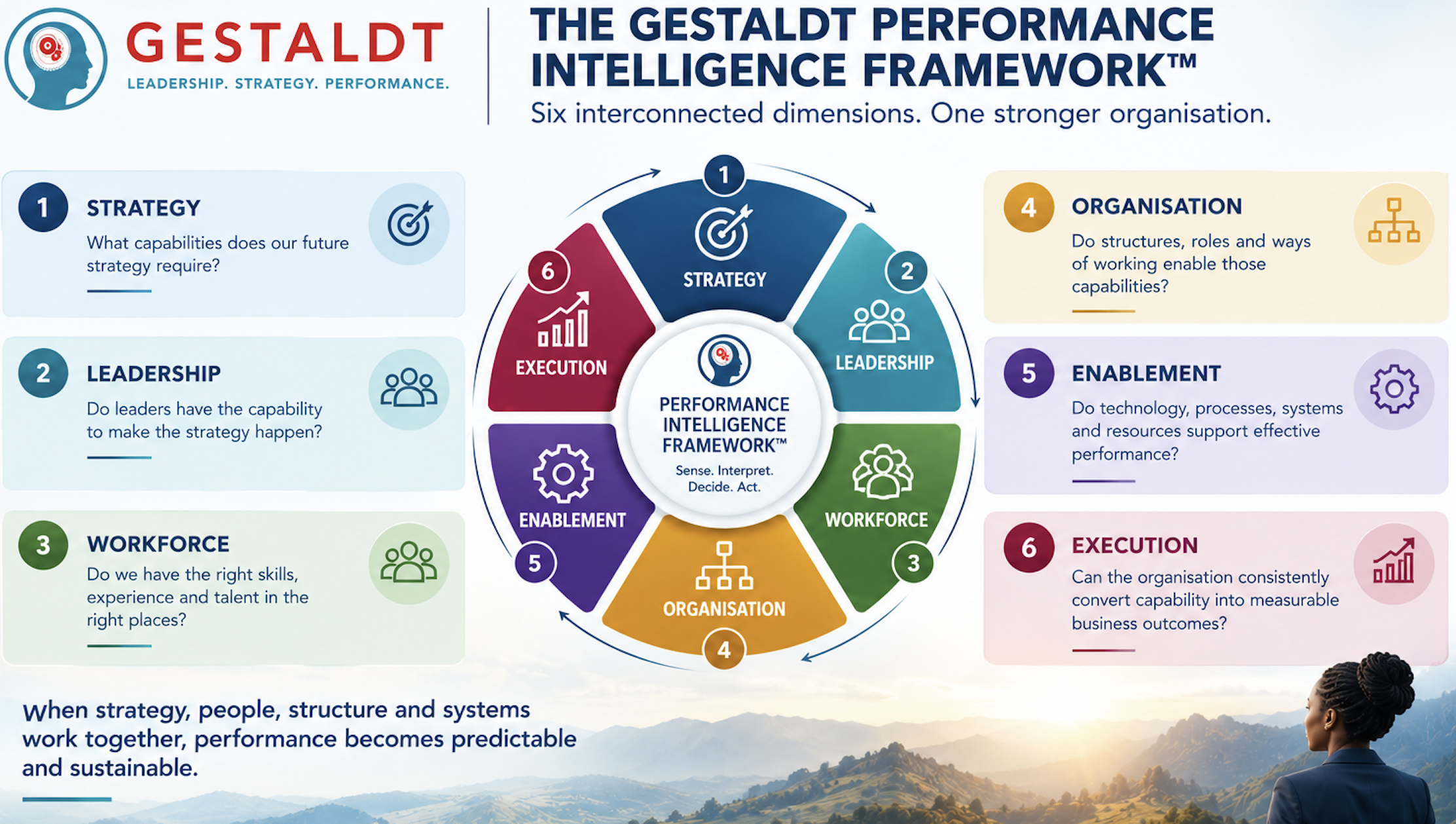
The model is deliberately broader than traditional KPI management.
Because performance does not improve simply because you measure it.
It improves when measurement leads to better decisions, clearer accountability, stronger capability and faster adaptation.
The CEO Performance Blind Spot Test
Score each statement from 1 to 5:
1 = strongly disagree
5 = strongly agree
Our executive dashboard contains meaningful leading indicators.
We can identify emerging performance problems before financial results deteriorate.
Every strategic priority has measurable outcomes.
Every critical outcome has a clearly accountable owner.
Our KPIs measure value rather than activity alone.
Managers understand which metrics they can influence directly.
Performance data regularly triggers executive decisions.
We can distinguish symptoms from underlying causes.
Our performance measures are connected to organisational capability.
We change measures when strategic priorities change.
Your Score
40–50: Performance intelligence is embedded
Your organisation has a strong foundation for proactive performance management.
30–39: Performance visibility is developing
You may have useful measurement, but important blind spots could remain.
Below 30: Performance blind-spot risk
Your organisation may be relying too heavily on lagging results or activity-based measurement.
The score is a diagnostic starting point—not a substitute for a deeper organisational assessment.
From Reporting Performance to Leading Performance
The modern CEO does not need more numbers.
They need better signals.
A performance system should make it easier to see:
where the organisation is heading;
what is changing;
why it is changing;
who needs to act;
what decision is required;
and whether the intervention is working.
That changes the role of performance management completely.
It moves from:
reporting → sensing
measuring → diagnosing
reviewing → deciding
managing activity → creating value
And that shift matters because organisations increasingly operate in environments where yesterday's performance provides only partial guidance about tomorrow's opportunity.
As Mohamed Kande put it, “The future belongs to the bold.”
Bold leadership, however, does not mean reckless leadership.
It means having enough visibility to act before the opportunity—or the problem—becomes obvious to everyone else.
The CEO's Five Questions
At your next executive performance meeting, ask:
1. What is improving?
Not just financially—but operationally, strategically and organisationally.
2. What is deteriorating?
Look for small movements before they become large problems.
3. What leading indicators are changing?
This is where future performance begins to reveal itself.
4. What are we doing about it?
Every significant signal should lead to a decision or deliberate choice not to intervene.
5. What are we not measuring?
This final question is often the most revealing.
Because the biggest performance blind spot may be the thing that isn't on the dashboard.
Conclusion: Don't Wait for the Numbers to Become Obvious
A strong organisation doesn't wait for declining revenue to discover that customers are unhappy.
It doesn't wait for productivity to collapse before examining process friction.
It doesn't wait for strategic initiatives to fail before asking whether people have the capability to execute them.
And it doesn't wait for a crisis before changing direction.
It learns to see earlier.
The future of performance management is not about producing more reports.
It is about creating an organisational system that can sense, interpret, decide and adapt.
Your financial results still matter.
Your KPIs still matter.
Your dashboards still matter.
But the real competitive advantage comes from knowing what those numbers are telling you before they become yesterday's news.
Measure what matters. Detect what is changing. Decide sooner. Act with purpose.
Ready to Identify Your Organisation's Performance Blind Spots?
Gestaldt can help executive teams assess whether their current performance systems provide the visibility, accountability and strategic intelligence required to improve execution.
Request a Gestaldt Performance Intelligence Assessment™
Assess:
Strategic KPIs
Leading and lagging indicators
Executive dashboards
Accountability
Performance culture
Organisational capability
Decision-making
Strategy-to-performance alignment
Assess Your Performance Intelligence

The Capability Gap: Why Your Strategy May Be Asking More of Your Organisation Than It Can Deliver
Diverse Black and white C-suite leadership team assessing the capabilities required to execute a strategic growth roadmap, including leadership, workforce, technology, organisational design and execution readiness.

Your Strategy Is Only as Strong as the Capabilities Behind It
A brilliant strategy can look impressive on a boardroom screen and still fail spectacularly in the real world.
Why?
Because strategy creates demand.
Your organisation must supply the capability to meet it.
Imagine putting a powerful engine into a vehicle without upgrading the transmission, tyres, brakes or fuel system. The engine may be exceptional, but the vehicle cannot safely convert that power into performance.
That is what happens when strategy outruns organisational capability.
A company decides to enter new markets—but doesn't have leaders with international experience.
It launches an AI strategy—but employees lack the skills to redesign workflows.
It promises customer-centricity—but incentives still reward internal efficiency.
It targets rapid growth—but its managers are already overloaded.
It invests in transformation—but nobody has the capability to embed the new way of working.
This is the capability gap: the distance between what the strategy requires and what the organisation is currently capable of delivering.
And it is becoming a more urgent CEO issue.
PwC's 2026 Global CEO Survey found that 22% of CEOs say their businesses are highly exposed to a lack of key skills, while nearly a quarter say talent shortages are already inhibiting performance.
The strategic question, therefore, is not simply:
"Do we have a good strategy?"
It is:
"Do we have the organisational capability to make this strategy real?"
1. Your Strategy May Be Ahead of Your Organisation
Here's the first warning sign: the strategy sounds achievable until you ask who will actually deliver it.
Consider a business with an ambitious three-year strategy.
It wants to:
expand into new markets;
digitise customer experiences;
introduce AI;
improve operational productivity;
develop new products;
strengthen innovation;
become more data-driven.
On paper, it sounds compelling.
Then leadership asks:
Who has the skills to do this?
Suddenly, the gaps become visible.
The organisation may lack:
digital leadership;
data capabilities;
commercial skills;
change leadership;
product development expertise;
strategic project management;
cross-functional collaboration;
experienced middle managers.
This is why capability assessment should happen before major strategic commitments are made—not after implementation begins.
McKinsey describes execution as requiring four critical elements, including capabilities, alongside accountability, coordination and motivation. Its research notes that 44% of organisations lose momentum during redesign efforts and roughly one-third fail to deliver after implementation.
Practical Tip
For every major strategic priority, create a simple question:
"What capabilities must be true for this strategy to succeed?"
Then compare that requirement with your current reality.
That gap is your starting point.
2. The Skills Gap Is Bigger Than Training Can Fix
Sending employees on courses won't automatically close a strategic capability gap.
This is where organisations often get stuck.
A capability gap is not simply:
"Our people need more training."
It may actually involve five different problems:
Knowledge — People don't know what to do.
Skill — They know what to do but can't consistently perform it.
Experience — They haven't applied the capability in sufficiently complex situations.
Systems — The organisation's processes and technology make the desired behaviour difficult.
Leadership — Leaders aren't reinforcing or modelling the new capability.
Deloitte's 2025 Global Human Capital Trends research found that 66% of managers and executives said their most recent hires were not fully prepared for their roles, with experience identified as the most common weakness.
That finding matters because experience cannot always be solved by putting someone through a classroom programme.
People need opportunities to apply knowledge under real-world conditions.
They need feedback.
They need increasingly difficult assignments.
They need leaders who create space for learning.
Practical Tip
When you identify a capability gap, ask five questions:
Is this a knowledge problem?
Is it a skill problem?
Is it an experience problem?
Is it a system or process problem?
Is leadership reinforcing the capability?
The answer determines the intervention.
3. Your Middle Managers May Be the Hidden Capability Constraint
The executive team can approve transformation—but middle management determines how much of it actually happens.
Middle managers translate strategy into daily behaviour.
They decide what gets prioritised.
They allocate attention.
They coach employees.
They resolve conflicts.
They interpret leadership messages.
They make countless decisions that never reach the executive committee.
Yet this layer can become a capability bottleneck as organisations grow.
Deloitte's 2025 research found that 73% of organisations recognise the importance of reinventing the manager role, but only 7% say they are making great progress.
That is a striking gap between recognition and action.
The modern manager increasingly needs to do more than supervise work.
They need to:
develop people;
make decisions amid ambiguity;
lead change;
collaborate across functions;
use technology intelligently;
manage performance;
communicate strategic priorities;
build trust.
Deloitte's research identifies judgement as a particularly important capability for managers operating in increasingly complex environments.
Practical Tip
Don't assess managers solely on current-role performance.
Ask:
"What complexity will this manager need to handle two levels above their current role?"
Then develop accordingly.
4. AI Is Exposing Capability Gaps That Were Already There
AI doesn't just create new skills requirements. It reveals weaknesses in the way organisations work.
An organisation may purchase sophisticated AI technology and discover that employees don't know how to integrate it into their workflows.
Or leadership may announce an AI strategy without redesigning roles.
Or teams may use AI individually while the organisation has no governance, data foundations or operating model to scale it.
PwC's 2026 research found that 14% of workers surveyed use GenAI daily at work, while 22% of CEOs say their businesses are highly exposed to a lack of key skills.
The implication is important:
Technology adoption and capability development cannot be separated.
Gestaldt similarly argues that AI is changing strategy work itself, increasing the importance of skills such as data analysis, creativity, judgement and the ability to translate insights into strategic choices.
So the question isn't:
"How do we train people to use AI?"
It is:
"How does AI change the capabilities our organisation needs?"
That is a much bigger question.
Practical Tip
For every significant technology investment, create a Capability Impact Map:
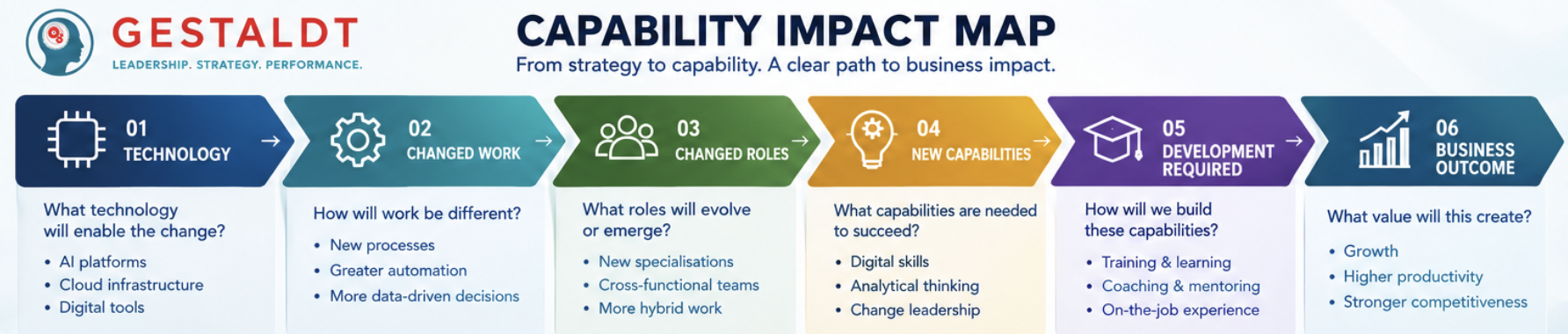
This prevents technology investment from becoming disconnected from organisational readiness.
5. Stop Hiring Your Way Out of Every Capability Problem
Sometimes the answer is new talent. Sometimes it isn't.
When leaders discover capability gaps, recruitment is often the first response.
Hire specialists.
Bring in consultants.
Acquire new talent.
Create a new department.
These can all be appropriate.
But excessive reliance on external hiring can create another problem: the organisation never develops its own capability.
McKinsey's research on strategic workforce planning highlights the value of treating talent with the same strategic discipline applied to financial capital. Its analysis found that S&P 500 companies that excel at maximising return on talent generate 300% more revenue per employee than the median firm.
The broader lesson is that workforce capability should be deliberately designed.
A mature capability strategy combines:
Build — develop existing employees;
Buy — recruit scarce expertise;
Borrow — use partners or external specialists;
Automate — use technology to reduce unnecessary work;
Redesign — change the work itself.
Practical Tip
Before opening a recruitment requisition, ask:
"Should we build, buy, borrow, automate or redesign this capability?"
That one question can significantly improve workforce decisions.
6. Build Capability Around the Strategy—Not Around the Organisation Chart
Your future capability requirements may have very little to do with today's departments.
Traditional workforce planning starts with roles.
CEO.
Finance.
Marketing.
HR.
Operations.
Technology.
But strategy starts with outcomes.
Suppose the organisation's future strategy depends on:
faster innovation;
stronger customer analytics;
international expansion;
digital products;
AI-enabled operations.
Those capabilities may cut across every function.
That means capability building must also cross functional boundaries.
Deloitte's 2025 Human Capital Trends report frames this challenge around three fundamental questions: whether the right work is being done, whether the organisation can access and develop the necessary workforce, and whether the organisation and culture enable performance.
That is a useful shift in perspective.
Instead of asking:
"What people do we need?"
Ask:
"What must the organisation become capable of doing?"
Then work backwards into roles, skills, structures and development.
Practical Tip
Create a Future Capability Map for the next three years.
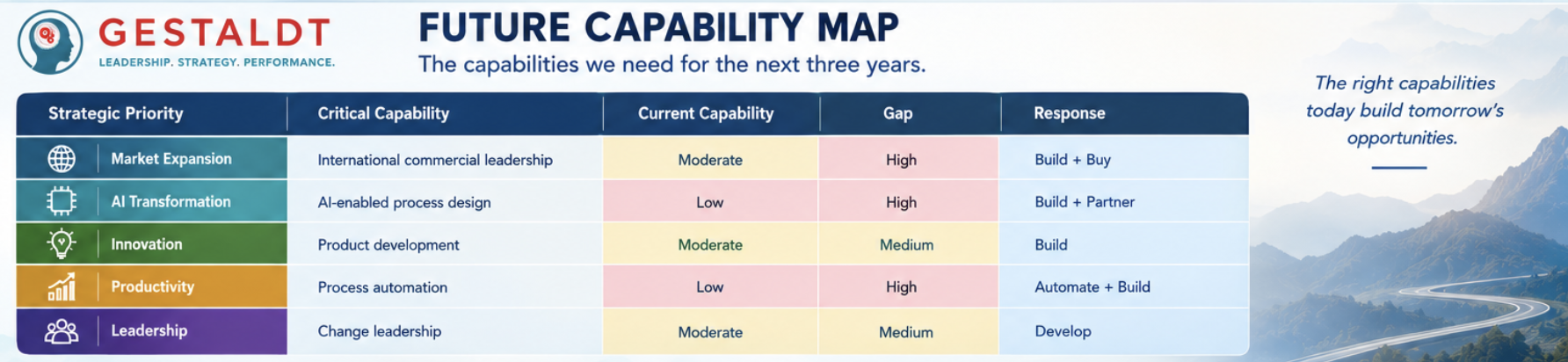
This makes capability a strategic conversation rather than an HR exercise.
The Gestaldt Capability Alignment Framework™
At Gestaldt, we believe capability should be directly connected to strategy.
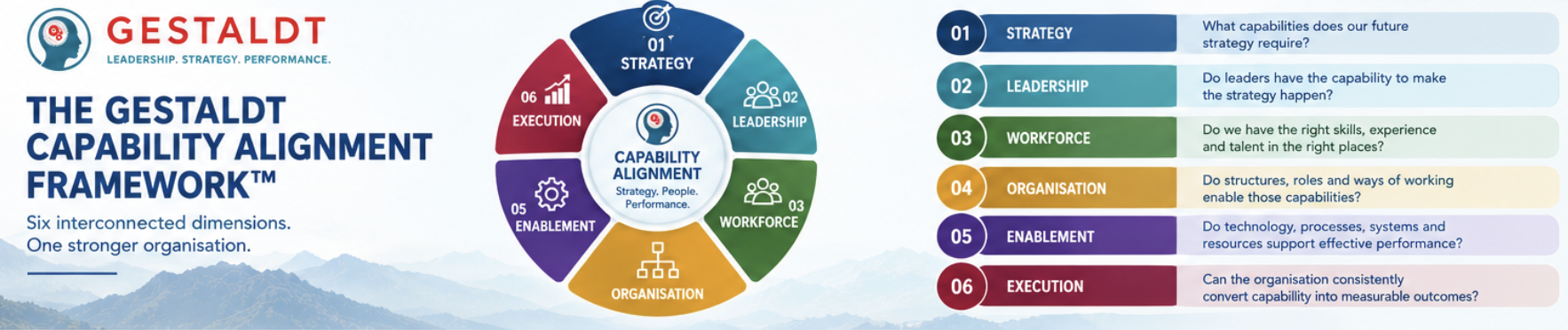
The critical insight is that capability does not sit inside the training department.
It sits across the organisation.
Strategy defines the demand.
Leadership sets the direction.
People provide the capability.
Organisation creates the conditions.
Systems enable performance.
Execution converts it into value.
The CEO Capability Gap Test
Before approving your next major strategic initiative, rate each statement from 1 (strongly disagree) to 5 (strongly agree).
We know which capabilities our future strategy requires.
We have assessed our current capability against those requirements.
We know where our most critical gaps are.
Our executive team has the capability to lead the next phase of growth.
Our middle managers are prepared for increasing complexity.
Employees have meaningful opportunities to build future-critical experience.
Our organisation structure supports the capabilities we need.
Technology and systems enable rather than restrict performance.
Our workforce strategy is directly connected to business strategy.
We can measure whether capability development is improving business outcomes.
Your Score
40–50: Capability aligned
Your organisation has a relatively strong foundation for translating strategy into execution.
30–39: Capability pressure
Important gaps may begin constraining execution as strategic demands increase.
Below 30: Capability risk
Your strategy may be demanding capabilities the organisation is not yet equipped to deliver.
The score is not a substitute for detailed assessment. It is a starting point for an executive conversation.
The Real Question Isn't "Do We Have Good People?"
It's:
"Do we have the right capabilities for where we are going?"
An organisation can have talented people and still have a capability problem.
It can have strong leaders and still lack digital expertise.
It can have experienced managers and still lack change leadership.
It can have thousands of employees and still be critically dependent on a handful of specialists.
Capability is therefore not about headcount.
It is about strategic capacity.
And that distinction becomes increasingly important as technology, customer expectations and competitive environments change.
As Tony Gambell of McKinsey puts it:
“You really do need people to execute.”
That sounds simple.
But it contains a powerful strategic truth.
The organisation cannot execute a capability it doesn't possess.
From Capability Gap to Competitive Advantage
The good news is that capability gaps are not permanent.
They can be diagnosed.
Prioritised.
Built.
Acquired.
Redesigned.
And measured.
The organisations that do this well don't simply respond to capability gaps when they become urgent.
They anticipate them.
They ask:
What will our strategy require from us next?
Then they begin building those capabilities before the market forces them to.
That is the difference between reacting to the future and preparing for it.
And it is why capability building belongs in the CEO's strategy agenda—not at the bottom of the HR agenda.
Is Your Strategy Outpacing Your Organisation?
If your organisation is pursuing growth, transformation, digitalisation, AI adoption, market expansion or operational change, a capability assessment can reveal whether your people, leadership, structure and systems are ready to deliver.
Gestaldt's Human Resources Consulting offering includes strategic talent management, organisational development, leadership effectiveness, succession planning, organisational design, change management, learning and development, and workforce strategy.
Request a Gestaldt Capability Alignment Assessment™
Assess:
Future-critical capabilities
Leadership readiness
Workforce skills and experience
Organisational structure
Capability gaps
Technology and process enablement
Strategic workforce priorities
Execution readiness
Assess Your Organisational Capability
The Cost of Strategic Drift: How CEOs Lose Competitive Advantage Without Realising It
Strategic drift can quietly erode competitive advantage while business performance still looks healthy. Learn how CEOs can detect drift early and realign strategy before growth stalls.
Your Strategy May Not Be Wrong. It May Simply Be Falling Behind.
A company can be profitable, growing and operationally busy—and still be moving in the wrong direction.
That is the danger of strategic drift.
Think of it like steering a ship through changing currents. The captain may keep the wheel pointed in the same direction, but if the current shifts, the vessel gradually moves off course. Nothing dramatic happens at first. There is no obvious crisis.
Then, one day, the destination is no longer where the organisation is heading.
For CEOs, this is one of the most dangerous strategic blind spots because drift rarely announces itself.
Customers change gradually.
Competitors reposition quietly.
Technology alters expectations incrementally.
New business models emerge at the edges.
Capabilities become outdated one decision at a time.
Meanwhile, the organisation continues executing yesterday's assumptions exceptionally well.
And that is precisely the problem.
Research from PwC's 2026 Global CEO Survey found that 42% of CEOs say their companies have started competing in new sectors over the past five years, while companies generating more revenue from new sectors report stronger profitability and growth confidence. PwC also found that more cautious companies are growing more slowly and reporting lower profit margins.
The question is no longer simply:
"Is our strategy working?"
The more important question is:
"Is our strategy still relevant to the environment we are operating in?"
In this article, we explore how strategic drift develops, why successful organisations are particularly vulnerable to it, and how CEOs can build a system that detects and corrects drift before it becomes a performance crisis.
1. The Most Dangerous Strategy Is the One That Still Looks Successful
Here's the uncomfortable truth: past success can make strategic drift harder to see.
When a strategy has delivered strong results for several years, leadership teams naturally develop confidence in it.
Revenue is growing.
Margins are healthy.
Customers remain loyal.
Employees understand the operating model.
Investors are satisfied.
So why change?
Because yesterday's success is evidence of what worked yesterday.
It is not proof that the same assumptions will create tomorrow's advantage.
Strategic drift occurs when the organisation's strategy gradually becomes disconnected from changes in its external environment.
The danger is that conventional performance metrics are often lagging indicators.
Revenue may still be strong while:
customer preferences are changing;
competitors are entering adjacent markets;
technology is altering cost structures;
new business models are emerging;
talent expectations are shifting;
regulation is changing;
margins are beginning to come under pressure.
By the time financial performance visibly deteriorates, the underlying strategic drift may have been developing for years.
PwC's research illustrates the scale of this challenge: 42% of CEOs surveyed in 2025 believed their companies would not remain viable for more than ten years if they continued on their current path.
Practical tip
At every quarterly executive meeting, ask:
"What has changed outside our organisation that could make our current strategy less effective?"
Do not ask only what is going well.
Ask what is becoming different.
2. Success Can Become Your Biggest Strategic Blind Spot
The organisations most vulnerable to strategic drift are often the ones that have been successful for a long time.
Why?
Because success creates assumptions.
A company may assume:
customers will continue buying in the same way;
competitors will remain positioned where they are;
its existing capabilities will remain valuable;
its current business model will continue producing attractive margins;
its market boundaries will remain stable.
These assumptions become embedded in budgets, structures, incentives and leadership thinking.
Eventually, the strategy becomes less of a conscious choice and more of an organisational habit.
This is particularly dangerous when the external environment changes faster than the organisation's ability to rethink itself.
PwC's 2026 CEO research describes a business environment shaped by AI, geopolitics, economic uncertainty and changing industry boundaries. More than four in ten CEOs say their organisations have already begun competing in new sectors.
The implication is significant:
Competitive advantage is increasingly determined by how quickly organisations can recognise when the basis of competition is changing.
Practical tip
Create a Strategic Assumption Register.
List the five to ten assumptions your current strategy depends on.
For each one, ask:
Is this assumption still true?
What evidence supports it?
What evidence challenges it?
What would happen if it became false?
That simple exercise can expose strategic risk long before the financial statements do.
3. Strategic Drift Starts at the Edges—Not in the Boardroom
By the time something becomes obvious to the CEO, it may already be obvious to the customer.
Strategic drift is rarely detected through annual strategic planning alone.
The signals often appear much earlier in places such as:
customer complaints;
changing buying behaviour;
emerging competitors;
declining conversion rates;
unusual employee turnover;
new technologies;
changing supplier economics;
declining customer loyalty;
unexpected moves from adjacent industries.
The challenge is that these signals often sit in different parts of the organisation.
Marketing sees one trend.
Operations sees another.
Technology sees something else.
Sales hears changing customer demands.
Finance notices margin pressure.
No one connects the dots.
This is why strategic leadership increasingly requires systems thinking rather than isolated departmental analysis.
PwC explicitly recommends that CEOs develop a systems-level view of changing customer needs and competitive environments rather than relying on isolated signals.
Practical tip
Establish a quarterly Strategic Signal Review.
Ask every executive:
"What are you seeing that could materially change our business within the next three years?"
Then look for patterns across functions.
The objective isn't to predict the future perfectly.
It is to notice meaningful signals early enough to respond.
4. When Everything Is a Priority, Strategic Drift Accelerates
This is where many organisations quietly lose their strategic edge.
Leadership teams recognise that the world is changing, so they respond by adding initiatives.
AI transformation.
Digital transformation.
Customer experience.
New markets.
Operational efficiency.
Talent development.
Innovation.
Sustainability.
Cost optimisation.
The organisation becomes extremely busy responding to change—but surprisingly unclear about what matters most.
This creates a paradox:
The organisation becomes more active while becoming less strategic.
Resources are spread across too many priorities. Executive attention becomes fragmented. Employees struggle to distinguish critical initiatives from merely important ones.
PwC's research found that one of the barriers to reinvention is limited resource reallocation. Around half of CEOs reported moving 10% or less of financial and human resources between projects or business units from one year to the next.
In other words, organisations may say they are reinventing while continuing to allocate most of their resources according to the old strategy.
That's not reinvention.
That's strategic drift with a larger project portfolio.
Practical tip
For every major strategic initiative, ask:
"If this becomes a top priority, what are we willing to stop funding?"
If the answer is "nothing," you probably don't have prioritisation.
You have accumulation.
5. Build a Strategic Drift Early-Warning System
You don't need perfect foresight. You need earlier visibility.
At Gestaldt, we recommend thinking about strategic drift through six connected dimensions.
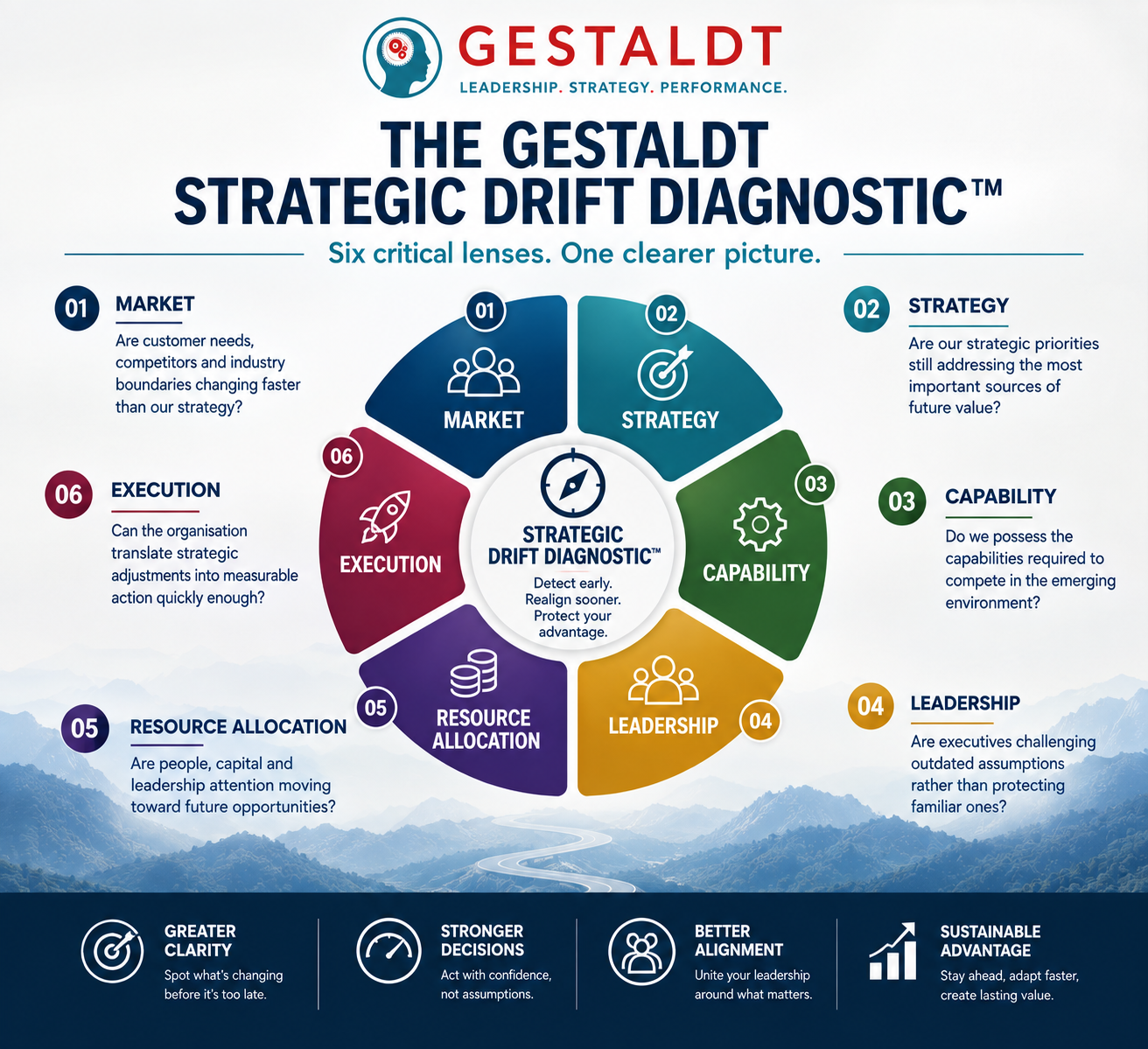
The Gestaldt Strategic Drift Diagnostic™ is a six-part executive framework designed to help organisations identify early signs of strategic drift. The infographic places six critical lenses—Market, Strategy, Capability, Leadership, Resource Allocation, and Execution—around a central diagnostic model. Each pillar poses a key question to help leaders assess whether the organisation is keeping pace with changing markets, capabilities, priorities, leadership assumptions, resources, and execution requirements. The framework highlights four intended outcomes: greater clarity, stronger decisions, better alignment, and sustainable competitive advantage.
These dimensions matter because strategic drift is rarely caused by strategy alone.
A strategy may be directionally correct but undermined by outdated capabilities.
Or leadership may recognise the need for change but fail to reallocate resources.
Or the organisation may identify a new opportunity but lack the execution capability to pursue it.
Strategic resilience comes from connecting all six.
Practical tip
Score each dimension from 1 to 5.
24–30: Strategic position appears resilient
18–23: Emerging strategic drift
Below 18: Significant strategic realignment may be required
The score is not a substitute for executive judgement. It is a conversation starter.
6. The CEO's Job Is Not to Predict the Future—It's to Keep the Organisation Adaptable
The strongest CEOs aren't necessarily those who predict disruption correctly. They're the ones who build organisations capable of responding when assumptions change.
This distinction matters.
Nobody knows exactly how AI, geopolitics, regulation, customer behaviour or economic conditions will evolve.
Trying to predict everything creates false confidence.
Building strategic adaptability creates resilience.
That means leadership teams need mechanisms for:
challenging strategic assumptions;
reallocating resources;
testing new opportunities;
developing future capabilities;
accelerating decisions;
stopping initiatives that no longer create value;
connecting external intelligence to executive decision-making.
Mohamed Kande, PwC Global Chairman, captured the challenge well:
“Business leaders around the world ... know they must re-invent how they create, deliver and capture value.”
That is the heart of the issue.
Strategic leadership is no longer about creating a five-year plan and defending it.
It is about creating enough direction to move decisively—and enough adaptability to change course when the evidence demands it.
Practical tip
Introduce a Quarterly Strategic Reset.
Do not rewrite the entire strategy.
Instead, review:
Keep: What remains strategically sound?
Change: What assumptions need updating?
Stop: What no longer creates sufficient value?
Start: What emerging opportunity deserves investment?
This creates strategic discipline without turning the organisation into a permanent planning exercise.
The CEO Strategic Drift Test
Before your next executive strategy session, ask your leadership team these ten questions:
Can we clearly explain what has changed in our competitive environment over the last 12 months?
Which assumptions underpin our current strategy?
Which of those assumptions are becoming weaker?
Are customer expectations changing faster than our organisation?
Are competitors entering spaces we previously considered outside our market?
Are we reallocating resources toward future opportunities?
Which capabilities will become strategically important over the next three years?
Which current initiatives should we stop?
How quickly can our executive team change strategic priorities when evidence changes?
If we continued executing our current strategy for another five years, what could make it fail?
The final question is the one most leadership teams avoid.
It is also one of the most valuable.
From Strategic Drift to Strategic Agility
Strategic drift does not mean an organisation has failed.
It means the environment has moved.
The real leadership failure is refusing to notice.
Organisations that remain competitive over time build mechanisms that allow them to continuously sense, challenge, decide and adapt.
This is where strategic alignment, organisational capability and execution become inseparable.
Your strategy must evolve.
Your leadership must evolve with it.
Your capabilities must evolve behind it.
And your organisation must be able to execute the new direction before the opportunity disappears.
For organisations already working on strategy execution, this connects directly with Gestaldt's existing thinking on From Strategy to Execution: Closing the Gap in Organisations and Organisational Design for Growth.
A Final Question for the C-Suite
Your organisation doesn't need to abandon everything that made it successful.
But it does need to distinguish between what should be protected and what must evolve.
That is the leadership challenge.
Strategic drift happens quietly.
Competitive advantage can disappear gradually.
And by the time the numbers make the problem obvious, the organisation may already be playing catch-up.
The best time to challenge strategic assumptions is not when performance collapses.
It is while performance is still strong enough to give you choices.
The future belongs to organisations that can recognise change early, make courageous choices and turn those choices into coordinated action.
Don't wait for strategic drift to become a crisis. Detect it while you still have time to act.
Ready to Test Your Organisation for Strategic Drift?
Gestaldt can help your executive team assess whether your current strategy, capabilities, leadership, resource allocation and execution model remain aligned with the environment ahead.
Request a Gestaldt Strategic Drift Diagnostic™
A confidential executive assessment can examine:
Strategic assumptions
Market and competitive shifts
Executive alignment
Resource allocation
Organisational capability
Strategic decision-making
Execution readiness
Future growth opportunities
Assess Your Strategic Resilience

Transformation Fatigue Is Becoming a CEO Problem: How to Keep Change From Breaking Your Organisation
Your organisation may not be resistant to change—it may be exhausted by it. Discover why transformation fatigue develops, how it undermines execution, and what CEOs can do to make change sustainable.

Your People May Not Be Resisting Change. They May Be Running Out of Capacity for It.
There is a point in every transformation when the language changes.
At the beginning, people talk about opportunity.
Then they talk about delivery.
Eventually, they start asking:
"What happens to the last transformation we launched?"
That's the moment leaders should pay attention.
A new strategy is announced.
Then a digital transformation.
Then an organisational redesign.
Then a cost programme.
Then an AI initiative.
Then another operating-model change.
Each initiative may make perfect sense individually.
The problem is what happens when they arrive simultaneously.
Employees don't experience transformation as a portfolio of strategically rational initiatives.
They experience it as:
another change.
And when change becomes continuous without sufficient capacity, clarity or visible progress, organisations can develop something far more dangerous than resistance:
transformation fatigue.
McKinsey reported in 2025 that employees were experiencing an average of around 10 planned change programmes a year, five times the level a decade earlier. Its research also found that people were increasingly exhausted and disconnected from leaders as the pace of change accelerated.
Deloitte's 2025 Chief Transformation Officer Study identified transformation fatigue as a top-five execution challenge, cited by 38% of respondents.
The message for CEOs is clear:
The challenge is no longer simply leading change. It is managing the organisation's capacity to absorb change.
Why Transformation Fatigue Is So Dangerous
Transformation fatigue rarely looks like open rebellion.
It is quieter than that.
People stop challenging ideas.
They attend workshops without enthusiasm.
They agree in meetings and revert to old behaviours afterwards.
Managers become overloaded.
Employees prioritise business-as-usual.
Transformation teams struggle to secure resources.
Initiatives technically continue—but momentum disappears.
Eventually, executives conclude:
"Our people are resistant to change."
That diagnosis can be dangerously wrong.
The organisation may not lack willingness.
It may lack capacity.
Research from Eagle Hill's 2025 change-management survey found that 63% of US employees had experienced workplace change during the previous year, while 34% said those changes had not been worth the organisational effort. Only 25% agreed their organisation managed change rollouts effectively.
This creates a critical distinction:
Change resistance asks, "Why won't people change?"
Transformation fatigue asks, "How much change can this organisation realistically absorb?"
That is a much more strategic question.
The Six Hidden Causes of Transformation Fatigue
1. Your Organisation Has More Change Than It Has Capacity
Here's the first problem.
Executives look at transformation from the portfolio level.
Employees experience it from the workload level.
The executive sees:
AI transformation
Cost optimisation
Customer experience
Operating-model redesign
The employee sees:
New systems
New processes
New reporting
New targets
New meetings
New responsibilities
The organisation may have enough money to fund all four initiatives.
But does it have enough leadership attention, employee bandwidth, skills and management capacity to execute them simultaneously?
Deloitte's research found that lack of resource bandwidth was the leading execution challenge, cited by 62% of respondents, followed by insufficient skills at 54%.
The CEO Question
How much organisational capacity are we consuming with our transformation portfolio?
Practical Tip
Create a change capacity map.
For every major initiative, estimate:
Executive time
Managerial time
Employee time
Required skills
Technology demands
Change-management requirements
Then compare the total demand with available capacity.
You may discover that your transformation strategy is mathematically impossible.
2. Everything Is a Priority—and Therefore Nothing Is
This is where transformation portfolios become dangerous.
One initiative is critical.
Another is strategic.
Another is urgent.
Another is mandatory.
Another is "too important to delay."
Eventually, employees cannot distinguish between what genuinely matters and what leadership simply wants to happen.
That creates priority dilution.
The result?
People spread their energy across too many initiatives and make insufficient progress on any of them.
PwC's 2025 CEO research found that 42% of CEOs identified resource constraints among the top three barriers to achieving corporate strategy.
The solution isn't working harder.
It is choosing.
Practical Tip
Ask your executive team:
"If we could successfully complete only three major changes this year, which three would create the greatest strategic value?"
Then stop calling everything else a priority.
3. Leaders Are Asking the Organisation to Change Without Changing How They Lead
This is one of the most overlooked causes of fatigue.
Leadership announces transformation.
But leadership behaviours remain unchanged.
Executives still make decisions slowly.
Managers remain measured against old targets.
Departments continue protecting their own priorities.
Meetings continue operating the same way.
Budgets continue reinforcing the old organisation.
Then leaders wonder why employees haven't changed.
The organisation has received a transformation message—but experienced business as usual.
Transformation requires leadership behaviour to change first.
Practical Tip
For every transformation, define five executive behaviours that must change.
For example:
Faster decisions
Greater cross-functional collaboration
More delegation
More transparent communication
Stronger accountability
Then measure leaders against them.
4. The Middle of the Organisation Is Carrying the Transformation
Here's the uncomfortable bit.
Transformation is often announced by executives and experienced most intensely by managers.
Managers translate strategy.
They answer employee questions.
They handle resistance.
They implement new processes.
They maintain performance.
They attend transformation meetings.
They manage competing priorities.
And they are expected to do all of this while delivering their existing responsibilities.
Deloitte's 2025 Human Capital Trends research found that while 73% of organisations recognise the importance of reinventing the manager role, only 7% said they were making great progress.
That gap matters.
If managers become exhausted, transformation slows down.
Practical Tip
Treat managers as a transformation capability, not merely a communication channel.
Give them:
Decision authority
Change-leadership skills
Clear priorities
Time
Resources
Executive access
Practical tools for managing uncertainty
5. Employees Cannot See What Is Changing—and Why
People can tolerate difficult change when they understand its purpose.
They struggle much more when change feels arbitrary.
Consider the difference between:
"We are implementing a new operating model."
and:
"Our current structure means customers move between five teams before receiving an answer. The new model will give one team end-to-end ownership."
The second explanation creates meaning.
The first creates another project.
Eagle Hill's 2025 research found that employees saw strong leadership and transparency as important ingredients in making workplace change work.
Practical Tip
Every transformation initiative should answer five questions:
Why are we changing?
What happens if we don't?
What will be different?
What will remain the same?
How will we know it worked?
If leaders cannot answer those questions clearly, employees will create their own answers.
6. Transformation Has Become a Collection of Projects Instead of a Change in How the Organisation Operates
This is perhaps the biggest issue of all.
A transformation office tracks projects.
Milestones are completed.
Systems go live.
Workstreams close.
Reports are produced.
But the organisation eventually returns to old habits.
Why?
Because transformation was treated as a programme rather than an organisational capability.
McKinsey's recent research makes a similar point: sustainable transformation depends on embedding new ways of working into everyday management rather than treating transformation as a finite collection of initiatives.
The real test is therefore not:
"Did we complete the transformation programme?"
It is:
"Does the organisation now operate differently?"
The Gestaldt Sustainable Transformation Framework™
At Gestaldt, we believe sustainable transformation rests on six interconnected pillars:
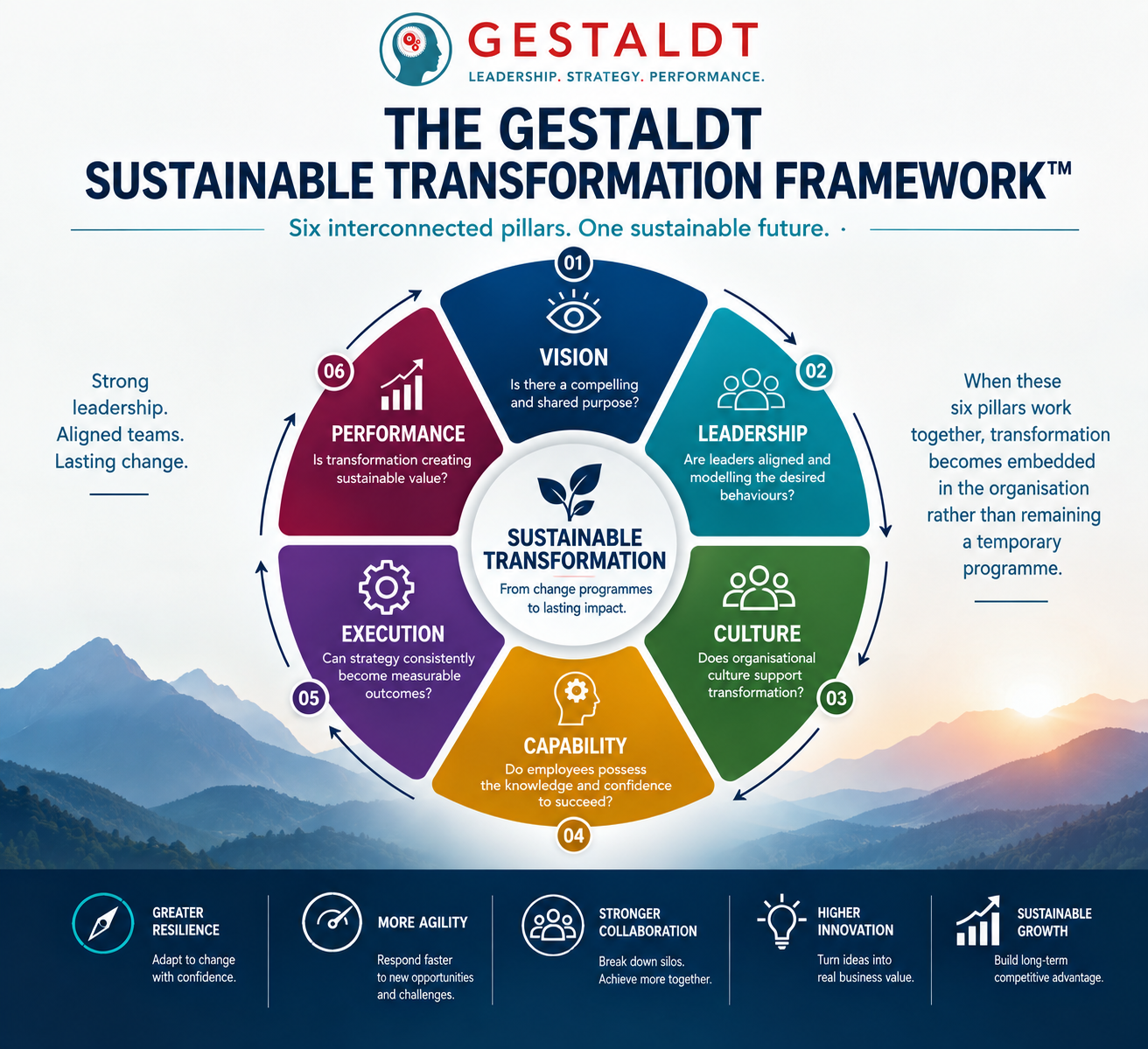
The Gestaldt Sustainable Transformation Framework™ connects Vision, Leadership, Culture, Capability, Execution, and Performance to help organisations turn change initiatives into lasting business value.
The Transformation Fatigue Test
Before launching another major initiative, ask your executive team to score the following from 1 to 5.
Strategic clarity
Our organisation understands why the change is necessary.
Priority
Employees know which transformation initiatives matter most.
Leadership
Executives consistently model the behaviours required by the transformation.
Capacity
Employees and managers have sufficient time and resources to absorb the change.
Capability
People have the skills required to operate successfully in the future state.
Communication
Employees understand what is changing, why and what it means for them.
Manager readiness
Managers are equipped to lead their teams through the change.
Governance
Decision rights and accountability are clear.
Measurement
Transformation progress is measured through business outcomes, not just project milestones.
Sustainability
New behaviours and processes are embedded into everyday management.
Interpreting the score
40–50 — Strong transformation capacity
Your organisation has a solid foundation for sustained change.
30–39 — Transformation risk
There are capability or capacity gaps that could slow execution.
Below 30 — High fatigue risk
Launching additional initiatives without addressing the underlying constraints could increase resistance, disengagement and execution failure.
The CEO's Transformation Paradox
CEOs are under pressure to transform faster.
Technology is accelerating.
Competition is changing.
Customer expectations are shifting.
AI is redefining work.
Economic conditions remain uncertain.
So leadership naturally responds:
"We need to move faster."
But there is a paradox.
Moving faster does not necessarily produce faster transformation.
If the organisation cannot absorb the change, acceleration can create:
More initiatives → more overload → less adoption → weaker execution → slower results.
The answer isn't always to slow down.
It is to become more selective, sequenced and disciplined about where change energy is invested.
Stop Measuring Transformation by Activity
A busy transformation can be a failing transformation.
Executives often measure:
Number of projects launched
Workshops completed
Employees trained
Systems implemented
Milestones achieved
Those are activity measures.
They don't necessarily demonstrate organisational change.
Instead, measure:
Decision speed
Adoption
Customer outcomes
Productivity
Revenue
Cost
Employee capability
Leadership behaviour
Process performance
Strategic outcomes
The question should always be:
"What is measurably different because of this transformation?"
Sequence Change Instead of Stacking Change
One of the most powerful things a CEO can do is create change sequencing.
Instead of:
AI + restructuring + ERP + cost reduction + culture transformation + new strategy
all at once—
ask:
What has to happen first?
Perhaps leadership alignment comes first.
Then operating-model redesign.
Then technology.
Then capability building.
Then performance optimisation.
The sequence will vary by organisation.
But sequencing matters because one change can create the conditions required for another.
Practical Tip
Build a 12–18 month transformation dependency map.
Identify which initiatives:
Enable others
Compete for resources
Depend on capabilities not yet available
Can be combined
Should be stopped
This turns transformation from a collection of projects into an integrated system.
The Most Important Transformation Is Often the One You Stop
Executives are generally rewarded for launching initiatives.
Stopping them requires a different kind of leadership.
A mature transformation portfolio should contain three categories:
Accelerate
High-value initiatives with strong organisational support.
Redesign
Important initiatives where capacity, capability or sequencing is weak.
Stop
Initiatives that consume significant organisational energy without sufficient strategic value.
Stopping the wrong work can create more transformation capacity than adding more resources.
From Change Fatigue to Change Capability
The objective shouldn't be to eliminate change.
That is impossible.
The objective is to build an organisation that becomes better at changing.
That requires:
Leadership that creates clarity.
Culture that supports experimentation.
Managers who can translate strategy into action.
Employees who have the capability and confidence to adapt.
Governance that removes unnecessary friction.
Execution systems that reinforce new behaviours.
Performance measures that reward the future rather than the past.
That is the difference between an organisation that merely survives transformation and one that develops a genuine transformation capability.
Five Questions Every CEO Should Ask Before Launching Another Transformation
1. What are we already asking the organisation to change?
You cannot manage capacity if you don't know the total change load.
2. What should we stop?
Transformation requires trade-offs.
3. Do managers have the capacity to lead this?
If not, the initiative is already at risk.
4. What behaviour must change at executive level?
Transformation cannot be delegated entirely downward.
5. What will be measurably different 12 months from now?
If you cannot answer this, the transformation may be too vague.
The Future Belongs to Organisations That Can Change Without Breaking
Transformation is not going away.
If anything, the pace will increase.
McKinsey's research argues that the traditional change-management toolkit needs to evolve as organisations face multiple transformations simultaneously.
Deloitte similarly describes transformation as increasingly becoming an always-on organisational capability, rather than an occasional programme.
That changes the CEO's responsibility.
The question is no longer:
"How do we successfully complete this transformation?"
It is:
"How do we build an organisation capable of continuously transforming?"
That is a much bigger leadership challenge.
And a much greater source of competitive advantage.
Is Your Organisation Experiencing Transformation Fatigue?
If your organisation is dealing with:
Too many competing initiatives
Exhausted managers
Declining enthusiasm for change
Repeated transformation programmes
Slow adoption
Change resistance
Weak executive sponsorship
Poor cross-functional execution
Capability gaps
Transformation initiatives that never seem to finish
the answer may not be another change programme.
It may be time to redesign how your organisation transforms.
Request a Gestaldt Sustainable Transformation Assessment
Gestaldt can help your executive team assess:
Transformation capacity
Executive alignment
Change portfolio
Leadership capability
Organisational culture
Manager readiness
Strategic priorities
Governance
Execution capability
Performance measurement
The objective isn't to make your organisation change faster.
It is to help your organisation change better—and make the change stick.
Assess Your Transformation Readiness

The Executive Alignment Gap: Why Your Leadership Team May Be Undermining Strategy Without Realising It
Your executive team may agree on the strategy—but still be working against it. Discover the hidden alignment gaps that undermine decision-making, execution and growth, and how CEOs can build a leadership team that moves as one.

Your Leadership Team May Agree in the Boardroom—and Disagree Everywhere Else
Here's a dangerous leadership illusion:
Everyone appears aligned.
The strategy has been approved.
The executive team nods in agreement.
The presentation has been circulated.
The town hall has been delivered.
The priorities are documented.
And yet, three months later, execution is slowing.
Functions are pursuing competing priorities.
Resources are being allocated differently.
Decisions are repeatedly revisited.
Leaders send contradictory messages.
Teams protect their own agendas.
And the CEO wonders:
"Why isn't the organisation executing the strategy we agreed on?"
The answer may not be poor strategy.
It may be executive alignment debt.
Alignment debt accumulates when executives appear to agree but hold different assumptions about priorities, trade-offs, accountability, risk or what success actually means.
Eventually, those differences surface in execution.
And by then, the cost can be substantial.
Why Executive Alignment Matters More Than Ever
The modern C-suite is operating under competing pressures: growth, cost, technology, talent, geopolitical uncertainty, transformation and resilience.
That makes leadership alignment harder—and more important.
PwC's 2025 CEO Pulse Survey found that 58% of CEOs were encouraging greater internal debate and diverse perspectives amid uncertainty, while 50% were bringing in external perspectives to challenge their thinking.
That is an important distinction:
Alignment does not mean agreement.
High-performing executive teams should challenge one another vigorously.
The objective is not to eliminate disagreement.
It is to create enough clarity and commitment that, once a decision is made, the leadership team moves forward together.
McKinsey's 2025 research found that companies with aligned, effective top teams are almost twice as likely to achieve above-median financial performance.
So the question for CEOs isn't:
"Does my executive team get along?"
It is:
"Can my executive team disagree productively, decide decisively and execute collectively?"
The Six Hidden Causes of Executive Misalignment
1. Everyone Agrees on the Strategy—but Not the Priorities
This is the first trap.
Ask six executives what the company's strategy is and you may get six different answers.
The CEO emphasises growth.
The CFO emphasises profitability.
The COO focuses on efficiency.
The CMO prioritises customer acquisition.
The CHRO emphasises capability.
The CIO wants digital acceleration.
All are legitimate.
But if the organisation cannot clearly distinguish between what matters most and what matters eventually, strategy becomes a collection of competing ambitions.
The warning sign
Your strategic plan contains 15 "top priorities."
That isn't prioritisation.
It's a wish list.
Practical Tip
Ask every executive to independently identify the organisation's three most important strategic outcomes.
Compare the answers.
The differences will tell you more about alignment than another strategy workshop.
2. Executives Are Optimising Their Functions Instead of the Enterprise
Functional excellence can become an organisational weakness.
A CFO can optimise cost.
A CMO can optimise acquisition.
An operations leader can optimise efficiency.
A technology leader can optimise infrastructure.
But the organisation needs someone thinking about the whole system.
This is particularly important when incentives and performance measures reinforce functional behaviour.
One executive may improve their department's performance while unintentionally making another department's job harder.
The question CEOs should ask
"Are we rewarding executives for enterprise outcomes—or functional performance?"
If the answer is primarily functional performance, silo behaviour shouldn't come as a surprise.
Practical Tip
Introduce a small number of shared executive KPIs that require cross-functional collaboration.
3. The Real Strategy Is Being Decided in Informal Conversations
Here's something many CEOs underestimate:
The organisation doesn't experience the strategy presentation. It experiences the decisions executives make every day.
If leaders tell employees that innovation is a priority but reject every experiment that introduces risk, employees quickly learn the real strategy.
If leadership says customer experience matters but rewards short-term cost reduction above all else, employees understand the message.
If executives promote collaboration while protecting departmental budgets and information, the culture follows the behaviour—not the presentation.
Leadership alignment is therefore behavioural.
McKinsey research has found that although leadership teams often agree that shared purpose is important, only around 60% of team members in its earlier research reported actually being aligned on purpose.
Practical Tip
Compare what your leadership team says matters with where it actually allocates:
Capital
Talent
Executive attention
Time
Rewards
That gap is often where the real strategy lives.
4. Executives Are Avoiding the Conversations That Matter Most
Polite leadership teams can be dangerous.
Nobody challenges the CEO.
Nobody questions the assumptions.
Nobody asks whether the strategy is still valid.
Nobody wants to create tension.
Everyone leaves the meeting apparently aligned.
Then the resistance happens elsewhere.
This is false alignment.
A healthy executive team needs constructive disagreement.
McKinsey's 2025 analysis of top teams identified conflict management, psychological safety, feedback and innovative thinking among the areas teams found most challenging.
The lesson is important:
The absence of conflict isn't necessarily evidence of a healthy leadership team.
Sometimes it is evidence that people don't feel safe enough to disagree.
Practical Tip
At the end of major strategic discussions, ask:
"What are we not saying that needs to be said?"
Then allow the silence.
Someone usually has an answer.
5. Decisions Are Being Made—but Commitment Isn't
This is one of the most expensive forms of misalignment.
The executive team makes a decision.
Everyone agrees to support it.
But beneath the surface, some leaders remain unconvinced.
They delay implementation.
Redirect resources.
Communicate different priorities.
Or quietly wait for the decision to be reversed.
That isn't execution.
It's organisational drag.
A decision becomes meaningful only when it produces coordinated action.
The Alignment Test
After every major executive decision, ask each leader:
What exactly have we decided?
Why have we decided it?
What changes because of this decision?
What will you personally do differently?
What trade-offs are we accepting?
If the answers differ substantially, alignment hasn't happened.
6. The CEO Has Become the Organisation's Alignment Mechanism
This is the most serious warning sign.
Whenever executives disagree, the CEO resolves it.
Whenever priorities conflict, the CEO intervenes.
Whenever accountability becomes unclear, the CEO steps in.
Whenever departments fail to collaborate, the CEO calls another meeting.
At first, this looks like strong leadership.
Eventually, it becomes a bottleneck.
The CEO becomes the organisation's human coordination system.
That doesn't scale.
A high-performing executive team should increase the CEO's leverage—not increase the CEO's workload.
The Gestaldt Executive Alignment Framework™
At Gestaldt, we believe executive alignment is built on six interconnected pillars:
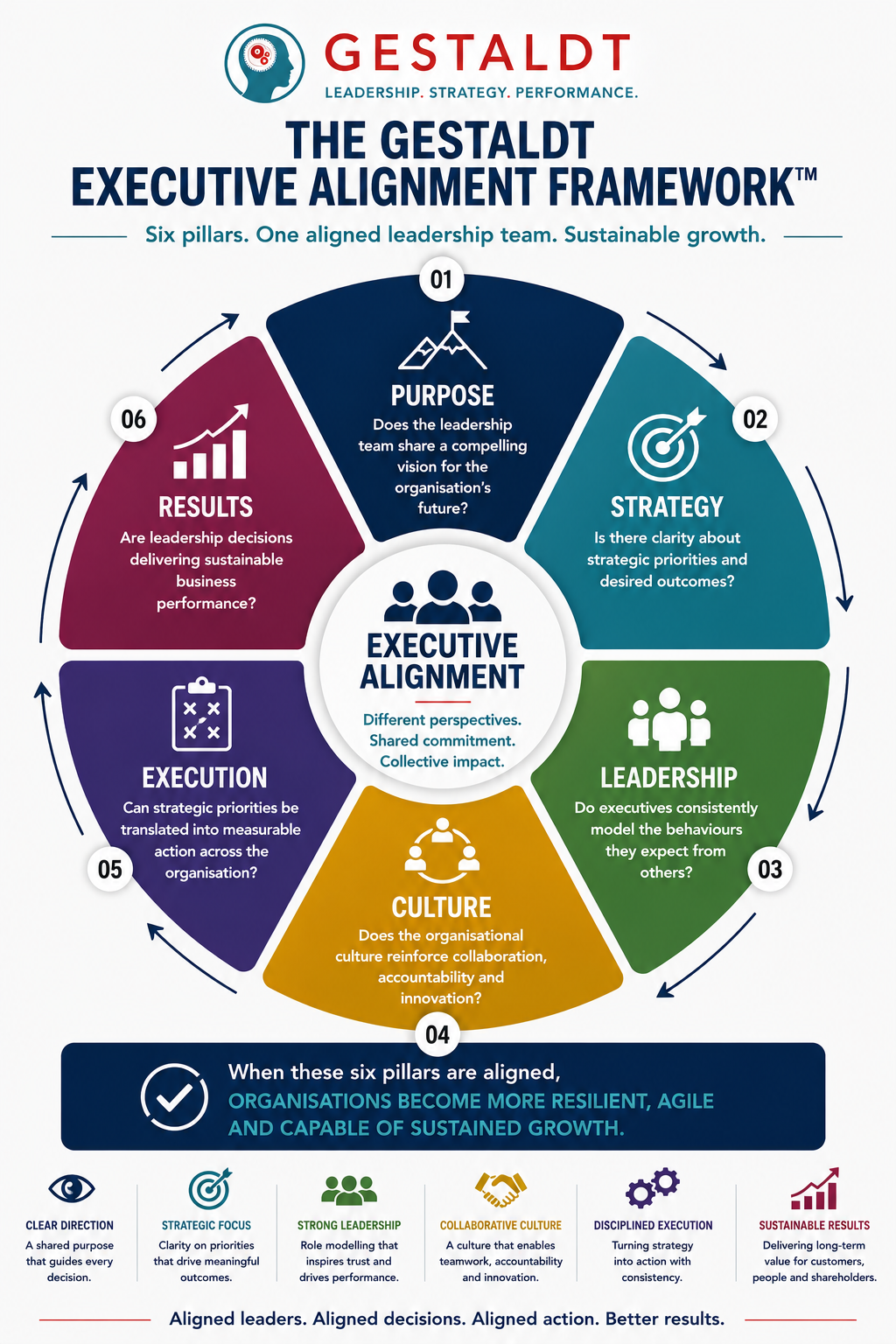
The Gestaldt Executive Alignment Framework™ connects purpose, strategy, leadership, culture, execution, and results to help executive teams turn shared direction into stronger organisational performance.
The Executive Alignment Stress Test
Before your next executive off-site, ask your leadership team to score each statement from 1 to 5.
Purpose
We have a shared understanding of where the organisation needs to go.
Strategy
We agree on the organisation's three most important strategic priorities.
Trade-offs
We agree on what we will not prioritise.
Decision-making
Decision rights are clear and major decisions are not repeatedly revisited.
Accountability
Every strategic priority has clear executive ownership.
Behaviour
Executives consistently model the behaviours expected across the organisation.
Challenge
Our leadership meetings encourage constructive disagreement.
Commitment
Once a decision is made, executives actively support it.
Execution
We translate strategic priorities into measurable organisational action.
Results
We evaluate executive performance based partly on enterprise-wide outcomes.
Interpreting the results
40–50: Strong alignment
Your leadership team has a solid foundation, although continuous alignment is still required.
30–39: Alignment risk
Differences may already be creating execution friction.
Below 30: Significant alignment gap
Your leadership team may be unintentionally undermining strategy through competing priorities, behaviours or decisions.
Alignment Isn't About Getting Everyone to Agree
This distinction deserves emphasis.
A strong executive team should contain disagreement.
Different perspectives improve decisions.
Constructive tension exposes blind spots.
Challenge prevents groupthink.
The problem isn't disagreement.
The problem is unresolved disagreement that leaks into execution.
A mature leadership team can move through four stages:
Challenge → Debate → Decision → Commitment
That is alignment.
Not:
Agreement → Silence → Confusion → Resistance
The CEO's Role Is to Create Alignment—not Manufacture Agreement
CEOs sometimes try to create alignment by communicating more.
More presentations.
More emails.
More town halls.
More strategy documents.
But communication cannot compensate for unresolved strategic ambiguity.
The CEO must instead create the conditions for alignment:
Clarify the destination.
Define the priorities.
Surface disagreement.
Make trade-offs explicit.
Establish decision rights.
Create shared accountability.
Model the required behaviours.
Measure collective outcomes.
PwC's research similarly highlights the importance of healthy debate, diverse perspectives and clear alignment between leadership and strategy when CEOs are navigating uncertainty.
From Executive Alignment to Organisational Performance
The real value of alignment appears below the executive team.
When executives are aligned:
Employees receive clearer priorities.
Decisions move faster.
Resources are allocated more effectively.
Functions collaborate more effectively.
Accountability becomes clearer.
Change initiatives gain momentum.
Strategy becomes easier to execute.
Deloitte's 2025 Chief Transformation Officer research found that organisations encountered some of their greatest transformation challenges during execution, including resource constraints, capability gaps, change management and insufficient ongoing executive engagement.
That is why executive alignment cannot be treated as a "soft" leadership issue.
It is an execution capability.
What Happens When Alignment Breaks Down?
The consequences rarely appear all at once.
Instead, they accumulate.
First, decisions slow.
Then meetings increase.
Then priorities multiply.
Then functions become protective.
Then employees receive contradictory messages.
Then transformation initiatives lose momentum.
Then the CEO becomes increasingly involved in operational decisions.
Eventually, performance suffers.
By this point, leadership may try to fix the symptoms.
New structures.
New KPIs.
New processes.
New technology.
Another transformation programme.
But the underlying issue remains.
The leadership system isn't aligned around how the organisation creates value.
Five Actions CEOs Can Take Now
1. Reduce the Strategic Agenda
Identify the three outcomes that matter most.
Then make the trade-offs explicit.
2. Test Alignment Individually
Ask executives what they believe the priorities are before discussing them collectively.
You may discover gaps that group meetings conceal.
3. Debate Before Deciding
Create space for challenge.
Once the decision is made, create absolute clarity around commitment.
4. Measure Enterprise Outcomes
Reward executives for outcomes that require collaboration—not simply departmental performance.
5. Diagnose the Leadership System
If alignment repeatedly breaks down, don't assume the problem is communication.
Examine:
Roles
Decision rights
Incentives
Culture
Governance
Leadership behaviours
Accountability
Strategic clarity
The Leadership Team Is the Strategy's First Execution Layer
Your strategy doesn't begin when it reaches employees.
It begins with the executive team.
If the C-suite isn't aligned, the organisation has little chance of executing consistently.
That is why executive alignment deserves the same level of attention as strategy development, financial planning and organisational design.
The strongest leadership teams don't simply ask:
"Do we have a good strategy?"
They ask:
"Are we collectively capable of executing it?"
That is a much harder question.
And a much more valuable one.
Is Your Executive Team Truly Aligned?
If your organisation is experiencing:
Slow strategic decisions
Competing executive priorities
Functional silos
Repeatedly revisited decisions
Transformation fatigue
Weak accountability
Inconsistent leadership messages
Increasing CEO intervention
the problem may not be your strategy.
It may be the alignment of the team responsible for delivering it.
Request a Gestaldt Executive Alignment Assessment
Gestaldt can help your leadership team examine:
Strategic alignment
Executive team effectiveness
Decision-making
Leadership behaviours
Organisational culture
Accountability
Governance
Execution
Cross-functional collaboration
Performance alignment
The objective isn't to make executives agree on everything.
It is to build a leadership team capable of challenging intelligently, deciding decisively and executing collectively.
Assess Your Executive Team Alignment

AI Isn't the Strategy: Why Most Organisations Are Struggling to Turn AI Investment Into Business Value
AI adoption is accelerating, but many organisations are struggling to turn experimentation into measurable business value. Discover the six organisational conditions CEOs must align to move AI from isolated pilots to sustainable transformation.

Your Organisation May Have an AI Problem That Technology Can't Solve
AI has moved from the technology department into the boardroom.
CEOs are asking how it will reshape their workforce.
CFOs want to understand the return on investment.
COOs want productivity gains.
CMOs are experimenting with generative AI.
HR leaders are considering how jobs and capabilities will change.
Boards want to know whether competitors are moving faster.
And across the organisation, employees are already using AI—sometimes officially, sometimes unofficially.
The technology is moving quickly.
But organisations aren't.
McKinsey's 2025 research found that 88% of respondents said their organisations were using AI in at least one business function, while only 7% reported that AI had been fully scaled across the organisation.
That gap tells us something important.
AI adoption is not the same as AI transformation.
Buying technology is relatively easy.
Creating an organisation capable of using it effectively is much harder.
And that is where many AI strategies are beginning to break down.
The AI Adoption Trap
Here's the uncomfortable truth:
Your organisation doesn't need another AI pilot. It needs an AI operating model.
Many organisations are running multiple experiments simultaneously.
Marketing has one.
HR has another.
IT has several.
Customer service is testing a chatbot.
Finance is experimenting with automation.
Executives are using AI assistants.
Everyone is busy.
Yet the organisation isn't necessarily becoming more intelligent, productive or competitive.
This creates what we might call the AI Adoption Trap:
More experimentation → more activity → more technology → little organisational change.
The problem isn't a lack of enthusiasm.
It's a lack of integration.
AI needs to connect to strategy, leadership, governance, people, processes and measurable business outcomes.
Otherwise, it remains a collection of disconnected tools.
1. Your AI Strategy May Be Starting With Technology Instead of Business Problems
This is where many organisations go wrong.
They discover a powerful AI capability and then ask:
"What can we use this for?"
A stronger strategic question is:
"What business problem are we trying to solve?"
That distinction matters.
AI can potentially:
Reduce operating costs.
Improve customer experience.
Accelerate decision-making.
Increase productivity.
Strengthen forecasting.
Improve knowledge management.
Accelerate innovation.
Create new products and services.
But not every AI application creates meaningful value.
McKinsey's research found that organisations achieving the strongest AI impact are more likely to pursue transformative ambitions, redesign workflows and scale AI faster.
The CEO Question
Which three business outcomes could AI materially improve over the next 12–24 months?
Start there.
Not with the technology.
Practical Tip
Create an AI opportunity map that ranks potential use cases according to business value, feasibility, risk and strategic importance.
2. AI Cannot Transform a Process That Was Already Broken
Here's a common misconception:
Automation automatically creates efficiency.
It doesn't.
If an organisation has a fragmented, bureaucratic or inefficient process, adding AI may simply make the bad process faster.
The organisation hasn't transformed.
It has automated complexity.
Before introducing AI, ask:
Why does this process exist?
Who owns it?
Where are the bottlenecks?
Which steps add value?
Which steps exist because of historical decisions?
Where are customers experiencing friction?
Then ask:
"If we redesigned this process from scratch using AI capabilities, what would it look like?"
That's a transformation question.
3. Leadership Is the Missing AI Capability
AI transformation is often presented as a technology challenge.
Increasingly, it's a leadership challenge.
Executives need to decide:
Where AI should be used.
Where it should not be used.
Which capabilities need to be developed.
Which processes should be redesigned.
How investment should be prioritised.
What risks are acceptable.
How performance should be measured.
Deloitte's research found that C-suite leaders need to redefine aspects of their roles around GenAI while maintaining alignment between technical and business leadership.
The CEO doesn't need to become an AI engineer.
But the CEO does need enough understanding to ask the right strategic questions.
Practical Tip
Create an AI leadership agenda with five standing questions:
Where are we creating value?
Where are we reducing risk?
What capabilities are we building?
What work should be redesigned?
What evidence shows that AI is improving performance?
4. Your Workforce Isn't Resisting AI—It May Be Resisting Uncertainty
This distinction is critical.
When employees hesitate to adopt AI, leadership may describe them as resistant to change.
But employees may actually be asking:
Will my role change?
Will my skills remain valuable?
How will performance be measured?
What am I allowed to use AI for?
Who is accountable when AI gets something wrong?
Will AI replace my job?
Those aren't resistance questions.
They're organisational design questions.
Deloitte's research identified talent and skills as major barriers to GenAI adoption and found that only 22% of surveyed leaders considered their organisations highly or very highly prepared to address talent-related GenAI issues.
Practical Tip
Don't launch AI adoption without a workforce transition plan covering skills, roles, communication, training, governance and leadership expectations.
5. Governance Can Either Accelerate AI—or Kill It
Here's the balancing act.
Too little governance creates risk.
Too much governance creates paralysis.
Organisations need enough control to protect:
Data
Privacy
Intellectual property
Customers
Employees
Reputation
Regulatory compliance
But governance must also enable responsible experimentation.
Deloitte's 2025 research found regulatory compliance had become a leading barrier to GenAI deployment, while many organisations were still taking more than a year to establish mature governance foundations.
The answer isn't to eliminate governance.
It's to make governance proportionate, clear and fast.
Practical Tip
Create three AI governance categories:
Green: Low-risk use cases that employees can use within clear guidelines.
Amber: Higher-risk applications requiring review.
Red: Applications requiring executive or specialist approval.
This gives employees clarity without creating unnecessary bureaucracy.
6. AI Transformation Fails When Nobody Owns the Outcome
This is perhaps the most important issue.
Who owns AI?
The CIO?
The CTO?
The Chief Digital Officer?
The CEO?
The business units?
The answer cannot simply be "IT."
AI changes how the business works.
Therefore, accountability must sit across the organisation.
Technology leaders should own technology architecture.
Risk leaders should own risk controls.
HR should help lead workforce transformation.
But business leaders must own the business outcomes.
Otherwise AI becomes another technology programme rather than a transformation agenda.
The Gestaldt AI Transformation Framework™
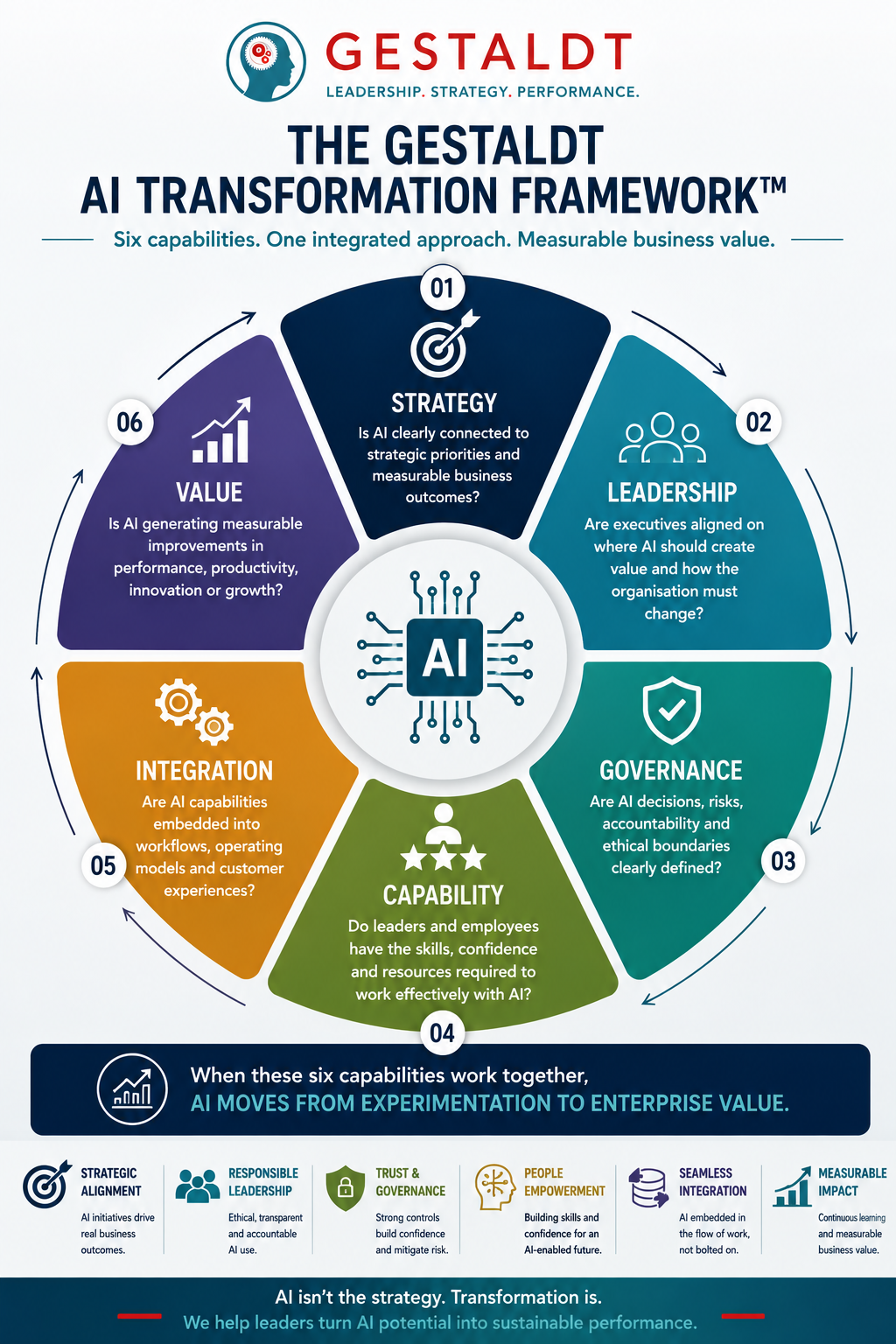
The Gestaldt AI Transformation Framework™ connects strategy, leadership, governance, capability, integration and value to help organisations turn AI potential into sustainable business performance.
The AI Transformation Readiness Test
Your executive team can use the following quick diagnostic.
Rate each statement from 1 (Strongly Disagree) to 5 (Strongly Agree).
Our AI initiatives are directly linked to strategic priorities.
We have identified the business problems where AI can create the greatest value.
The executive team has a shared AI vision.
AI decision rights and governance are clearly defined.
Employees understand how AI will affect their roles.
We are actively developing AI-related capabilities.
Our core workflows are being redesigned rather than simply automated.
AI initiatives have clear business owners.
We measure AI according to business outcomes rather than activity.
We have a clear roadmap for scaling successful AI initiatives.
Your Score
40–50 — AI-ready organisation
Your organisation has strong foundations for scaling AI strategically.
30–39 — Emerging readiness
You have promising foundations, but gaps may prevent consistent enterprise-wide value.
Below 30 — Transformation risk
Your organisation may be investing in AI faster than it is building the capabilities required to use it effectively.
The Difference Between AI Adoption and AI Transformation
The distinction is simple.
AI Adoption
Employees use AI tools.
AI Transformation
The organisation changes how work gets done because of AI.
That could mean:
Redesigning customer journeys.
Rebuilding operating processes.
Changing decision-making.
Creating new products.
Redefining roles.
Developing new leadership capabilities.
Changing performance measures.
Reallocating resources.
The technology is only the catalyst.
The organisation is the transformation.
The CEO's Five AI Questions
Before approving another AI initiative, ask:
1. What business outcome will this change?
If the answer is unclear, reconsider the investment.
2. What process or operating model must change?
AI rarely creates sustainable value when the organisation refuses to change the way work is done.
3. Who owns the business result?
Technology ownership isn't enough.
4. What capabilities will our people need?
Adoption depends on confidence as much as technology.
5. How will we know it worked?
Define measurable outcomes before launching the initiative.
Don't Build an AI Portfolio. Build an AI-Powered Organisation.
This is the strategic shift CEOs need to make.
The goal isn't to have the most AI tools.
It isn't to run the most pilots.
It isn't to announce the biggest AI investment.
The real competitive advantage comes from building an organisation that can identify opportunities, make disciplined decisions, redesign work, develop people and scale what works faster than competitors.
That is an organisational capability.
And capabilities are built deliberately.
AI Will Reward Organisations That Can Change
Technology is accelerating.
The organisations that benefit most won't necessarily be those with the biggest technology budgets.
They will be those capable of changing quickly enough to capture the value technology creates.
McKinsey's 2026 research describes AI, economic uncertainty, geopolitical fragmentation and changing workforce expectations as forces reshaping how organisations create value and sustain performance.
The strategic question for CEOs is therefore no longer:
"Should we adopt AI?"
That question has largely been answered.
The better question is:
"Are we organisationally capable of turning AI into sustainable competitive advantage?"
That is the question that belongs in the boardroom.
Is Your Organisation Ready to Turn AI Into Business Value?
If your organisation is investing in AI but struggling to move beyond pilots, isolated experiments or productivity improvements, the problem may not be your technology.
It may be your strategy, leadership, governance, capability or operating model.
Request a Gestaldt AI Transformation Readiness Assessment
Gestaldt can help your executive team assess:
AI strategic alignment
Executive readiness
AI governance
Workforce capability
Operating-model implications
Workflow redesign
Change readiness
Accountability
AI scaling capability
Business-value measurement
The objective isn't simply to help your organisation adopt AI.
It is to build the organisational capability required to turn AI into measurable business performance.
Assess Your AI Transformation Readiness

When Growth Starts Breaking the Business: The CEO's Guide to Scaling Without Losing Control
Rapid growth can expose weaknesses that remained invisible when an organisation was smaller. Discover the six organisational barriers that make growth harder—and how CEOs can build structures, leadership and capabilities that scale without sacrificing speed, accountability or performance.

Growth Can Hide Problems—Until Suddenly It Can't
Growth looks like success.
More customers. More employees. More revenue. More locations. More products.
Then, almost imperceptibly, the organisation starts behaving differently.
Decisions take longer.
Meetings multiply.
Customers receive inconsistent experiences.
Departments create their own priorities.
Senior leaders become involved in operational details.
Managers spend more time coordinating than leading.
And the organisation that once moved quickly begins to feel strangely heavy.
This is the paradox of growth:
The organisation can become more successful while becoming less effective.
The problem isn't necessarily poor leadership or a weak strategy.
Often, the organisation has simply outgrown the structures that made it successful in the first place.
At Gestaldt, we believe sustainable growth requires more than expanding revenue or headcount. Organisations must evolve their leadership, structure, governance, culture, capability and execution at the same pace as their strategy.
Otherwise, yesterday's operating model becomes tomorrow's growth constraint.
The Hidden Cost of Organisational Complexity
Complexity doesn't arrive with a warning.
It accumulates.
One additional approval process seems harmless.
One new reporting requirement seems reasonable.
One additional management layer appears necessary.
One more strategic initiative feels manageable.
But eventually the organisation reaches a tipping point.
Employees need permission to act.
Leaders spend their time coordinating.
Information becomes fragmented.
Accountability becomes blurred.
And customers experience the consequences.
This is why organisational design matters.
Gestaldt's existing work on organisational design highlights the same fundamental issue: structures designed for stability can struggle when organisations need speed, adaptability and innovation.
The CEO's challenge is therefore not simply:
"How do we grow?"
It is:
"How do we grow without allowing complexity to grow faster than value?"
Six Warning Signs Your Organisation Has Outgrown Its Operating Model
1. Decisions Keep Moving Up the Hierarchy
Here's the first red flag.
Managers who once made decisions independently now need executive approval.
Executives become involved in increasingly operational matters.
The CEO's calendar fills with issues that should have been resolved several levels below.
This is often mistaken for strong executive oversight.
It isn't.
It can be a sign that decision rights haven't evolved with organisational scale.
What to Ask
Which decisions are reaching the executive team that shouldn't?
If the answer is "too many," your governance model may be constraining growth.
Practical Tip
Map your 20 most frequent high-impact decisions and identify who currently makes each one. Look for unnecessary escalation.
2. The Organisation Has More People—But Less Accountability
Growth often creates functional silos.
Sales owns customers.
Operations owns delivery.
Finance owns budgets.
Technology owns systems.
HR owns people.
Each function may perform well independently.
Yet nobody owns the end-to-end outcome.
That is where accountability starts to disappear.
Customers don't experience departments.
They experience the organisation.
A scalable operating model therefore needs clear ownership across organisational boundaries.
Practical Tip
For each major customer or strategic outcome, identify one accountable executive—not a committee.
3. Meetings Become the Operating System
This one is easy to miss.
When organisations become more complex, meetings multiply.
Weekly meetings.
Steering committees.
Transformation forums.
Performance reviews.
Project meetings.
Executive committees.
Soon, employees spend their working lives discussing work rather than doing it.
Meetings aren't inherently bad.
But excessive coordination is often evidence of structural problems.
Ask Yourself
If we cancelled 20% of our meetings tomorrow, what decisions or activities would actually stop?
The answer can reveal where the organisation has become unnecessarily dependent on coordination.
Practical Tip
Audit recurring meetings by asking:
What decision does this meeting make?
Who actually needs to attend?
What happens if the meeting disappears?
If the answer is unclear, redesign it.
4. Your High Performers Are Becoming Organisational Shock Absorbers
This is a dangerous growth pattern.
The organisation relies on a handful of exceptional people to keep everything moving.
They know who to call.
They understand the informal processes.
They solve cross-functional problems.
They compensate for structural weaknesses.
And because they are successful, leadership may not realise how dependent the organisation has become on them.
Until one leaves.
Then the cracks appear.
This is why leadership capability and succession planning matter to scalability.
Gestaldt's Leadership Pipeline Framework™ addresses this challenge by moving organisations from identifying critical capability gaps through assessment, development, deployment, evaluation and sustained leadership readiness.
Practical Tip
Ask:
"If our three most capable problem-solvers left tomorrow, what would break?"
Your answer is a useful measure of organisational dependency.
5. Growth Has Created More Priorities Than the Organisation Can Execute
This is where ambition becomes a liability.
As organisations grow, every function sees new opportunities.
Digital transformation.
New markets.
Customer experience.
AI.
Talent.
Operational efficiency.
Innovation.
ESG.
New products.
The list keeps growing.
But organisational capacity doesn't automatically grow at the same rate.
When everything becomes a priority, strategic focus disappears.
Gestaldt's existing work on strategy execution highlights the importance of converting strategic priorities into measurable action rather than allowing organisations to remain trapped in planning mode.
Practical Tip
Ask your executive team to identify the three outcomes that matter most over the next 12 months.
Then identify what you will deliberately stop, defer or deprioritise.
Focus is a growth capability.
6. The Organisation Is Scaling Faster Than Its Leadership Capability
Revenue can grow quickly.
Leadership capability usually doesn't.
This creates a dangerous gap.
A company that once had 50 employees may now have 500.
Yet leadership practices remain designed for a 50-person organisation.
Communication becomes fragmented.
Managers are promoted without sufficient preparation.
Executive roles become more complex.
Decision-making becomes slower.
Culture becomes harder to maintain.
This is why leadership development cannot be treated as an occasional intervention.
It must evolve alongside organisational complexity.
The Gestaldt Scalable Organisation Framework™
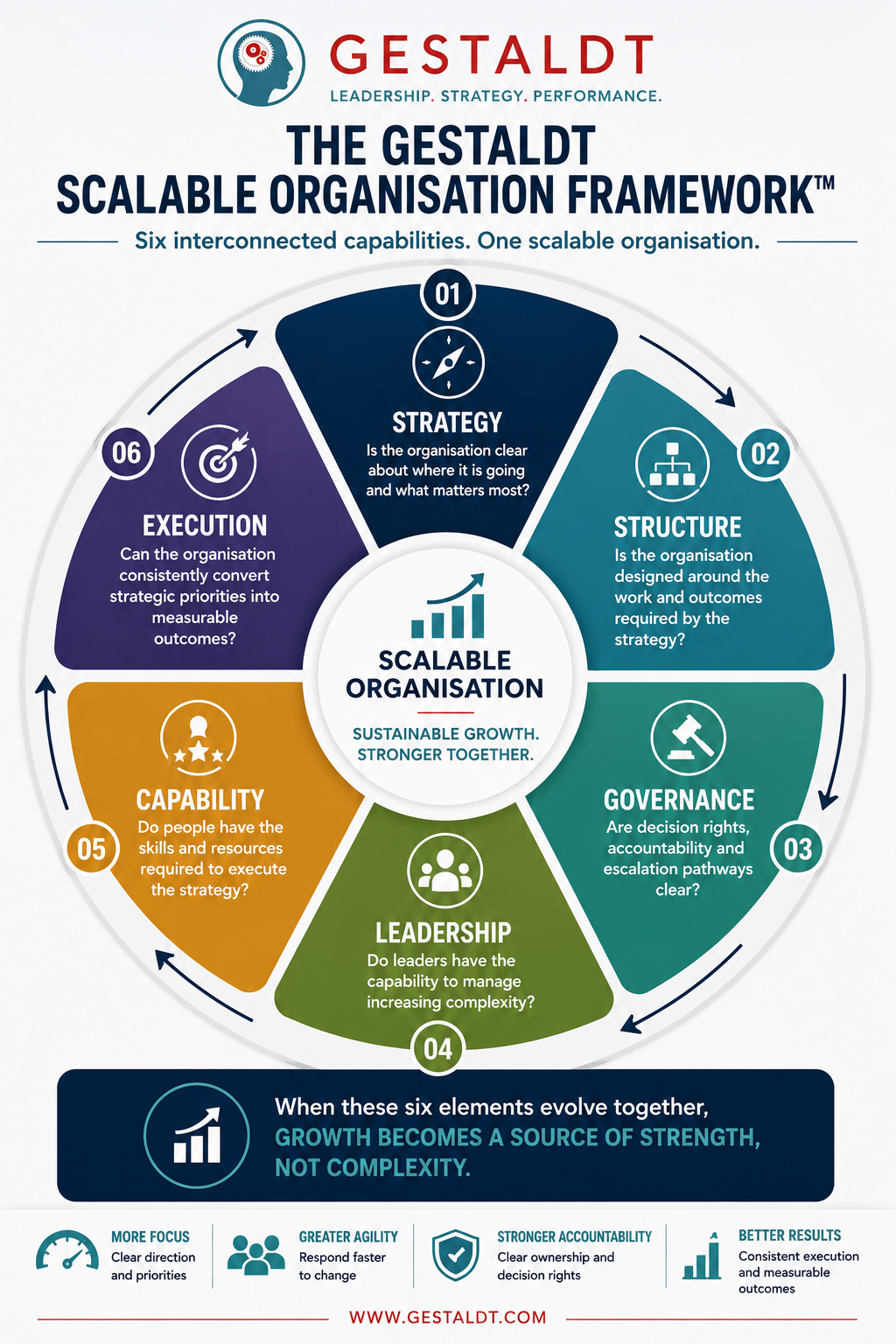
The Gestaldt Scalable Organisation Framework™ shows how strategy, structure, governance, leadership, capability, and execution work together to create a more agile, accountable, and scalable organisation.
The Scalability Stress Test
How scalable is your organisation?
Rate each statement from 1 (Strongly Disagree) to 5 (Strongly Agree).
Decision-making remains fast as the organisation grows.
Roles and responsibilities are clearly defined.
Strategic priorities are understood across the organisation.
Leaders have sufficient authority to make decisions.
Our structure supports cross-functional collaboration.
Accountability remains clear as complexity increases.
Our leadership pipeline is strong enough to support future growth.
We can add customers without proportionally increasing organisational complexity.
Our governance enables rather than slows execution.
Our operating model can adapt as strategy changes.
Your Score
40–50 — Scalable
Your organisation has strong foundations for sustainable growth.
30–39 — Emerging complexity
Your current operating model may soon begin constraining performance.
Below 30 — Growth risk
Structural and leadership issues may already be limiting scalability.
The CEO's Growth Trap: Fixing Symptoms Instead of the System
When growth slows, CEOs often look for an immediate answer.
Hire more people.
Add technology.
Restructure.
Launch another initiative.
Increase sales.
Cut costs.
But these interventions can treat symptoms without addressing the underlying system.
For example:
Slow decisions → add another approval process.
The result?
Even slower decisions.
Poor accountability → create another reporting dashboard.
The result?
More reporting but not necessarily better ownership.
Weak collaboration → create another committee.
The result?
More coordination.
The better question is:
What about the way our organisation is designed is producing this outcome?
That shift—from fixing symptoms to understanding the system—is one of the most important transitions a growing organisation can make.
Organisational Design Is a Strategic Decision
Organisational design is sometimes treated as an HR exercise.
It shouldn't be.
Structure determines:
Who makes decisions.
Where information flows.
How resources are allocated.
Who owns outcomes.
How quickly teams respond.
How effectively strategy is executed.
In other words:
Organisation design determines how strategy becomes reality.
This is particularly important in volatile markets, where slow-moving organisations can struggle to respond quickly. Gestaldt's current Insights content similarly emphasises organisational agility, simplified decision-making and capability building as important drivers of sustainable growth.
A Better Way to Think About Scaling
Don't ask:
"How do we build a bigger version of the organisation we have today?"
Ask:
"What organisation will our next stage of strategy require?"
That distinction changes everything.
Your future organisation may require:
Fewer management layers.
Greater decision authority.
New leadership capabilities.
Different customer-facing structures.
More cross-functional teams.
New governance mechanisms.
Different performance measures.
The goal isn't simply to replicate today's organisation at a larger scale.
It is to design the organisation for tomorrow's strategy.
Five Questions Every CEO Should Ask Before the Next Growth Phase
1. What has become unnecessarily complicated?
Look beyond organisational charts.
Examine processes, meetings, approvals and decision pathways.
2. Where does accountability become blurred?
Find the points where multiple functions share responsibility but nobody owns the outcome.
3. Which decisions are unnecessarily centralised?
Identify where senior leaders are acting as bottlenecks.
4. What capabilities will the next stage of growth require?
Don't develop people for today's organisation alone.
5. Can our current operating model execute our future strategy?
If the answer is no, redesign before growth exposes the weakness.
From Growth to Scalable Performance
Growth is not the finish line.
It is a test.
It tests leadership.
It tests culture.
It tests governance.
It tests capability.
It tests whether the organisation can maintain execution as complexity increases.
The organisations that scale successfully understand a simple principle:
Growth requires organisational evolution.
The structure that worked at one stage may become a constraint at the next.
The leadership practices that worked when the organisation was smaller may no longer be sufficient.
The governance mechanisms that created control may eventually create friction.
The challenge for CEOs is knowing when to evolve—and what to change.
Is Your Organisation Designed for Its Next Stage of Growth?
If growth is creating slower decisions, greater complexity, unclear accountability or increasing pressure on your leadership team, the problem may not be your strategy.
It may be the organisation's ability to support it.
Request a Gestaldt Organisational Scalability Assessment
Gestaldt can help your executive team assess:
Organisational structure
Operating model effectiveness
Leadership capability
Decision rights
Governance
Accountability
Strategic alignment
Organisational complexity
Future capability requirements
Execution capacity
The objective isn't simply to restructure.
It is to design an organisation capable of delivering your next stage of growth.
Assess Your Organisation's Scalability

The Accountability Crisis: Why Organisational Performance Stalls Even When Everyone Is Busy
Your organisation isn't failing because people aren't working hard. It's failing because accountability is unclear. Learn why accountability breaks down, how it impacts organisational performance, and the leadership practices that create high-performing organisations.

Everyone Is Working Hard—So Why Isn't the Organisation Moving Faster?
Walk through almost any organisation and you'll find people who are busy.
Meetings are full.
Calendars are packed.
Projects are underway.
Emails never stop.
Performance dashboards are updated weekly.
Yet despite all this activity, many organisations struggle to achieve meaningful progress.
Strategic initiatives are delayed.
Customer issues persist.
Innovation slows.
Budgets overrun.
Deadlines are missed.
When leaders investigate, the explanation is often the same:
"We need people to be more accountable."
But accountability isn't something leaders can demand. It is something organisations must design.
The highest-performing organisations don't rely on heroic individuals to deliver results. They create systems where ownership is clear, expectations are understood, decisions are made with confidence, and people are empowered to act.
At Gestaldt, we believe accountability is one of the strongest predictors of sustainable organisational performance. When accountability is embedded in leadership, culture, governance, and execution, organisations move faster, collaborate better, and achieve better outcomes.
Why Accountability Has Become a Strategic Priority
Today's organisations operate in an environment of constant change.
Artificial intelligence is reshaping industries.
Customer expectations continue to rise.
Hybrid work has changed how teams collaborate.
Economic uncertainty requires faster, more confident decision-making.
In this environment, organisations cannot afford ambiguity.
When accountability is weak, decision-making slows, priorities become confused, and strategic initiatives lose momentum.
Strong accountability creates clarity, trust, and confidence throughout the organisation.
Seven Reasons Accountability Breaks Down
1. Ownership Is Unclear
Many strategic initiatives have multiple stakeholders but no single owner.
When responsibility is shared without clarity, progress slows.
Every major initiative should have one accountable leader.
2. Priorities Constantly Change
Employees cannot be accountable for moving targets.
When leadership frequently changes priorities, focus disappears and accountability weakens.
Consistency creates confidence.
3. Leaders Avoid Difficult Conversations
Accountability requires honest feedback.
Avoiding underperformance sends a message that expectations are optional.
High-performing organisations address issues early, respectfully, and constructively.
4. Decision Rights Are Undefined
When people don't know who can approve, decide, or escalate, work stalls.
Clear governance removes uncertainty and empowers action.
5. Success Measures Are Vague
Employees cannot deliver what hasn't been clearly defined.
Objectives should be measurable, visible, and linked to organisational strategy.
6. Culture Rewards Activity Instead of Outcomes
Being busy should never be confused with creating value.
Organisations should celebrate results, collaboration, innovation, and learning—not simply effort.
7. Leaders Model Inconsistent Behaviour
Employees notice when executives fail to uphold the standards they expect from others.
Leadership credibility is the foundation of accountability.
People follow what leaders do more than what they say.
The Gestaldt Accountability Framework™
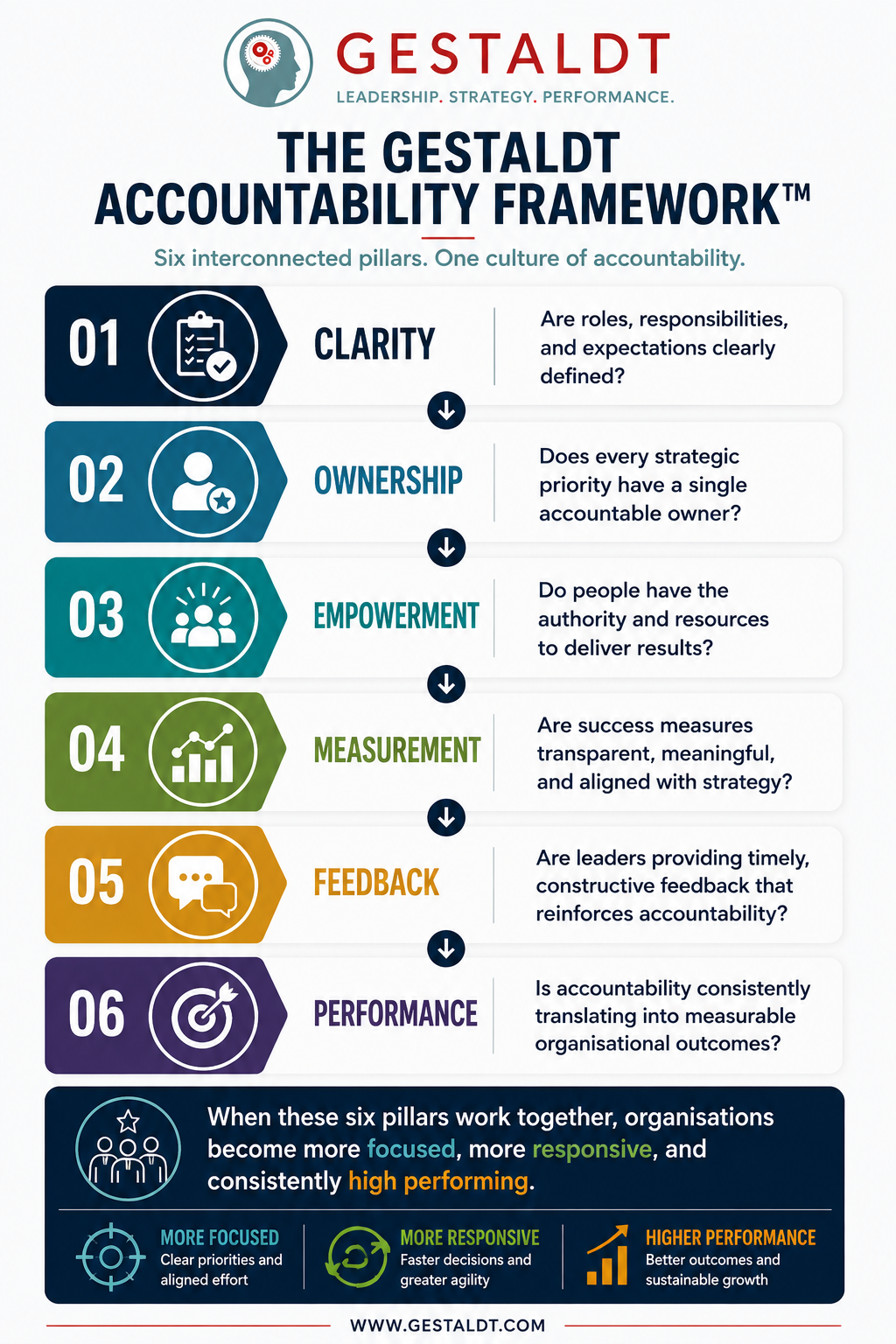
Executive Accountability Scorecard
Rate each statement from 1 (Strongly Disagree) to 5 (Strongly Agree).
Everyone understands their role in delivering strategy.
Major initiatives have clear owners.
Leaders make expectations explicit.
Employees have authority to make appropriate decisions.
Performance measures are aligned with business priorities.
Feedback is timely and constructive.
Accountability is applied consistently at every level.
Leaders model the behaviours they expect.
Teams collaborate effectively to achieve outcomes.
We celebrate results rather than activity.
Results
40–50: Accountability is a strategic strength.
30–39: Some accountability gaps may be limiting execution.
Below 30: Organisational performance is likely being affected by unclear ownership and inconsistent leadership.
Executive Case Study
A growing professional services firm approached Gestaldt after repeatedly missing strategic milestones despite having a highly capable workforce.
Our assessment revealed:
Overlapping responsibilities across senior leaders.
Inconsistent performance measures.
Delayed decisions due to unclear ownership.
A culture where teams were busy but not always aligned.
Using the Gestaldt Accountability Framework™, we helped redesign governance, clarify decision rights, and introduce organisation-wide accountability practices.
Within nine months, the organisation reported:
Faster delivery of strategic initiatives.
Improved cross-functional collaboration.
Clearer executive accountability.
Higher employee engagement.
Greater confidence in leadership.
The transformation was not driven by asking people to work harder. It was achieved by creating clarity about who was responsible for what.
Five Questions Every CEO Should Ask
Does every strategic initiative have one accountable owner?
Are our leaders modelling accountability every day?
Can employees explain how their work contributes to organisational strategy?
Are performance measures focused on outcomes or activity?
Would our customers notice if accountability improved?
These questions often reveal whether accountability is embedded in the organisation—or simply expected.
Accountability Is the Engine of Execution
Strategies succeed because people take ownership.
Transformation succeeds because leaders remain accountable.
Culture strengthens because expectations are consistently reinforced.
Organisations become resilient because accountability creates confidence, trust, and disciplined execution.
The organisations that outperform their competitors are not necessarily those with the smartest people or the largest budgets. They are those where accountability is woven into every aspect of leadership and organisational life.
Ready to Strengthen Accountability Across Your Organisation?
If your organisation is experiencing slow execution, unclear ownership, or inconsistent performance, it may be time to examine how accountability is designed—not just discussed.
Request an Organisational Accountability Assessment
Gestaldt's confidential assessment evaluates:
Leadership accountability.
Role clarity.
Decision rights.
Governance effectiveness.
Performance measurement.
Feedback culture.
Strategy execution.
Organisational alignment.
Together, we'll identify the barriers limiting accountability and develop practical strategies that improve execution, strengthen leadership, and accelerate organisational performance.
👉 Request Your Organisational Accountability Assessment Today
Organisational Resilience: The CEO's Blueprint for Building a Business That Thrives Through Disruption
Economic uncertainty, digital disruption, and changing workforce expectations are redefining business success. Discover how CEOs can build organisational resilience through leadership, culture, governance, capability, and strategic execution.
Resilience Is No Longer About Survival—It's About Sustainable Advantage
Not long ago, resilience was associated with crisis management. Organisations built contingency plans for unlikely events and hoped they would never need them.
Today, disruption is no longer the exception—it is the operating environment.
Economic volatility, technological advances, geopolitical tensions, cybersecurity threats, supply chain disruptions, climate-related events, and changing employee expectations have transformed the business landscape. The question is no longer whether disruption will occur, but how prepared organisations are to respond.
Some organisations emerge stronger from uncertainty. Others lose momentum, talent, customers, and market share.
The difference is rarely luck.
It is organisational resilience.
Resilient organisations do more than recover. They adapt, innovate, and continue creating value while others are reacting. They build leadership teams capable of making confident decisions, cultures that embrace change, governance that accelerates action, and capabilities that prepare people for an uncertain future.
At Gestaldt, we believe resilience is not a programme or a policy. It is an organisational capability that must be intentionally designed, developed, and sustained.
Why Resilience Has Become a Strategic Priority
The pace of change has accelerated beyond traditional planning cycles.
Business models evolve faster.
Customer expectations change continuously.
Technology reshapes entire industries.
Employees expect greater flexibility, purpose, and development.
Boards are demanding greater oversight of organisational risk and long-term sustainability.
In this environment, organisations that rely solely on annual strategic planning risk falling behind.
Resilient organisations embed adaptability into the way they lead, decide, collaborate, and execute.
The Seven Characteristics of Highly Resilient Organisations
1. Leadership Creates Confidence During Uncertainty
Employees look to leaders for clarity, consistency, and confidence when uncertainty increases.
Resilient leaders communicate openly, make informed decisions despite incomplete information, and provide direction without pretending to have every answer.
Leadership behaviour shapes organisational resilience more than any policy.
Related Reading:Executive Team Alignment: Why Your Leadership Team Is Holding Your Business Back (And How to Fix It)
2. Culture Encourages Adaptability
A resilient culture values learning over blame.
Employees feel safe to challenge assumptions, test new ideas, and respond quickly when circumstances change.
Cultures built on trust and accountability recover faster because people focus on solving problems rather than protecting themselves.
Related Reading:The Invisible Fuel of Business Growth: How Leadership Culture Drives Organisational Success
3. Strategy Remains Flexible
Long-term vision should remain stable.
Execution should remain adaptable.
Resilient organisations regularly review assumptions, monitor external trends, and adjust priorities without abandoning their strategic direction.
Flexibility is a sign of disciplined leadership—not indecision.
4. Governance Enables Fast Decisions
In times of disruption, slow governance becomes a competitive disadvantage.
Decision rights should be clear, escalation pathways defined, and accountability transparent.
Governance exists to accelerate informed decisions, not create unnecessary bureaucracy.
5. Capability Is Continuously Developed
Skills become outdated more quickly than ever before.
Resilient organisations invest in leadership development, digital capability, change management, and continuous learning.
Preparing people for future challenges is more effective than reacting after disruption occurs.
6. Execution Remains Disciplined
Resilience is not achieved through planning alone.
It depends on consistent execution.
High-performing organisations translate strategic priorities into measurable action while maintaining focus, accountability, and momentum.
Related Reading:Why Strategy Execution Fails: The 7 Hidden Barriers Most CEOs Never See
7. Performance Is Measured Beyond Financial Results
Revenue and profitability remain essential.
However, resilient organisations also monitor:
Leadership effectiveness
Employee engagement
Innovation capacity
Customer trust
Decision-making speed
Change readiness
Organisational agility
These indicators provide early warning signs long before financial performance is affected.
The Gestaldt Organisational Resilience Framework™
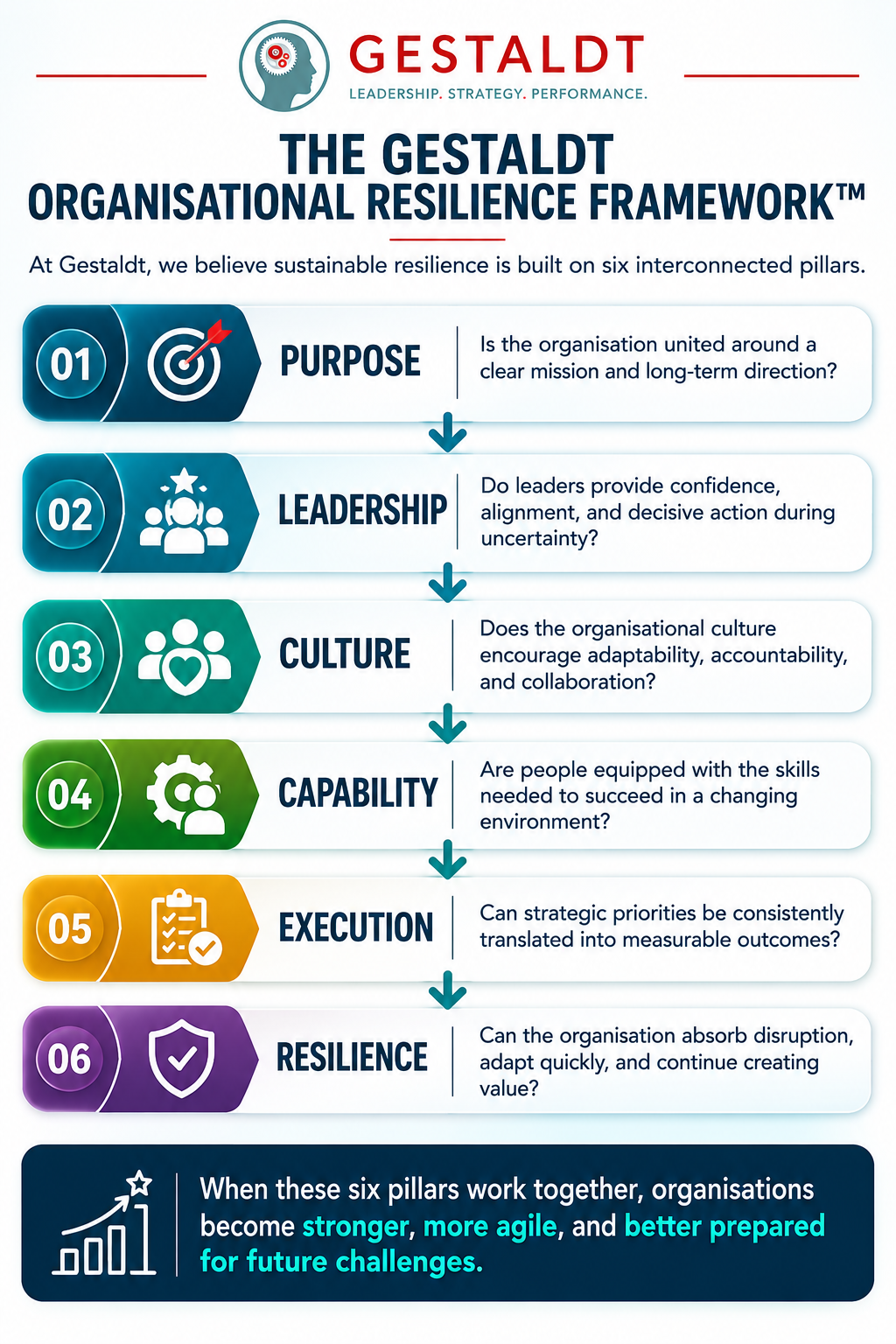
Executive Resilience Scorecard
Rate each statement from 1 (Strongly Disagree) to 5 (Strongly Agree).
Leaders communicate consistently during uncertainty.
Strategic priorities remain clear during change.
Employees embrace innovation and continuous improvement.
Decision-making is timely and well governed.
Learning and capability development are ongoing priorities.
Cross-functional collaboration is strong.
Strategic initiatives are executed effectively.
The organisation adapts quickly to market changes.
We measure organisational health beyond financial results.
We are confident in our ability to respond to future disruption.
Results
40–50: Your organisation demonstrates strong resilience.
30–39: Opportunities exist to strengthen organisational adaptability.
Below 30: Your organisation may be vulnerable to future disruption.
Executive Case Study
A diversified services organisation approached Gestaldt after experiencing repeated disruptions caused by changing market conditions and internal restructuring.
Although financial performance remained stable, executive leaders recognised growing signs of organisational fatigue:
Slower decision-making.
Declining employee engagement.
Increased turnover among key talent.
Difficulty executing strategic initiatives.
Gestaldt conducted an organisational resilience assessment and identified weaknesses in leadership alignment, governance, and capability development.
Working closely with the executive team, we introduced a resilience roadmap that strengthened leadership communication, clarified decision rights, and embedded continuous learning across the organisation.
Within twelve months, the organisation experienced:
Faster responses to market opportunities.
Improved executive collaboration.
Higher employee engagement.
Greater confidence in strategic execution.
Increased organisational agility.
Resilience became a competitive advantage rather than a defensive capability.
Five Questions Every CEO Should Ask
How quickly can our organisation adapt when conditions change?
Do our leaders inspire confidence during uncertainty?
Are we investing enough in future capability?
Does our governance accelerate or delay strategic decisions?
Would our employees describe our organisation as adaptable?
The answers reveal how prepared your organisation is for tomorrow's challenges.
The Future Belongs to Resilient Organisations
No organisation can predict every disruption.
But every organisation can improve its ability to respond.
Resilience is not built in moments of crisis. It is built through deliberate leadership, strong culture, effective governance, capable people, disciplined execution, and a commitment to continuous improvement.
Organisations that invest in resilience today will be better positioned to innovate, grow, and create lasting value tomorrow.
Ready to Strengthen Your Organisation's Resilience?
If your organisation is navigating uncertainty, preparing for transformation, or seeking sustainable growth, resilience should be at the centre of your leadership agenda.
Request an Organisational Resilience Assessment
Gestaldt's confidential assessment evaluates:
Leadership resilience.
Executive alignment.
Organisational culture.
Governance effectiveness.
Capability development.
Strategy execution.
Organisational agility.
Change readiness.
Together, we'll identify the strengths that will carry your organisation forward and the barriers that may be limiting future performance.

Decision Paralysis in the C-Suite: Why Great Leaders Make Slow Decisions (And How to Regain Strategic Agility)
Slow executive decision-making can cost organisations millions in missed opportunities, delayed execution, and declining competitiveness. Learn why decision paralysis develops, how it affects organisational performance, and the practical steps CEOs can take to build faster, more confident leadership teams.

The Cost of Waiting
A competitor launches a new product. Your organisation has the capability to respond, but approval takes weeks.
A customer requests a customised solution. Sales is ready, operations is willing, but leadership can't reach a decision.
A promising acquisition is identified. Due diligence is complete, yet the executive team delays. By the time a decision is made, the opportunity has disappeared.
These situations are more common than many leaders admit.
Organisations rarely lose their competitive edge because of one poor decision. More often, they lose it because of slow decisions.
In an environment defined by economic uncertainty, technological disruption, and rapidly changing customer expectations, speed has become a strategic advantage. Yet many executive teams are trapped in decision paralysis—where caution, complexity, and competing priorities delay action until opportunities are lost.
At Gestaldt, we have found that decision paralysis is rarely caused by a lack of intelligence or experience. It is usually a symptom of deeper organisational issues: unclear governance, misaligned leadership, risk-averse cultures, and ineffective decision-making processes.
The organisations that thrive are not those that make perfect decisions. They are the ones that make timely, informed, and accountable decisions.
Why Decision Speed Is Now a Competitive Advantage
Business cycles have accelerated dramatically.
Markets change in months rather than years.
Artificial intelligence reshapes industries almost overnight.
Customer expectations evolve continuously.
Regulatory landscapes shift with increasing frequency.
In this environment, organisations that hesitate risk becoming irrelevant.
Strategic agility is no longer a desirable leadership quality—it is an organisational necessity.
Research has consistently shown that organisations with effective decision-making processes outperform their peers in profitability, innovation, and long-term growth. They respond more quickly to market opportunities, allocate resources more effectively, and build greater confidence across their workforce.
Decision speed, however, should never be confused with recklessness. The objective is not faster decisions at any cost, but better decisions made without unnecessary delay.
Seven Hidden Causes of Decision Paralysis
1. Too Many Decisions Reach the Executive Team
Not every decision requires CEO approval.
When executives become involved in operational issues, strategic discussions become crowded with matters that should have been resolved elsewhere.
This creates bottlenecks, delays implementation, and distracts leaders from long-term priorities.
Executive Reflection
Are your executives making strategic decisions—or operational ones?
2. Governance Is Unclear
Who owns the decision?
Who provides input?
Who has final authority?
Without clearly defined governance, decisions circulate endlessly between committees, departments, and executives.
Good governance accelerates action by providing clarity, not bureaucracy.
3. Leaders Are Misaligned
When executives have different interpretations of organisational priorities, decision-making slows.
Instead of evaluating options against shared objectives, discussions become negotiations between competing interests.
Alignment transforms debate into productive decision-making.
4. Fear of Failure Overrides Strategic Thinking
High-performing organisations encourage calculated risk-taking.
Risk-averse organisations avoid difficult decisions altogether.
The result is stagnation.
Leaders must create an environment where informed experimentation is encouraged and learning is valued.
5. Data Overload Creates Analysis Paralysis
Modern organisations have access to unprecedented amounts of information.
The challenge is no longer obtaining data—it is knowing which data matters.
Executives who wait for perfect information often miss the opportunity to act.
The goal is to make decisions using the best available evidence, recognising that uncertainty will always exist.
6. Accountability Is Diffused
When everyone is responsible, no one is responsible.
Without clear ownership, decisions are delayed, implementation weakens, and momentum fades.
Accountability should be explicit at every stage of the decision-making process.
7. Organisational Culture Rewards Consensus Over Progress
Consensus has value, but it should not become a prerequisite for every decision.
Healthy executive teams encourage debate, seek diverse perspectives, and then commit to a clear course of action.
Progress requires confidence, not unanimity.
The Gestaldt Strategic Decision Agility Framework™
At Gestaldt, we believe high-quality decision-making is built on six interconnected pillars.
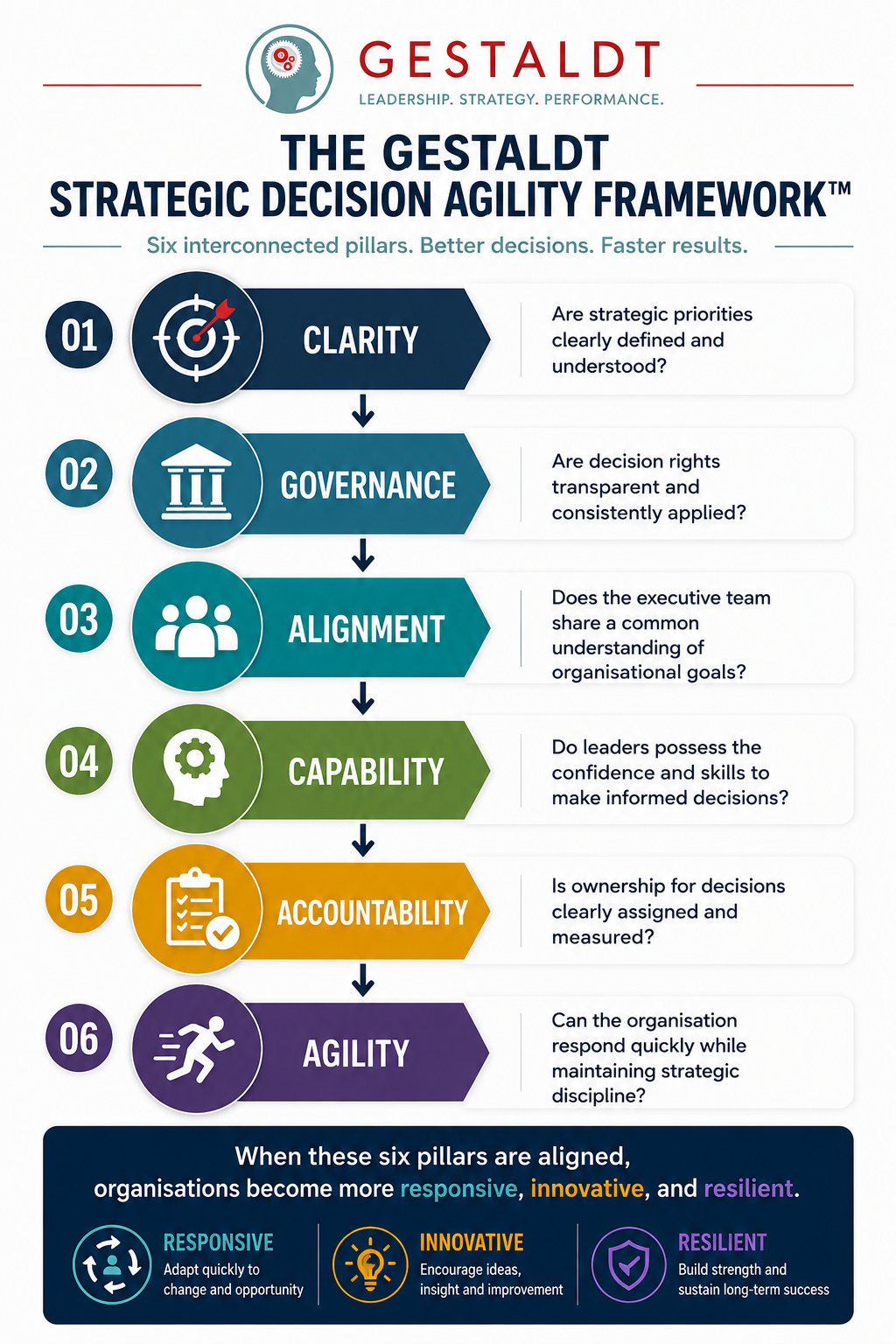
Executive Decision Agility Scorecard
Rate each statement from 1 (Strongly Disagree) to 5 (Strongly Agree).
Strategic priorities are clearly understood.
Decision rights are well defined.
Executive meetings result in timely decisions.
Leaders are comfortable making decisions with incomplete information.
Accountability for implementation is clear.
Governance supports rather than delays execution.
Departments collaborate effectively.
Decision-making is transparent.
We learn from decisions, whether successful or not.
Our organisation adapts quickly to change.
Results
40–50: Your organisation demonstrates strong decision agility.
30–39: Decision-making processes may be slowing performance.
Below 30: Decision paralysis is likely affecting strategic execution and organisational growth.
Case Study: Breaking the Decision Bottleneck
A large services organisation approached Gestaldt after a major transformation programme had stalled. Although the strategy was clear, executive meetings had become increasingly lengthy, decisions were repeatedly revisited, and implementation timelines continued to slip.
Our assessment identified three root causes:
Over-centralised decision-making.
Unclear governance and decision rights.
Inconsistent alignment on strategic priorities.
Gestaldt worked with the executive team to redesign governance structures, clarify accountability, and establish a disciplined decision-making framework.
Within nine months, the organisation reported:
Faster executive decision cycles.
Reduced project delays.
Greater cross-functional collaboration.
Improved confidence in leadership.
Stronger execution of strategic initiatives.
The organisation did not succeed because it made more decisions. It succeeded because it made better decisions, faster.
Five Questions Every CEO Should Ask
Before your next executive meeting, consider these questions:
Which decisions genuinely require executive attention?
Are our governance structures enabling or delaying action?
Do our leaders share the same understanding of strategic priorities?
Are we waiting for perfect information instead of acting on good evidence?
Does our culture reward informed action or excessive caution?
Your answers may reveal hidden constraints on organisational performance.
Strategic Agility Is a Leadership Capability
Markets will continue to change.
Technology will continue to evolve.
Uncertainty will remain.
The organisations that succeed will not be those with the most detailed plans. They will be those whose leaders can make confident, timely, and accountable decisions in the face of complexity.
Strategic agility is not about reacting faster than everyone else. It is about building an organisation where leadership, governance, culture, and execution work together to enable decisive action.
For CEOs, this is no longer simply a leadership skill. It is a strategic advantage.
Ready to Improve Executive Decision-Making?
If your organisation is experiencing delayed execution, prolonged decision cycles, or leadership misalignment, it may be time to evaluate how decisions are made.
Request a Strategic Decision Agility Assessment
Gestaldt's confidential executive assessment examines:
Decision-making effectiveness.
Leadership alignment.
Governance and decision rights.
Strategic clarity.
Organisational agility.
Accountability structures.
Strategy execution capability.
Together, we'll identify the barriers slowing your organisation and develop practical strategies to improve executive effectiveness and organisational performance.

Executive Team Alignment: Why Your Leadership Team Is Holding Your Business Back (And How to Fix It)
Even the strongest business strategy can fail if the executive team isn't aligned. Discover the hidden signs of executive misalignment, the impact on organisational performance, and the practical steps CEOs can take to build a leadership team that drives sustainable growth.

The Most Expensive Problem in Business Isn't Strategy—It's Executive Misalignment
Imagine sitting in a board meeting where every executive agrees with the strategy. The presentation is polished, the objectives are clear, and the budget has been approved. On paper, the organisation appears united.
Six months later, progress has stalled.
Projects are delayed, departments are working at cross-purposes, and employees are receiving conflicting messages from different leaders. Customer complaints are increasing, innovation has slowed, and the organisation is struggling to deliver the very strategy everyone supported.
What happened?
The strategy didn't fail.
The leadership team did.
One of the greatest misconceptions in business is that alignment means agreement. In reality, executive alignment is about far more than consensus. It is about shared purpose, consistent decision-making, mutual accountability, and the ability to lead the organisation as one cohesive team.
At Gestaldt, we have seen organisations invest heavily in strategy, technology, and transformation programmes, only to achieve disappointing results because their executive teams were not operating in alignment.
If your organisation is experiencing slower growth, declining engagement, or inconsistent execution, the problem may not be your strategy—it may be the way your leadership team works together.
Why Executive Alignment Matters More Than Ever
Today's executives are expected to lead through unprecedented complexity.
Economic uncertainty.
Artificial intelligence.
Digital transformation.
Regulatory change.
Hybrid work.
Talent shortages.
Customer expectations that evolve almost daily.
These pressures require leadership teams that can make fast, informed decisions while maintaining strategic focus.
When executive teams are aligned, organisations respond with confidence and agility. When they are not, uncertainty spreads throughout the business.
Research consistently shows that organisations with aligned leadership teams are more likely to execute strategy successfully, retain top talent, and outperform competitors. Alignment improves decision quality, strengthens collaboration, and builds trust across every level of the organisation.
The Hidden Cost of Executive Misalignment
Misalignment rarely announces itself with dramatic conflict. More often, it appears in subtle but costly ways.
Decisions Take Too Long
Simple decisions require multiple meetings because leaders lack clarity or confidence. Opportunities are missed while competitors move faster.
Departments Compete Instead of Collaborate
Functional leaders optimise their own objectives rather than organisational outcomes. Silos develop, reducing efficiency and innovation.
Employees Receive Mixed Messages
When executives communicate different priorities, employees become confused about what matters most, leading to inconsistent execution.
Accountability Becomes Blurred
Without shared ownership, responsibility shifts between teams and initiatives lose momentum.
High Performers Become Frustrated
Talented employees are often the first to leave environments where leadership appears fragmented or indecisive.
The financial cost of these issues is significant, but the cultural cost can be even greater.
Seven Warning Signs Your Executive Team Is Out of Alignment
1. Meetings Produce Discussion Instead of Decisions
If strategic meetings end with more questions than answers, alignment may be lacking.
2. Priorities Change Constantly
Employees struggle to understand what is truly important because leadership messages continue to evolve.
3. Business Units Operate Independently
Departments optimise their own performance rather than contributing to shared organisational goals.
4. Strategic Initiatives Lose Momentum
Projects begin with enthusiasm but gradually lose executive sponsorship and organisational focus.
5. Conflict Remains Unresolved
Healthy debate strengthens leadership teams. Avoiding difficult conversations weakens them.
6. Leadership Behaviours Are Inconsistent
When executives model different values and expectations, organisational culture becomes fragmented.
7. Employees Lack Confidence in Leadership
Trust declines when leaders appear disconnected or unable to make timely decisions.
Why High-Performing Leaders Still Become Misaligned
Executive misalignment is rarely caused by incompetence.
More often, it develops as organisations grow and become more complex.
Common causes include:
Rapid organisational growth
Mergers and acquisitions
Leadership transitions
Conflicting performance metrics
Poor governance
Inadequate communication
Unclear decision rights
Without intentional effort, even experienced leadership teams drift apart over time.
The Gestaldt Executive Alignment Framework™
At Gestaldt, we believe executive alignment is built on six interconnected pillars.
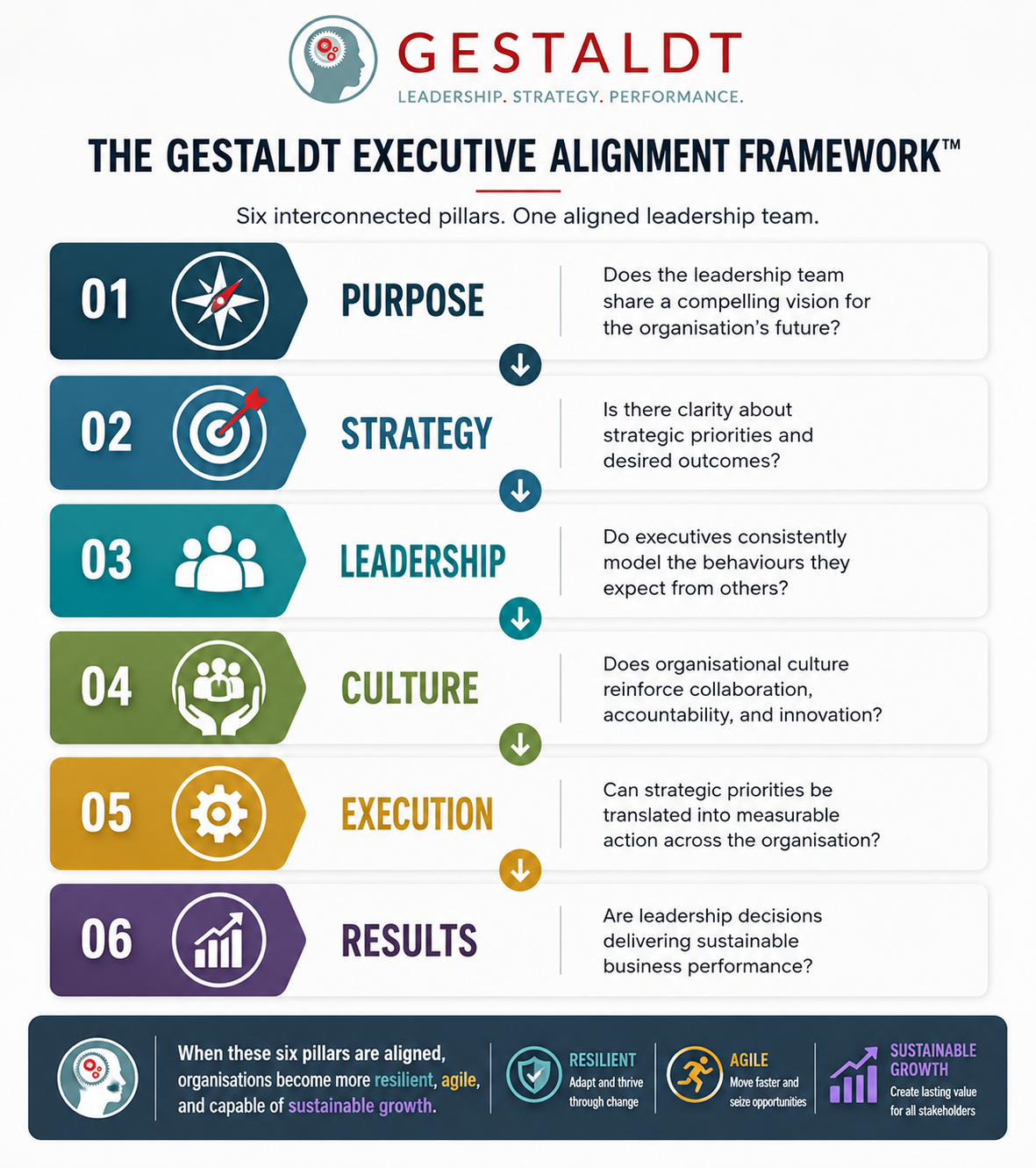
Executive Alignment Self-Assessment
Rate each statement from 1 (Strongly Disagree) to 5 (Strongly Agree).
Our executive team communicates a consistent vision.
Strategic priorities are understood across the organisation.
Leaders make decisions quickly and collaboratively.
Accountability for strategic initiatives is clear.
Departments work together effectively.
Leadership behaviours reflect organisational values.
Conflict is addressed constructively.
Employees trust senior leadership.
Meetings result in timely decisions.
Our strategy is consistently translated into action.
Scoring
40–50: Your executive team demonstrates strong alignment.
30–39: Alignment gaps may be affecting performance.
Below 30: Executive misalignment is likely limiting organisational effectiveness and growth.
A Real-World Example
A national organisation engaged Gestaldt after several years of declining performance despite repeated strategic planning exercises.
An executive alignment assessment revealed:
Different interpretations of strategic priorities
Confeting departmental objectives
Inconsistent communication
Weak accountability structures
Working with the executive team, Gestaldt facilitated leadership alignment sessions, clarified governance, and introduced shared performance measures.
Within twelve months, the organisation experienced:
Faster strategic decision-making
Improved collaboration across business units
Greater employee confidence in leadership
More consistent execution of strategic initiatives
The strategy had not changed.
The leadership team had.
Five Questions Every CEO Should Ask
Before approving another strategic initiative, ask your executive team:
Can every executive explain our strategy in the same way?
Do our behaviours reinforce the culture we want to build?
Are decisions made quickly and consistently?
Do we hold one another accountable for outcomes?
Would our employees describe us as one leadership team?
The answers often reveal whether alignment is a strength—or a hidden risk.
Alignment Is a Competitive Advantage
Organisations don't outperform competitors because they have the smartest executives.
They outperform because their leaders work together with clarity, trust, and discipline.
Executive alignment accelerates strategy execution, strengthens culture, improves decision-making, and creates the conditions for sustainable growth.
In today's rapidly changing business environment, alignment is no longer a leadership aspiration. It is a strategic necessity.
Ready to Strengthen Your Executive Team?
If your organisation is experiencing slower decision-making, inconsistent execution, or competing priorities, the issue may not be your strategy—it may be executive alignment.
Request an Executive Alignment Assessment
Gestaldt's confidential assessment helps executive teams evaluate:
Leadership alignment
Strategic clarity
Governance effectiveness
Decision-making
Accountability
Team dynamics
Organisational culture
Strategy execution capability
Together, we'll identify the barriers limiting your leadership team's effectiveness and develop practical strategies to improve organisational performance.
👉 Request Your Executive Alignment Assessment Today
Why Business Transformation Fails: The CEO's Guide to Leading Sustainable Organisational Change
More than two-thirds of business transformation initiatives fail to achieve their intended outcomes. Discover the hidden reasons why transformation stalls and learn how CEOs can build organisations that successfully adapt, execute strategy, and sustain long-term growth.
Change Is Easy. Transformation Is Not.
Every CEO understands that change is inevitable.
Markets evolve.
Customer expectations shift.
Technology disrupts entire industries.
Economic uncertainty reshapes investment decisions.
New competitors emerge seemingly overnight.
In response, organisations launch ambitious transformation programmes designed to modernise operations, improve performance, and secure future growth.
Yet despite significant investment, most transformations fail to deliver lasting value.
Budgets are exceeded.
Timelines slip.
Employee engagement declines.
Momentum fades.
Eventually, the organisation quietly returns to old behaviours.
The strategy wasn't the problem.
The technology wasn't the problem.
Often, the organisation itself wasn't ready for transformation.
Successful transformation requires far more than introducing new systems or restructuring departments. It demands aligned leadership, a culture that embraces change, clear governance, capable people, disciplined execution, and an unwavering focus on long-term value creation.
This article explores the seven reasons business transformation fails—and what executive leaders can do differently.
Why Transformation Has Become a Boardroom Priority
Business transformation is no longer optional.
Artificial intelligence, digital disruption, geopolitical instability, shifting workforce expectations, sustainability demands, and changing customer behaviours require organisations to evolve continuously.
Transformation today includes:
Leadership transformation
Culture transformation
Operating model redesign
Customer experience transformation
Sustainability transformation
Workforce transformation
The question is no longer whether organisations should transform.
It is whether they can transform successfully.
1. Leadership Alignment Breaks Down Before Transformation Begins
Most transformation programmes start with executive enthusiasm.
The board approves the investment.
Leadership launches the initiative.
Employees attend town halls.
The vision is communicated.
Yet beneath the surface, executive alignment is often incomplete.
Different leaders interpret transformation differently.
Some view it as technology.
Others view it as restructuring.
Others see it as cost reduction.
Without genuine alignment, every subsequent decision becomes inconsistent.
Signs of Misalignment
Conflicting priorities
Inconsistent communication
Slow decision-making
Departmental silos
Resource competition
Transformation requires one leadership voice.
Not many.
2. Culture Quietly Rejects Change
Technology changes quickly.
Culture changes slowly.
Many organisations attempt digital transformation while maintaining cultures built around stability, hierarchy and risk avoidance.
Employees hear leaders speak about innovation.
Yet mistakes are punished.
New ideas are discouraged.
Approvals multiply.
Experimentation disappears.
Eventually employees stop engaging.
Transformation becomes another corporate initiative that "will pass."
Culture determines whether transformation succeeds.
Ask Yourself
Does your culture reward:
✔ Innovation
✔ Collaboration
✔ Accountability
✔ Continuous learning
✔ Customer focus
If not, transformation resistance is inevitable.
Related Reading
The Invisible Fuel of Business Growth: How Leadership Culture Drives Organisational Success
3. Organisations Focus on Technology Instead of People
One of the biggest misconceptions about transformation is that technology creates change.
People create change.
Technology simply enables it.
Executives often invest millions in:
ERP systems
Artificial Intelligence
CRM platforms
Automation
Analytics
Yet relatively little investment goes into preparing people.
Without capability development:
Employees resist.
Managers struggle.
Leadership loses confidence.
Transformation slows.
Successful organisations invest equally in technology and human capability.
4. Middle Management Is Forgotten
Transformation is rarely delivered by executives.
It is delivered by managers.
Middle managers translate strategy into operational behaviour.
If they don't understand transformation...
Neither will employees.
Unfortunately many organisations communicate transformation to managers instead of involving them.
The result:
Confusion
Inconsistent implementation
Low engagement
Resistance
High-performing organisations make middle management transformation champions.
5. Governance Is Too Weak—or Too Bureaucratic
Transformation requires disciplined governance.
Too little governance creates chaos.
Too much governance creates paralysis.
Successful organisations establish:
Clear decision rights
Defined accountability
Transparent reporting
Rapid escalation
Agile decision-making
Governance should accelerate transformation—not slow it.
6. Organisations Measure Activity Instead of Impact
Transformation dashboards often report:
✔ Workshops completed
✔ Systems implemented
✔ Training delivered
These are activity metrics.
Executives should instead measure:
Customer experience
Employee engagement
Leadership capability
Innovation
Strategic execution
Organisational agility
Decision speed
Transformation should improve organisational performance—not simply complete projects.
7. Transformation Is Treated as a Project Instead of a Capability
Projects finish.
Transformation doesn't.
The world's highest-performing organisations don't transform every five years.
They build organisations capable of continuous adaptation.
Transformation becomes part of leadership.
Part of culture.
Part of governance.
Part of everyday decision-making.
This is what creates long-term resilience.
The Gestaldt Sustainable Transformation Framework™
At Gestaldt, we believe sustainable transformation rests on six interconnected pillars.
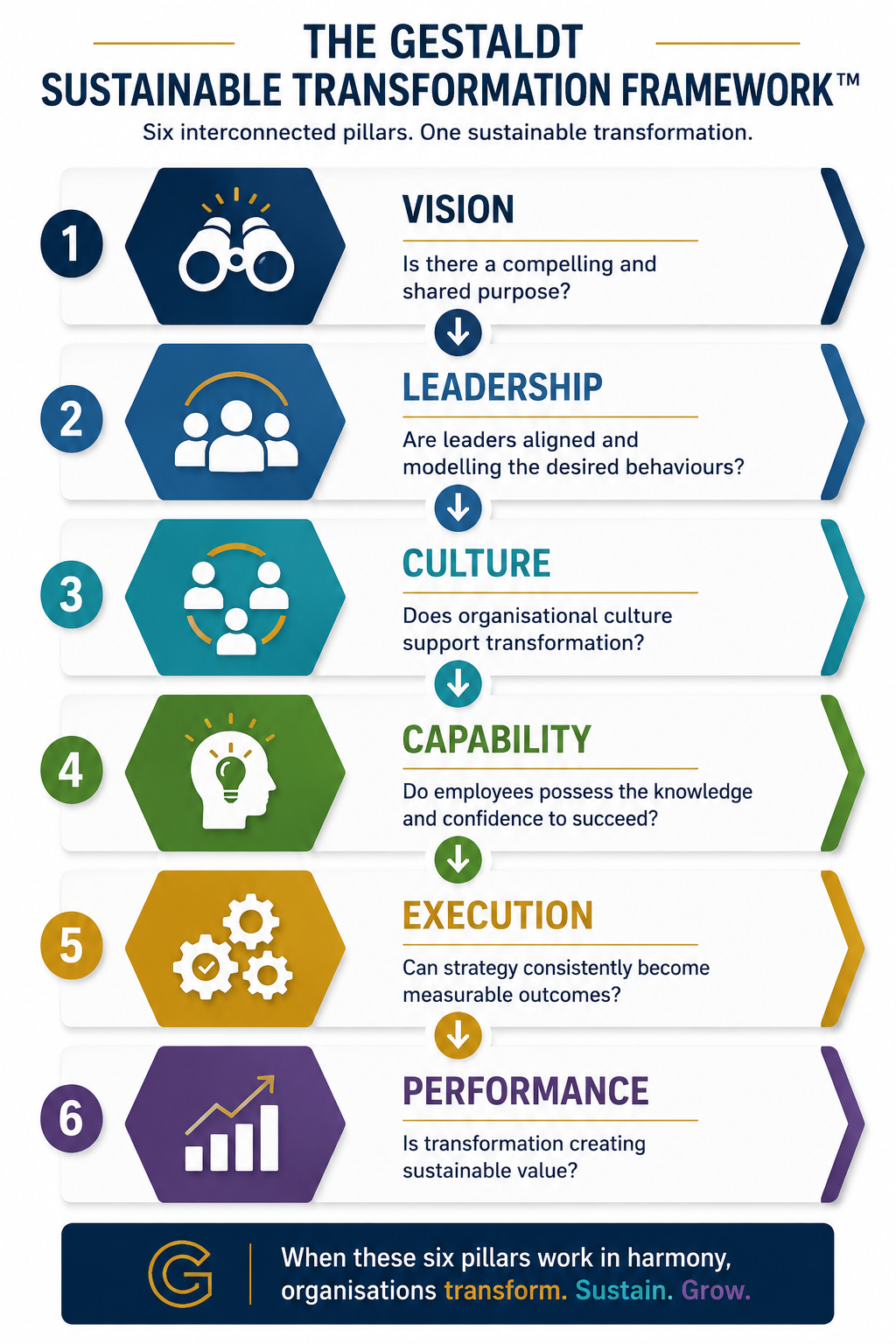
Executive Transformation Health Check
Score each statement from 1 (Strongly Disagree) to 5 (Strongly Agree)
Leaders communicate a consistent transformation vision.
Employees understand why change is necessary.
Managers actively support transformation.
Our culture encourages innovation.
Decision-making is fast.
Accountability is clear.
We measure transformation outcomes.
Employees possess future-ready capabilities.
Leadership embraces continuous learning.
Transformation has improved organisational performance.
Results
40–50
Transformation is becoming a competitive advantage.
30–39
Transformation risks are emerging.
Below 30
Transformation requires immediate leadership attention.
Five Questions Every CEO Should Ask
Before approving another transformation initiative, ask:
Are our leaders truly aligned?
Does our culture support transformation?
Are our people ready?
Can our governance accelerate change?
How will we measure success?
If these questions cannot be answered confidently, transformation risk increases significantly.
Transformation Is Ultimately About Leadership
Technology changes systems.
Leadership changes organisations.
The most successful CEOs understand that transformation isn't an IT initiative.
It isn't a restructuring exercise.
It isn't a communications campaign.
It is an organisational capability.
When leadership, culture, governance, capability, and execution align, organisations become resilient, adaptable, and prepared for whatever comes next.
Ready to Lead Sustainable Transformation?
Every organisation faces transformation challenges.
The difference lies in identifying them before they become barriers to growth.
Request a Business Transformation Diagnostic
Our executive consultants will help you assess:
✔ Leadership alignment
✔ Transformation readiness
✔ Organisational culture
✔ Governance effectiveness
✔ Strategy execution capability
✔ Leadership capability
✔ Organisational agility
Together, we'll identify the obstacles preventing sustainable transformation and develop practical strategies that deliver measurable business outcomes.
👉 Schedule your confidential Business Transformation Diagnostic today.

Why High-Performing Organisations Suddenly Stop Growing: The CEO's Blind Spot
Why do successful organisations suddenly lose momentum? Discover the seven hidden organisational barriers that silently stall growth, reduce performance, and prevent strategy execution—and learn how executive leaders can regain competitive advantage.

Success Can Become Your Greatest Risk
Growth is exciting.
Revenue increases.
New markets open.
The workforce expands.
Customers multiply.
Confidence rises.
Then something changes.
The organisation isn't in crisis—but it isn't accelerating either.
Projects take longer to complete.
Decisions slow down.
Innovation loses momentum.
Departments begin protecting their own priorities.
Top performers quietly leave.
Customer satisfaction starts to decline.
The business still appears healthy from the outside, yet internally, leaders know something isn't right.
For many CEOs, this is the most dangerous stage of organisational growth—not because the problems are visible, but because they are hidden beneath the surface.
The instinctive response is often to develop a new strategy, restructure the organisation, or invest in new technology. Yet in many cases, the real issue isn't the strategy itself. It's the organisation's ability to execute, adapt, and grow in alignment.
At Gestaldt, we've found that sustained growth depends on more than a strong business plan. It requires leadership alignment, a healthy organisational culture, effective governance, and the ability to translate strategic intent into consistent action.
Let's explore the seven hidden barriers that quietly prevent high-performing organisations from reaching their next level of success.

1. Leadership Alignment Is Only Skin Deep
"We're aligned."
Most executive teams believe they are.
Yet when asked individually about the organisation's top priorities, success measures, or strategic risks, their answers often differ.
Alignment is more than agreeing during a strategy session. It means leaders consistently communicate the same vision, make decisions using the same principles, and reinforce the same priorities throughout the organisation.
When alignment is weak, mixed messages filter through the business, creating confusion, duplicated effort, and competing priorities.
Questions Every CEO Should Ask
Can every executive clearly articulate the organisation's top three strategic priorities?
Are leaders making decisions using the same criteria?
Does every business unit understand how its work contributes to the strategy?
Without alignment at the top, execution breaks down across the organisation.
2. Culture Quietly Rejects the Strategy
Organisations rarely fail because of poor strategies.
They fail because everyday behaviours don't support those strategies.
A company may aspire to become more innovative while rewarding risk avoidance.
It may seek greater collaboration while maintaining siloed structures.
It may promote accountability while tolerating inconsistent performance.
These contradictions create friction between intention and execution.
As Peter Drucker famously said:
"Culture eats strategy for breakfast."
A healthy organisational culture doesn't happen by chance. It is intentionally shaped by leadership behaviours, governance structures, and shared values.
Related Reading:The Invisible Fuel of Business Growth: How Leadership Culture Drives Organisational Success
3. Complexity Has Replaced Clarity
As organisations grow, complexity grows with them.
More products.
More meetings.
More reporting.
More approvals.
More initiatives.
Before long, employees spend more time managing processes than creating value.
One of the biggest threats to sustained growth isn't competition—it's organisational complexity.
High-performing organisations simplify relentlessly.
They identify what matters most, eliminate unnecessary work, and focus resources on the initiatives that create the greatest strategic value.
4. Middle Managers Become the Missing Link
Middle managers are often expected to implement strategic change without being meaningfully involved in shaping it.
This creates a disconnect between executive intent and operational reality.
Employees don't execute strategy because executives communicate it.
They execute it because managers translate it into daily priorities.
Organisations that consistently outperform invest heavily in developing middle leadership capability, communication skills, and change leadership.
5. Growth Has Outpaced Leadership Capability
Many organisations invest heavily in systems and technology but overlook leadership capability.
The skills required to lead a 100-person organisation differ significantly from those needed to lead a 5,000-person enterprise.
Leadership development cannot remain static while the organisation evolves.
Future-ready organisations continuously strengthen executive capability in:
Strategic thinking
Decision-making
Change leadership
Innovation
Collaboration
Emotional intelligence
Without leadership growth, organisational growth inevitably slows.
6. You're Measuring Yesterday Instead of Tomorrow
Most executive dashboards focus on lagging indicators.
Revenue.
Profit.
Market share.
Operational costs.
While essential, these metrics reveal what has already happened.
Leading organisations also monitor indicators that predict future performance.
Examples include:
Leadership alignment
Employee engagement
Innovation pipeline
Customer advocacy
Decision-making speed
Organisational agility
Change readiness
These measures provide early warning signs long before financial performance begins to decline.
7. You're Solving Symptoms Instead of Root Causes
Revenue slows.
So marketing budgets increase.
Employee turnover rises.
So salaries increase.
Projects fail.
So governance becomes more bureaucratic.
Often these interventions address symptoms rather than underlying organisational issues.
True transformation begins by identifying root causes.
Leadership.
Culture.
Capability.
Governance.
Execution.
These are the systems that determine long-term organisational performance.
The Gestaldt Growth Performance Model™
At Gestaldt, we believe sustainable business growth depends on five interconnected pillars:
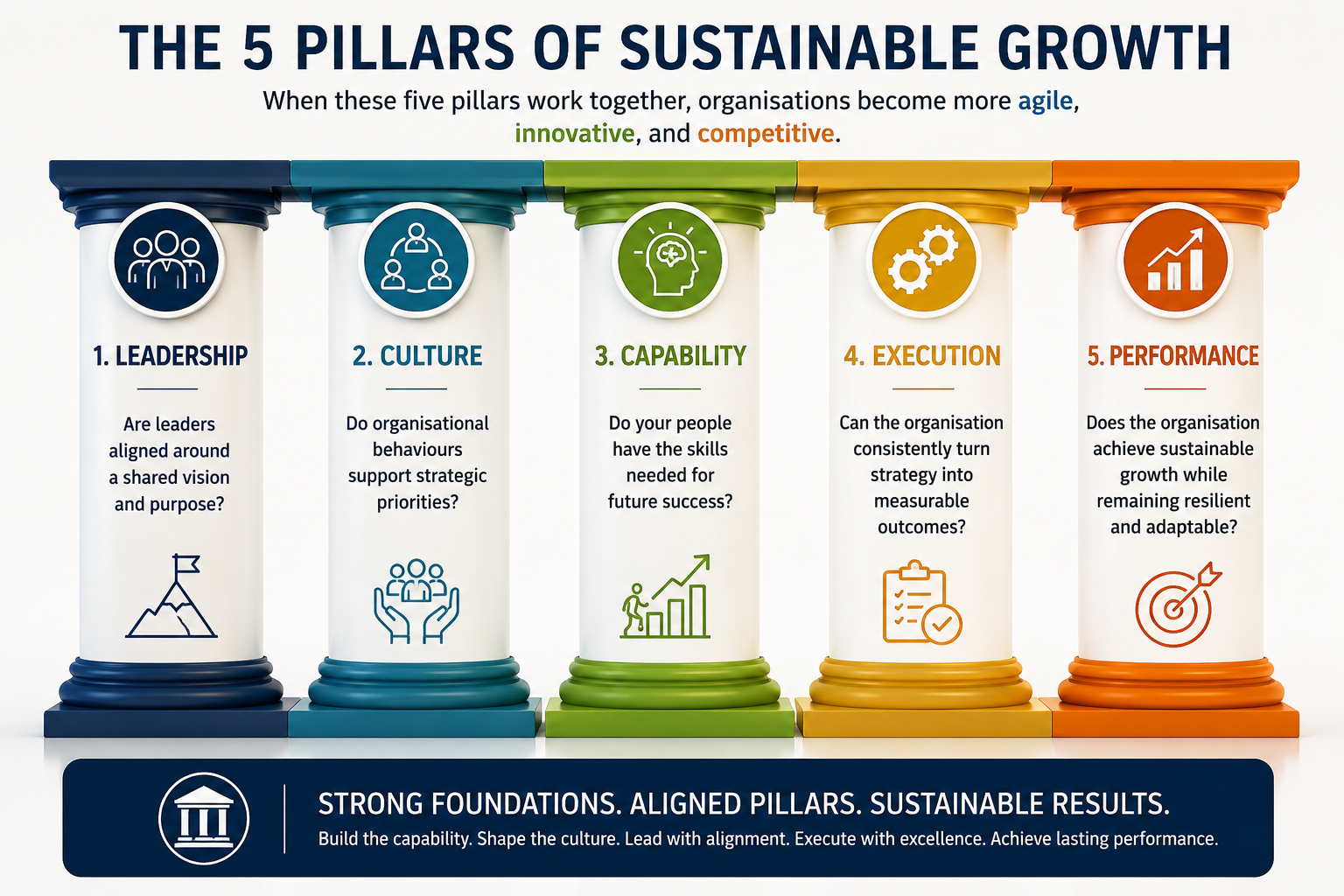
Executive Self-Assessment
Is Your Organisation Quietly Losing Momentum?
Score your organisation from 1 (Strongly Disagree) to 5 (Strongly Agree):
Our executive team consistently communicates the same priorities.
Employees understand how their work contributes to our strategy.
Our culture encourages accountability and innovation.
We execute strategic initiatives on time.
We measure leading indicators, not only financial results.
Leaders adapt quickly to change.
Our middle managers actively drive transformation.
Decision-making is fast and effective.
Leadership capability keeps pace with organisational growth.
Our strategy consistently translates into measurable business results.
Your Score
40–50: Your organisation is well positioned for sustainable growth.
30–39: Warning signs are emerging. Small issues may become significant barriers if left unaddressed.
Below 30: Your organisation may be experiencing hidden execution challenges that require immediate attention.
Sustainable Growth Isn't an Accident
The organisations that outperform their competitors over decades share one common characteristic.
They don't simply develop better strategies.
They build organisations capable of executing them.
For CEOs, the greatest blind spot is often assuming that growth challenges originate in the market.
More often than not, the answers lie within the organisation itself.
Leadership alignment.
Culture.
Capability.
Governance.
Execution.
These are the true drivers of sustainable performance.
Ready to Discover What's Holding Your Organisation Back?
Growth challenges rarely resolve themselves.
The sooner hidden barriers are identified, the sooner meaningful transformation can begin.

Request a Complimentary Executive Growth Diagnostic
In a confidential executive consultation, Gestaldt will help you assess:
Leadership alignment
Strategy execution capability
Organisational culture
Governance effectiveness
Change readiness
Leadership capability
Performance barriers
Together, we'll identify the issues limiting your organisation's growth and develop practical strategies to unlock its full potential.
👉 Schedule your Executive Growth Diagnostic today and take the first step towards sustainable organisational success.

Why Strategy Execution Fails: The 7 Hidden Barriers Most CEOs Never See
Most business leaders don't struggle with strategy—they struggle with execution. Discover the seven hidden barriers that prevent organisations from turning ambitious plans into measurable results, and learn how CEOs can close the gap between strategy and performance.

The Strategy Illusion
Every year, leadership teams invest substantial time and resources into strategic planning. Executive retreats are held, vision statements are refined, objectives are agreed upon, and ambitious targets are set.
Yet months later, many organisations find themselves asking the same question:
"Why aren't we seeing the results we expected?"
The truth is that most organisations don't have a strategy problem. They have an execution problem.
Research consistently shows that the majority of strategic initiatives fail to achieve their intended outcomes. While strategies often look impressive on paper, execution breaks down when organisations fail to align leadership, culture, governance, capabilities, and accountability.
At Gestaldt, we've observed a recurring pattern across industries: the barriers that derail execution are often invisible to leadership until performance begins to suffer.
Here are the seven hidden barriers that prevent strategy from becoming reality.
Barrier 1: Leadership Teams Are Not Truly Aligned
The Silent Killer of Strategic Success
Many executive teams believe they are aligned because they attended the same planning sessions and approved the same strategic objectives.
However, alignment is not agreement.
True alignment means leaders share a common understanding of priorities, outcomes, responsibilities, risks, and decision-making principles.
When executives interpret strategy differently, organisations experience:
Conflicting priorities
Mixed messages to employees
Departmental silos
Slower decision-making
Resource misallocation
The result is confusion throughout the organisation.
Key Question
Can every member of your executive team clearly articulate the organisation's top three strategic priorities in exactly the same way?
If not, execution risks are already emerging.
Related Reading:
Read our article on leadership culture and organisational performance:
The Invisible Fuel of Business Growth: How Leadership Culture Drives Organisational Success
Barrier 2: Culture Is Working Against the Strategy
Strategy Doesn't Fail—Culture Rejects It
One of the most underestimated barriers to execution is organisational culture.
A company may have a brilliant growth strategy, but if its culture discourages innovation, collaboration, accountability, or change, execution stalls.
As management expert Peter Drucker famously observed:
"Culture eats strategy for breakfast."
Many organisations attempt transformation while maintaining behaviours that reward the status quo.
Signs of cultural resistance include:
Fear of failure
Risk avoidance
Low accountability
Resistance to change
Internal politics
Without cultural alignment, even the most sophisticated strategies struggle to gain traction.
Related Reading:
Explore how organisational culture influences performance and growth in:
The Invisible Fuel of Business Growth: How Leadership Culture Drives Organisational Success
Barrier 3: Too Many Priorities Create Strategic Paralysis
When Everything Is Important, Nothing Is Important
Leadership teams often attempt to tackle too many strategic initiatives simultaneously.
Growth initiatives.
Digital transformation.
Culture change.
Talent development.
ESG commitments.
Customer experience improvements.
Operational excellence.
While each initiative may be valuable, pursuing too many priorities creates organisational overload.
Employees become confused about where to focus their efforts.
Resources become diluted.
Momentum disappears.
High-performing organisations understand the power of focus.
They identify a small number of critical priorities and align resources accordingly.
Practical Reality
If your organisation currently has more than five major strategic initiatives competing for attention, execution complexity is likely increasing significantly.
Barrier 4: Accountability Is Unclear
The Ownership Gap
One of the most common execution failures occurs when responsibility is shared by everyone and owned by no one.
Strategic objectives frequently appear on executive dashboards without clear accountability structures.
Questions leaders should ask include:
Who owns this initiative?
What outcomes are expected?
How will progress be measured?
What happens if milestones are missed?
When accountability is unclear:
Decisions are delayed
Deadlines slip
Problems remain unresolved
Progress becomes difficult to track
Successful organisations establish clear ownership and measurable outcomes at every level of execution.
Barrier 5: Middle Management Is Excluded From the Strategy
The Forgotten Layer of Execution
Many strategies fail because executives focus on designing the strategy but neglect the people responsible for delivering it.
Middle managers translate strategy into operational reality.
They shape employee engagement.
They manage performance.
They drive adoption.
Yet they are often informed rather than involved.
This creates a disconnect between strategic intent and operational execution.
The organisations that execute effectively actively engage middle management throughout the strategy lifecycle.
They become champions of change rather than passive recipients of directives.

Barrier 6: Organisations Underestimate Change Fatigue
People Can Only Absorb So Much Change
Today's workforce is navigating unprecedented levels of disruption.
Digital transformation.
Economic uncertainty.
Hybrid work.
Artificial intelligence.
Market volatility.
Leadership changes.
Employees are being asked to adapt continuously.
Many executives underestimate the cumulative impact of change fatigue.
When organisations launch multiple initiatives without considering employee capacity, engagement declines and resistance increases.
Symptoms include:
Lower productivity
Increased turnover
Reduced innovation
Change resistance
Burnout
Effective execution requires organisations to manage change as carefully as they manage strategy.
Related Reading:
Explore how leaders can navigate uncertainty in:
Thriving Amid Uncertainty: How C-Suite Leaders Can Navigate Economic Volatility
Barrier 7: Progress Is Measured Too Late
What Gets Measured Gets Managed
Many organisations rely exclusively on lagging indicators such as:
Revenue growth
Profitability
Market share
Customer retention
While important, these metrics reveal problems after they occur.
Successful strategy execution requires leading indicators that provide early warning signals.
Examples include:
Employee engagement scores
Leadership alignment metrics
Change adoption rates
Customer sentiment
Project milestone completion
By monitoring leading indicators, executives can identify execution risks before they impact business performance.
A Framework for Closing the Execution Gap
At Gestaldt, we believe successful execution requires alignment across five critical dimensions:
The Gestaldt Strategy Execution Framework™
Leadership Alignment
Do leaders share a common understanding of priorities and outcomes?
Culture Alignment
Do organisational behaviours support strategic objectives?
Capability Alignment
Do employees possess the skills required for execution?
Governance Alignment
Are decision-making processes clear and effective?
Accountability Alignment
Are responsibilities clearly defined and measured?
When these five dimensions operate in harmony, strategy moves from aspiration to achievement.
The Cost of Ignoring Execution
Poor execution doesn't simply delay results.
It creates measurable business consequences:
Lost revenue opportunities
Increased operating costs
Talent attrition
Customer dissatisfaction
Competitive disadvantage
Reduced investor confidence
Perhaps most importantly, repeated execution failures erode trust in leadership.
Employees become sceptical.
Stakeholders lose confidence.
Future transformation efforts become increasingly difficult.
The CEO's Challenge
The organisations that outperform their competitors are not necessarily those with the most innovative strategies.
They are the organisations that consistently execute.
The challenge for today's leaders is not creating another strategic plan.
It is identifying the hidden barriers preventing existing strategies from succeeding.
The sooner those barriers become visible, the sooner organisations can unlock sustainable growth.
Ready to Discover What's Blocking Your Strategy?
Many execution challenges remain hidden until performance begins to suffer.
Gestaldt helps executive teams identify the barriers preventing strategy from translating into measurable business results.
Request a Strategy Execution Diagnostic
Our consultants will help you assess:
✔ Leadership alignment
✔ Organisational culture
✔ Governance effectiveness
✔ Change readiness
✔ Accountability structures
✔ Execution capability
Schedule a confidential consultation and discover where your strategy may be breaking down before it impacts performance.

From Strategy to Execution: Closing the Gap in Organisations
Bridging the gap between strategy and execution is the key to lasting success. Learn how to turn great plans into measurable results that drive performance.

You’ve got a brilliant strategy on paper—visionary, data-backed, and full of promise. But when it comes to execution, things stall, teams lose momentum, and results fall short. Sound familiar? You’re not alone. The strategy–execution gap is one of the biggest silent killers of organisational performance.
Think of a strategy as a blueprint for a skyscraper—it’s elegant and ambitious. But without skilled builders, the right materials, and clear direction, it remains just that: a drawing.
Bridging the gap between strategy and execution is what separates thriving organisations from those stuck in perpetual “planning mode.” In this article, we’ll unpack why execution so often fails, what leading companies are doing differently, and how leaders can turn strategic vision into measurable action.
By the end, you’ll have a roadmap to close the gap and build a culture that delivers—consistently.
1. Why the Strategy–Execution Gap Exists
It’s estimated that over 60% of strategies fail at the execution stage, according to Harvard Business Review. The problem isn’t the lack of good ideas—it’s the lack of alignment and follow-through.
Common culprits include:
Poor communication between leadership and frontline teams
Lack of clarity on ownership and accountability
Misaligned KPIs and incentives
Limited capacity or resources to deliver on goals
Tip: Translate every strategic objective into specific, measurable outcomes. Make sure every team member knows how their work contributes to the bigger picture.
Quote: “Strategy without execution is hallucination.” — Thomas Edison
2. Turning Strategy into Actionable Goals
A vision is inspiring—but it’s not actionable until it’s broken down into achievable milestones.
High-performing organisations use OKRs (Objectives and Key Results) or similar frameworks to make strategies tangible. Each department defines outcomes linked directly to corporate priorities, ensuring visibility and accountability across all levels.
Example: When a South African financial services firm adopted OKRs, it reduced project overlap by 25% and improved cross-team collaboration dramatically within six months.
Tip: Start with a simple rule—every strategy session should end with a clear execution plan, not just ideas.
3. Empowering Middle Management—the Real Bridge Builders
Middle managers are often the unsung heroes in translating vision into results. Yet they’re also the first to be overwhelmed by conflicting priorities.
To empower them, leadership must provide decision-making autonomy, resources, and training. When middle management understands the “why” behind strategy, they can effectively communicate and motivate their teams to act.
Stat: Research by Gestaldt found that organisations with empowered middle managers are 75% more likely to achieve their strategic goals.
Tip: Encourage two-way communication—let insights from the ground inform strategic adjustments.

4. Building a Culture of Accountability
Culture eats strategy for breakfast—and accountability is its main course.
Without a culture of ownership, even the best execution frameworks crumble. The key is to establish shared responsibility, where success and failure are collective outcomes.
Practical Step: Incorporate performance dashboards that are visible across teams. Public transparency encourages commitment and shared progress tracking.
Quote: “When everyone owns the results, everyone strives to improve them.” — Indra Nooyi, former PepsiCo CEO
5. Leveraging Technology to Drive Execution
Technology is the great enabler of execution. From project management tools like Asana and Monday.com to advanced performance analytics, digital systems bring visibility, coordination, and accountability.
Stat: Companies using integrated performance management tools are 33% more likely to hit their strategic goals (Gestaldt).
Tip: Use data dashboards to monitor progress in real time, helping leaders make fast, informed decisions when plans veer off course.
6. Continuous Feedback and Adaptation
Execution is not static—it evolves. Continuous feedback loops help organisations pivot when market conditions, technologies, or customer needs shift.
Adopting an agile mindset ensures strategies remain relevant while execution stays dynamic.
Example: A retail group in Johannesburg used real-time customer data to adjust its product strategy mid-year, boosting quarterly revenue by 18%.
Tip: Schedule regular strategy “pulse checks” to review what’s working and what needs to change.
Conclusion: Bridging Vision and Reality
The true test of leadership isn’t crafting a winning strategy—it’s turning that strategy into sustained performance.
When organisations align people, processes, and technology around a shared vision, strategy transforms from a document into a living, breathing force.
Closing the gap requires relentless clarity, accountability, and adaptability. As Peter Drucker famously said, “Plans are only good intentions unless they immediately degenerate into hard work.”
In 2025 and beyond, success will belong to those who not only dream big but also execute relentlessly.