Why Business Transformation Fails: The CEO's Guide to Leading Sustainable Organisational Change
Change Is Easy. Transformation Is Not.
Every CEO understands that change is inevitable.
Markets evolve.
Customer expectations shift.
Technology disrupts entire industries.
Economic uncertainty reshapes investment decisions.
New competitors emerge seemingly overnight.
In response, organisations launch ambitious transformation programmes designed to modernise operations, improve performance, and secure future growth.
Yet despite significant investment, most transformations fail to deliver lasting value.
Budgets are exceeded.
Timelines slip.
Employee engagement declines.
Momentum fades.
Eventually, the organisation quietly returns to old behaviours.
The strategy wasn't the problem.
The technology wasn't the problem.
Often, the organisation itself wasn't ready for transformation.
Successful transformation requires far more than introducing new systems or restructuring departments. It demands aligned leadership, a culture that embraces change, clear governance, capable people, disciplined execution, and an unwavering focus on long-term value creation.
This article explores the seven reasons business transformation fails—and what executive leaders can do differently.
Why Transformation Has Become a Boardroom Priority
Business transformation is no longer optional.
Artificial intelligence, digital disruption, geopolitical instability, shifting workforce expectations, sustainability demands, and changing customer behaviours require organisations to evolve continuously.
Transformation today includes:
Leadership transformation
Culture transformation
Operating model redesign
Customer experience transformation
Sustainability transformation
Workforce transformation
The question is no longer whether organisations should transform.
It is whether they can transform successfully.
1. Leadership Alignment Breaks Down Before Transformation Begins
Most transformation programmes start with executive enthusiasm.
The board approves the investment.
Leadership launches the initiative.
Employees attend town halls.
The vision is communicated.
Yet beneath the surface, executive alignment is often incomplete.
Different leaders interpret transformation differently.
Some view it as technology.
Others view it as restructuring.
Others see it as cost reduction.
Without genuine alignment, every subsequent decision becomes inconsistent.
Signs of Misalignment
Conflicting priorities
Inconsistent communication
Slow decision-making
Departmental silos
Resource competition
Transformation requires one leadership voice.
Not many.
2. Culture Quietly Rejects Change
Technology changes quickly.
Culture changes slowly.
Many organisations attempt digital transformation while maintaining cultures built around stability, hierarchy and risk avoidance.
Employees hear leaders speak about innovation.
Yet mistakes are punished.
New ideas are discouraged.
Approvals multiply.
Experimentation disappears.
Eventually employees stop engaging.
Transformation becomes another corporate initiative that "will pass."
Culture determines whether transformation succeeds.
Ask Yourself
Does your culture reward:
✔ Innovation
✔ Collaboration
✔ Accountability
✔ Continuous learning
✔ Customer focus
If not, transformation resistance is inevitable.
Related Reading
The Invisible Fuel of Business Growth: How Leadership Culture Drives Organisational Success
3. Organisations Focus on Technology Instead of People
One of the biggest misconceptions about transformation is that technology creates change.
People create change.
Technology simply enables it.
Executives often invest millions in:
ERP systems
Artificial Intelligence
CRM platforms
Automation
Analytics
Yet relatively little investment goes into preparing people.
Without capability development:
Employees resist.
Managers struggle.
Leadership loses confidence.
Transformation slows.
Successful organisations invest equally in technology and human capability.
4. Middle Management Is Forgotten
Transformation is rarely delivered by executives.
It is delivered by managers.
Middle managers translate strategy into operational behaviour.
If they don't understand transformation...
Neither will employees.
Unfortunately many organisations communicate transformation to managers instead of involving them.
The result:
Confusion
Inconsistent implementation
Low engagement
Resistance
High-performing organisations make middle management transformation champions.
5. Governance Is Too Weak—or Too Bureaucratic
Transformation requires disciplined governance.
Too little governance creates chaos.
Too much governance creates paralysis.
Successful organisations establish:
Clear decision rights
Defined accountability
Transparent reporting
Rapid escalation
Agile decision-making
Governance should accelerate transformation—not slow it.
6. Organisations Measure Activity Instead of Impact
Transformation dashboards often report:
✔ Workshops completed
✔ Systems implemented
✔ Training delivered
These are activity metrics.
Executives should instead measure:
Customer experience
Employee engagement
Leadership capability
Innovation
Strategic execution
Organisational agility
Decision speed
Transformation should improve organisational performance—not simply complete projects.
7. Transformation Is Treated as a Project Instead of a Capability
Projects finish.
Transformation doesn't.
The world's highest-performing organisations don't transform every five years.
They build organisations capable of continuous adaptation.
Transformation becomes part of leadership.
Part of culture.
Part of governance.
Part of everyday decision-making.
This is what creates long-term resilience.
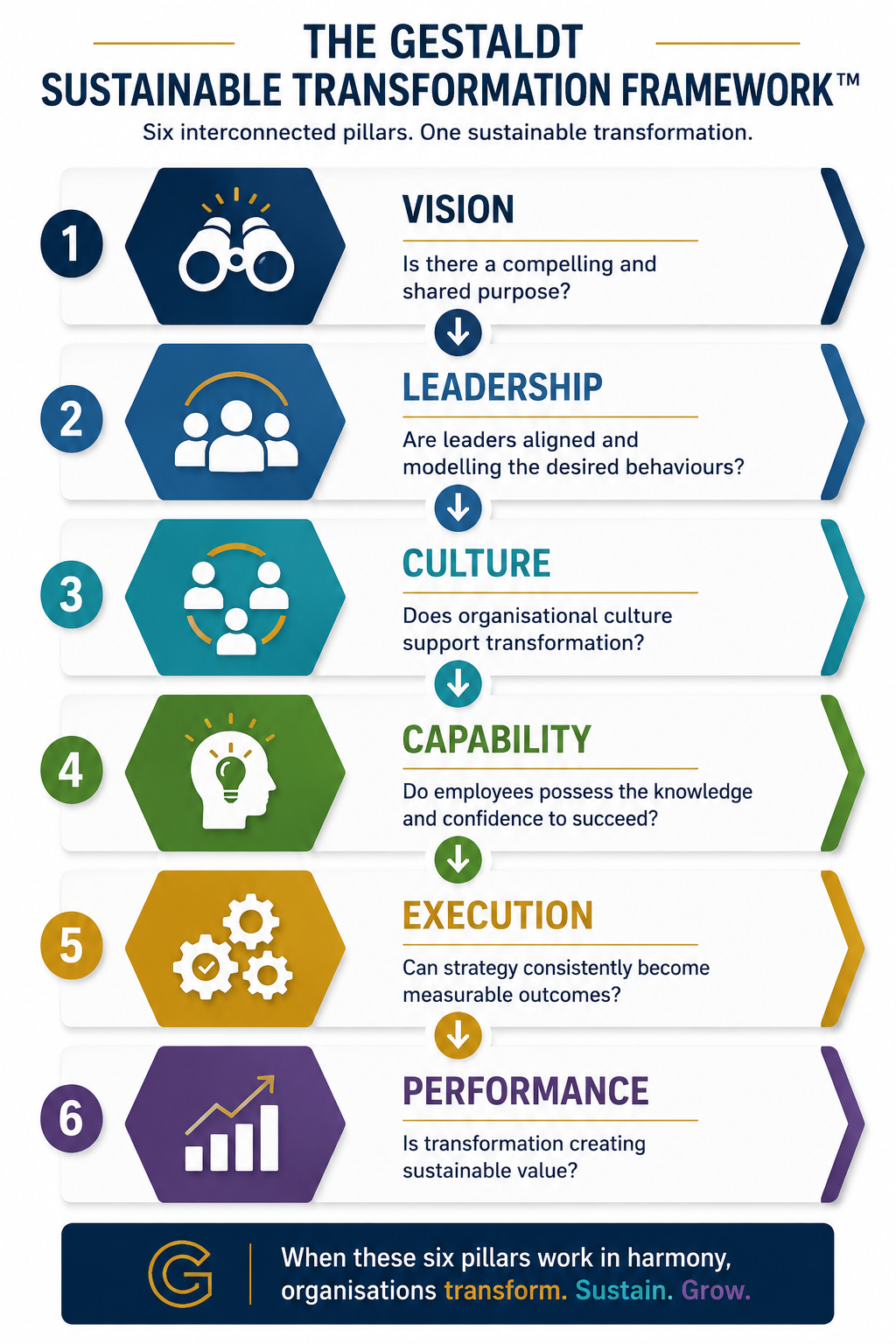
The Gestaldt Sustainable Transformation Framework™
At Gestaldt, we believe sustainable transformation rests on six interconnected pillars.
Executive Transformation Health Check
Score each statement from 1 (Strongly Disagree) to 5 (Strongly Agree)
Leaders communicate a consistent transformation vision.
Employees understand why change is necessary.
Managers actively support transformation.
Our culture encourages innovation.
Decision-making is fast.
Accountability is clear.
We measure transformation outcomes.
Employees possess future-ready capabilities.
Leadership embraces continuous learning.
Transformation has improved organisational performance.
Results
40–50
Transformation is becoming a competitive advantage.
30–39
Transformation risks are emerging.
Below 30
Transformation requires immediate leadership attention.
Five Questions Every CEO Should Ask
Before approving another transformation initiative, ask:
Are our leaders truly aligned?
Does our culture support transformation?
Are our people ready?
Can our governance accelerate change?
How will we measure success?
If these questions cannot be answered confidently, transformation risk increases significantly.
Transformation Is Ultimately About Leadership
Technology changes systems.
Leadership changes organisations.
The most successful CEOs understand that transformation isn't an IT initiative.
It isn't a restructuring exercise.
It isn't a communications campaign.
It is an organisational capability.
When leadership, culture, governance, capability, and execution align, organisations become resilient, adaptable, and prepared for whatever comes next.
Ready to Lead Sustainable Transformation?
Every organisation faces transformation challenges.
The difference lies in identifying them before they become barriers to growth.
Request a Business Transformation Diagnostic
Our executive consultants will help you assess:
✔ Leadership alignment
✔ Transformation readiness
✔ Organisational culture
✔ Governance effectiveness
✔ Strategy execution capability
✔ Leadership capability
✔ Organisational agility
Together, we'll identify the obstacles preventing sustainable transformation and develop practical strategies that deliver measurable business outcomes.
👉 Schedule your confidential Business Transformation Diagnostic today.