

The Accountability Crisis: Why Organisational Performance Stalls Even When Everyone Is Busy
Your organisation isn't failing because people aren't working hard. It's failing because accountability is unclear. Learn why accountability breaks down, how it impacts organisational performance, and the leadership practices that create high-performing organisations.

Everyone Is Working Hard—So Why Isn't the Organisation Moving Faster?
Walk through almost any organisation and you'll find people who are busy.
Meetings are full.
Calendars are packed.
Projects are underway.
Emails never stop.
Performance dashboards are updated weekly.
Yet despite all this activity, many organisations struggle to achieve meaningful progress.
Strategic initiatives are delayed.
Customer issues persist.
Innovation slows.
Budgets overrun.
Deadlines are missed.
When leaders investigate, the explanation is often the same:
"We need people to be more accountable."
But accountability isn't something leaders can demand. It is something organisations must design.
The highest-performing organisations don't rely on heroic individuals to deliver results. They create systems where ownership is clear, expectations are understood, decisions are made with confidence, and people are empowered to act.
At Gestaldt, we believe accountability is one of the strongest predictors of sustainable organisational performance. When accountability is embedded in leadership, culture, governance, and execution, organisations move faster, collaborate better, and achieve better outcomes.
Why Accountability Has Become a Strategic Priority
Today's organisations operate in an environment of constant change.
Artificial intelligence is reshaping industries.
Customer expectations continue to rise.
Hybrid work has changed how teams collaborate.
Economic uncertainty requires faster, more confident decision-making.
In this environment, organisations cannot afford ambiguity.
When accountability is weak, decision-making slows, priorities become confused, and strategic initiatives lose momentum.
Strong accountability creates clarity, trust, and confidence throughout the organisation.
Seven Reasons Accountability Breaks Down
1. Ownership Is Unclear
Many strategic initiatives have multiple stakeholders but no single owner.
When responsibility is shared without clarity, progress slows.
Every major initiative should have one accountable leader.
2. Priorities Constantly Change
Employees cannot be accountable for moving targets.
When leadership frequently changes priorities, focus disappears and accountability weakens.
Consistency creates confidence.
3. Leaders Avoid Difficult Conversations
Accountability requires honest feedback.
Avoiding underperformance sends a message that expectations are optional.
High-performing organisations address issues early, respectfully, and constructively.
4. Decision Rights Are Undefined
When people don't know who can approve, decide, or escalate, work stalls.
Clear governance removes uncertainty and empowers action.
5. Success Measures Are Vague
Employees cannot deliver what hasn't been clearly defined.
Objectives should be measurable, visible, and linked to organisational strategy.
6. Culture Rewards Activity Instead of Outcomes
Being busy should never be confused with creating value.
Organisations should celebrate results, collaboration, innovation, and learning—not simply effort.
7. Leaders Model Inconsistent Behaviour
Employees notice when executives fail to uphold the standards they expect from others.
Leadership credibility is the foundation of accountability.
People follow what leaders do more than what they say.
The Gestaldt Accountability Framework™
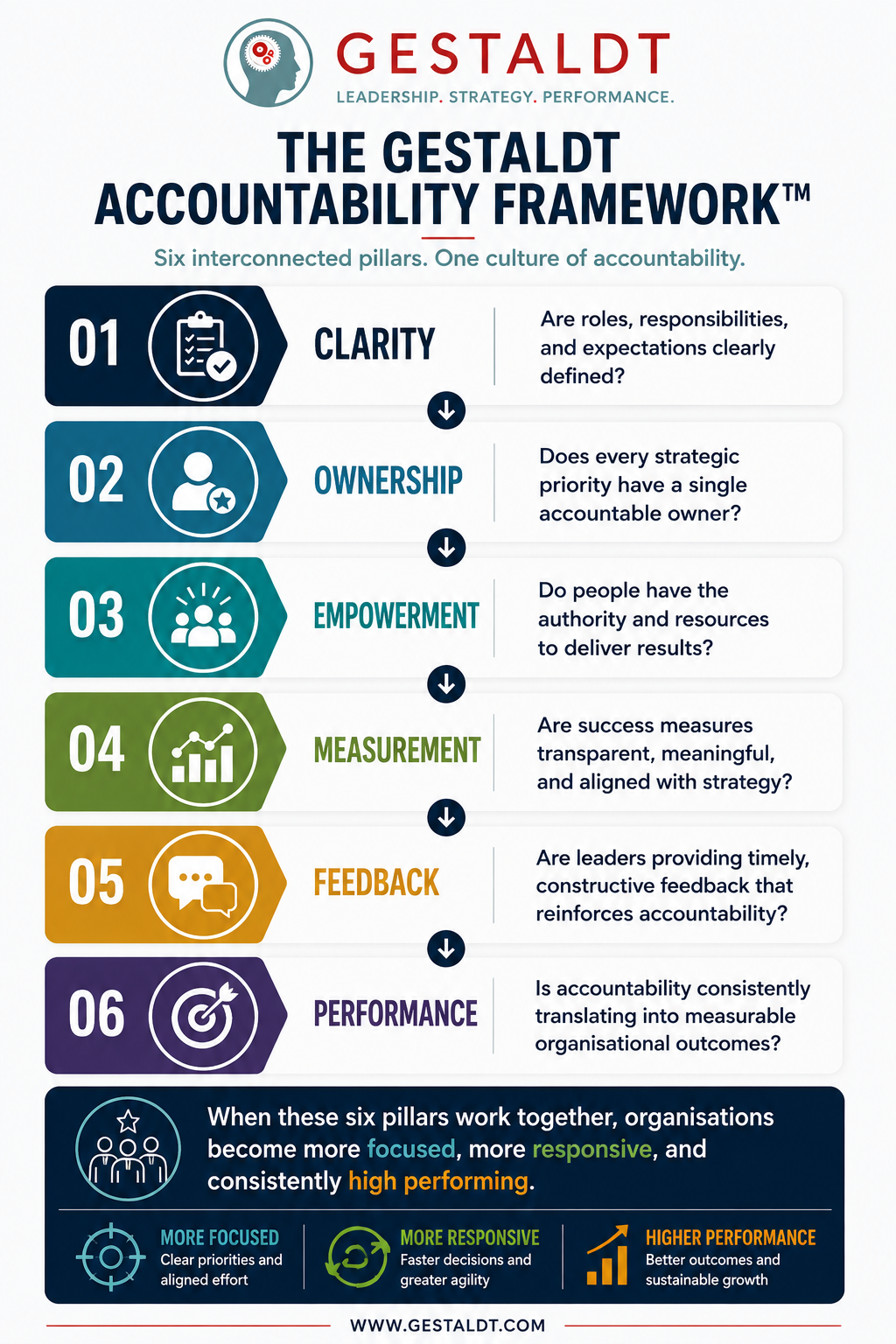
Executive Accountability Scorecard
Rate each statement from 1 (Strongly Disagree) to 5 (Strongly Agree).
Everyone understands their role in delivering strategy.
Major initiatives have clear owners.
Leaders make expectations explicit.
Employees have authority to make appropriate decisions.
Performance measures are aligned with business priorities.
Feedback is timely and constructive.
Accountability is applied consistently at every level.
Leaders model the behaviours they expect.
Teams collaborate effectively to achieve outcomes.
We celebrate results rather than activity.
Results
40–50: Accountability is a strategic strength.
30–39: Some accountability gaps may be limiting execution.
Below 30: Organisational performance is likely being affected by unclear ownership and inconsistent leadership.
Executive Case Study
A growing professional services firm approached Gestaldt after repeatedly missing strategic milestones despite having a highly capable workforce.
Our assessment revealed:
Overlapping responsibilities across senior leaders.
Inconsistent performance measures.
Delayed decisions due to unclear ownership.
A culture where teams were busy but not always aligned.
Using the Gestaldt Accountability Framework™, we helped redesign governance, clarify decision rights, and introduce organisation-wide accountability practices.
Within nine months, the organisation reported:
Faster delivery of strategic initiatives.
Improved cross-functional collaboration.
Clearer executive accountability.
Higher employee engagement.
Greater confidence in leadership.
The transformation was not driven by asking people to work harder. It was achieved by creating clarity about who was responsible for what.
Five Questions Every CEO Should Ask
Does every strategic initiative have one accountable owner?
Are our leaders modelling accountability every day?
Can employees explain how their work contributes to organisational strategy?
Are performance measures focused on outcomes or activity?
Would our customers notice if accountability improved?
These questions often reveal whether accountability is embedded in the organisation—or simply expected.
Accountability Is the Engine of Execution
Strategies succeed because people take ownership.
Transformation succeeds because leaders remain accountable.
Culture strengthens because expectations are consistently reinforced.
Organisations become resilient because accountability creates confidence, trust, and disciplined execution.
The organisations that outperform their competitors are not necessarily those with the smartest people or the largest budgets. They are those where accountability is woven into every aspect of leadership and organisational life.
Ready to Strengthen Accountability Across Your Organisation?
If your organisation is experiencing slow execution, unclear ownership, or inconsistent performance, it may be time to examine how accountability is designed—not just discussed.
Request an Organisational Accountability Assessment
Gestaldt's confidential assessment evaluates:
Leadership accountability.
Role clarity.
Decision rights.
Governance effectiveness.
Performance measurement.
Feedback culture.
Strategy execution.
Organisational alignment.
Together, we'll identify the barriers limiting accountability and develop practical strategies that improve execution, strengthen leadership, and accelerate organisational performance.
👉 Request Your Organisational Accountability Assessment Today
Organisational Resilience: The CEO's Blueprint for Building a Business That Thrives Through Disruption
Economic uncertainty, digital disruption, and changing workforce expectations are redefining business success. Discover how CEOs can build organisational resilience through leadership, culture, governance, capability, and strategic execution.
Resilience Is No Longer About Survival—It's About Sustainable Advantage
Not long ago, resilience was associated with crisis management. Organisations built contingency plans for unlikely events and hoped they would never need them.
Today, disruption is no longer the exception—it is the operating environment.
Economic volatility, technological advances, geopolitical tensions, cybersecurity threats, supply chain disruptions, climate-related events, and changing employee expectations have transformed the business landscape. The question is no longer whether disruption will occur, but how prepared organisations are to respond.
Some organisations emerge stronger from uncertainty. Others lose momentum, talent, customers, and market share.
The difference is rarely luck.
It is organisational resilience.
Resilient organisations do more than recover. They adapt, innovate, and continue creating value while others are reacting. They build leadership teams capable of making confident decisions, cultures that embrace change, governance that accelerates action, and capabilities that prepare people for an uncertain future.
At Gestaldt, we believe resilience is not a programme or a policy. It is an organisational capability that must be intentionally designed, developed, and sustained.
Why Resilience Has Become a Strategic Priority
The pace of change has accelerated beyond traditional planning cycles.
Business models evolve faster.
Customer expectations change continuously.
Technology reshapes entire industries.
Employees expect greater flexibility, purpose, and development.
Boards are demanding greater oversight of organisational risk and long-term sustainability.
In this environment, organisations that rely solely on annual strategic planning risk falling behind.
Resilient organisations embed adaptability into the way they lead, decide, collaborate, and execute.
The Seven Characteristics of Highly Resilient Organisations
1. Leadership Creates Confidence During Uncertainty
Employees look to leaders for clarity, consistency, and confidence when uncertainty increases.
Resilient leaders communicate openly, make informed decisions despite incomplete information, and provide direction without pretending to have every answer.
Leadership behaviour shapes organisational resilience more than any policy.
Related Reading:Executive Team Alignment: Why Your Leadership Team Is Holding Your Business Back (And How to Fix It)
2. Culture Encourages Adaptability
A resilient culture values learning over blame.
Employees feel safe to challenge assumptions, test new ideas, and respond quickly when circumstances change.
Cultures built on trust and accountability recover faster because people focus on solving problems rather than protecting themselves.
Related Reading:The Invisible Fuel of Business Growth: How Leadership Culture Drives Organisational Success
3. Strategy Remains Flexible
Long-term vision should remain stable.
Execution should remain adaptable.
Resilient organisations regularly review assumptions, monitor external trends, and adjust priorities without abandoning their strategic direction.
Flexibility is a sign of disciplined leadership—not indecision.
4. Governance Enables Fast Decisions
In times of disruption, slow governance becomes a competitive disadvantage.
Decision rights should be clear, escalation pathways defined, and accountability transparent.
Governance exists to accelerate informed decisions, not create unnecessary bureaucracy.
5. Capability Is Continuously Developed
Skills become outdated more quickly than ever before.
Resilient organisations invest in leadership development, digital capability, change management, and continuous learning.
Preparing people for future challenges is more effective than reacting after disruption occurs.
6. Execution Remains Disciplined
Resilience is not achieved through planning alone.
It depends on consistent execution.
High-performing organisations translate strategic priorities into measurable action while maintaining focus, accountability, and momentum.
Related Reading:Why Strategy Execution Fails: The 7 Hidden Barriers Most CEOs Never See
7. Performance Is Measured Beyond Financial Results
Revenue and profitability remain essential.
However, resilient organisations also monitor:
Leadership effectiveness
Employee engagement
Innovation capacity
Customer trust
Decision-making speed
Change readiness
Organisational agility
These indicators provide early warning signs long before financial performance is affected.
The Gestaldt Organisational Resilience Framework™
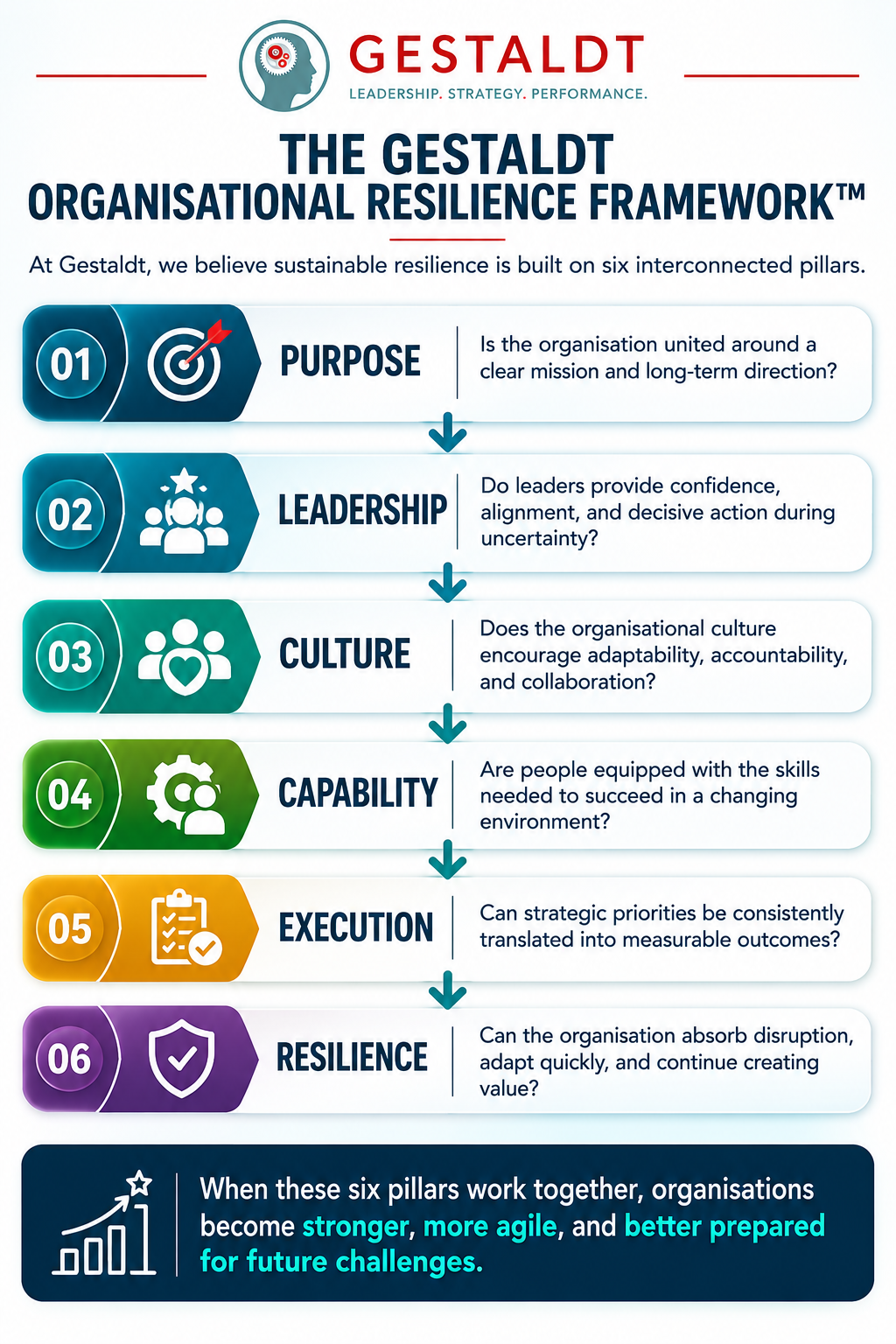
Executive Resilience Scorecard
Rate each statement from 1 (Strongly Disagree) to 5 (Strongly Agree).
Leaders communicate consistently during uncertainty.
Strategic priorities remain clear during change.
Employees embrace innovation and continuous improvement.
Decision-making is timely and well governed.
Learning and capability development are ongoing priorities.
Cross-functional collaboration is strong.
Strategic initiatives are executed effectively.
The organisation adapts quickly to market changes.
We measure organisational health beyond financial results.
We are confident in our ability to respond to future disruption.
Results
40–50: Your organisation demonstrates strong resilience.
30–39: Opportunities exist to strengthen organisational adaptability.
Below 30: Your organisation may be vulnerable to future disruption.
Executive Case Study
A diversified services organisation approached Gestaldt after experiencing repeated disruptions caused by changing market conditions and internal restructuring.
Although financial performance remained stable, executive leaders recognised growing signs of organisational fatigue:
Slower decision-making.
Declining employee engagement.
Increased turnover among key talent.
Difficulty executing strategic initiatives.
Gestaldt conducted an organisational resilience assessment and identified weaknesses in leadership alignment, governance, and capability development.
Working closely with the executive team, we introduced a resilience roadmap that strengthened leadership communication, clarified decision rights, and embedded continuous learning across the organisation.
Within twelve months, the organisation experienced:
Faster responses to market opportunities.
Improved executive collaboration.
Higher employee engagement.
Greater confidence in strategic execution.
Increased organisational agility.
Resilience became a competitive advantage rather than a defensive capability.
Five Questions Every CEO Should Ask
How quickly can our organisation adapt when conditions change?
Do our leaders inspire confidence during uncertainty?
Are we investing enough in future capability?
Does our governance accelerate or delay strategic decisions?
Would our employees describe our organisation as adaptable?
The answers reveal how prepared your organisation is for tomorrow's challenges.
The Future Belongs to Resilient Organisations
No organisation can predict every disruption.
But every organisation can improve its ability to respond.
Resilience is not built in moments of crisis. It is built through deliberate leadership, strong culture, effective governance, capable people, disciplined execution, and a commitment to continuous improvement.
Organisations that invest in resilience today will be better positioned to innovate, grow, and create lasting value tomorrow.
Ready to Strengthen Your Organisation's Resilience?
If your organisation is navigating uncertainty, preparing for transformation, or seeking sustainable growth, resilience should be at the centre of your leadership agenda.
Request an Organisational Resilience Assessment
Gestaldt's confidential assessment evaluates:
Leadership resilience.
Executive alignment.
Organisational culture.
Governance effectiveness.
Capability development.
Strategy execution.
Organisational agility.
Change readiness.
Together, we'll identify the strengths that will carry your organisation forward and the barriers that may be limiting future performance.

Decision Paralysis in the C-Suite: Why Great Leaders Make Slow Decisions (And How to Regain Strategic Agility)
Slow executive decision-making can cost organisations millions in missed opportunities, delayed execution, and declining competitiveness. Learn why decision paralysis develops, how it affects organisational performance, and the practical steps CEOs can take to build faster, more confident leadership teams.

The Cost of Waiting
A competitor launches a new product. Your organisation has the capability to respond, but approval takes weeks.
A customer requests a customised solution. Sales is ready, operations is willing, but leadership can't reach a decision.
A promising acquisition is identified. Due diligence is complete, yet the executive team delays. By the time a decision is made, the opportunity has disappeared.
These situations are more common than many leaders admit.
Organisations rarely lose their competitive edge because of one poor decision. More often, they lose it because of slow decisions.
In an environment defined by economic uncertainty, technological disruption, and rapidly changing customer expectations, speed has become a strategic advantage. Yet many executive teams are trapped in decision paralysis—where caution, complexity, and competing priorities delay action until opportunities are lost.
At Gestaldt, we have found that decision paralysis is rarely caused by a lack of intelligence or experience. It is usually a symptom of deeper organisational issues: unclear governance, misaligned leadership, risk-averse cultures, and ineffective decision-making processes.
The organisations that thrive are not those that make perfect decisions. They are the ones that make timely, informed, and accountable decisions.
Why Decision Speed Is Now a Competitive Advantage
Business cycles have accelerated dramatically.
Markets change in months rather than years.
Artificial intelligence reshapes industries almost overnight.
Customer expectations evolve continuously.
Regulatory landscapes shift with increasing frequency.
In this environment, organisations that hesitate risk becoming irrelevant.
Strategic agility is no longer a desirable leadership quality—it is an organisational necessity.
Research has consistently shown that organisations with effective decision-making processes outperform their peers in profitability, innovation, and long-term growth. They respond more quickly to market opportunities, allocate resources more effectively, and build greater confidence across their workforce.
Decision speed, however, should never be confused with recklessness. The objective is not faster decisions at any cost, but better decisions made without unnecessary delay.
Seven Hidden Causes of Decision Paralysis
1. Too Many Decisions Reach the Executive Team
Not every decision requires CEO approval.
When executives become involved in operational issues, strategic discussions become crowded with matters that should have been resolved elsewhere.
This creates bottlenecks, delays implementation, and distracts leaders from long-term priorities.
Executive Reflection
Are your executives making strategic decisions—or operational ones?
2. Governance Is Unclear
Who owns the decision?
Who provides input?
Who has final authority?
Without clearly defined governance, decisions circulate endlessly between committees, departments, and executives.
Good governance accelerates action by providing clarity, not bureaucracy.
3. Leaders Are Misaligned
When executives have different interpretations of organisational priorities, decision-making slows.
Instead of evaluating options against shared objectives, discussions become negotiations between competing interests.
Alignment transforms debate into productive decision-making.
4. Fear of Failure Overrides Strategic Thinking
High-performing organisations encourage calculated risk-taking.
Risk-averse organisations avoid difficult decisions altogether.
The result is stagnation.
Leaders must create an environment where informed experimentation is encouraged and learning is valued.
5. Data Overload Creates Analysis Paralysis
Modern organisations have access to unprecedented amounts of information.
The challenge is no longer obtaining data—it is knowing which data matters.
Executives who wait for perfect information often miss the opportunity to act.
The goal is to make decisions using the best available evidence, recognising that uncertainty will always exist.
6. Accountability Is Diffused
When everyone is responsible, no one is responsible.
Without clear ownership, decisions are delayed, implementation weakens, and momentum fades.
Accountability should be explicit at every stage of the decision-making process.
7. Organisational Culture Rewards Consensus Over Progress
Consensus has value, but it should not become a prerequisite for every decision.
Healthy executive teams encourage debate, seek diverse perspectives, and then commit to a clear course of action.
Progress requires confidence, not unanimity.
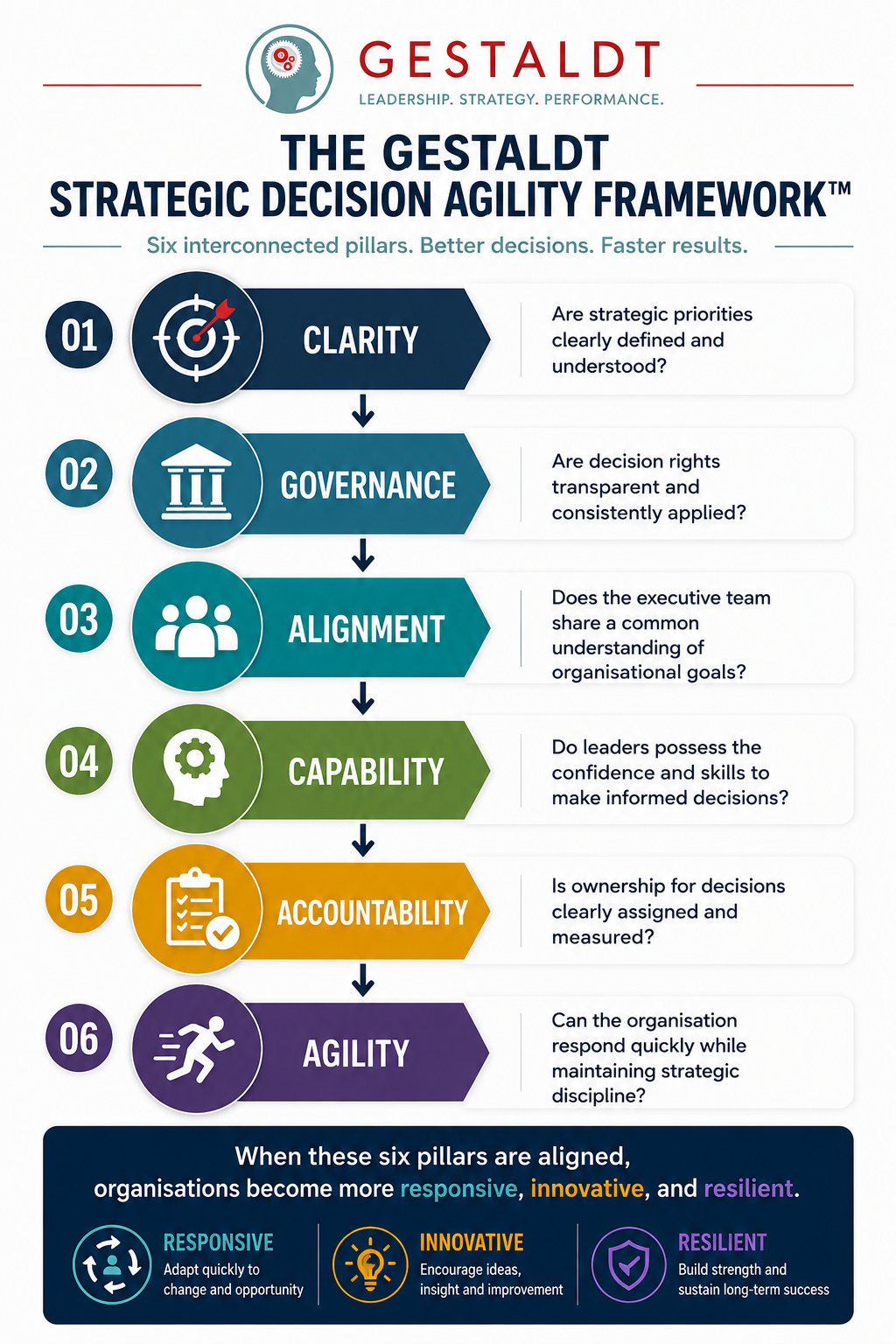
The Gestaldt Strategic Decision Agility Framework™
At Gestaldt, we believe high-quality decision-making is built on six interconnected pillars.
Executive Decision Agility Scorecard
Rate each statement from 1 (Strongly Disagree) to 5 (Strongly Agree).
Strategic priorities are clearly understood.
Decision rights are well defined.
Executive meetings result in timely decisions.
Leaders are comfortable making decisions with incomplete information.
Accountability for implementation is clear.
Governance supports rather than delays execution.
Departments collaborate effectively.
Decision-making is transparent.
We learn from decisions, whether successful or not.
Our organisation adapts quickly to change.
Results
40–50: Your organisation demonstrates strong decision agility.
30–39: Decision-making processes may be slowing performance.
Below 30: Decision paralysis is likely affecting strategic execution and organisational growth.
Case Study: Breaking the Decision Bottleneck
A large services organisation approached Gestaldt after a major transformation programme had stalled. Although the strategy was clear, executive meetings had become increasingly lengthy, decisions were repeatedly revisited, and implementation timelines continued to slip.
Our assessment identified three root causes:
Over-centralised decision-making.
Unclear governance and decision rights.
Inconsistent alignment on strategic priorities.
Gestaldt worked with the executive team to redesign governance structures, clarify accountability, and establish a disciplined decision-making framework.
Within nine months, the organisation reported:
Faster executive decision cycles.
Reduced project delays.
Greater cross-functional collaboration.
Improved confidence in leadership.
Stronger execution of strategic initiatives.
The organisation did not succeed because it made more decisions. It succeeded because it made better decisions, faster.
Five Questions Every CEO Should Ask
Before your next executive meeting, consider these questions:
Which decisions genuinely require executive attention?
Are our governance structures enabling or delaying action?
Do our leaders share the same understanding of strategic priorities?
Are we waiting for perfect information instead of acting on good evidence?
Does our culture reward informed action or excessive caution?
Your answers may reveal hidden constraints on organisational performance.
Strategic Agility Is a Leadership Capability
Markets will continue to change.
Technology will continue to evolve.
Uncertainty will remain.
The organisations that succeed will not be those with the most detailed plans. They will be those whose leaders can make confident, timely, and accountable decisions in the face of complexity.
Strategic agility is not about reacting faster than everyone else. It is about building an organisation where leadership, governance, culture, and execution work together to enable decisive action.
For CEOs, this is no longer simply a leadership skill. It is a strategic advantage.
Ready to Improve Executive Decision-Making?
If your organisation is experiencing delayed execution, prolonged decision cycles, or leadership misalignment, it may be time to evaluate how decisions are made.
Request a Strategic Decision Agility Assessment
Gestaldt's confidential executive assessment examines:
Decision-making effectiveness.
Leadership alignment.
Governance and decision rights.
Strategic clarity.
Organisational agility.
Accountability structures.
Strategy execution capability.
Together, we'll identify the barriers slowing your organisation and develop practical strategies to improve executive effectiveness and organisational performance.

Executive Team Alignment: Why Your Leadership Team Is Holding Your Business Back (And How to Fix It)
Even the strongest business strategy can fail if the executive team isn't aligned. Discover the hidden signs of executive misalignment, the impact on organisational performance, and the practical steps CEOs can take to build a leadership team that drives sustainable growth.

The Most Expensive Problem in Business Isn't Strategy—It's Executive Misalignment
Imagine sitting in a board meeting where every executive agrees with the strategy. The presentation is polished, the objectives are clear, and the budget has been approved. On paper, the organisation appears united.
Six months later, progress has stalled.
Projects are delayed, departments are working at cross-purposes, and employees are receiving conflicting messages from different leaders. Customer complaints are increasing, innovation has slowed, and the organisation is struggling to deliver the very strategy everyone supported.
What happened?
The strategy didn't fail.
The leadership team did.
One of the greatest misconceptions in business is that alignment means agreement. In reality, executive alignment is about far more than consensus. It is about shared purpose, consistent decision-making, mutual accountability, and the ability to lead the organisation as one cohesive team.
At Gestaldt, we have seen organisations invest heavily in strategy, technology, and transformation programmes, only to achieve disappointing results because their executive teams were not operating in alignment.
If your organisation is experiencing slower growth, declining engagement, or inconsistent execution, the problem may not be your strategy—it may be the way your leadership team works together.
Why Executive Alignment Matters More Than Ever
Today's executives are expected to lead through unprecedented complexity.
Economic uncertainty.
Artificial intelligence.
Digital transformation.
Regulatory change.
Hybrid work.
Talent shortages.
Customer expectations that evolve almost daily.
These pressures require leadership teams that can make fast, informed decisions while maintaining strategic focus.
When executive teams are aligned, organisations respond with confidence and agility. When they are not, uncertainty spreads throughout the business.
Research consistently shows that organisations with aligned leadership teams are more likely to execute strategy successfully, retain top talent, and outperform competitors. Alignment improves decision quality, strengthens collaboration, and builds trust across every level of the organisation.
The Hidden Cost of Executive Misalignment
Misalignment rarely announces itself with dramatic conflict. More often, it appears in subtle but costly ways.
Decisions Take Too Long
Simple decisions require multiple meetings because leaders lack clarity or confidence. Opportunities are missed while competitors move faster.
Departments Compete Instead of Collaborate
Functional leaders optimise their own objectives rather than organisational outcomes. Silos develop, reducing efficiency and innovation.
Employees Receive Mixed Messages
When executives communicate different priorities, employees become confused about what matters most, leading to inconsistent execution.
Accountability Becomes Blurred
Without shared ownership, responsibility shifts between teams and initiatives lose momentum.
High Performers Become Frustrated
Talented employees are often the first to leave environments where leadership appears fragmented or indecisive.
The financial cost of these issues is significant, but the cultural cost can be even greater.
Seven Warning Signs Your Executive Team Is Out of Alignment
1. Meetings Produce Discussion Instead of Decisions
If strategic meetings end with more questions than answers, alignment may be lacking.
2. Priorities Change Constantly
Employees struggle to understand what is truly important because leadership messages continue to evolve.
3. Business Units Operate Independently
Departments optimise their own performance rather than contributing to shared organisational goals.
4. Strategic Initiatives Lose Momentum
Projects begin with enthusiasm but gradually lose executive sponsorship and organisational focus.
5. Conflict Remains Unresolved
Healthy debate strengthens leadership teams. Avoiding difficult conversations weakens them.
6. Leadership Behaviours Are Inconsistent
When executives model different values and expectations, organisational culture becomes fragmented.
7. Employees Lack Confidence in Leadership
Trust declines when leaders appear disconnected or unable to make timely decisions.
Why High-Performing Leaders Still Become Misaligned
Executive misalignment is rarely caused by incompetence.
More often, it develops as organisations grow and become more complex.
Common causes include:
Rapid organisational growth
Mergers and acquisitions
Leadership transitions
Conflicting performance metrics
Poor governance
Inadequate communication
Unclear decision rights
Without intentional effort, even experienced leadership teams drift apart over time.
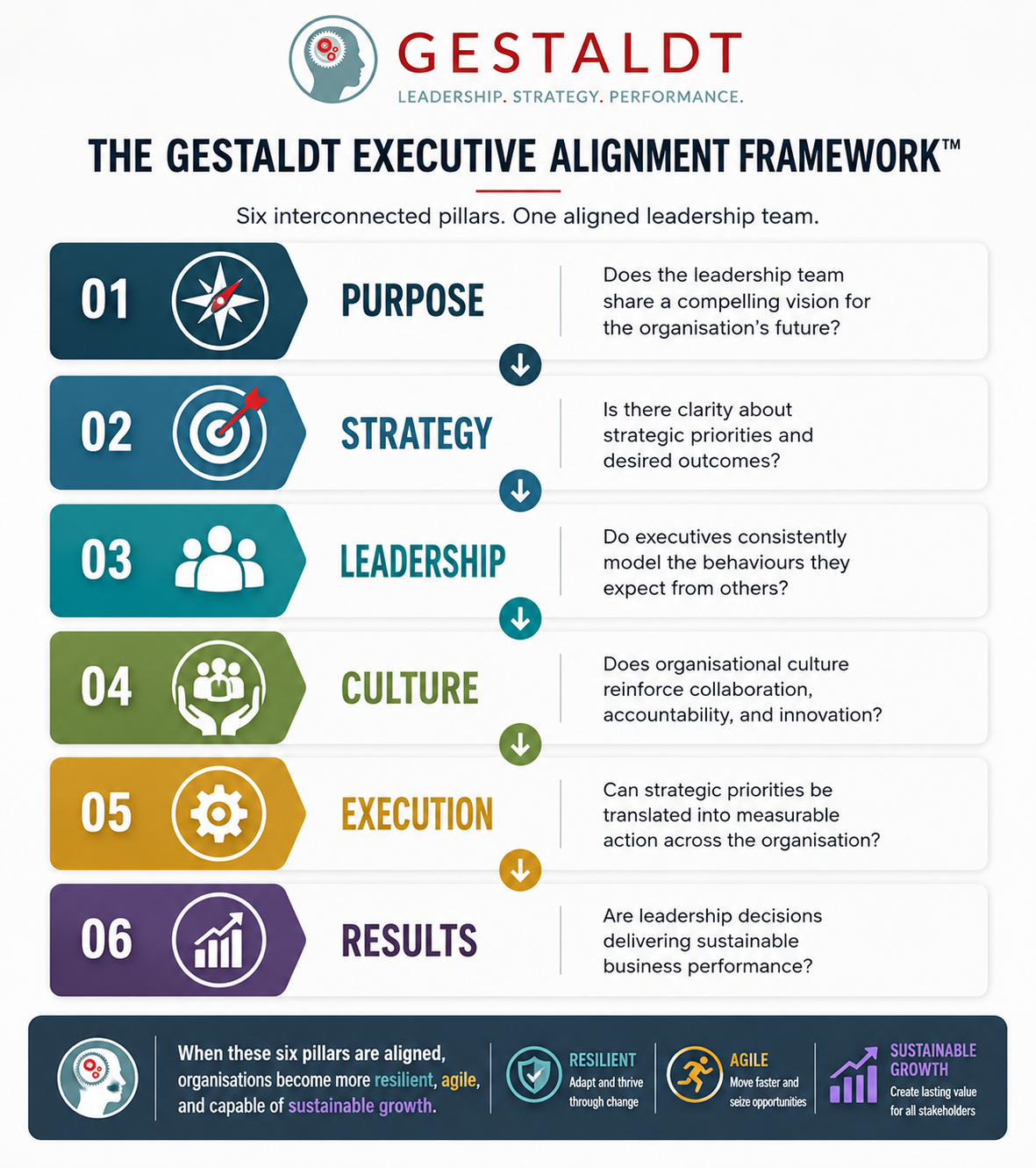
The Gestaldt Executive Alignment Framework™
At Gestaldt, we believe executive alignment is built on six interconnected pillars.
Executive Alignment Self-Assessment
Rate each statement from 1 (Strongly Disagree) to 5 (Strongly Agree).
Our executive team communicates a consistent vision.
Strategic priorities are understood across the organisation.
Leaders make decisions quickly and collaboratively.
Accountability for strategic initiatives is clear.
Departments work together effectively.
Leadership behaviours reflect organisational values.
Conflict is addressed constructively.
Employees trust senior leadership.
Meetings result in timely decisions.
Our strategy is consistently translated into action.
Scoring
40–50: Your executive team demonstrates strong alignment.
30–39: Alignment gaps may be affecting performance.
Below 30: Executive misalignment is likely limiting organisational effectiveness and growth.
A Real-World Example
A national organisation engaged Gestaldt after several years of declining performance despite repeated strategic planning exercises.
An executive alignment assessment revealed:
Different interpretations of strategic priorities
Confeting departmental objectives
Inconsistent communication
Weak accountability structures
Working with the executive team, Gestaldt facilitated leadership alignment sessions, clarified governance, and introduced shared performance measures.
Within twelve months, the organisation experienced:
Faster strategic decision-making
Improved collaboration across business units
Greater employee confidence in leadership
More consistent execution of strategic initiatives
The strategy had not changed.
The leadership team had.
Five Questions Every CEO Should Ask
Before approving another strategic initiative, ask your executive team:
Can every executive explain our strategy in the same way?
Do our behaviours reinforce the culture we want to build?
Are decisions made quickly and consistently?
Do we hold one another accountable for outcomes?
Would our employees describe us as one leadership team?
The answers often reveal whether alignment is a strength—or a hidden risk.
Alignment Is a Competitive Advantage
Organisations don't outperform competitors because they have the smartest executives.
They outperform because their leaders work together with clarity, trust, and discipline.
Executive alignment accelerates strategy execution, strengthens culture, improves decision-making, and creates the conditions for sustainable growth.
In today's rapidly changing business environment, alignment is no longer a leadership aspiration. It is a strategic necessity.
Ready to Strengthen Your Executive Team?
If your organisation is experiencing slower decision-making, inconsistent execution, or competing priorities, the issue may not be your strategy—it may be executive alignment.
Request an Executive Alignment Assessment
Gestaldt's confidential assessment helps executive teams evaluate:
Leadership alignment
Strategic clarity
Governance effectiveness
Decision-making
Accountability
Team dynamics
Organisational culture
Strategy execution capability
Together, we'll identify the barriers limiting your leadership team's effectiveness and develop practical strategies to improve organisational performance.
👉 Request Your Executive Alignment Assessment Today
Why Business Transformation Fails: The CEO's Guide to Leading Sustainable Organisational Change
More than two-thirds of business transformation initiatives fail to achieve their intended outcomes. Discover the hidden reasons why transformation stalls and learn how CEOs can build organisations that successfully adapt, execute strategy, and sustain long-term growth.
Change Is Easy. Transformation Is Not.
Every CEO understands that change is inevitable.
Markets evolve.
Customer expectations shift.
Technology disrupts entire industries.
Economic uncertainty reshapes investment decisions.
New competitors emerge seemingly overnight.
In response, organisations launch ambitious transformation programmes designed to modernise operations, improve performance, and secure future growth.
Yet despite significant investment, most transformations fail to deliver lasting value.
Budgets are exceeded.
Timelines slip.
Employee engagement declines.
Momentum fades.
Eventually, the organisation quietly returns to old behaviours.
The strategy wasn't the problem.
The technology wasn't the problem.
Often, the organisation itself wasn't ready for transformation.
Successful transformation requires far more than introducing new systems or restructuring departments. It demands aligned leadership, a culture that embraces change, clear governance, capable people, disciplined execution, and an unwavering focus on long-term value creation.
This article explores the seven reasons business transformation fails—and what executive leaders can do differently.
Why Transformation Has Become a Boardroom Priority
Business transformation is no longer optional.
Artificial intelligence, digital disruption, geopolitical instability, shifting workforce expectations, sustainability demands, and changing customer behaviours require organisations to evolve continuously.
Transformation today includes:
Leadership transformation
Culture transformation
Operating model redesign
Customer experience transformation
Sustainability transformation
Workforce transformation
The question is no longer whether organisations should transform.
It is whether they can transform successfully.
1. Leadership Alignment Breaks Down Before Transformation Begins
Most transformation programmes start with executive enthusiasm.
The board approves the investment.
Leadership launches the initiative.
Employees attend town halls.
The vision is communicated.
Yet beneath the surface, executive alignment is often incomplete.
Different leaders interpret transformation differently.
Some view it as technology.
Others view it as restructuring.
Others see it as cost reduction.
Without genuine alignment, every subsequent decision becomes inconsistent.
Signs of Misalignment
Conflicting priorities
Inconsistent communication
Slow decision-making
Departmental silos
Resource competition
Transformation requires one leadership voice.
Not many.
2. Culture Quietly Rejects Change
Technology changes quickly.
Culture changes slowly.
Many organisations attempt digital transformation while maintaining cultures built around stability, hierarchy and risk avoidance.
Employees hear leaders speak about innovation.
Yet mistakes are punished.
New ideas are discouraged.
Approvals multiply.
Experimentation disappears.
Eventually employees stop engaging.
Transformation becomes another corporate initiative that "will pass."
Culture determines whether transformation succeeds.
Ask Yourself
Does your culture reward:
✔ Innovation
✔ Collaboration
✔ Accountability
✔ Continuous learning
✔ Customer focus
If not, transformation resistance is inevitable.
Related Reading
The Invisible Fuel of Business Growth: How Leadership Culture Drives Organisational Success
3. Organisations Focus on Technology Instead of People
One of the biggest misconceptions about transformation is that technology creates change.
People create change.
Technology simply enables it.
Executives often invest millions in:
ERP systems
Artificial Intelligence
CRM platforms
Automation
Analytics
Yet relatively little investment goes into preparing people.
Without capability development:
Employees resist.
Managers struggle.
Leadership loses confidence.
Transformation slows.
Successful organisations invest equally in technology and human capability.
4. Middle Management Is Forgotten
Transformation is rarely delivered by executives.
It is delivered by managers.
Middle managers translate strategy into operational behaviour.
If they don't understand transformation...
Neither will employees.
Unfortunately many organisations communicate transformation to managers instead of involving them.
The result:
Confusion
Inconsistent implementation
Low engagement
Resistance
High-performing organisations make middle management transformation champions.
5. Governance Is Too Weak—or Too Bureaucratic
Transformation requires disciplined governance.
Too little governance creates chaos.
Too much governance creates paralysis.
Successful organisations establish:
Clear decision rights
Defined accountability
Transparent reporting
Rapid escalation
Agile decision-making
Governance should accelerate transformation—not slow it.
6. Organisations Measure Activity Instead of Impact
Transformation dashboards often report:
✔ Workshops completed
✔ Systems implemented
✔ Training delivered
These are activity metrics.
Executives should instead measure:
Customer experience
Employee engagement
Leadership capability
Innovation
Strategic execution
Organisational agility
Decision speed
Transformation should improve organisational performance—not simply complete projects.
7. Transformation Is Treated as a Project Instead of a Capability
Projects finish.
Transformation doesn't.
The world's highest-performing organisations don't transform every five years.
They build organisations capable of continuous adaptation.
Transformation becomes part of leadership.
Part of culture.
Part of governance.
Part of everyday decision-making.
This is what creates long-term resilience.
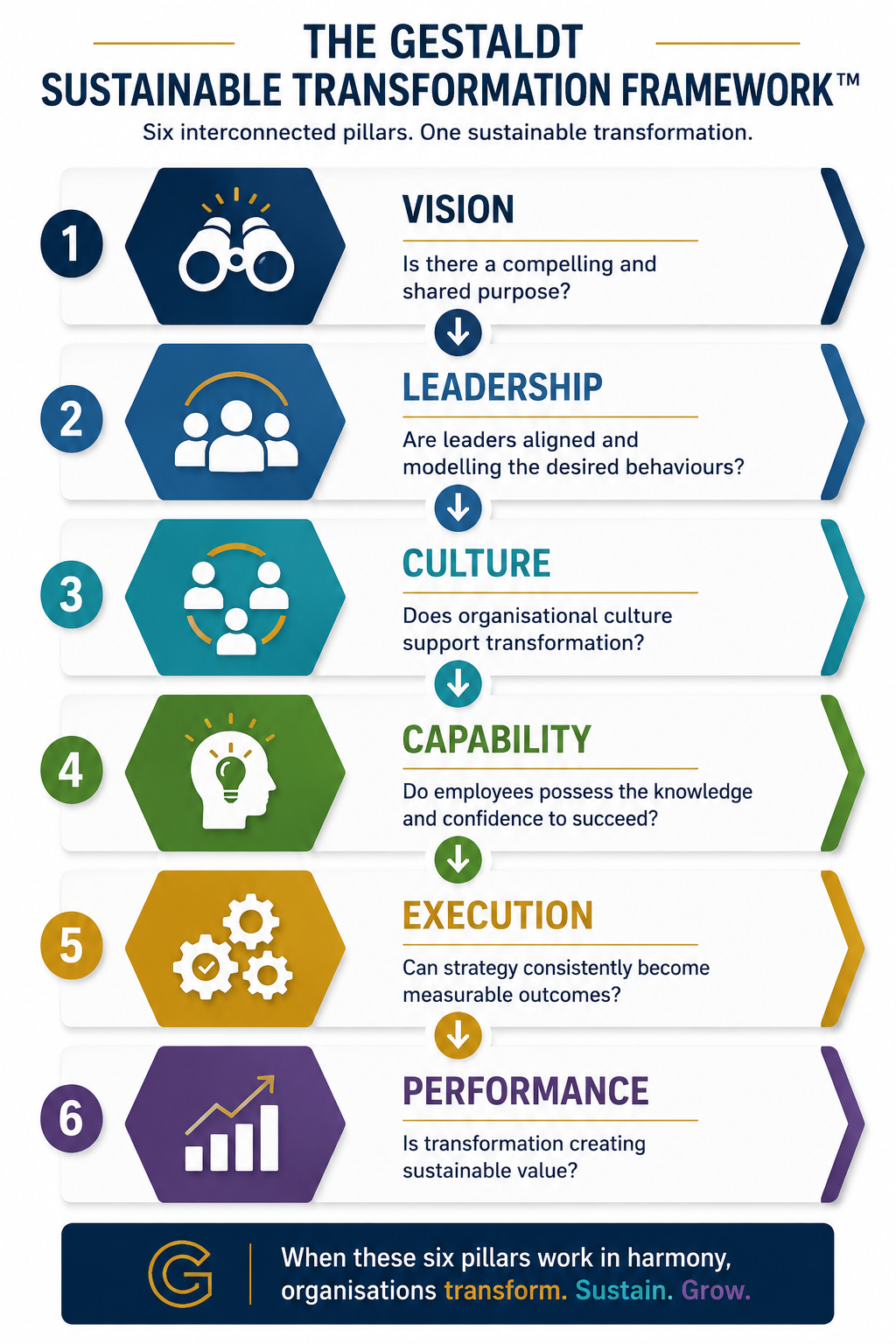
The Gestaldt Sustainable Transformation Framework™
At Gestaldt, we believe sustainable transformation rests on six interconnected pillars.
Executive Transformation Health Check
Score each statement from 1 (Strongly Disagree) to 5 (Strongly Agree)
Leaders communicate a consistent transformation vision.
Employees understand why change is necessary.
Managers actively support transformation.
Our culture encourages innovation.
Decision-making is fast.
Accountability is clear.
We measure transformation outcomes.
Employees possess future-ready capabilities.
Leadership embraces continuous learning.
Transformation has improved organisational performance.
Results
40–50
Transformation is becoming a competitive advantage.
30–39
Transformation risks are emerging.
Below 30
Transformation requires immediate leadership attention.
Five Questions Every CEO Should Ask
Before approving another transformation initiative, ask:
Are our leaders truly aligned?
Does our culture support transformation?
Are our people ready?
Can our governance accelerate change?
How will we measure success?
If these questions cannot be answered confidently, transformation risk increases significantly.
Transformation Is Ultimately About Leadership
Technology changes systems.
Leadership changes organisations.
The most successful CEOs understand that transformation isn't an IT initiative.
It isn't a restructuring exercise.
It isn't a communications campaign.
It is an organisational capability.
When leadership, culture, governance, capability, and execution align, organisations become resilient, adaptable, and prepared for whatever comes next.
Ready to Lead Sustainable Transformation?
Every organisation faces transformation challenges.
The difference lies in identifying them before they become barriers to growth.
Request a Business Transformation Diagnostic
Our executive consultants will help you assess:
✔ Leadership alignment
✔ Transformation readiness
✔ Organisational culture
✔ Governance effectiveness
✔ Strategy execution capability
✔ Leadership capability
✔ Organisational agility
Together, we'll identify the obstacles preventing sustainable transformation and develop practical strategies that deliver measurable business outcomes.
👉 Schedule your confidential Business Transformation Diagnostic today.

Why High-Performing Organisations Suddenly Stop Growing: The CEO's Blind Spot
Why do successful organisations suddenly lose momentum? Discover the seven hidden organisational barriers that silently stall growth, reduce performance, and prevent strategy execution—and learn how executive leaders can regain competitive advantage.

Success Can Become Your Greatest Risk
Growth is exciting.
Revenue increases.
New markets open.
The workforce expands.
Customers multiply.
Confidence rises.
Then something changes.
The organisation isn't in crisis—but it isn't accelerating either.
Projects take longer to complete.
Decisions slow down.
Innovation loses momentum.
Departments begin protecting their own priorities.
Top performers quietly leave.
Customer satisfaction starts to decline.
The business still appears healthy from the outside, yet internally, leaders know something isn't right.
For many CEOs, this is the most dangerous stage of organisational growth—not because the problems are visible, but because they are hidden beneath the surface.
The instinctive response is often to develop a new strategy, restructure the organisation, or invest in new technology. Yet in many cases, the real issue isn't the strategy itself. It's the organisation's ability to execute, adapt, and grow in alignment.
At Gestaldt, we've found that sustained growth depends on more than a strong business plan. It requires leadership alignment, a healthy organisational culture, effective governance, and the ability to translate strategic intent into consistent action.
Let's explore the seven hidden barriers that quietly prevent high-performing organisations from reaching their next level of success.

1. Leadership Alignment Is Only Skin Deep
"We're aligned."
Most executive teams believe they are.
Yet when asked individually about the organisation's top priorities, success measures, or strategic risks, their answers often differ.
Alignment is more than agreeing during a strategy session. It means leaders consistently communicate the same vision, make decisions using the same principles, and reinforce the same priorities throughout the organisation.
When alignment is weak, mixed messages filter through the business, creating confusion, duplicated effort, and competing priorities.
Questions Every CEO Should Ask
Can every executive clearly articulate the organisation's top three strategic priorities?
Are leaders making decisions using the same criteria?
Does every business unit understand how its work contributes to the strategy?
Without alignment at the top, execution breaks down across the organisation.
2. Culture Quietly Rejects the Strategy
Organisations rarely fail because of poor strategies.
They fail because everyday behaviours don't support those strategies.
A company may aspire to become more innovative while rewarding risk avoidance.
It may seek greater collaboration while maintaining siloed structures.
It may promote accountability while tolerating inconsistent performance.
These contradictions create friction between intention and execution.
As Peter Drucker famously said:
"Culture eats strategy for breakfast."
A healthy organisational culture doesn't happen by chance. It is intentionally shaped by leadership behaviours, governance structures, and shared values.
Related Reading:The Invisible Fuel of Business Growth: How Leadership Culture Drives Organisational Success
3. Complexity Has Replaced Clarity
As organisations grow, complexity grows with them.
More products.
More meetings.
More reporting.
More approvals.
More initiatives.
Before long, employees spend more time managing processes than creating value.
One of the biggest threats to sustained growth isn't competition—it's organisational complexity.
High-performing organisations simplify relentlessly.
They identify what matters most, eliminate unnecessary work, and focus resources on the initiatives that create the greatest strategic value.
4. Middle Managers Become the Missing Link
Middle managers are often expected to implement strategic change without being meaningfully involved in shaping it.
This creates a disconnect between executive intent and operational reality.
Employees don't execute strategy because executives communicate it.
They execute it because managers translate it into daily priorities.
Organisations that consistently outperform invest heavily in developing middle leadership capability, communication skills, and change leadership.
5. Growth Has Outpaced Leadership Capability
Many organisations invest heavily in systems and technology but overlook leadership capability.
The skills required to lead a 100-person organisation differ significantly from those needed to lead a 5,000-person enterprise.
Leadership development cannot remain static while the organisation evolves.
Future-ready organisations continuously strengthen executive capability in:
Strategic thinking
Decision-making
Change leadership
Innovation
Collaboration
Emotional intelligence
Without leadership growth, organisational growth inevitably slows.
6. You're Measuring Yesterday Instead of Tomorrow
Most executive dashboards focus on lagging indicators.
Revenue.
Profit.
Market share.
Operational costs.
While essential, these metrics reveal what has already happened.
Leading organisations also monitor indicators that predict future performance.
Examples include:
Leadership alignment
Employee engagement
Innovation pipeline
Customer advocacy
Decision-making speed
Organisational agility
Change readiness
These measures provide early warning signs long before financial performance begins to decline.
7. You're Solving Symptoms Instead of Root Causes
Revenue slows.
So marketing budgets increase.
Employee turnover rises.
So salaries increase.
Projects fail.
So governance becomes more bureaucratic.
Often these interventions address symptoms rather than underlying organisational issues.
True transformation begins by identifying root causes.
Leadership.
Culture.
Capability.
Governance.
Execution.
These are the systems that determine long-term organisational performance.
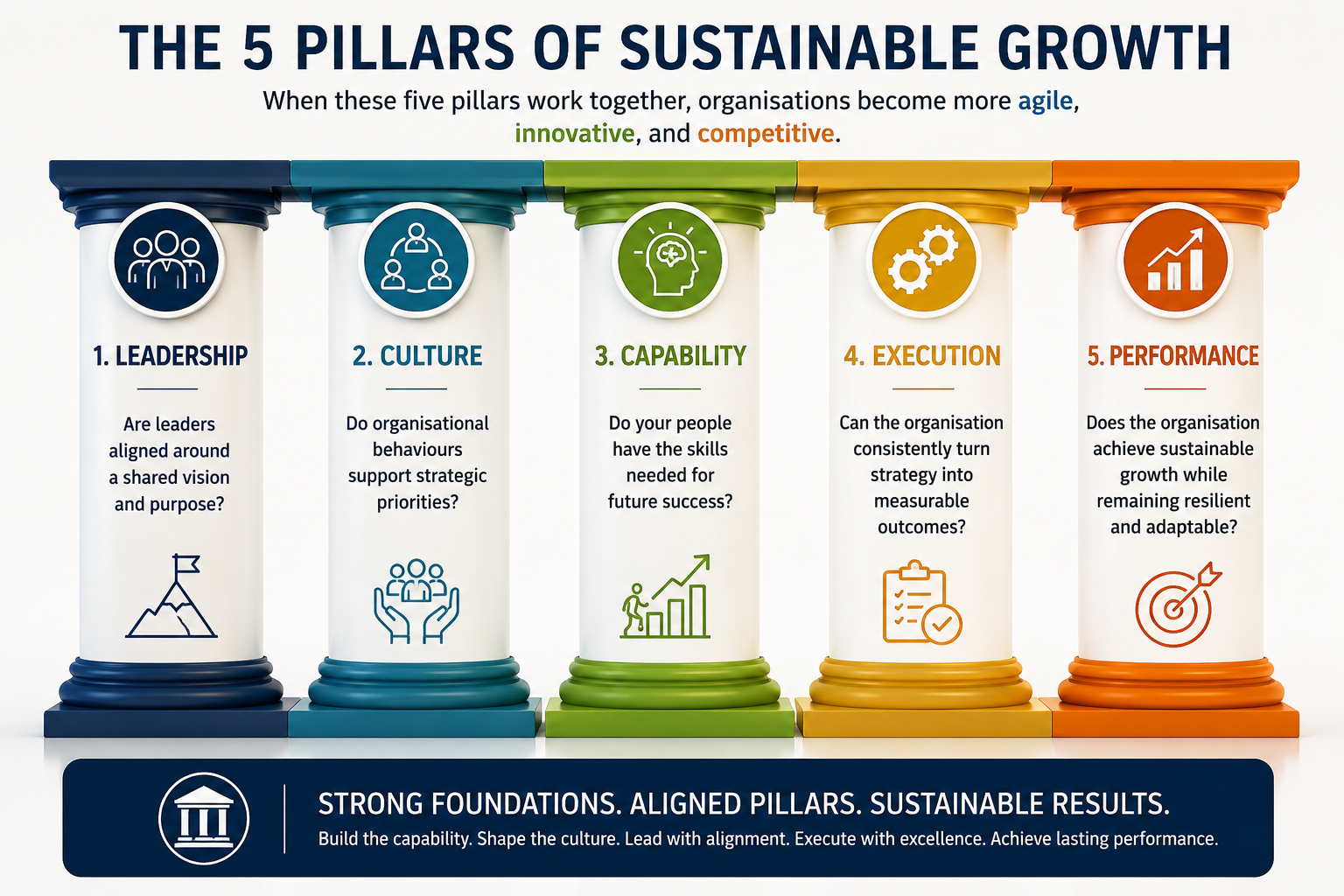
The Gestaldt Growth Performance Model™
At Gestaldt, we believe sustainable business growth depends on five interconnected pillars:
Executive Self-Assessment
Is Your Organisation Quietly Losing Momentum?
Score your organisation from 1 (Strongly Disagree) to 5 (Strongly Agree):
Our executive team consistently communicates the same priorities.
Employees understand how their work contributes to our strategy.
Our culture encourages accountability and innovation.
We execute strategic initiatives on time.
We measure leading indicators, not only financial results.
Leaders adapt quickly to change.
Our middle managers actively drive transformation.
Decision-making is fast and effective.
Leadership capability keeps pace with organisational growth.
Our strategy consistently translates into measurable business results.
Your Score
40–50: Your organisation is well positioned for sustainable growth.
30–39: Warning signs are emerging. Small issues may become significant barriers if left unaddressed.
Below 30: Your organisation may be experiencing hidden execution challenges that require immediate attention.
Sustainable Growth Isn't an Accident
The organisations that outperform their competitors over decades share one common characteristic.
They don't simply develop better strategies.
They build organisations capable of executing them.
For CEOs, the greatest blind spot is often assuming that growth challenges originate in the market.
More often than not, the answers lie within the organisation itself.
Leadership alignment.
Culture.
Capability.
Governance.
Execution.
These are the true drivers of sustainable performance.
Ready to Discover What's Holding Your Organisation Back?
Growth challenges rarely resolve themselves.
The sooner hidden barriers are identified, the sooner meaningful transformation can begin.

Request a Complimentary Executive Growth Diagnostic
In a confidential executive consultation, Gestaldt will help you assess:
Leadership alignment
Strategy execution capability
Organisational culture
Governance effectiveness
Change readiness
Leadership capability
Performance barriers
Together, we'll identify the issues limiting your organisation's growth and develop practical strategies to unlock its full potential.
👉 Schedule your Executive Growth Diagnostic today and take the first step towards sustainable organisational success.

Why Strategy Execution Fails: The 7 Hidden Barriers Most CEOs Never See
Most business leaders don't struggle with strategy—they struggle with execution. Discover the seven hidden barriers that prevent organisations from turning ambitious plans into measurable results, and learn how CEOs can close the gap between strategy and performance.

The Strategy Illusion
Every year, leadership teams invest substantial time and resources into strategic planning. Executive retreats are held, vision statements are refined, objectives are agreed upon, and ambitious targets are set.
Yet months later, many organisations find themselves asking the same question:
"Why aren't we seeing the results we expected?"
The truth is that most organisations don't have a strategy problem. They have an execution problem.
Research consistently shows that the majority of strategic initiatives fail to achieve their intended outcomes. While strategies often look impressive on paper, execution breaks down when organisations fail to align leadership, culture, governance, capabilities, and accountability.
At Gestaldt, we've observed a recurring pattern across industries: the barriers that derail execution are often invisible to leadership until performance begins to suffer.
Here are the seven hidden barriers that prevent strategy from becoming reality.
Barrier 1: Leadership Teams Are Not Truly Aligned
The Silent Killer of Strategic Success
Many executive teams believe they are aligned because they attended the same planning sessions and approved the same strategic objectives.
However, alignment is not agreement.
True alignment means leaders share a common understanding of priorities, outcomes, responsibilities, risks, and decision-making principles.
When executives interpret strategy differently, organisations experience:
Conflicting priorities
Mixed messages to employees
Departmental silos
Slower decision-making
Resource misallocation
The result is confusion throughout the organisation.
Key Question
Can every member of your executive team clearly articulate the organisation's top three strategic priorities in exactly the same way?
If not, execution risks are already emerging.
Related Reading:
Read our article on leadership culture and organisational performance:
The Invisible Fuel of Business Growth: How Leadership Culture Drives Organisational Success
Barrier 2: Culture Is Working Against the Strategy
Strategy Doesn't Fail—Culture Rejects It
One of the most underestimated barriers to execution is organisational culture.
A company may have a brilliant growth strategy, but if its culture discourages innovation, collaboration, accountability, or change, execution stalls.
As management expert Peter Drucker famously observed:
"Culture eats strategy for breakfast."
Many organisations attempt transformation while maintaining behaviours that reward the status quo.
Signs of cultural resistance include:
Fear of failure
Risk avoidance
Low accountability
Resistance to change
Internal politics
Without cultural alignment, even the most sophisticated strategies struggle to gain traction.
Related Reading:
Explore how organisational culture influences performance and growth in:
The Invisible Fuel of Business Growth: How Leadership Culture Drives Organisational Success
Barrier 3: Too Many Priorities Create Strategic Paralysis
When Everything Is Important, Nothing Is Important
Leadership teams often attempt to tackle too many strategic initiatives simultaneously.
Growth initiatives.
Digital transformation.
Culture change.
Talent development.
ESG commitments.
Customer experience improvements.
Operational excellence.
While each initiative may be valuable, pursuing too many priorities creates organisational overload.
Employees become confused about where to focus their efforts.
Resources become diluted.
Momentum disappears.
High-performing organisations understand the power of focus.
They identify a small number of critical priorities and align resources accordingly.
Practical Reality
If your organisation currently has more than five major strategic initiatives competing for attention, execution complexity is likely increasing significantly.
Barrier 4: Accountability Is Unclear
The Ownership Gap
One of the most common execution failures occurs when responsibility is shared by everyone and owned by no one.
Strategic objectives frequently appear on executive dashboards without clear accountability structures.
Questions leaders should ask include:
Who owns this initiative?
What outcomes are expected?
How will progress be measured?
What happens if milestones are missed?
When accountability is unclear:
Decisions are delayed
Deadlines slip
Problems remain unresolved
Progress becomes difficult to track
Successful organisations establish clear ownership and measurable outcomes at every level of execution.
Barrier 5: Middle Management Is Excluded From the Strategy
The Forgotten Layer of Execution
Many strategies fail because executives focus on designing the strategy but neglect the people responsible for delivering it.
Middle managers translate strategy into operational reality.
They shape employee engagement.
They manage performance.
They drive adoption.
Yet they are often informed rather than involved.
This creates a disconnect between strategic intent and operational execution.
The organisations that execute effectively actively engage middle management throughout the strategy lifecycle.
They become champions of change rather than passive recipients of directives.

Barrier 6: Organisations Underestimate Change Fatigue
People Can Only Absorb So Much Change
Today's workforce is navigating unprecedented levels of disruption.
Digital transformation.
Economic uncertainty.
Hybrid work.
Artificial intelligence.
Market volatility.
Leadership changes.
Employees are being asked to adapt continuously.
Many executives underestimate the cumulative impact of change fatigue.
When organisations launch multiple initiatives without considering employee capacity, engagement declines and resistance increases.
Symptoms include:
Lower productivity
Increased turnover
Reduced innovation
Change resistance
Burnout
Effective execution requires organisations to manage change as carefully as they manage strategy.
Related Reading:
Explore how leaders can navigate uncertainty in:
Thriving Amid Uncertainty: How C-Suite Leaders Can Navigate Economic Volatility
Barrier 7: Progress Is Measured Too Late
What Gets Measured Gets Managed
Many organisations rely exclusively on lagging indicators such as:
Revenue growth
Profitability
Market share
Customer retention
While important, these metrics reveal problems after they occur.
Successful strategy execution requires leading indicators that provide early warning signals.
Examples include:
Employee engagement scores
Leadership alignment metrics
Change adoption rates
Customer sentiment
Project milestone completion
By monitoring leading indicators, executives can identify execution risks before they impact business performance.
A Framework for Closing the Execution Gap
At Gestaldt, we believe successful execution requires alignment across five critical dimensions:
The Gestaldt Strategy Execution Framework™
Leadership Alignment
Do leaders share a common understanding of priorities and outcomes?
Culture Alignment
Do organisational behaviours support strategic objectives?
Capability Alignment
Do employees possess the skills required for execution?
Governance Alignment
Are decision-making processes clear and effective?
Accountability Alignment
Are responsibilities clearly defined and measured?
When these five dimensions operate in harmony, strategy moves from aspiration to achievement.
The Cost of Ignoring Execution
Poor execution doesn't simply delay results.
It creates measurable business consequences:
Lost revenue opportunities
Increased operating costs
Talent attrition
Customer dissatisfaction
Competitive disadvantage
Reduced investor confidence
Perhaps most importantly, repeated execution failures erode trust in leadership.
Employees become sceptical.
Stakeholders lose confidence.
Future transformation efforts become increasingly difficult.
The CEO's Challenge
The organisations that outperform their competitors are not necessarily those with the most innovative strategies.
They are the organisations that consistently execute.
The challenge for today's leaders is not creating another strategic plan.
It is identifying the hidden barriers preventing existing strategies from succeeding.
The sooner those barriers become visible, the sooner organisations can unlock sustainable growth.
Ready to Discover What's Blocking Your Strategy?
Many execution challenges remain hidden until performance begins to suffer.
Gestaldt helps executive teams identify the barriers preventing strategy from translating into measurable business results.
Request a Strategy Execution Diagnostic
Our consultants will help you assess:
✔ Leadership alignment
✔ Organisational culture
✔ Governance effectiveness
✔ Change readiness
✔ Accountability structures
✔ Execution capability
Schedule a confidential consultation and discover where your strategy may be breaking down before it impacts performance.

Corporate Governance in Changing Times: Transparency, Accountability, and Trust
Corporate governance is evolving fast in today’s uncertain business environment. Discover how transparency, accountability, and trust are shaping modern governance practices and why companies that embrace these principles outperform their competitors.

Corporate scandals have toppled billion-dollar companies overnight. When trust collapses, reputations crumble faster than a house of cards. In today’s hyper-connected world, businesses can no longer hide behind closed boardroom doors.
Think of corporate governance like the steering wheel of a ship sailing through unpredictable waters. When the seas are calm, almost anyone can keep the ship moving forward. But when storms hit—economic uncertainty, regulatory changes, or public scrutiny—it’s strong governance that keeps the vessel from drifting off course.
In today’s fast-changing business landscape, companies must prioritise transparency, accountability, and trust more than ever before. These three pillars not only help organisations avoid scandals but also build lasting credibility with investors, employees, and customers.
In this article, you’ll discover how modern governance practices are evolving and why organizations that embrace transparency and ethical leadership are better positioned for long-term success.
1. Transparency: Why Open Businesses Win the Long Game
Ever notice how companies that “have nothing to hide” tend to earn the most loyal customers and investors? That’s no coincidence.
Transparency is no longer optional in corporate governance—it’s expected. With social media, regulatory scrutiny, and stakeholder activism on the rise, organisations must openly communicate their decisions, financial performance, and risks.
Transparent governance means:
Clear financial reporting
Open communication with stakeholders
Ethical decision-making processes
Accessible corporate policies
When companies operate transparently, they reduce uncertainty and strengthen investor confidence. According to a 2023 Edelman Trust Barometer report, 63% of global investors say transparency significantly influences their investment decisions.
As legendary investor Warren Buffett once said:
“Honesty is a very expensive gift. Don’t expect it from cheap people.”
Practical Tip
Create regular transparency reports that explain not just what decisions were made, but why they were made.
2. Accountability: The Backbone of Responsible Leadership
A company without accountability is like a car without brakes—it might move fast, but it’s heading for disaster.
Accountability ensures that leaders, executives, and board members take responsibility for their actions. In modern corporate governance, accountability frameworks include:
Independent board oversight
Performance-based executive compensation
Risk management committees
Ethical compliance programs
Research from the Harvard Business Review shows that companies with strong board accountability structures experience up to 20% higher long-term shareholder returns.
Leadership accountability also shapes company culture. When executives model responsibility, employees follow suit.
Leadership expert Simon Sinek highlights this principle:
“Leadership is not about being in charge. It is about taking care of those in your charge.”
Practical Tip
Establish measurable governance KPIs that evaluate leadership decisions against ethical and financial benchmarks.
3. Building Trust: The Invisible Currency of Business
Trust is the silent asset that can’t be listed on a balance sheet—yet it often determines a company’s true value.
Trust is built slowly but lost quickly. In corporate governance, trust emerges when stakeholders consistently observe ethical behaviour, fairness, and integrity.
Trust-based governance benefits include:
Stronger investor relationships
Higher employee retention
Greater customer loyalty
Improved brand reputation
A Gestaldt Trust Survey found that 94% of business executives believe building trust directly improves financial performance.
Renowned business author Stephen M. R. Covey explains:
“Trust is the glue of life. It’s the foundational principle that holds all relationships.”
Practical Tip
Measure stakeholder trust through regular surveys and incorporate feedback into governance decisions.

4. The Digital Era: Governance Under the Spotlight
In the digital age, one viral post can expose a governance failure in minutes.
Technology has radically transformed corporate governance. Stakeholders now expect real-time communication and immediate responses to crises.
Digital governance challenges include:
Data privacy regulations
Cybersecurity oversight
AI decision-making transparency
Online reputation management
According to Gestaldt’s Risk Management Survey, 56% of organisations now view cybersecurity governance as a board-level responsibility.
Tech entrepreneur Elon Musk once noted:
“If something is important enough, you do it even if the odds are not in your favor.”
For governance leaders, digital oversight is one of those critical responsibilities.
Practical Tip
Create a board-level technology governance committee responsible for cybersecurity, data ethics, and digital risk.
5. ESG and Ethical Governance: The New Corporate Standard
Today’s investors don’t just ask “How profitable is this company?” They ask “How responsible is it?”
Environmental, Social, and Governance (ESG) principles are reshaping corporate governance globally. Investors and regulators now evaluate companies based on their impact on society and the environment.
Key ESG governance priorities include:
Environmental sustainability oversight
Social responsibility initiatives
Ethical supply chain management
Diversity and inclusion leadership
A Morgan Stanley Institute for Sustainable Investing report found that 79% of individual investors consider ESG factors before making investment decisions.
Former Unilever CEO Paul Polman summarised this shift perfectly:
“Businesses that fail to embrace sustainability will become obsolete.”
Practical Tip
Integrate ESG metrics into executive compensation to ensure leadership prioritizes long-term sustainability.
6. Future-Proof Governance: Adapting to Constant Change
The companies that thrive tomorrow will be the ones that evolve their governance today.
Corporate governance must continually adapt to global disruptions such as:
Economic volatility
Political shifts
Technological innovation
Changing workforce expectations
Adaptive governance frameworks emphasize:
Agile leadership
Continuous board education
Stakeholder engagement
Proactive risk management
According to the World Economic Forum, organizations with adaptive governance models respond 30% faster to major market disruptions.
Management guru Peter Drucker famously said:
“The greatest danger in times of turbulence is not the turbulence—it is to act with yesterday’s logic.”
Practical Tip
Conduct annual governance reviews to identify emerging risks and update governance policies accordingly.
Conclusion: The Future of Governance Is Built on Trust
Corporate governance is no longer a box-ticking exercise—it’s the foundation of sustainable leadership.
Companies that embrace transparency, accountability, and trust create stronger relationships with stakeholders and build resilient organisations capable of navigating uncertain times.
In an era where information travels at lightning speed and reputations are fragile, governance must be proactive, ethical, and forward-thinking.
Because at the end of the day, the most successful organisations aren’t just profitable—they’re trusted.
And trust, once earned, becomes the most powerful competitive advantage any company can have.

Sustainability Meets Profit: How ESG Drives Competitive Advantage in Emerging Markets
Discover how ESG strategies turn sustainability into profit in emerging markets. Learn how environmental, social, and governance practices drive competitive advantage, attract investors, and fuel long-term growth.

What if the biggest growth opportunity in emerging markets isn’t cheap labor or untapped consumers—but sustainability?
For years, ESG was treated like a compliance checklist. Today, it’s more like a compass guiding companies toward resilience and long-term profit. In fast-growing economies, where volatility and opportunity collide, businesses that embed environmental, social, and governance principles into their core strategy aren’t just “doing good”—they’re outperforming.
In this article, you’ll learn how ESG creates measurable competitive advantage in emerging markets, backed by data, real-world examples, and practical steps you can implement right away.
1. ESG Is No Longer a “Nice-to-Have” — It’s a Growth Engine
Here’s the reality: investors are watching.
According to the World Bank, emerging markets will drive over 65% of global economic growth by 2030. At the same time, global sustainable investments surpassed $30 trillion, as reported by the Global Sustainable Investment Alliance.
Capital flows where risk is managed—and ESG reduces risk.
Larry Fink, CEO of BlackRock, famously stated: “Climate risk is investment risk.”
Why this matters:
Companies with strong ESG performance often enjoy lower cost of capital, higher valuations, and stronger investor confidence.
A study by MSCI found that companies with high ESG ratings showed lower volatility during market downturns.
Practical Tip:
Start by conducting a simple ESG materiality assessment to identify which sustainability factors matter most to your stakeholders.
2. Environmental Innovation Cuts Costs and Unlocks New Revenue
Sustainability doesn’t drain profits—it protects margins.
Take Unilever. Its Sustainable Living Brands have grown 69% faster than the rest of the business and delivered 75% of company growth in recent years.
In emerging markets, resource scarcity is common. Efficient energy use, water management, and waste reduction translate directly into cost savings.
According to the International Finance Corporation, climate-smart investments in emerging markets could generate over $23 trillion in opportunities by 2030.
As Paul Polman, former CEO of Unilever, said: “Businesses cannot succeed in societies that fail.”
Practical Tip:
Audit your top three operational expenses and explore renewable energy, circular supply chains, or waste reduction programs to cut costs and enhance brand perception.
3. Social Impact Builds Brand Trust in Volatile Markets
In emerging markets, trust is currency.
Companies operating in regions with regulatory instability or economic inequality must earn legitimacy beyond compliance.
Look at Safaricom in Kenya. Its mobile money platform, M-Pesa, transformed financial inclusion for millions, strengthening both social impact and profitability.
According to Edelman’s Trust Barometer, 81% of consumers say trust influences purchasing decisions.
Indra Nooyi, former CEO of PepsiCo, once said: “Performance with purpose is the new competitive advantage.”
Why this works:
Social initiatives reduce reputational risk, increase customer loyalty, and improve employee engagement.
Practical Tip:
Align one core product or service with a measurable social outcome—such as financial inclusion, education access, or community development.
4. Strong Governance Attracts Global Capital
Here’s the unglamorous truth: governance makes or breaks investment deals.
Emerging markets often struggle with regulatory unpredictability. Transparent governance structures send a powerful signal to international investors.
The Organisation for Economic Co-operation and Development highlights that firms with strong governance frameworks enjoy greater access to foreign investment.
Warren Buffett of Berkshire Hathaway put it bluntly: “It takes 20 years to build a reputation and five minutes to ruin it.”
Companies with clear board oversight, anti-corruption policies, and transparent reporting often outperform peers in emerging economies.
Practical Tip:
Adopt globally recognized reporting standards such as IFRS Sustainability Disclosure Standards or align reporting with investor expectations to increase credibility.
5. ESG Strengthens Resilience in High-Risk Environments
Emerging markets can be unpredictable—currency swings, supply chain disruptions, climate shocks.
ESG-ready companies are better prepared.
Research from Gestaldt Market Research shows that companies integrating sustainability into operations experience improved long-term performance and risk mitigation.
For example, businesses investing in renewable energy are less exposed to fossil fuel price volatility.
As Al Gore, former U.S. Vice President and climate advocate, stated: “Sustainability is the new growth strategy.”
Practical Tip:
Map your top five business risks and evaluate how ESG integration can reduce exposure.
6. ESG Differentiation Wins Competitive Positioning
Standing out in crowded emerging markets isn’t easy.
But sustainability creates distinction.
According to Nielsen, 73% of global consumers say they would change consumption habits to reduce environmental impact.
Brands that communicate authentic ESG commitments often capture premium pricing and stronger loyalty.
Consider how Patagonia built a fiercely loyal customer base through environmental activism and transparency.
Simon Sinek famously said: “People don’t buy what you do; they buy why you do it.”
Practical Tip:
Develop a transparent ESG storytelling strategy. Share measurable outcomes—not just promises.

Internal Resources to Expand Your Strategy
Deepen your approach with these related guides:
Learn how to build resilience in Risk Management Frameworks for Emerging Economies
Discover innovation insights in SME Innovation Labs: How Small Firms Can Build Big Ideas with Limited Budget
Conclusion: The Future of Profit Is Sustainable
The old narrative said sustainability costs money. The new reality? Sustainability creates value.
In emerging markets—where volatility meets opportunity—ESG is not just ethical positioning. It’s strategic positioning.
Environmental efficiency reduces costs. Social trust builds loyalty. Governance transparency attracts capital. Together, they form a powerful competitive moat.
The companies that win tomorrow won’t just chase short-term margins—they’ll build long-term resilience.
Sustainability and profit aren’t rivals. They’re partners.
And in emerging markets, that partnership might just be your greatest competitive advantage.