

The Executive Alignment Gap: Why Your Leadership Team May Be Undermining Strategy Without Realising It
Your executive team may agree on the strategy—but still be working against it. Discover the hidden alignment gaps that undermine decision-making, execution and growth, and how CEOs can build a leadership team that moves as one.

Your Leadership Team May Agree in the Boardroom—and Disagree Everywhere Else
Here's a dangerous leadership illusion:
Everyone appears aligned.
The strategy has been approved.
The executive team nods in agreement.
The presentation has been circulated.
The town hall has been delivered.
The priorities are documented.
And yet, three months later, execution is slowing.
Functions are pursuing competing priorities.
Resources are being allocated differently.
Decisions are repeatedly revisited.
Leaders send contradictory messages.
Teams protect their own agendas.
And the CEO wonders:
"Why isn't the organisation executing the strategy we agreed on?"
The answer may not be poor strategy.
It may be executive alignment debt.
Alignment debt accumulates when executives appear to agree but hold different assumptions about priorities, trade-offs, accountability, risk or what success actually means.
Eventually, those differences surface in execution.
And by then, the cost can be substantial.
Why Executive Alignment Matters More Than Ever
The modern C-suite is operating under competing pressures: growth, cost, technology, talent, geopolitical uncertainty, transformation and resilience.
That makes leadership alignment harder—and more important.
PwC's 2025 CEO Pulse Survey found that 58% of CEOs were encouraging greater internal debate and diverse perspectives amid uncertainty, while 50% were bringing in external perspectives to challenge their thinking.
That is an important distinction:
Alignment does not mean agreement.
High-performing executive teams should challenge one another vigorously.
The objective is not to eliminate disagreement.
It is to create enough clarity and commitment that, once a decision is made, the leadership team moves forward together.
McKinsey's 2025 research found that companies with aligned, effective top teams are almost twice as likely to achieve above-median financial performance.
So the question for CEOs isn't:
"Does my executive team get along?"
It is:
"Can my executive team disagree productively, decide decisively and execute collectively?"
The Six Hidden Causes of Executive Misalignment
1. Everyone Agrees on the Strategy—but Not the Priorities
This is the first trap.
Ask six executives what the company's strategy is and you may get six different answers.
The CEO emphasises growth.
The CFO emphasises profitability.
The COO focuses on efficiency.
The CMO prioritises customer acquisition.
The CHRO emphasises capability.
The CIO wants digital acceleration.
All are legitimate.
But if the organisation cannot clearly distinguish between what matters most and what matters eventually, strategy becomes a collection of competing ambitions.
The warning sign
Your strategic plan contains 15 "top priorities."
That isn't prioritisation.
It's a wish list.
Practical Tip
Ask every executive to independently identify the organisation's three most important strategic outcomes.
Compare the answers.
The differences will tell you more about alignment than another strategy workshop.
2. Executives Are Optimising Their Functions Instead of the Enterprise
Functional excellence can become an organisational weakness.
A CFO can optimise cost.
A CMO can optimise acquisition.
An operations leader can optimise efficiency.
A technology leader can optimise infrastructure.
But the organisation needs someone thinking about the whole system.
This is particularly important when incentives and performance measures reinforce functional behaviour.
One executive may improve their department's performance while unintentionally making another department's job harder.
The question CEOs should ask
"Are we rewarding executives for enterprise outcomes—or functional performance?"
If the answer is primarily functional performance, silo behaviour shouldn't come as a surprise.
Practical Tip
Introduce a small number of shared executive KPIs that require cross-functional collaboration.
3. The Real Strategy Is Being Decided in Informal Conversations
Here's something many CEOs underestimate:
The organisation doesn't experience the strategy presentation. It experiences the decisions executives make every day.
If leaders tell employees that innovation is a priority but reject every experiment that introduces risk, employees quickly learn the real strategy.
If leadership says customer experience matters but rewards short-term cost reduction above all else, employees understand the message.
If executives promote collaboration while protecting departmental budgets and information, the culture follows the behaviour—not the presentation.
Leadership alignment is therefore behavioural.
McKinsey research has found that although leadership teams often agree that shared purpose is important, only around 60% of team members in its earlier research reported actually being aligned on purpose.
Practical Tip
Compare what your leadership team says matters with where it actually allocates:
Capital
Talent
Executive attention
Time
Rewards
That gap is often where the real strategy lives.
4. Executives Are Avoiding the Conversations That Matter Most
Polite leadership teams can be dangerous.
Nobody challenges the CEO.
Nobody questions the assumptions.
Nobody asks whether the strategy is still valid.
Nobody wants to create tension.
Everyone leaves the meeting apparently aligned.
Then the resistance happens elsewhere.
This is false alignment.
A healthy executive team needs constructive disagreement.
McKinsey's 2025 analysis of top teams identified conflict management, psychological safety, feedback and innovative thinking among the areas teams found most challenging.
The lesson is important:
The absence of conflict isn't necessarily evidence of a healthy leadership team.
Sometimes it is evidence that people don't feel safe enough to disagree.
Practical Tip
At the end of major strategic discussions, ask:
"What are we not saying that needs to be said?"
Then allow the silence.
Someone usually has an answer.
5. Decisions Are Being Made—but Commitment Isn't
This is one of the most expensive forms of misalignment.
The executive team makes a decision.
Everyone agrees to support it.
But beneath the surface, some leaders remain unconvinced.
They delay implementation.
Redirect resources.
Communicate different priorities.
Or quietly wait for the decision to be reversed.
That isn't execution.
It's organisational drag.
A decision becomes meaningful only when it produces coordinated action.
The Alignment Test
After every major executive decision, ask each leader:
What exactly have we decided?
Why have we decided it?
What changes because of this decision?
What will you personally do differently?
What trade-offs are we accepting?
If the answers differ substantially, alignment hasn't happened.
6. The CEO Has Become the Organisation's Alignment Mechanism
This is the most serious warning sign.
Whenever executives disagree, the CEO resolves it.
Whenever priorities conflict, the CEO intervenes.
Whenever accountability becomes unclear, the CEO steps in.
Whenever departments fail to collaborate, the CEO calls another meeting.
At first, this looks like strong leadership.
Eventually, it becomes a bottleneck.
The CEO becomes the organisation's human coordination system.
That doesn't scale.
A high-performing executive team should increase the CEO's leverage—not increase the CEO's workload.
The Gestaldt Executive Alignment Framework™
At Gestaldt, we believe executive alignment is built on six interconnected pillars:
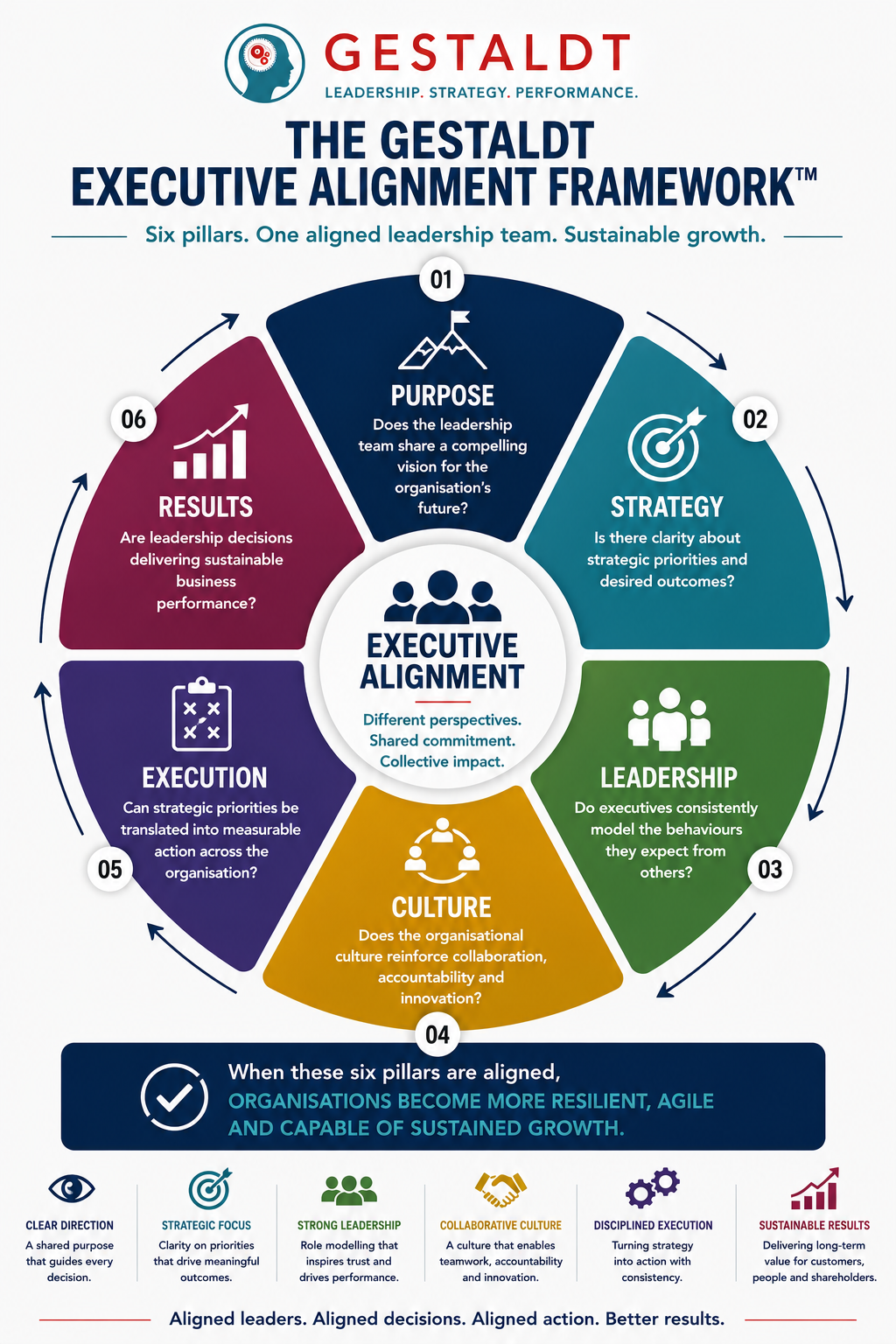
The Gestaldt Executive Alignment Framework™ connects purpose, strategy, leadership, culture, execution, and results to help executive teams turn shared direction into stronger organisational performance.
The Executive Alignment Stress Test
Before your next executive off-site, ask your leadership team to score each statement from 1 to 5.
Purpose
We have a shared understanding of where the organisation needs to go.
Strategy
We agree on the organisation's three most important strategic priorities.
Trade-offs
We agree on what we will not prioritise.
Decision-making
Decision rights are clear and major decisions are not repeatedly revisited.
Accountability
Every strategic priority has clear executive ownership.
Behaviour
Executives consistently model the behaviours expected across the organisation.
Challenge
Our leadership meetings encourage constructive disagreement.
Commitment
Once a decision is made, executives actively support it.
Execution
We translate strategic priorities into measurable organisational action.
Results
We evaluate executive performance based partly on enterprise-wide outcomes.
Interpreting the results
40–50: Strong alignment
Your leadership team has a solid foundation, although continuous alignment is still required.
30–39: Alignment risk
Differences may already be creating execution friction.
Below 30: Significant alignment gap
Your leadership team may be unintentionally undermining strategy through competing priorities, behaviours or decisions.
Alignment Isn't About Getting Everyone to Agree
This distinction deserves emphasis.
A strong executive team should contain disagreement.
Different perspectives improve decisions.
Constructive tension exposes blind spots.
Challenge prevents groupthink.
The problem isn't disagreement.
The problem is unresolved disagreement that leaks into execution.
A mature leadership team can move through four stages:
Challenge → Debate → Decision → Commitment
That is alignment.
Not:
Agreement → Silence → Confusion → Resistance
The CEO's Role Is to Create Alignment—not Manufacture Agreement
CEOs sometimes try to create alignment by communicating more.
More presentations.
More emails.
More town halls.
More strategy documents.
But communication cannot compensate for unresolved strategic ambiguity.
The CEO must instead create the conditions for alignment:
Clarify the destination.
Define the priorities.
Surface disagreement.
Make trade-offs explicit.
Establish decision rights.
Create shared accountability.
Model the required behaviours.
Measure collective outcomes.
PwC's research similarly highlights the importance of healthy debate, diverse perspectives and clear alignment between leadership and strategy when CEOs are navigating uncertainty.
From Executive Alignment to Organisational Performance
The real value of alignment appears below the executive team.
When executives are aligned:
Employees receive clearer priorities.
Decisions move faster.
Resources are allocated more effectively.
Functions collaborate more effectively.
Accountability becomes clearer.
Change initiatives gain momentum.
Strategy becomes easier to execute.
Deloitte's 2025 Chief Transformation Officer research found that organisations encountered some of their greatest transformation challenges during execution, including resource constraints, capability gaps, change management and insufficient ongoing executive engagement.
That is why executive alignment cannot be treated as a "soft" leadership issue.
It is an execution capability.
What Happens When Alignment Breaks Down?
The consequences rarely appear all at once.
Instead, they accumulate.
First, decisions slow.
Then meetings increase.
Then priorities multiply.
Then functions become protective.
Then employees receive contradictory messages.
Then transformation initiatives lose momentum.
Then the CEO becomes increasingly involved in operational decisions.
Eventually, performance suffers.
By this point, leadership may try to fix the symptoms.
New structures.
New KPIs.
New processes.
New technology.
Another transformation programme.
But the underlying issue remains.
The leadership system isn't aligned around how the organisation creates value.
Five Actions CEOs Can Take Now
1. Reduce the Strategic Agenda
Identify the three outcomes that matter most.
Then make the trade-offs explicit.
2. Test Alignment Individually
Ask executives what they believe the priorities are before discussing them collectively.
You may discover gaps that group meetings conceal.
3. Debate Before Deciding
Create space for challenge.
Once the decision is made, create absolute clarity around commitment.
4. Measure Enterprise Outcomes
Reward executives for outcomes that require collaboration—not simply departmental performance.
5. Diagnose the Leadership System
If alignment repeatedly breaks down, don't assume the problem is communication.
Examine:
Roles
Decision rights
Incentives
Culture
Governance
Leadership behaviours
Accountability
Strategic clarity
The Leadership Team Is the Strategy's First Execution Layer
Your strategy doesn't begin when it reaches employees.
It begins with the executive team.
If the C-suite isn't aligned, the organisation has little chance of executing consistently.
That is why executive alignment deserves the same level of attention as strategy development, financial planning and organisational design.
The strongest leadership teams don't simply ask:
"Do we have a good strategy?"
They ask:
"Are we collectively capable of executing it?"
That is a much harder question.
And a much more valuable one.
Is Your Executive Team Truly Aligned?
If your organisation is experiencing:
Slow strategic decisions
Competing executive priorities
Functional silos
Repeatedly revisited decisions
Transformation fatigue
Weak accountability
Inconsistent leadership messages
Increasing CEO intervention
the problem may not be your strategy.
It may be the alignment of the team responsible for delivering it.
Request a Gestaldt Executive Alignment Assessment
Gestaldt can help your leadership team examine:
Strategic alignment
Executive team effectiveness
Decision-making
Leadership behaviours
Organisational culture
Accountability
Governance
Execution
Cross-functional collaboration
Performance alignment
The objective isn't to make executives agree on everything.
It is to build a leadership team capable of challenging intelligently, deciding decisively and executing collectively.
Assess Your Executive Team Alignment
Why Business Transformation Fails: The CEO's Guide to Leading Sustainable Organisational Change
More than two-thirds of business transformation initiatives fail to achieve their intended outcomes. Discover the hidden reasons why transformation stalls and learn how CEOs can build organisations that successfully adapt, execute strategy, and sustain long-term growth.
Change Is Easy. Transformation Is Not.
Every CEO understands that change is inevitable.
Markets evolve.
Customer expectations shift.
Technology disrupts entire industries.
Economic uncertainty reshapes investment decisions.
New competitors emerge seemingly overnight.
In response, organisations launch ambitious transformation programmes designed to modernise operations, improve performance, and secure future growth.
Yet despite significant investment, most transformations fail to deliver lasting value.
Budgets are exceeded.
Timelines slip.
Employee engagement declines.
Momentum fades.
Eventually, the organisation quietly returns to old behaviours.
The strategy wasn't the problem.
The technology wasn't the problem.
Often, the organisation itself wasn't ready for transformation.
Successful transformation requires far more than introducing new systems or restructuring departments. It demands aligned leadership, a culture that embraces change, clear governance, capable people, disciplined execution, and an unwavering focus on long-term value creation.
This article explores the seven reasons business transformation fails—and what executive leaders can do differently.
Why Transformation Has Become a Boardroom Priority
Business transformation is no longer optional.
Artificial intelligence, digital disruption, geopolitical instability, shifting workforce expectations, sustainability demands, and changing customer behaviours require organisations to evolve continuously.
Transformation today includes:
Leadership transformation
Culture transformation
Operating model redesign
Customer experience transformation
Sustainability transformation
Workforce transformation
The question is no longer whether organisations should transform.
It is whether they can transform successfully.
1. Leadership Alignment Breaks Down Before Transformation Begins
Most transformation programmes start with executive enthusiasm.
The board approves the investment.
Leadership launches the initiative.
Employees attend town halls.
The vision is communicated.
Yet beneath the surface, executive alignment is often incomplete.
Different leaders interpret transformation differently.
Some view it as technology.
Others view it as restructuring.
Others see it as cost reduction.
Without genuine alignment, every subsequent decision becomes inconsistent.
Signs of Misalignment
Conflicting priorities
Inconsistent communication
Slow decision-making
Departmental silos
Resource competition
Transformation requires one leadership voice.
Not many.
2. Culture Quietly Rejects Change
Technology changes quickly.
Culture changes slowly.
Many organisations attempt digital transformation while maintaining cultures built around stability, hierarchy and risk avoidance.
Employees hear leaders speak about innovation.
Yet mistakes are punished.
New ideas are discouraged.
Approvals multiply.
Experimentation disappears.
Eventually employees stop engaging.
Transformation becomes another corporate initiative that "will pass."
Culture determines whether transformation succeeds.
Ask Yourself
Does your culture reward:
✔ Innovation
✔ Collaboration
✔ Accountability
✔ Continuous learning
✔ Customer focus
If not, transformation resistance is inevitable.
Related Reading
The Invisible Fuel of Business Growth: How Leadership Culture Drives Organisational Success
3. Organisations Focus on Technology Instead of People
One of the biggest misconceptions about transformation is that technology creates change.
People create change.
Technology simply enables it.
Executives often invest millions in:
ERP systems
Artificial Intelligence
CRM platforms
Automation
Analytics
Yet relatively little investment goes into preparing people.
Without capability development:
Employees resist.
Managers struggle.
Leadership loses confidence.
Transformation slows.
Successful organisations invest equally in technology and human capability.
4. Middle Management Is Forgotten
Transformation is rarely delivered by executives.
It is delivered by managers.
Middle managers translate strategy into operational behaviour.
If they don't understand transformation...
Neither will employees.
Unfortunately many organisations communicate transformation to managers instead of involving them.
The result:
Confusion
Inconsistent implementation
Low engagement
Resistance
High-performing organisations make middle management transformation champions.
5. Governance Is Too Weak—or Too Bureaucratic
Transformation requires disciplined governance.
Too little governance creates chaos.
Too much governance creates paralysis.
Successful organisations establish:
Clear decision rights
Defined accountability
Transparent reporting
Rapid escalation
Agile decision-making
Governance should accelerate transformation—not slow it.
6. Organisations Measure Activity Instead of Impact
Transformation dashboards often report:
✔ Workshops completed
✔ Systems implemented
✔ Training delivered
These are activity metrics.
Executives should instead measure:
Customer experience
Employee engagement
Leadership capability
Innovation
Strategic execution
Organisational agility
Decision speed
Transformation should improve organisational performance—not simply complete projects.
7. Transformation Is Treated as a Project Instead of a Capability
Projects finish.
Transformation doesn't.
The world's highest-performing organisations don't transform every five years.
They build organisations capable of continuous adaptation.
Transformation becomes part of leadership.
Part of culture.
Part of governance.
Part of everyday decision-making.
This is what creates long-term resilience.
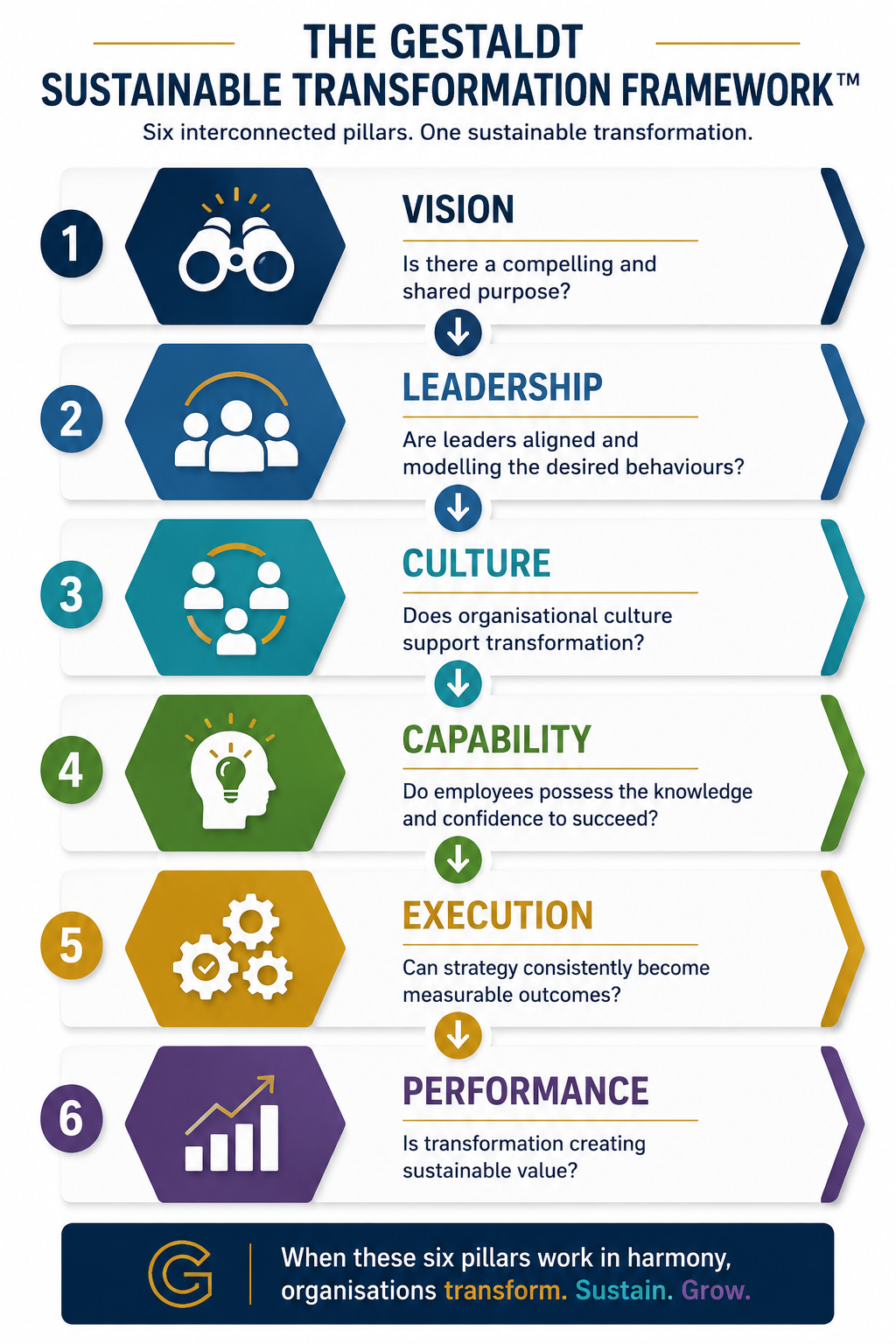
The Gestaldt Sustainable Transformation Framework™
At Gestaldt, we believe sustainable transformation rests on six interconnected pillars.
Executive Transformation Health Check
Score each statement from 1 (Strongly Disagree) to 5 (Strongly Agree)
Leaders communicate a consistent transformation vision.
Employees understand why change is necessary.
Managers actively support transformation.
Our culture encourages innovation.
Decision-making is fast.
Accountability is clear.
We measure transformation outcomes.
Employees possess future-ready capabilities.
Leadership embraces continuous learning.
Transformation has improved organisational performance.
Results
40–50
Transformation is becoming a competitive advantage.
30–39
Transformation risks are emerging.
Below 30
Transformation requires immediate leadership attention.
Five Questions Every CEO Should Ask
Before approving another transformation initiative, ask:
Are our leaders truly aligned?
Does our culture support transformation?
Are our people ready?
Can our governance accelerate change?
How will we measure success?
If these questions cannot be answered confidently, transformation risk increases significantly.
Transformation Is Ultimately About Leadership
Technology changes systems.
Leadership changes organisations.
The most successful CEOs understand that transformation isn't an IT initiative.
It isn't a restructuring exercise.
It isn't a communications campaign.
It is an organisational capability.
When leadership, culture, governance, capability, and execution align, organisations become resilient, adaptable, and prepared for whatever comes next.
Ready to Lead Sustainable Transformation?
Every organisation faces transformation challenges.
The difference lies in identifying them before they become barriers to growth.
Request a Business Transformation Diagnostic
Our executive consultants will help you assess:
✔ Leadership alignment
✔ Transformation readiness
✔ Organisational culture
✔ Governance effectiveness
✔ Strategy execution capability
✔ Leadership capability
✔ Organisational agility
Together, we'll identify the obstacles preventing sustainable transformation and develop practical strategies that deliver measurable business outcomes.
👉 Schedule your confidential Business Transformation Diagnostic today.