

AI Isn't the Strategy: Why Most Organisations Are Struggling to Turn AI Investment Into Business Value
AI adoption is accelerating, but many organisations are struggling to turn experimentation into measurable business value. Discover the six organisational conditions CEOs must align to move AI from isolated pilots to sustainable transformation.

Your Organisation May Have an AI Problem That Technology Can't Solve
AI has moved from the technology department into the boardroom.
CEOs are asking how it will reshape their workforce.
CFOs want to understand the return on investment.
COOs want productivity gains.
CMOs are experimenting with generative AI.
HR leaders are considering how jobs and capabilities will change.
Boards want to know whether competitors are moving faster.
And across the organisation, employees are already using AI—sometimes officially, sometimes unofficially.
The technology is moving quickly.
But organisations aren't.
McKinsey's 2025 research found that 88% of respondents said their organisations were using AI in at least one business function, while only 7% reported that AI had been fully scaled across the organisation.
That gap tells us something important.
AI adoption is not the same as AI transformation.
Buying technology is relatively easy.
Creating an organisation capable of using it effectively is much harder.
And that is where many AI strategies are beginning to break down.
The AI Adoption Trap
Here's the uncomfortable truth:
Your organisation doesn't need another AI pilot. It needs an AI operating model.
Many organisations are running multiple experiments simultaneously.
Marketing has one.
HR has another.
IT has several.
Customer service is testing a chatbot.
Finance is experimenting with automation.
Executives are using AI assistants.
Everyone is busy.
Yet the organisation isn't necessarily becoming more intelligent, productive or competitive.
This creates what we might call the AI Adoption Trap:
More experimentation → more activity → more technology → little organisational change.
The problem isn't a lack of enthusiasm.
It's a lack of integration.
AI needs to connect to strategy, leadership, governance, people, processes and measurable business outcomes.
Otherwise, it remains a collection of disconnected tools.
1. Your AI Strategy May Be Starting With Technology Instead of Business Problems
This is where many organisations go wrong.
They discover a powerful AI capability and then ask:
"What can we use this for?"
A stronger strategic question is:
"What business problem are we trying to solve?"
That distinction matters.
AI can potentially:
Reduce operating costs.
Improve customer experience.
Accelerate decision-making.
Increase productivity.
Strengthen forecasting.
Improve knowledge management.
Accelerate innovation.
Create new products and services.
But not every AI application creates meaningful value.
McKinsey's research found that organisations achieving the strongest AI impact are more likely to pursue transformative ambitions, redesign workflows and scale AI faster.
The CEO Question
Which three business outcomes could AI materially improve over the next 12–24 months?
Start there.
Not with the technology.
Practical Tip
Create an AI opportunity map that ranks potential use cases according to business value, feasibility, risk and strategic importance.
2. AI Cannot Transform a Process That Was Already Broken
Here's a common misconception:
Automation automatically creates efficiency.
It doesn't.
If an organisation has a fragmented, bureaucratic or inefficient process, adding AI may simply make the bad process faster.
The organisation hasn't transformed.
It has automated complexity.
Before introducing AI, ask:
Why does this process exist?
Who owns it?
Where are the bottlenecks?
Which steps add value?
Which steps exist because of historical decisions?
Where are customers experiencing friction?
Then ask:
"If we redesigned this process from scratch using AI capabilities, what would it look like?"
That's a transformation question.
3. Leadership Is the Missing AI Capability
AI transformation is often presented as a technology challenge.
Increasingly, it's a leadership challenge.
Executives need to decide:
Where AI should be used.
Where it should not be used.
Which capabilities need to be developed.
Which processes should be redesigned.
How investment should be prioritised.
What risks are acceptable.
How performance should be measured.
Deloitte's research found that C-suite leaders need to redefine aspects of their roles around GenAI while maintaining alignment between technical and business leadership.
The CEO doesn't need to become an AI engineer.
But the CEO does need enough understanding to ask the right strategic questions.
Practical Tip
Create an AI leadership agenda with five standing questions:
Where are we creating value?
Where are we reducing risk?
What capabilities are we building?
What work should be redesigned?
What evidence shows that AI is improving performance?
4. Your Workforce Isn't Resisting AI—It May Be Resisting Uncertainty
This distinction is critical.
When employees hesitate to adopt AI, leadership may describe them as resistant to change.
But employees may actually be asking:
Will my role change?
Will my skills remain valuable?
How will performance be measured?
What am I allowed to use AI for?
Who is accountable when AI gets something wrong?
Will AI replace my job?
Those aren't resistance questions.
They're organisational design questions.
Deloitte's research identified talent and skills as major barriers to GenAI adoption and found that only 22% of surveyed leaders considered their organisations highly or very highly prepared to address talent-related GenAI issues.
Practical Tip
Don't launch AI adoption without a workforce transition plan covering skills, roles, communication, training, governance and leadership expectations.
5. Governance Can Either Accelerate AI—or Kill It
Here's the balancing act.
Too little governance creates risk.
Too much governance creates paralysis.
Organisations need enough control to protect:
Data
Privacy
Intellectual property
Customers
Employees
Reputation
Regulatory compliance
But governance must also enable responsible experimentation.
Deloitte's 2025 research found regulatory compliance had become a leading barrier to GenAI deployment, while many organisations were still taking more than a year to establish mature governance foundations.
The answer isn't to eliminate governance.
It's to make governance proportionate, clear and fast.
Practical Tip
Create three AI governance categories:
Green: Low-risk use cases that employees can use within clear guidelines.
Amber: Higher-risk applications requiring review.
Red: Applications requiring executive or specialist approval.
This gives employees clarity without creating unnecessary bureaucracy.
6. AI Transformation Fails When Nobody Owns the Outcome
This is perhaps the most important issue.
Who owns AI?
The CIO?
The CTO?
The Chief Digital Officer?
The CEO?
The business units?
The answer cannot simply be "IT."
AI changes how the business works.
Therefore, accountability must sit across the organisation.
Technology leaders should own technology architecture.
Risk leaders should own risk controls.
HR should help lead workforce transformation.
But business leaders must own the business outcomes.
Otherwise AI becomes another technology programme rather than a transformation agenda.
The Gestaldt AI Transformation Framework™
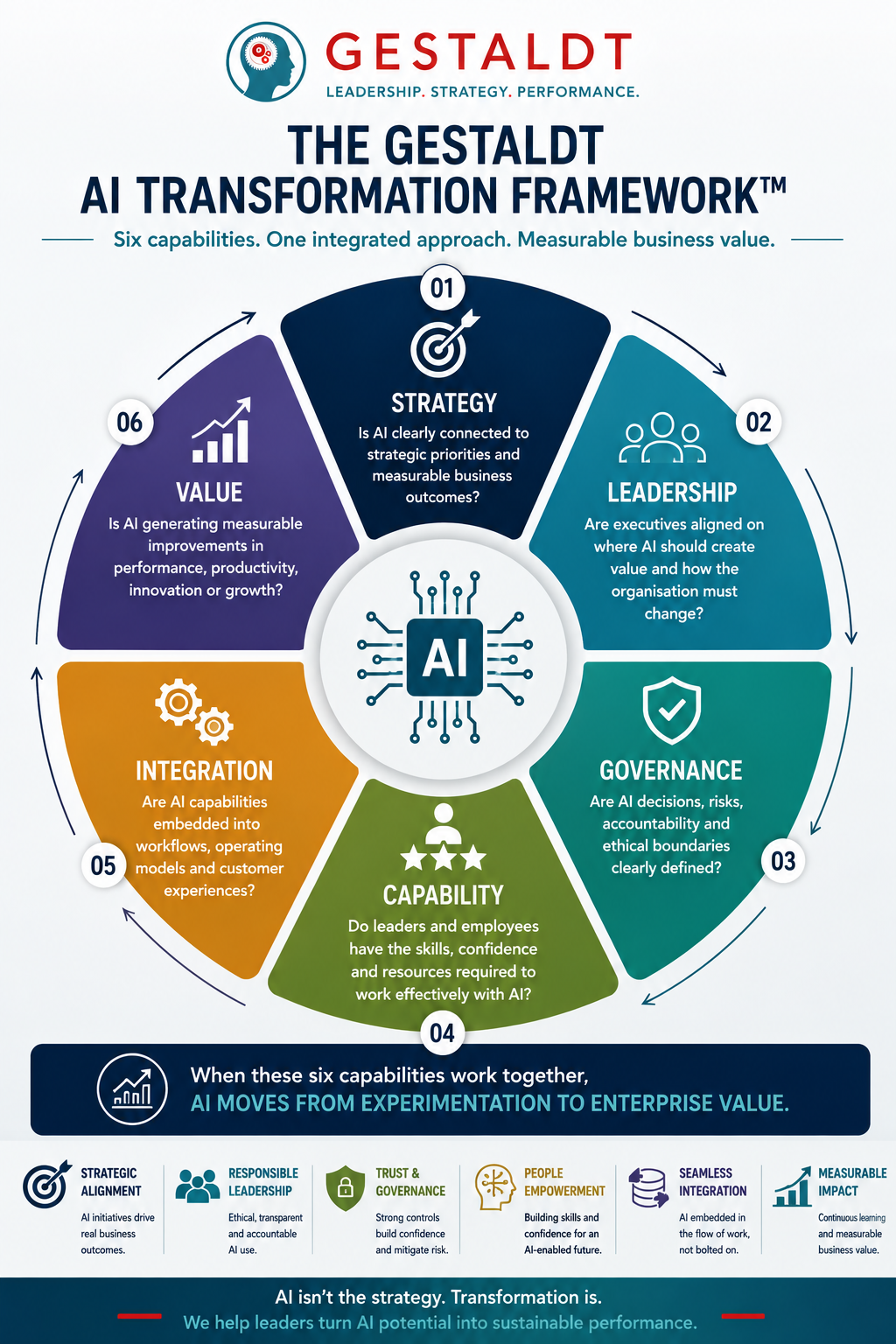
The Gestaldt AI Transformation Framework™ connects strategy, leadership, governance, capability, integration and value to help organisations turn AI potential into sustainable business performance.
The AI Transformation Readiness Test
Your executive team can use the following quick diagnostic.
Rate each statement from 1 (Strongly Disagree) to 5 (Strongly Agree).
Our AI initiatives are directly linked to strategic priorities.
We have identified the business problems where AI can create the greatest value.
The executive team has a shared AI vision.
AI decision rights and governance are clearly defined.
Employees understand how AI will affect their roles.
We are actively developing AI-related capabilities.
Our core workflows are being redesigned rather than simply automated.
AI initiatives have clear business owners.
We measure AI according to business outcomes rather than activity.
We have a clear roadmap for scaling successful AI initiatives.
Your Score
40–50 — AI-ready organisation
Your organisation has strong foundations for scaling AI strategically.
30–39 — Emerging readiness
You have promising foundations, but gaps may prevent consistent enterprise-wide value.
Below 30 — Transformation risk
Your organisation may be investing in AI faster than it is building the capabilities required to use it effectively.
The Difference Between AI Adoption and AI Transformation
The distinction is simple.
AI Adoption
Employees use AI tools.
AI Transformation
The organisation changes how work gets done because of AI.
That could mean:
Redesigning customer journeys.
Rebuilding operating processes.
Changing decision-making.
Creating new products.
Redefining roles.
Developing new leadership capabilities.
Changing performance measures.
Reallocating resources.
The technology is only the catalyst.
The organisation is the transformation.
The CEO's Five AI Questions
Before approving another AI initiative, ask:
1. What business outcome will this change?
If the answer is unclear, reconsider the investment.
2. What process or operating model must change?
AI rarely creates sustainable value when the organisation refuses to change the way work is done.
3. Who owns the business result?
Technology ownership isn't enough.
4. What capabilities will our people need?
Adoption depends on confidence as much as technology.
5. How will we know it worked?
Define measurable outcomes before launching the initiative.
Don't Build an AI Portfolio. Build an AI-Powered Organisation.
This is the strategic shift CEOs need to make.
The goal isn't to have the most AI tools.
It isn't to run the most pilots.
It isn't to announce the biggest AI investment.
The real competitive advantage comes from building an organisation that can identify opportunities, make disciplined decisions, redesign work, develop people and scale what works faster than competitors.
That is an organisational capability.
And capabilities are built deliberately.
AI Will Reward Organisations That Can Change
Technology is accelerating.
The organisations that benefit most won't necessarily be those with the biggest technology budgets.
They will be those capable of changing quickly enough to capture the value technology creates.
McKinsey's 2026 research describes AI, economic uncertainty, geopolitical fragmentation and changing workforce expectations as forces reshaping how organisations create value and sustain performance.
The strategic question for CEOs is therefore no longer:
"Should we adopt AI?"
That question has largely been answered.
The better question is:
"Are we organisationally capable of turning AI into sustainable competitive advantage?"
That is the question that belongs in the boardroom.
Is Your Organisation Ready to Turn AI Into Business Value?
If your organisation is investing in AI but struggling to move beyond pilots, isolated experiments or productivity improvements, the problem may not be your technology.
It may be your strategy, leadership, governance, capability or operating model.
Request a Gestaldt AI Transformation Readiness Assessment
Gestaldt can help your executive team assess:
AI strategic alignment
Executive readiness
AI governance
Workforce capability
Operating-model implications
Workflow redesign
Change readiness
Accountability
AI scaling capability
Business-value measurement
The objective isn't simply to help your organisation adopt AI.
It is to build the organisational capability required to turn AI into measurable business performance.
Assess Your AI Transformation Readiness

The Role of Purpose in Enterprise: How Meaning Creates Competitive Advantage
Discover how purpose-driven organisations create competitive advantage through stronger culture, greater innovation, enhanced customer loyalty, and sustainable business growth.

Why do some companies inspire fierce customer loyalty, attract top talent effortlessly, and outperform competitors over the long term? The answer often has less to do with products and profits—and more to do with purpose.
Imagine an organisation as a ship navigating unpredictable waters. Strategy determines the route, operations keep the vessel moving, and technology powers the engine. But purpose? Purpose is the compass. It provides direction when conditions change, guides decision-making during uncertainty, and keeps everyone moving toward a shared destination.
In an era defined by rapid technological disruption, evolving consumer expectations, and increasing demands for corporate accountability, purpose has become more than a mission statement hanging on a boardroom wall. It has become a strategic asset.
This article explores how purpose-driven organisations create competitive advantage, strengthen culture, enhance innovation, attract talent, and build long-term resilience in a constantly changing business environment.
1. Purpose Is No Longer a Corporate Luxury—It's a Strategic Necessity
Customers can copy your products. Competitors can replicate your pricing. But purpose is far harder to duplicate.
For decades, businesses focused primarily on profitability as their defining objective. While profit remains essential, modern stakeholders increasingly expect organisations to contribute positively to society while generating financial returns.
Purpose provides a clear answer to a fundamental question:
Why does the organisation exist beyond making money?
When employees, customers, investors, and communities understand and believe in that answer, businesses gain a powerful differentiator.
Research from Deloitte has consistently shown that purpose-driven organisations tend to achieve higher levels of growth, innovation, and employee engagement than their peers.
As leadership expert Simon Sinek famously said:
"People don't buy what you do; they buy why you do it."
Purpose creates emotional connections that transactional relationships cannot.
Practical Tip:
Review your organisation's mission statement. If it focuses only on products, services, or profits, consider redefining it around the value you create for people and society.
2. Purpose Attracts and Retains Top Talent
The best employees aren't just looking for a pay cheque—they're looking for a reason to care.
Workplace expectations have evolved dramatically. Today's professionals increasingly seek employers whose values align with their own.
Purpose-driven organisations often experience:
Higher employee engagement
Lower turnover
Greater job satisfaction
Stronger employer branding
Improved workforce loyalty
Younger generations entering the workforce particularly prioritise meaningful work and social impact when evaluating employers.
When employees understand how their contributions support a larger mission, motivation becomes intrinsic rather than purely financial.
As management thinker Peter Drucker observed:
"Culture eats strategy for breakfast."
Purpose fuels culture by giving employees a shared sense of significance.
Practical Tip:
Help employees connect their daily responsibilities to broader organisational goals through regular communication and recognition programs.
Related Reading:
/continuous-learning-organisations – Building a Culture of Lifelong Development
3. Purpose Drives Innovation Through Shared Vision
Innovation thrives when people are united by a cause bigger than themselves.
Many organisations mistakenly view innovation solely as a technology issue. In reality, innovation often begins with clarity of purpose.
Purpose acts as a decision-making filter:
Which opportunities should we pursue?
Which problems should we solve?
Which customers should we serve?
Which innovations align with our mission?
When teams share a common purpose, collaboration improves and creativity becomes more focused.
Harvard Business Review research has repeatedly highlighted that organisations with strong cultures and clearly defined missions are more likely to foster innovation.
As former Apple CEO Steve Jobs stated:
"The people who are crazy enough to think they can change the world are the ones who do."
Purpose inspires ambitious thinking.
Practical Tip:
Evaluate innovation projects against your organisation's core purpose to ensure strategic alignment.
Related Reading:
/innovation-in-business – Innovation Strategies for Sustainable Growth
4. Purpose Strengthens Customer Loyalty and Brand Trust
Customers increasingly buy from brands that reflect their beliefs—not just their budgets.
Consumer behaviour is changing. People are becoming more conscious about where they spend their money and which brands they support.
Purpose-driven organisations often benefit from:
Stronger customer relationships
Increased brand advocacy
Higher customer retention
Enhanced reputation
Greater resilience during crises
Trust is becoming one of the world's most valuable business assets.
A meaningful purpose helps build that trust by demonstrating authenticity and commitment beyond short-term profits.
As Richard Branson explains:
"Doing good is good for business."
Customers reward businesses that consistently demonstrate values they believe in.
Practical Tip:
Ensure your purpose is reflected in customer experience, marketing, and operational decisions—not just corporate communications.

5. Purpose Creates Resilience During Economic Uncertainty
When markets become volatile, purpose helps organisations stay grounded.
Economic downturns, geopolitical tensions, supply chain disruptions, and technological shifts create uncertainty for businesses worldwide.
Purpose-driven organisations often navigate these challenges more effectively because they have a clear framework for decision-making.
Purpose provides:
Strategic consistency
Organisational alignment
Long-term focus
Stronger stakeholder support
Improved adaptability
During difficult periods, employees and customers are more likely to remain committed to organisations they believe in.
Research suggests that companies with strong stakeholder relationships frequently recover faster from crises than those focused solely on short-term financial outcomes.
Practical Tip:
Use your organisational purpose as a guiding principle when making difficult strategic decisions during uncertain times.
Related Reading:
/supply-chain-resilience – Building Resilient Systems in Uncertain Times
6. Purpose and Profit Are Partners, Not Opponents
One of the biggest myths in business is that organisations must choose between doing good and doing well.
The most successful enterprises understand that purpose and profitability can reinforce one another.
Purpose can create value by:
Attracting customers
Improving employee retention
Enhancing innovation
Strengthening reputation
Reducing operational risks
Building investor confidence
The rise of ESG investing, impact investment, and stakeholder capitalism demonstrates growing recognition that long-term value creation extends beyond quarterly earnings.
As investor Larry Fink has noted:
"Purpose is not the sole pursuit of profits but the animating force for achieving them."
Purpose helps organisations create sustainable success rather than temporary gains.
Practical Tip:
Incorporate both financial and purpose-driven metrics into strategic planning and performance reviews.
Related Reading:
/impact-investment-africa – Aligning Purpose, Profit, and Social Value in African Contexts
7. Embedding Purpose Into Organisational Culture
Purpose only becomes powerful when it moves from words on paper to actions in practice.
Many organisations define a purpose but struggle to bring it to life.
Purpose becomes meaningful when it influences:
Leadership behaviour
Recruitment decisions
Performance management
Customer interactions
Product development
Strategic investments
Leaders play a crucial role in demonstrating purpose through consistent actions.
Employees quickly recognise the difference between authentic commitment and corporate rhetoric.
As Brené Brown explains:
"Integrity is choosing courage over comfort."
Purpose requires organisations to consistently align actions with values.
Practical Tip:
Embed purpose into leadership development, onboarding processes, and employee recognition programs.
Related Reading:
/inclusive-leadership-strategies – Inclusive Leadership: Practical Ways to Lead Diverse Teams
The Future of Enterprise Belongs to Purpose-Driven Organisations
As businesses navigate economic uncertainty, technological transformation, shifting workforce expectations, and increasing social accountability, purpose is becoming one of the most important competitive advantages available.
Purpose provides direction when strategies evolve.
It inspires innovation when challenges arise.
It builds trust when competitors struggle to differentiate.
And it creates meaning that attracts employees, customers, and investors alike.
The organisations that thrive in the coming decade will not simply be those that generate profits. They will be those that clearly understand why they exist, whom they serve, and the positive impact they seek to create.
Because in today's marketplace, purpose is no longer separate from success.
It is increasingly the foundation of it.

Diversity and Inclusion as Strategy: How Equity Drives Performance and Innovation
Discover how diversity, inclusion, and equity drive business performance and innovation. Learn actionable strategies to build an inclusive workplace that fuels growth.

Diversity and inclusion aren’t just buzzwords anymore—they’re the secret sauce behind the world’s most innovative and high-performing companies. Ignore them, and you’re leaving serious growth on the table.
Think of your organisation as a garden. If you plant only one type of seed, you’ll get a uniform—but limited—result. But mix different seeds, nurture them equally, and suddenly you’ve got a thriving ecosystem bursting with colour, resilience, and creativity.
That’s exactly what diversity and inclusion (D&I) do for businesses. In this article, you’ll learn how equity fuels performance, sparks innovation, and why companies that embrace D&I as a strategy—not a checkbox—are miles ahead of the competition.
1. Why Diversity Isn’t Just “Nice to Have” Anymore
Still thinking diversity is a soft HR initiative? Think again—it’s a bottom-line driver.
Diversity brings together people with different perspectives, backgrounds, and problem-solving approaches. This variety leads to better decision-making and stronger business outcomes.
A Gestaldt study found that companies in the top quartile for ethnic diversity are 37% more likely to outperform financially than their peers.
As business leader Indra Nooyi once said:
“Diversity of thought is what drives innovation.”
Practical Tip:
Audit your current team composition—look beyond gender and race to include skills, experiences, and thinking styles.
2. Inclusion: The Missing Piece That Makes Diversity Work
Hiring diverse talent is one thing—making them feel valued is where the magic happens.
Without inclusion, diversity is just optics. Employees need to feel safe, heard, and empowered to contribute.
Research from Gestaldt shows that inclusive teams are 9 times more likely to achieve better business outcomes.
When people feel included, they’re more engaged, productive, and loyal.
Practical Tip:
Create structured opportunities for all voices to be heard—think roundtable discussions instead of top-down meetings.
3. Equity: The Game-Changer Most Companies Overlook
Equality gives everyone the same shoes. Equity makes sure they actually fit.
Equity ensures that employees have access to the resources and opportunities they need to succeed. This means addressing systemic barriers, not just treating everyone the same.
According to Gartner, organisations that prioritise equity see a 26% increase in employee performance.
As author Verna Myers puts it:
“Diversity is being invited to the party; inclusion is being asked to dance.”
Practical Tip:
Review pay structures, promotions, and development opportunities to identify and eliminate disparities.
4. Innovation Thrives Where Differences Collide
If everyone thinks the same, innovation doesn’t stand a chance.
Diverse teams challenge assumptions and bring fresh ideas to the table. This friction—when managed well—leads to breakthroughs.
Gestaldt Management Consultants found that companies with above-average diversity in leadership generate 20% more innovation revenue.
Practical Tip:
Encourage cross-functional collaboration—mix departments and backgrounds when forming teams.
5. D&I as a Competitive Advantage in Talent Attraction
Top talent isn’t just chasing salaries—they’re chasing purpose and belonging.
Today’s workforce, especially younger generations, prioritises inclusive workplaces. Companies that fail to embrace D&I risk losing out on top-tier candidates.
Our survey revealed that 77% of job seekers consider workplace diversity important when evaluating job offers.
Practical Tip:
Showcase your D&I initiatives transparently on your careers page and social media.
6. Building a Culture That Sustains Inclusion
One-off workshops won’t cut it—culture is built daily, not annually.
Sustainable D&I requires leadership commitment, consistent policies, and accountability. It’s about embedding inclusion into everyday practices.
According to Harvard Business Review, companies with inclusive cultures are more adaptable and resilient during change.
As leadership expert Simon Sinek says:
“A culture is strong when people work with each other, for each other.”
Practical Tip:
Tie leadership performance metrics to D&I goals to ensure accountability.
Conclusion
Diversity, inclusion, and equity aren’t just ethical imperatives—they’re strategic powerhouses. Together, they unlock innovation, improve performance, and create workplaces where people genuinely thrive.
From boosting financial results to attracting top talent, the evidence is clear: businesses that embrace D&I as a core strategy don’t just survive—they lead.
So, if you want your organisation to grow like that thriving garden, it’s time to plant the seeds of equity, nurture inclusion, and let diversity do what it does best—transform everything.

Leadership Lessons from Africa’s Fastest-Growing Startups
Africa’s fastest-growing startups are redefining leadership. Learn key lessons from visionary founders who turn challenges into innovation and impact.

What do Africa’s fastest-growing startups have in common? It’s not just bold ideas or big funding—it’s the leaders steering them. From Lagos to Nairobi to Cape Town, visionary founders are rewriting the playbook for leadership in emerging markets.
Think of Africa’s startup ecosystem as a wildfire—rapid, unpredictable, and unstoppable. In the past decade, the continent has produced some of the world’s most dynamic ventures, from fintech powerhouses like Flutterwave and Chipper Cash to health-tech and agritech innovators.
But behind every successful startup is a leader who turns uncertainty into opportunity. This article explores the leadership lessons driving Africa’s entrepreneurial boom—insights that established executives and aspiring founders alike can apply to build resilient, high-growth organisations.
1. Lead with Purpose, Not Just Profit
African startups are proving that purpose fuels profit. Founders are solving real-world problems—access to finance, energy, and healthcare—while building sustainable businesses.
Take M-Pesa, for example. What started as a mobile payment solution for Kenya’s unbanked population is now a global model for financial inclusion.
Quote: “We didn’t set out to create a fintech revolution; we wanted to solve a problem.” — Nick Hughes, M-Pesa co-founder
Tip: Anchor your leadership around purpose. When teams believe in the “why,” they’ll push harder, innovate faster, and stay committed longer.
2. Adaptability Is the New Competitive Advantage
In Africa’s fast-changing markets, agility isn’t optional—it’s survival. Leaders who can pivot quickly and make data-informed decisions thrive even amid volatility.
During the pandemic, Nigerian edtech firm uLesson pivoted from in-person tutoring to a fully digital learning platform, doubling its user base within a year.
Statistic: According to Partech Africa, startups that adapted business models during crises grew 1.5x faster than those that didn’t.
Tip: Build adaptability into your company DNA—create flexible strategies, decentralised teams, and rapid feedback loops.
3. Empower Your Team and Trust Local Talent
African startup leaders understand that success is a team sport. The best founders hire smart, local talent who understand the nuances of their markets.
Flutterwave’s CEO, Olugbenga Agboola, attributes the company’s success to empowering employees to take ownership and make decisions.
Tip: Delegate authority, not just tasks. Give teams autonomy to solve problems, experiment, and lead from within. Empowered teams move faster and innovate more.
4. Build Resilience Through Resourcefulness
Limited resources don’t stop African founders—they spark creativity. Many successful startups thrive because leaders turn constraints into innovation.
For instance, Twiga Foods in Kenya built a tech-enabled supply chain to connect farmers directly with retailers, cutting waste and costs in a fragmented market.
Quote: “Africa teaches you to do more with less—and that’s the ultimate startup advantage.” — Peter Njonjo, Twiga Foods CEO
Tip: Encourage a culture of problem-solving and frugality. Constraints can drive your team to find smarter, more efficient solutions.

5. Prioritise Community and Collaboration
Unlike in some hyper-competitive markets, African startups often win by collaborating. Partnerships with governments, NGOs, and corporates create shared value and open doors to scale.
Yoco, a South African fintech company, built partnerships with local banks to bring digital payment solutions to small businesses, helping expand financial inclusion while growing its customer base.
Statistic: Ecosystem collaboration has helped African startups raise over $6.5 billion in 2022, a 55% increase from the previous year (Disrupt Africa).
Tip: Look beyond competition. Build alliances that amplify your reach, credibility, and impact.
6. Stay Customer-Centric—Always
African entrepreneurs know that customer empathy drives loyalty and innovation. Leaders who listen closely to their users adapt products faster and build lasting relationships.
Example: South Africa’s SweepSouth continually refines its home services app based on direct feedback from users and domestic workers—turning insights into better customer experiences.
Tip: Implement continuous feedback mechanisms—user surveys, social media monitoring, and in-app analytics—to keep customer needs at the heart of your growth strategy.
7. Scale with Vision, Not Chaos
Growth is thrilling—but without structure, it can unravel. Successful African startups scale by balancing entrepreneurial hustle with disciplined execution.
Andela, for instance, transformed from a talent-matching startup into a global tech network by refining its processes and leadership systems at every stage.
Tip: Build scalable frameworks early—clear communication channels, decision-making structures, and measurable goals. Vision without structure breeds burnout.
Conclusion: Redefining Leadership for a New Era
Africa’s fastest-growing startups are more than business success stories—they’re leadership case studies. Their founders show that purpose, adaptability, empowerment, and community aren’t buzzwords; they’re the foundations of sustainable growth.
As global investors increasingly turn their eyes toward Africa, one thing is clear: leadership, not luck, will define the continent’s next wave of innovation.
“The future of business leadership is being written in Africa—by those who dare to reimagine what’s possible.” - Thapelo Mahlangu, Gestaldt Consulting Group MD.