

The Performance Blind Spot: How CEOs Can Detect Business Problems Earlier
The Gestaldt Performance Intelligence Framework™ connects Strategy, Leadership, Workforce, Organisation, Enablement, and Execution into one integrated system—helping leaders turn organisational capability into measurable, sustainable performance.

Your Dashboard May Be Telling You the Truth—and Still Hiding the Problem
A business can hit its revenue target while losing customers.
It can increase productivity while exhausting its managers.
It can deliver quarterly profit while its pipeline weakens.
It can complete transformation projects while adoption remains poor.
It can report strong employee performance while critical capabilities are quietly disappearing.
And by the time the financial numbers reveal the problem, the organisation may already be paying the price.
This is the performance blind spot.
Many leadership teams are excellent at measuring what happened but less effective at detecting what is likely to happen next.
Think of it like driving a car by looking only in the rear-view mirror.
The mirror is useful. You absolutely need it.
But it cannot tell you what is around the next corner.
That is why CEOs need a performance system that combines lagging indicators with leading indicators—financial results with the operational, customer, workforce and strategic signals that influence future performance.
Gestaldt has long highlighted this distinction, noting that organisations often rely heavily on lagging measures while stronger performance-management systems also monitor critical process inputs early enough to influence outcomes.
The challenge is particularly relevant now. Survey, based on 4,454 CEOs across 95 countries and territories, found that CEOs are balancing short-term threats with longer-term reinvention, while major shifts in technology, AI, geopolitics and business models continue to reshape the competitive environment.
The question for leaders is therefore not simply:
"How did we perform?"
It is:
"What is today's performance telling us about tomorrow?"
1. The Numbers Can Look Healthy Right Before the Warning Signs Become Obvious
Here's the trap: financial performance is essential, but it is often late.
Revenue, profit, EBITDA and cash flow tell leadership whether value has already been created.
They don't always tell you why performance is changing—or whether the current trajectory is sustainable.
Imagine three companies reporting identical quarterly revenue.
Company A has:
growing customer retention;
improving sales conversion;
strong employee engagement;
rising productivity;
a healthy innovation pipeline.
Company B has:
stable retention;
declining sales conversion;
rising employee turnover;
slower decision-making;
weakening pipeline quality.
Company C has:
declining retention;
heavy discounting;
growing operational costs;
increasing absenteeism;
stalled strategic initiatives.
Their financial statements may look similar today.
Their future situations are not.
This is why a sophisticated performance system distinguishes between outcomes and drivers.
Research found that only 32% of executives said their performance-management approach enabled timely, high-quality talent decisions about high and low performers.
The quote that matters
Satya Nadella, CEO of Microsoft, described the distinction between current performance and future performance through what he called “performance metrics” and “power metrics”, with the latter focused on leading indicators such as usage and customer satisfaction.
Practical Tip
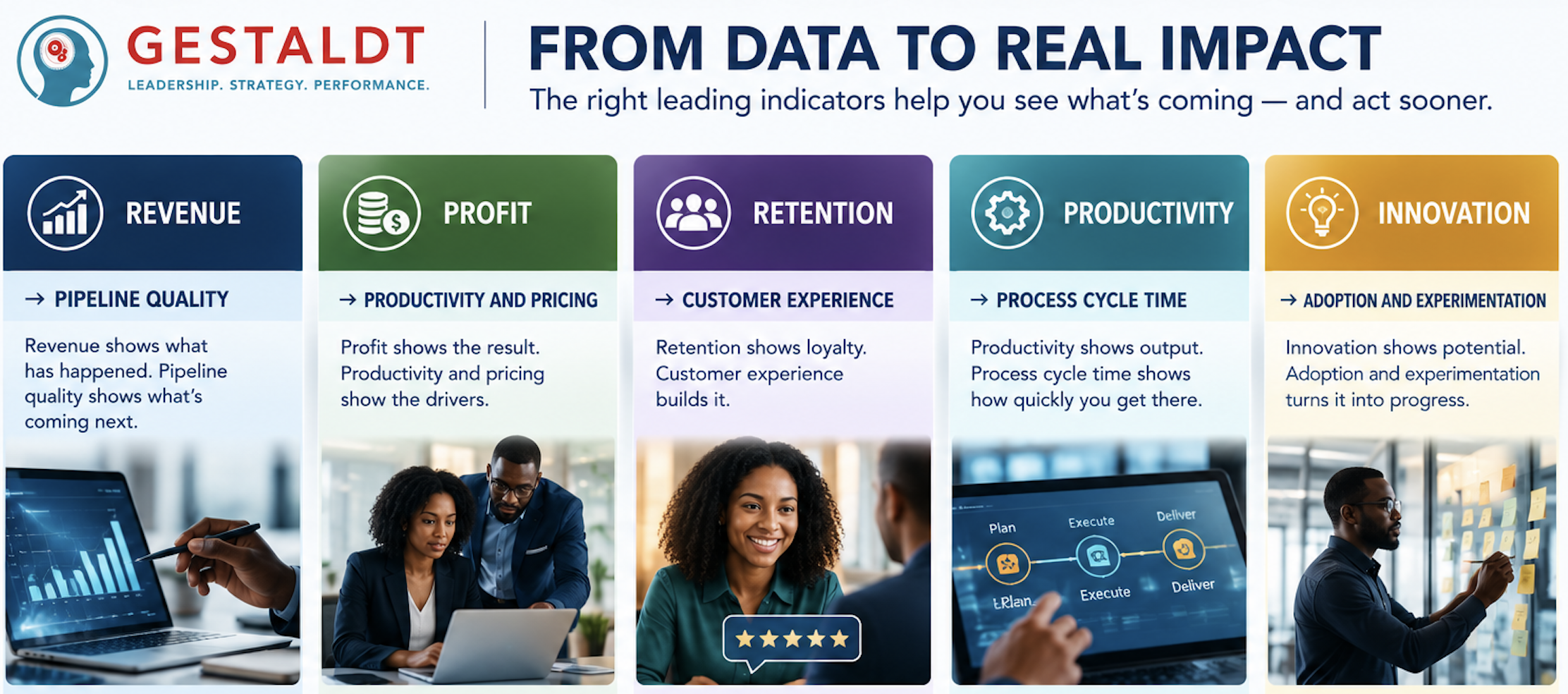
For every major financial KPI, identify at least one leading indicator that influences it.
Don't throw away the financial measures.
Add the signals that explain where they are heading.
2. Stop Asking "Are We On Target?" and Start Asking "What's Moving?"
A target tells you where you want to go. A leading indicator tells you whether the system is moving in the right direction.
This distinction can completely change an executive dashboard.
Consider customer retention.
A traditional dashboard might show:
Annual retention: 91%
That looks reassuring.
But a more diagnostic dashboard might also show:
customer complaints +18%;
response time +11%;
renewal conversations delayed;
NPS declining;
service escalations increasing.
Suddenly, the 91% figure looks less reassuring.
The organisation isn't necessarily in trouble.
But the drivers of future retention are moving.
That is the information executives need early.
Gestaldt's research on performance management specifically recommends combining lagging indicators with process inputs so organisations can respond before variations damage output or quality.
The quote that matters
Tufan Erginbilgiç, CEO of Rolls-Royce, has described performance improvement as part of strategy implementation and emphasised the importance of a granular strategy that makes performance visible throughout the organisation.
Practical Tip
Review your executive dashboard and classify every KPI as:
Lagging: tells us what happened.
Leading: signals what is likely to happen.
Diagnostic: helps explain why it is happening.
If most of your dashboard is lagging, you have a reporting system.
You may not yet have a performance-management system.
3. Your Strategy Needs a Performance Translation Layer
A strategy fails when it stays at the level of ambition.
"Become more customer-centric."
"Expand internationally."
"Improve productivity."
"Accelerate innovation."
"Build a digital organisation."
These statements may be strategically sound.
But they are not yet measurable enough to drive behaviour.
The missing layer is translation.
For example:
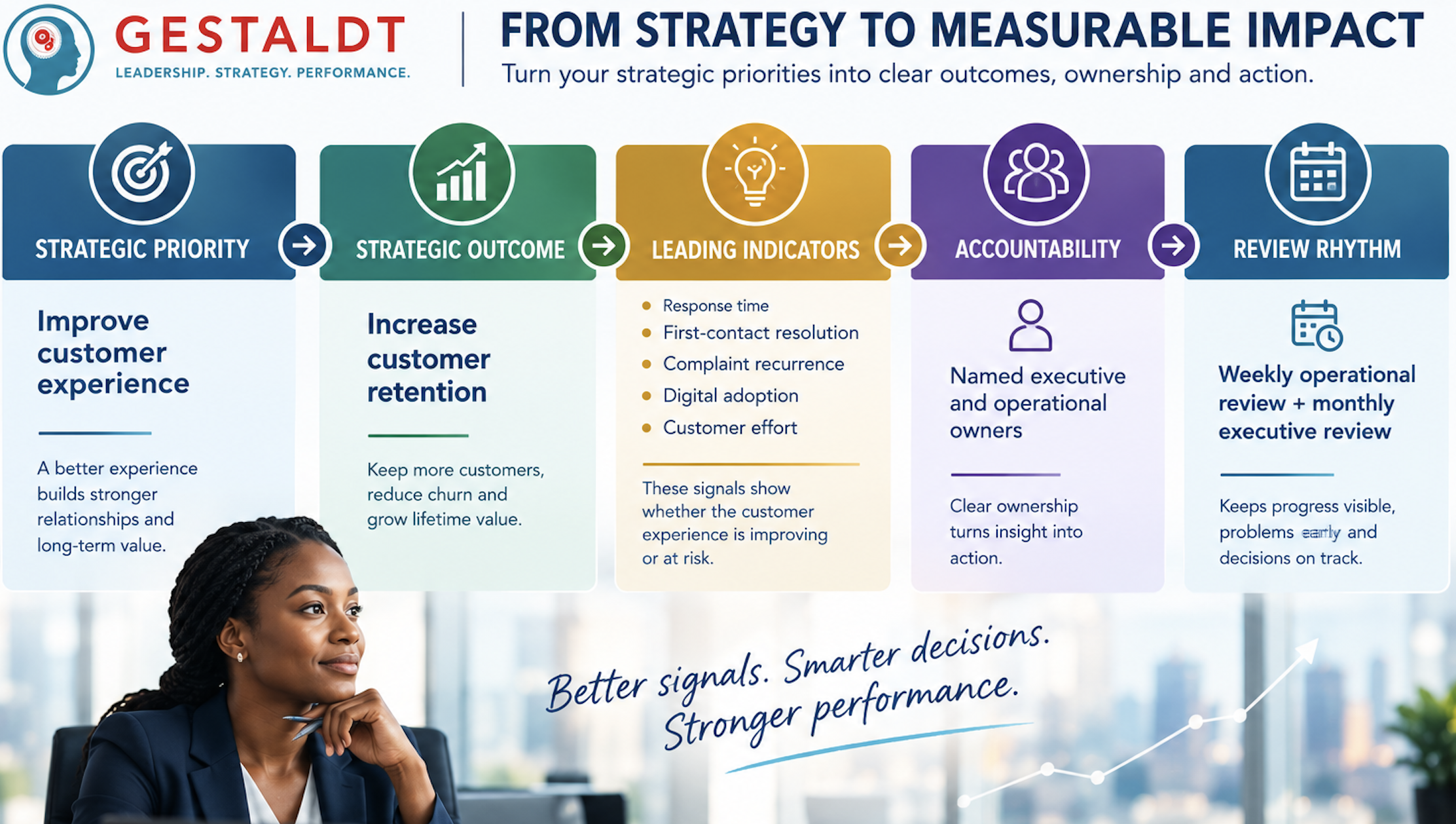
Now strategy has become executable.
Gestaldt's 2025 research on strategy found that only one in five companies surveyed believed they had a high-quality strategy, while stronger performers were distinguished by their ability to mobilise execution behind strategic choices.
The quote that matters
Erginbilgiç argues that a “granular strategy” becomes a tool for alignment and engagement because people can see their role in transformation.
Practical Tip
For every strategic priority, complete this sentence:
"We will know this strategy is working when..."
Then identify:
the desired outcome;
two or three leading indicators;
the accountable owner;
the review cadence;
the intervention trigger.
That creates a bridge between strategy and performance.
4. When Everyone Is Busy, Activity Can Easily Be Mistaken for Performance
This is one of the most expensive illusions in management: confusing activity with impact.
A transformation office reports that 27 initiatives are underway.
HR reports that 4,000 employees completed training.
Technology reports that a new platform has gone live.
Operations reports that 15 processes have been redesigned.
Everyone is busy.
But what changed?
Did decision-making improve?
Did customers notice?
Did productivity increase?
Did employees actually adopt the new system?
Did costs fall?
Did revenue improve?
Did strategic execution accelerate?
Research found that 64% of workers surveyed considered performance reviews a waste of time that did not help them perform better.
The lesson extends beyond performance reviews.
Measurement becomes counterproductive when people learn to optimise for what is easiest to report rather than what matters most.
The quote that matters
Dania Nourallah described the required shift as “a mindset shift—from controlling systems to empowering people.”
That means measurement should help people make better decisions—not simply give leaders more numbers.
Practical Tip
For every activity metric, add an outcome question.
Training completed → What capability improved?
Projects delivered → What business outcome changed?
Meetings held → What decision was made?
Automation implemented → What productivity improved?
Customers contacted → What behaviour changed?
If you cannot connect activity to value, reconsider the metric.
5. Performance Problems Often Begin With Weak Accountability
A metric without ownership is just information.
Leadership teams sometimes have impressive dashboards filled with targets, traffic lights and trend lines.
Yet when performance deteriorates, the conversation becomes:
"Someone needs to address this."
Who?
That's where the problem begins.
A strong performance system makes four things explicit:
What matters?
Who owns it?
What evidence shows progress?
What happens when performance moves off course?
Research on organisational execution identifies accountability, coordination and control, capabilities, and motivation as four elements that help organisations convert strategy into results. It reports that 44% of organisations lose momentum during redesign efforts and about one-third fail to deliver after implementation.
The quote that matters
Erginbilgiç described Rolls-Royce's approach as using a detailed view of strategic initiatives to identify where intervention was needed, rather than assuming initiatives already on track required the same executive attention as those falling behind.
Practical Tip
Every strategic KPI should have:
one accountable owner;
a defined target;
a leading indicator;
a reporting frequency;
a clear intervention threshold.
Don't assign accountability to a committee.
Committees can govern.
Individuals must own outcomes.
6. The Best Performance Systems Create Better Decisions, Not Bigger Dashboards
The purpose of measurement isn't measurement. It's action.
This is where many executive dashboards go wrong.
They contain too much information.
Revenue by region.
Sales by product.
Customer complaints.
Employee turnover.
Project status.
Cost variance.
Productivity.
Cash.
Margins.
Risk.
Innovation.
AI adoption.
The leadership team receives 80 pages of information and leaves the meeting with three unresolved decisions.
That is not performance intelligence.
It is data accumulation.
CEOs are navigating a tension between short-term pressures and longer-term reinvention. They are spending substantial attention on near-term issues while still needing to invest in capabilities and business-model changes that shape longer-term competitiveness.
That makes executive attention a scarce resource.
Your performance system should therefore answer three questions:
What changed?
The signal.
Why did it change?
The diagnosis.
What are we going to do?
The decision.
The quote that matters
The current environment demands that leaders must balance short-term pressure with long-term reinvention, with competitive advantage increasingly linked to how organisations adapt as technology, AI and talent are reconfigured.
Practical Tip
Redesign executive performance reviews around decisions, not presentations.
For every red or deteriorating metric, require:
Signal → Cause → Decision → Owner → Deadline → Expected impact
That turns performance reporting into performance leadership.
The Gestaldt Performance Intelligence Framework™
At Gestaldt, we believe performance should function like an organisational nervous system.
It should detect movement.
Interpret signals.
Trigger decisions.
And enable action before small problems become major performance failures.
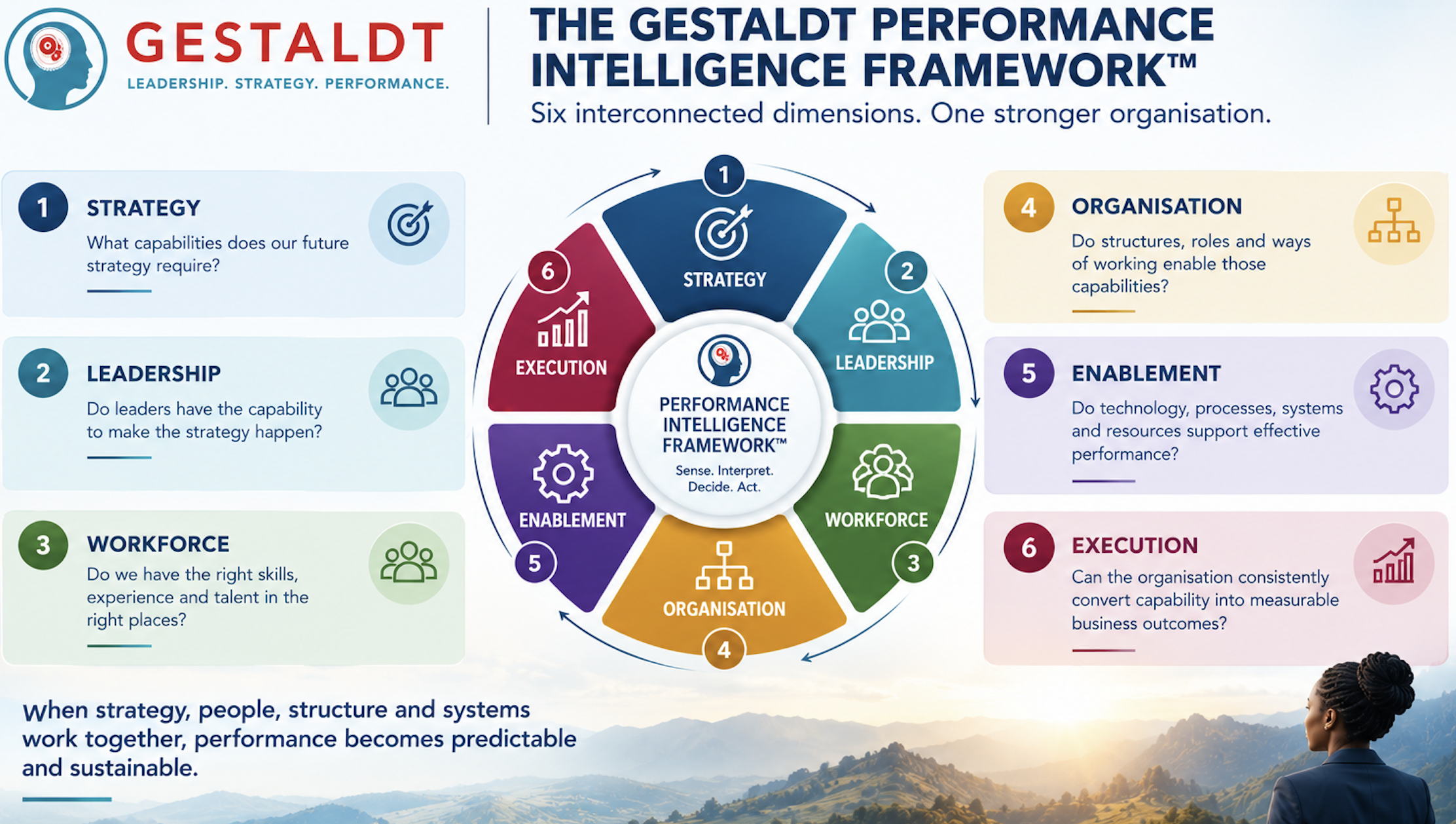
The model is deliberately broader than traditional KPI management.
Because performance does not improve simply because you measure it.
It improves when measurement leads to better decisions, clearer accountability, stronger capability and faster adaptation.
The CEO Performance Blind Spot Test
Score each statement from 1 to 5:
1 = strongly disagree
5 = strongly agree
Our executive dashboard contains meaningful leading indicators.
We can identify emerging performance problems before financial results deteriorate.
Every strategic priority has measurable outcomes.
Every critical outcome has a clearly accountable owner.
Our KPIs measure value rather than activity alone.
Managers understand which metrics they can influence directly.
Performance data regularly triggers executive decisions.
We can distinguish symptoms from underlying causes.
Our performance measures are connected to organisational capability.
We change measures when strategic priorities change.
Your Score
40–50: Performance intelligence is embedded
Your organisation has a strong foundation for proactive performance management.
30–39: Performance visibility is developing
You may have useful measurement, but important blind spots could remain.
Below 30: Performance blind-spot risk
Your organisation may be relying too heavily on lagging results or activity-based measurement.
The score is a diagnostic starting point—not a substitute for a deeper organisational assessment.
From Reporting Performance to Leading Performance
The modern CEO does not need more numbers.
They need better signals.
A performance system should make it easier to see:
where the organisation is heading;
what is changing;
why it is changing;
who needs to act;
what decision is required;
and whether the intervention is working.
That changes the role of performance management completely.
It moves from:
reporting → sensing
measuring → diagnosing
reviewing → deciding
managing activity → creating value
And that shift matters because organisations increasingly operate in environments where yesterday's performance provides only partial guidance about tomorrow's opportunity.
As Mohamed Kande put it, “The future belongs to the bold.”
Bold leadership, however, does not mean reckless leadership.
It means having enough visibility to act before the opportunity—or the problem—becomes obvious to everyone else.
The CEO's Five Questions
At your next executive performance meeting, ask:
1. What is improving?
Not just financially—but operationally, strategically and organisationally.
2. What is deteriorating?
Look for small movements before they become large problems.
3. What leading indicators are changing?
This is where future performance begins to reveal itself.
4. What are we doing about it?
Every significant signal should lead to a decision or deliberate choice not to intervene.
5. What are we not measuring?
This final question is often the most revealing.
Because the biggest performance blind spot may be the thing that isn't on the dashboard.
Conclusion: Don't Wait for the Numbers to Become Obvious
A strong organisation doesn't wait for declining revenue to discover that customers are unhappy.
It doesn't wait for productivity to collapse before examining process friction.
It doesn't wait for strategic initiatives to fail before asking whether people have the capability to execute them.
And it doesn't wait for a crisis before changing direction.
It learns to see earlier.
The future of performance management is not about producing more reports.
It is about creating an organisational system that can sense, interpret, decide and adapt.
Your financial results still matter.
Your KPIs still matter.
Your dashboards still matter.
But the real competitive advantage comes from knowing what those numbers are telling you before they become yesterday's news.
Measure what matters. Detect what is changing. Decide sooner. Act with purpose.
Ready to Identify Your Organisation's Performance Blind Spots?
Gestaldt can help executive teams assess whether their current performance systems provide the visibility, accountability and strategic intelligence required to improve execution.
Request a Gestaldt Performance Intelligence Assessment™
Assess:
Strategic KPIs
Leading and lagging indicators
Executive dashboards
Accountability
Performance culture
Organisational capability
Decision-making
Strategy-to-performance alignment
Assess Your Performance Intelligence

The Accountability Crisis: Why Organisational Performance Stalls Even When Everyone Is Busy
Your organisation isn't failing because people aren't working hard. It's failing because accountability is unclear. Learn why accountability breaks down, how it impacts organisational performance, and the leadership practices that create high-performing organisations.

Everyone Is Working Hard—So Why Isn't the Organisation Moving Faster?
Walk through almost any organisation and you'll find people who are busy.
Meetings are full.
Calendars are packed.
Projects are underway.
Emails never stop.
Performance dashboards are updated weekly.
Yet despite all this activity, many organisations struggle to achieve meaningful progress.
Strategic initiatives are delayed.
Customer issues persist.
Innovation slows.
Budgets overrun.
Deadlines are missed.
When leaders investigate, the explanation is often the same:
"We need people to be more accountable."
But accountability isn't something leaders can demand. It is something organisations must design.
The highest-performing organisations don't rely on heroic individuals to deliver results. They create systems where ownership is clear, expectations are understood, decisions are made with confidence, and people are empowered to act.
At Gestaldt, we believe accountability is one of the strongest predictors of sustainable organisational performance. When accountability is embedded in leadership, culture, governance, and execution, organisations move faster, collaborate better, and achieve better outcomes.
Why Accountability Has Become a Strategic Priority
Today's organisations operate in an environment of constant change.
Artificial intelligence is reshaping industries.
Customer expectations continue to rise.
Hybrid work has changed how teams collaborate.
Economic uncertainty requires faster, more confident decision-making.
In this environment, organisations cannot afford ambiguity.
When accountability is weak, decision-making slows, priorities become confused, and strategic initiatives lose momentum.
Strong accountability creates clarity, trust, and confidence throughout the organisation.
Seven Reasons Accountability Breaks Down
1. Ownership Is Unclear
Many strategic initiatives have multiple stakeholders but no single owner.
When responsibility is shared without clarity, progress slows.
Every major initiative should have one accountable leader.
2. Priorities Constantly Change
Employees cannot be accountable for moving targets.
When leadership frequently changes priorities, focus disappears and accountability weakens.
Consistency creates confidence.
3. Leaders Avoid Difficult Conversations
Accountability requires honest feedback.
Avoiding underperformance sends a message that expectations are optional.
High-performing organisations address issues early, respectfully, and constructively.
4. Decision Rights Are Undefined
When people don't know who can approve, decide, or escalate, work stalls.
Clear governance removes uncertainty and empowers action.
5. Success Measures Are Vague
Employees cannot deliver what hasn't been clearly defined.
Objectives should be measurable, visible, and linked to organisational strategy.
6. Culture Rewards Activity Instead of Outcomes
Being busy should never be confused with creating value.
Organisations should celebrate results, collaboration, innovation, and learning—not simply effort.
7. Leaders Model Inconsistent Behaviour
Employees notice when executives fail to uphold the standards they expect from others.
Leadership credibility is the foundation of accountability.
People follow what leaders do more than what they say.
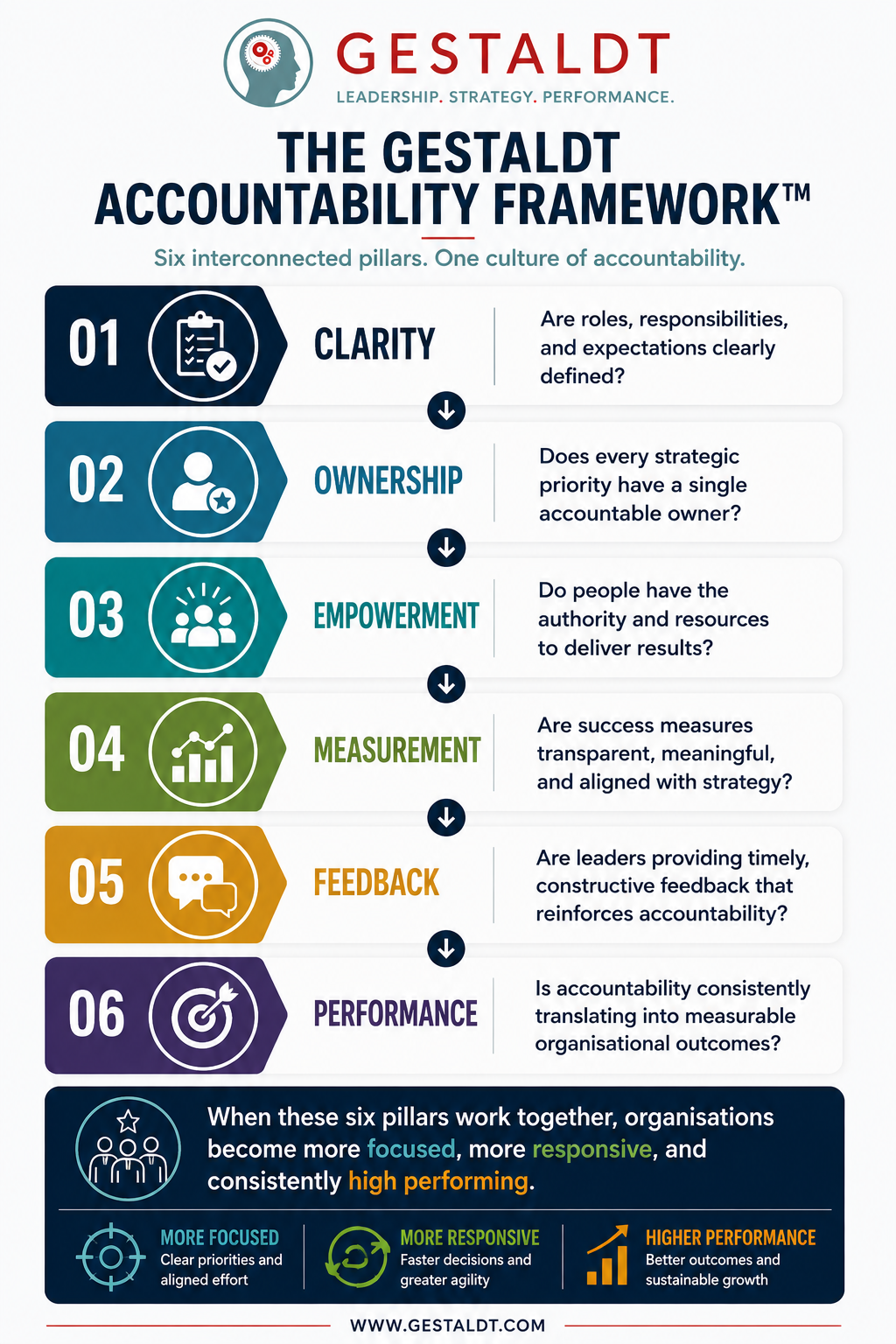
The Gestaldt Accountability Framework™
Executive Accountability Scorecard
Rate each statement from 1 (Strongly Disagree) to 5 (Strongly Agree).
Everyone understands their role in delivering strategy.
Major initiatives have clear owners.
Leaders make expectations explicit.
Employees have authority to make appropriate decisions.
Performance measures are aligned with business priorities.
Feedback is timely and constructive.
Accountability is applied consistently at every level.
Leaders model the behaviours they expect.
Teams collaborate effectively to achieve outcomes.
We celebrate results rather than activity.
Results
40–50: Accountability is a strategic strength.
30–39: Some accountability gaps may be limiting execution.
Below 30: Organisational performance is likely being affected by unclear ownership and inconsistent leadership.
Executive Case Study
A growing professional services firm approached Gestaldt after repeatedly missing strategic milestones despite having a highly capable workforce.
Our assessment revealed:
Overlapping responsibilities across senior leaders.
Inconsistent performance measures.
Delayed decisions due to unclear ownership.
A culture where teams were busy but not always aligned.
Using the Gestaldt Accountability Framework™, we helped redesign governance, clarify decision rights, and introduce organisation-wide accountability practices.
Within nine months, the organisation reported:
Faster delivery of strategic initiatives.
Improved cross-functional collaboration.
Clearer executive accountability.
Higher employee engagement.
Greater confidence in leadership.
The transformation was not driven by asking people to work harder. It was achieved by creating clarity about who was responsible for what.
Five Questions Every CEO Should Ask
Does every strategic initiative have one accountable owner?
Are our leaders modelling accountability every day?
Can employees explain how their work contributes to organisational strategy?
Are performance measures focused on outcomes or activity?
Would our customers notice if accountability improved?
These questions often reveal whether accountability is embedded in the organisation—or simply expected.
Accountability Is the Engine of Execution
Strategies succeed because people take ownership.
Transformation succeeds because leaders remain accountable.
Culture strengthens because expectations are consistently reinforced.
Organisations become resilient because accountability creates confidence, trust, and disciplined execution.
The organisations that outperform their competitors are not necessarily those with the smartest people or the largest budgets. They are those where accountability is woven into every aspect of leadership and organisational life.
Ready to Strengthen Accountability Across Your Organisation?
If your organisation is experiencing slow execution, unclear ownership, or inconsistent performance, it may be time to examine how accountability is designed—not just discussed.
Request an Organisational Accountability Assessment
Gestaldt's confidential assessment evaluates:
Leadership accountability.
Role clarity.
Decision rights.
Governance effectiveness.
Performance measurement.
Feedback culture.
Strategy execution.
Organisational alignment.
Together, we'll identify the barriers limiting accountability and develop practical strategies that improve execution, strengthen leadership, and accelerate organisational performance.
👉 Request Your Organisational Accountability Assessment Today

Why High-Performing Organisations Suddenly Stop Growing: The CEO's Blind Spot
Why do successful organisations suddenly lose momentum? Discover the seven hidden organisational barriers that silently stall growth, reduce performance, and prevent strategy execution—and learn how executive leaders can regain competitive advantage.

Success Can Become Your Greatest Risk
Growth is exciting.
Revenue increases.
New markets open.
The workforce expands.
Customers multiply.
Confidence rises.
Then something changes.
The organisation isn't in crisis—but it isn't accelerating either.
Projects take longer to complete.
Decisions slow down.
Innovation loses momentum.
Departments begin protecting their own priorities.
Top performers quietly leave.
Customer satisfaction starts to decline.
The business still appears healthy from the outside, yet internally, leaders know something isn't right.
For many CEOs, this is the most dangerous stage of organisational growth—not because the problems are visible, but because they are hidden beneath the surface.
The instinctive response is often to develop a new strategy, restructure the organisation, or invest in new technology. Yet in many cases, the real issue isn't the strategy itself. It's the organisation's ability to execute, adapt, and grow in alignment.
At Gestaldt, we've found that sustained growth depends on more than a strong business plan. It requires leadership alignment, a healthy organisational culture, effective governance, and the ability to translate strategic intent into consistent action.
Let's explore the seven hidden barriers that quietly prevent high-performing organisations from reaching their next level of success.

1. Leadership Alignment Is Only Skin Deep
"We're aligned."
Most executive teams believe they are.
Yet when asked individually about the organisation's top priorities, success measures, or strategic risks, their answers often differ.
Alignment is more than agreeing during a strategy session. It means leaders consistently communicate the same vision, make decisions using the same principles, and reinforce the same priorities throughout the organisation.
When alignment is weak, mixed messages filter through the business, creating confusion, duplicated effort, and competing priorities.
Questions Every CEO Should Ask
Can every executive clearly articulate the organisation's top three strategic priorities?
Are leaders making decisions using the same criteria?
Does every business unit understand how its work contributes to the strategy?
Without alignment at the top, execution breaks down across the organisation.
2. Culture Quietly Rejects the Strategy
Organisations rarely fail because of poor strategies.
They fail because everyday behaviours don't support those strategies.
A company may aspire to become more innovative while rewarding risk avoidance.
It may seek greater collaboration while maintaining siloed structures.
It may promote accountability while tolerating inconsistent performance.
These contradictions create friction between intention and execution.
As Peter Drucker famously said:
"Culture eats strategy for breakfast."
A healthy organisational culture doesn't happen by chance. It is intentionally shaped by leadership behaviours, governance structures, and shared values.
Related Reading:The Invisible Fuel of Business Growth: How Leadership Culture Drives Organisational Success
3. Complexity Has Replaced Clarity
As organisations grow, complexity grows with them.
More products.
More meetings.
More reporting.
More approvals.
More initiatives.
Before long, employees spend more time managing processes than creating value.
One of the biggest threats to sustained growth isn't competition—it's organisational complexity.
High-performing organisations simplify relentlessly.
They identify what matters most, eliminate unnecessary work, and focus resources on the initiatives that create the greatest strategic value.
4. Middle Managers Become the Missing Link
Middle managers are often expected to implement strategic change without being meaningfully involved in shaping it.
This creates a disconnect between executive intent and operational reality.
Employees don't execute strategy because executives communicate it.
They execute it because managers translate it into daily priorities.
Organisations that consistently outperform invest heavily in developing middle leadership capability, communication skills, and change leadership.
5. Growth Has Outpaced Leadership Capability
Many organisations invest heavily in systems and technology but overlook leadership capability.
The skills required to lead a 100-person organisation differ significantly from those needed to lead a 5,000-person enterprise.
Leadership development cannot remain static while the organisation evolves.
Future-ready organisations continuously strengthen executive capability in:
Strategic thinking
Decision-making
Change leadership
Innovation
Collaboration
Emotional intelligence
Without leadership growth, organisational growth inevitably slows.
6. You're Measuring Yesterday Instead of Tomorrow
Most executive dashboards focus on lagging indicators.
Revenue.
Profit.
Market share.
Operational costs.
While essential, these metrics reveal what has already happened.
Leading organisations also monitor indicators that predict future performance.
Examples include:
Leadership alignment
Employee engagement
Innovation pipeline
Customer advocacy
Decision-making speed
Organisational agility
Change readiness
These measures provide early warning signs long before financial performance begins to decline.
7. You're Solving Symptoms Instead of Root Causes
Revenue slows.
So marketing budgets increase.
Employee turnover rises.
So salaries increase.
Projects fail.
So governance becomes more bureaucratic.
Often these interventions address symptoms rather than underlying organisational issues.
True transformation begins by identifying root causes.
Leadership.
Culture.
Capability.
Governance.
Execution.
These are the systems that determine long-term organisational performance.
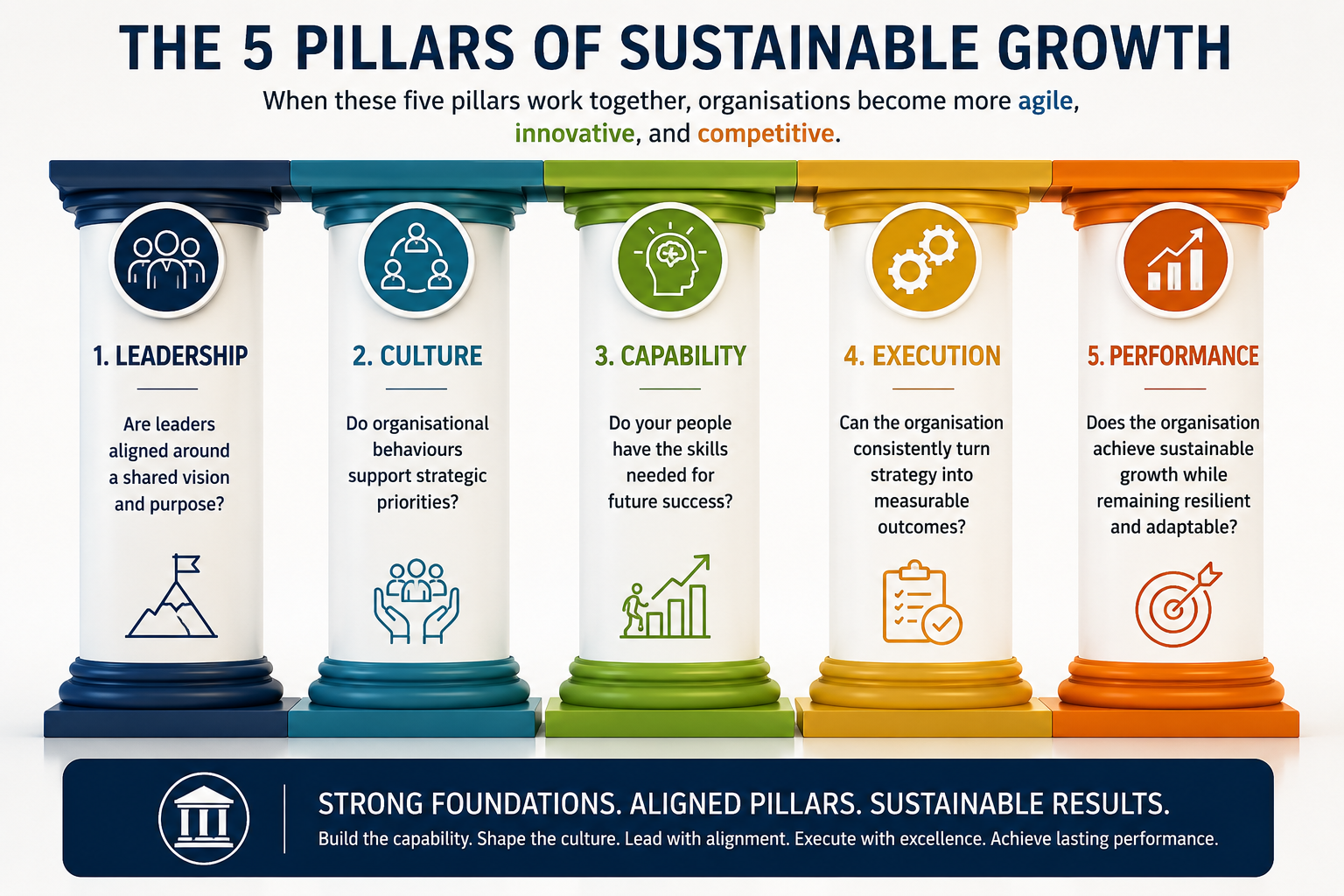
The Gestaldt Growth Performance Model™
At Gestaldt, we believe sustainable business growth depends on five interconnected pillars:
Executive Self-Assessment
Is Your Organisation Quietly Losing Momentum?
Score your organisation from 1 (Strongly Disagree) to 5 (Strongly Agree):
Our executive team consistently communicates the same priorities.
Employees understand how their work contributes to our strategy.
Our culture encourages accountability and innovation.
We execute strategic initiatives on time.
We measure leading indicators, not only financial results.
Leaders adapt quickly to change.
Our middle managers actively drive transformation.
Decision-making is fast and effective.
Leadership capability keeps pace with organisational growth.
Our strategy consistently translates into measurable business results.
Your Score
40–50: Your organisation is well positioned for sustainable growth.
30–39: Warning signs are emerging. Small issues may become significant barriers if left unaddressed.
Below 30: Your organisation may be experiencing hidden execution challenges that require immediate attention.
Sustainable Growth Isn't an Accident
The organisations that outperform their competitors over decades share one common characteristic.
They don't simply develop better strategies.
They build organisations capable of executing them.
For CEOs, the greatest blind spot is often assuming that growth challenges originate in the market.
More often than not, the answers lie within the organisation itself.
Leadership alignment.
Culture.
Capability.
Governance.
Execution.
These are the true drivers of sustainable performance.
Ready to Discover What's Holding Your Organisation Back?
Growth challenges rarely resolve themselves.
The sooner hidden barriers are identified, the sooner meaningful transformation can begin.

Request a Complimentary Executive Growth Diagnostic
In a confidential executive consultation, Gestaldt will help you assess:
Leadership alignment
Strategy execution capability
Organisational culture
Governance effectiveness
Change readiness
Leadership capability
Performance barriers
Together, we'll identify the issues limiting your organisation's growth and develop practical strategies to unlock its full potential.
👉 Schedule your Executive Growth Diagnostic today and take the first step towards sustainable organisational success.

Why Strategy Execution Fails: The 7 Hidden Barriers Most CEOs Never See
Most business leaders don't struggle with strategy—they struggle with execution. Discover the seven hidden barriers that prevent organisations from turning ambitious plans into measurable results, and learn how CEOs can close the gap between strategy and performance.

The Strategy Illusion
Every year, leadership teams invest substantial time and resources into strategic planning. Executive retreats are held, vision statements are refined, objectives are agreed upon, and ambitious targets are set.
Yet months later, many organisations find themselves asking the same question:
"Why aren't we seeing the results we expected?"
The truth is that most organisations don't have a strategy problem. They have an execution problem.
Research consistently shows that the majority of strategic initiatives fail to achieve their intended outcomes. While strategies often look impressive on paper, execution breaks down when organisations fail to align leadership, culture, governance, capabilities, and accountability.
At Gestaldt, we've observed a recurring pattern across industries: the barriers that derail execution are often invisible to leadership until performance begins to suffer.
Here are the seven hidden barriers that prevent strategy from becoming reality.
Barrier 1: Leadership Teams Are Not Truly Aligned
The Silent Killer of Strategic Success
Many executive teams believe they are aligned because they attended the same planning sessions and approved the same strategic objectives.
However, alignment is not agreement.
True alignment means leaders share a common understanding of priorities, outcomes, responsibilities, risks, and decision-making principles.
When executives interpret strategy differently, organisations experience:
Conflicting priorities
Mixed messages to employees
Departmental silos
Slower decision-making
Resource misallocation
The result is confusion throughout the organisation.
Key Question
Can every member of your executive team clearly articulate the organisation's top three strategic priorities in exactly the same way?
If not, execution risks are already emerging.
Related Reading:
Read our article on leadership culture and organisational performance:
The Invisible Fuel of Business Growth: How Leadership Culture Drives Organisational Success
Barrier 2: Culture Is Working Against the Strategy
Strategy Doesn't Fail—Culture Rejects It
One of the most underestimated barriers to execution is organisational culture.
A company may have a brilliant growth strategy, but if its culture discourages innovation, collaboration, accountability, or change, execution stalls.
As management expert Peter Drucker famously observed:
"Culture eats strategy for breakfast."
Many organisations attempt transformation while maintaining behaviours that reward the status quo.
Signs of cultural resistance include:
Fear of failure
Risk avoidance
Low accountability
Resistance to change
Internal politics
Without cultural alignment, even the most sophisticated strategies struggle to gain traction.
Related Reading:
Explore how organisational culture influences performance and growth in:
The Invisible Fuel of Business Growth: How Leadership Culture Drives Organisational Success
Barrier 3: Too Many Priorities Create Strategic Paralysis
When Everything Is Important, Nothing Is Important
Leadership teams often attempt to tackle too many strategic initiatives simultaneously.
Growth initiatives.
Digital transformation.
Culture change.
Talent development.
ESG commitments.
Customer experience improvements.
Operational excellence.
While each initiative may be valuable, pursuing too many priorities creates organisational overload.
Employees become confused about where to focus their efforts.
Resources become diluted.
Momentum disappears.
High-performing organisations understand the power of focus.
They identify a small number of critical priorities and align resources accordingly.
Practical Reality
If your organisation currently has more than five major strategic initiatives competing for attention, execution complexity is likely increasing significantly.
Barrier 4: Accountability Is Unclear
The Ownership Gap
One of the most common execution failures occurs when responsibility is shared by everyone and owned by no one.
Strategic objectives frequently appear on executive dashboards without clear accountability structures.
Questions leaders should ask include:
Who owns this initiative?
What outcomes are expected?
How will progress be measured?
What happens if milestones are missed?
When accountability is unclear:
Decisions are delayed
Deadlines slip
Problems remain unresolved
Progress becomes difficult to track
Successful organisations establish clear ownership and measurable outcomes at every level of execution.
Barrier 5: Middle Management Is Excluded From the Strategy
The Forgotten Layer of Execution
Many strategies fail because executives focus on designing the strategy but neglect the people responsible for delivering it.
Middle managers translate strategy into operational reality.
They shape employee engagement.
They manage performance.
They drive adoption.
Yet they are often informed rather than involved.
This creates a disconnect between strategic intent and operational execution.
The organisations that execute effectively actively engage middle management throughout the strategy lifecycle.
They become champions of change rather than passive recipients of directives.

Barrier 6: Organisations Underestimate Change Fatigue
People Can Only Absorb So Much Change
Today's workforce is navigating unprecedented levels of disruption.
Digital transformation.
Economic uncertainty.
Hybrid work.
Artificial intelligence.
Market volatility.
Leadership changes.
Employees are being asked to adapt continuously.
Many executives underestimate the cumulative impact of change fatigue.
When organisations launch multiple initiatives without considering employee capacity, engagement declines and resistance increases.
Symptoms include:
Lower productivity
Increased turnover
Reduced innovation
Change resistance
Burnout
Effective execution requires organisations to manage change as carefully as they manage strategy.
Related Reading:
Explore how leaders can navigate uncertainty in:
Thriving Amid Uncertainty: How C-Suite Leaders Can Navigate Economic Volatility
Barrier 7: Progress Is Measured Too Late
What Gets Measured Gets Managed
Many organisations rely exclusively on lagging indicators such as:
Revenue growth
Profitability
Market share
Customer retention
While important, these metrics reveal problems after they occur.
Successful strategy execution requires leading indicators that provide early warning signals.
Examples include:
Employee engagement scores
Leadership alignment metrics
Change adoption rates
Customer sentiment
Project milestone completion
By monitoring leading indicators, executives can identify execution risks before they impact business performance.
A Framework for Closing the Execution Gap
At Gestaldt, we believe successful execution requires alignment across five critical dimensions:
The Gestaldt Strategy Execution Framework™
Leadership Alignment
Do leaders share a common understanding of priorities and outcomes?
Culture Alignment
Do organisational behaviours support strategic objectives?
Capability Alignment
Do employees possess the skills required for execution?
Governance Alignment
Are decision-making processes clear and effective?
Accountability Alignment
Are responsibilities clearly defined and measured?
When these five dimensions operate in harmony, strategy moves from aspiration to achievement.
The Cost of Ignoring Execution
Poor execution doesn't simply delay results.
It creates measurable business consequences:
Lost revenue opportunities
Increased operating costs
Talent attrition
Customer dissatisfaction
Competitive disadvantage
Reduced investor confidence
Perhaps most importantly, repeated execution failures erode trust in leadership.
Employees become sceptical.
Stakeholders lose confidence.
Future transformation efforts become increasingly difficult.
The CEO's Challenge
The organisations that outperform their competitors are not necessarily those with the most innovative strategies.
They are the organisations that consistently execute.
The challenge for today's leaders is not creating another strategic plan.
It is identifying the hidden barriers preventing existing strategies from succeeding.
The sooner those barriers become visible, the sooner organisations can unlock sustainable growth.
Ready to Discover What's Blocking Your Strategy?
Many execution challenges remain hidden until performance begins to suffer.
Gestaldt helps executive teams identify the barriers preventing strategy from translating into measurable business results.
Request a Strategy Execution Diagnostic
Our consultants will help you assess:
✔ Leadership alignment
✔ Organisational culture
✔ Governance effectiveness
✔ Change readiness
✔ Accountability structures
✔ Execution capability
Schedule a confidential consultation and discover where your strategy may be breaking down before it impacts performance.