The Performance Blind Spot: How CEOs Can Detect Business Problems Earlier

Your Dashboard May Be Telling You the Truth—and Still Hiding the Problem
A business can hit its revenue target while losing customers.
It can increase productivity while exhausting its managers.
It can deliver quarterly profit while its pipeline weakens.
It can complete transformation projects while adoption remains poor.
It can report strong employee performance while critical capabilities are quietly disappearing.
And by the time the financial numbers reveal the problem, the organisation may already be paying the price.
This is the performance blind spot.
Many leadership teams are excellent at measuring what happened but less effective at detecting what is likely to happen next.
Think of it like driving a car by looking only in the rear-view mirror.
The mirror is useful. You absolutely need it.
But it cannot tell you what is around the next corner.
That is why CEOs need a performance system that combines lagging indicators with leading indicators—financial results with the operational, customer, workforce and strategic signals that influence future performance.
Gestaldt has long highlighted this distinction, noting that organisations often rely heavily on lagging measures while stronger performance-management systems also monitor critical process inputs early enough to influence outcomes.
The challenge is particularly relevant now. Survey, based on 4,454 CEOs across 95 countries and territories, found that CEOs are balancing short-term threats with longer-term reinvention, while major shifts in technology, AI, geopolitics and business models continue to reshape the competitive environment.
The question for leaders is therefore not simply:
"How did we perform?"
It is:
"What is today's performance telling us about tomorrow?"
1. The Numbers Can Look Healthy Right Before the Warning Signs Become Obvious
Here's the trap: financial performance is essential, but it is often late.
Revenue, profit, EBITDA and cash flow tell leadership whether value has already been created.
They don't always tell you why performance is changing—or whether the current trajectory is sustainable.
Imagine three companies reporting identical quarterly revenue.
Company A has:
growing customer retention;
improving sales conversion;
strong employee engagement;
rising productivity;
a healthy innovation pipeline.
Company B has:
stable retention;
declining sales conversion;
rising employee turnover;
slower decision-making;
weakening pipeline quality.
Company C has:
declining retention;
heavy discounting;
growing operational costs;
increasing absenteeism;
stalled strategic initiatives.
Their financial statements may look similar today.
Their future situations are not.
This is why a sophisticated performance system distinguishes between outcomes and drivers.
Research found that only 32% of executives said their performance-management approach enabled timely, high-quality talent decisions about high and low performers.
The quote that matters
Satya Nadella, CEO of Microsoft, described the distinction between current performance and future performance through what he called “performance metrics” and “power metrics”, with the latter focused on leading indicators such as usage and customer satisfaction.
Practical Tip
For every major financial KPI, identify at least one leading indicator that influences it.
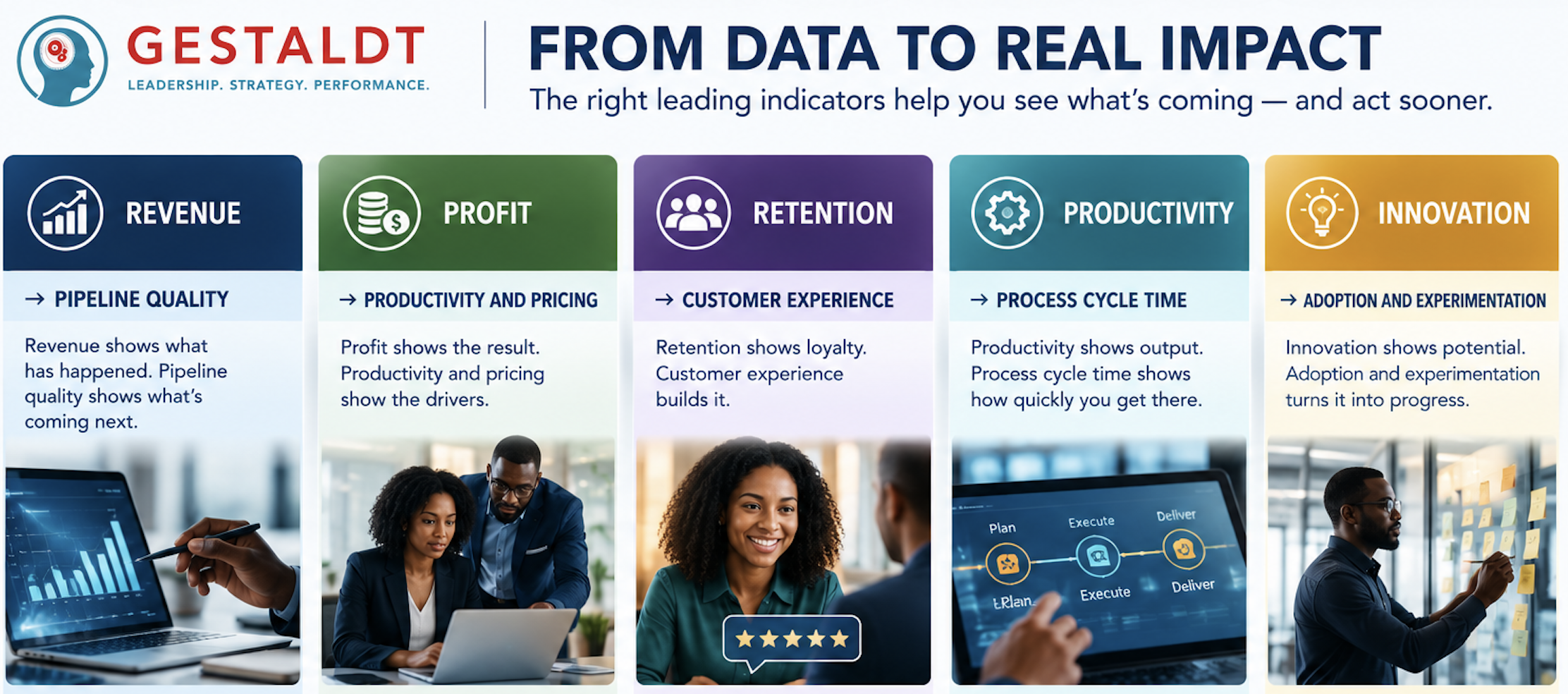
Don't throw away the financial measures.
Add the signals that explain where they are heading.
2. Stop Asking "Are We On Target?" and Start Asking "What's Moving?"
A target tells you where you want to go. A leading indicator tells you whether the system is moving in the right direction.
This distinction can completely change an executive dashboard.
Consider customer retention.
A traditional dashboard might show:
Annual retention: 91%
That looks reassuring.
But a more diagnostic dashboard might also show:
customer complaints +18%;
response time +11%;
renewal conversations delayed;
NPS declining;
service escalations increasing.
Suddenly, the 91% figure looks less reassuring.
The organisation isn't necessarily in trouble.
But the drivers of future retention are moving.
That is the information executives need early.
Gestaldt's research on performance management specifically recommends combining lagging indicators with process inputs so organisations can respond before variations damage output or quality.
The quote that matters
Tufan Erginbilgiç, CEO of Rolls-Royce, has described performance improvement as part of strategy implementation and emphasised the importance of a granular strategy that makes performance visible throughout the organisation.
Practical Tip
Review your executive dashboard and classify every KPI as:
Lagging: tells us what happened.
Leading: signals what is likely to happen.
Diagnostic: helps explain why it is happening.
If most of your dashboard is lagging, you have a reporting system.
You may not yet have a performance-management system.
3. Your Strategy Needs a Performance Translation Layer
A strategy fails when it stays at the level of ambition.
"Become more customer-centric."
"Expand internationally."
"Improve productivity."
"Accelerate innovation."
"Build a digital organisation."
These statements may be strategically sound.
But they are not yet measurable enough to drive behaviour.
The missing layer is translation.
For example:
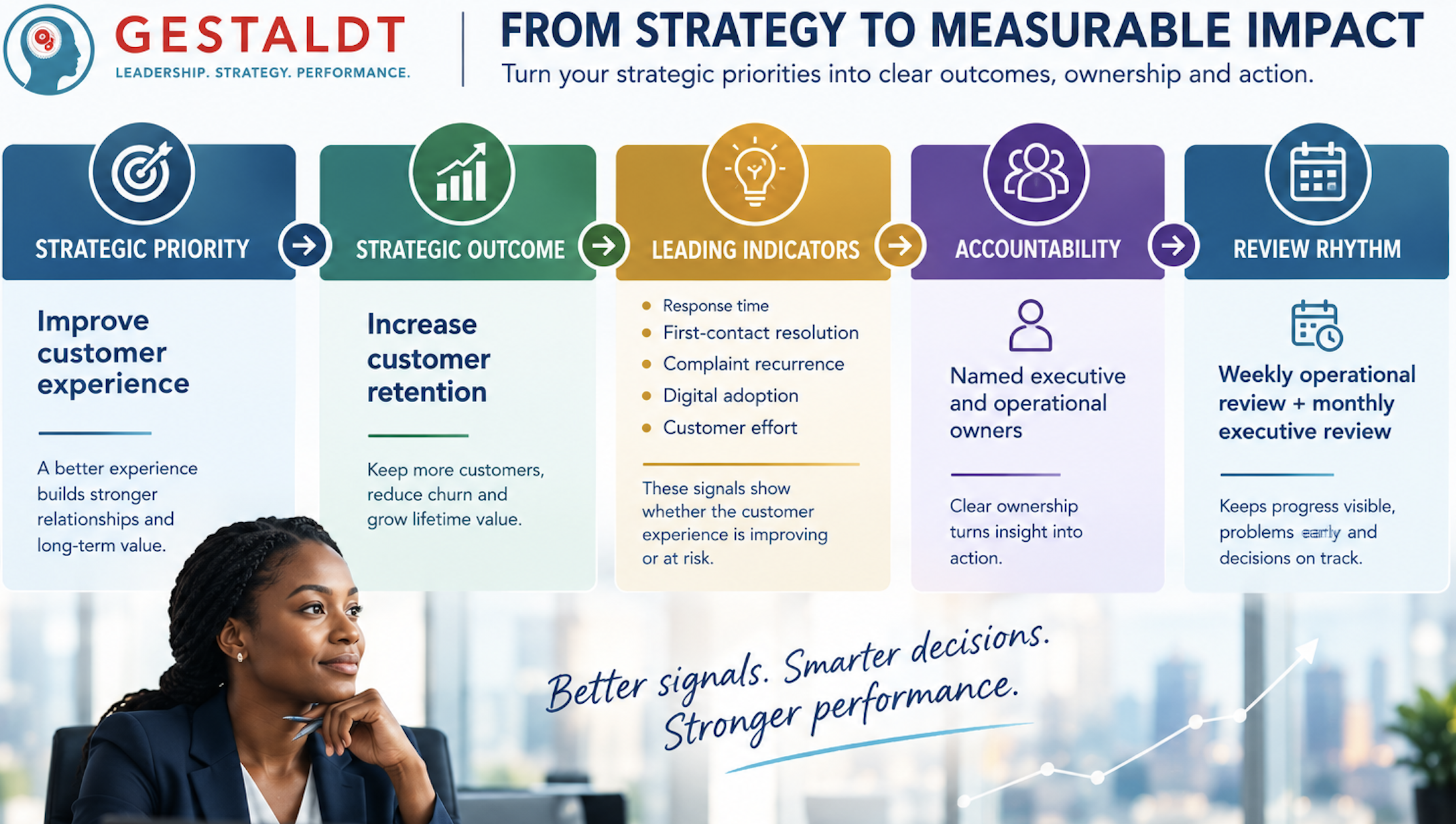
Now strategy has become executable.
Gestaldt's 2025 research on strategy found that only one in five companies surveyed believed they had a high-quality strategy, while stronger performers were distinguished by their ability to mobilise execution behind strategic choices.
The quote that matters
Erginbilgiç argues that a “granular strategy” becomes a tool for alignment and engagement because people can see their role in transformation.
Practical Tip
For every strategic priority, complete this sentence:
"We will know this strategy is working when..."
Then identify:
the desired outcome;
two or three leading indicators;
the accountable owner;
the review cadence;
the intervention trigger.
That creates a bridge between strategy and performance.
4. When Everyone Is Busy, Activity Can Easily Be Mistaken for Performance
This is one of the most expensive illusions in management: confusing activity with impact.
A transformation office reports that 27 initiatives are underway.
HR reports that 4,000 employees completed training.
Technology reports that a new platform has gone live.
Operations reports that 15 processes have been redesigned.
Everyone is busy.
But what changed?
Did decision-making improve?
Did customers notice?
Did productivity increase?
Did employees actually adopt the new system?
Did costs fall?
Did revenue improve?
Did strategic execution accelerate?
Research found that 64% of workers surveyed considered performance reviews a waste of time that did not help them perform better.
The lesson extends beyond performance reviews.
Measurement becomes counterproductive when people learn to optimise for what is easiest to report rather than what matters most.
The quote that matters
Dania Nourallah described the required shift as “a mindset shift—from controlling systems to empowering people.”
That means measurement should help people make better decisions—not simply give leaders more numbers.
Practical Tip
For every activity metric, add an outcome question.
Training completed → What capability improved?
Projects delivered → What business outcome changed?
Meetings held → What decision was made?
Automation implemented → What productivity improved?
Customers contacted → What behaviour changed?
If you cannot connect activity to value, reconsider the metric.
5. Performance Problems Often Begin With Weak Accountability
A metric without ownership is just information.
Leadership teams sometimes have impressive dashboards filled with targets, traffic lights and trend lines.
Yet when performance deteriorates, the conversation becomes:
"Someone needs to address this."
Who?
That's where the problem begins.
A strong performance system makes four things explicit:
What matters?
Who owns it?
What evidence shows progress?
What happens when performance moves off course?
Research on organisational execution identifies accountability, coordination and control, capabilities, and motivation as four elements that help organisations convert strategy into results. It reports that 44% of organisations lose momentum during redesign efforts and about one-third fail to deliver after implementation.
The quote that matters
Erginbilgiç described Rolls-Royce's approach as using a detailed view of strategic initiatives to identify where intervention was needed, rather than assuming initiatives already on track required the same executive attention as those falling behind.
Practical Tip
Every strategic KPI should have:
one accountable owner;
a defined target;
a leading indicator;
a reporting frequency;
a clear intervention threshold.
Don't assign accountability to a committee.
Committees can govern.
Individuals must own outcomes.
6. The Best Performance Systems Create Better Decisions, Not Bigger Dashboards
The purpose of measurement isn't measurement. It's action.
This is where many executive dashboards go wrong.
They contain too much information.
Revenue by region.
Sales by product.
Customer complaints.
Employee turnover.
Project status.
Cost variance.
Productivity.
Cash.
Margins.
Risk.
Innovation.
AI adoption.
The leadership team receives 80 pages of information and leaves the meeting with three unresolved decisions.
That is not performance intelligence.
It is data accumulation.
CEOs are navigating a tension between short-term pressures and longer-term reinvention. They are spending substantial attention on near-term issues while still needing to invest in capabilities and business-model changes that shape longer-term competitiveness.
That makes executive attention a scarce resource.
Your performance system should therefore answer three questions:
What changed?
The signal.
Why did it change?
The diagnosis.
What are we going to do?
The decision.
The quote that matters
The current environment demands that leaders must balance short-term pressure with long-term reinvention, with competitive advantage increasingly linked to how organisations adapt as technology, AI and talent are reconfigured.
Practical Tip
Redesign executive performance reviews around decisions, not presentations.
For every red or deteriorating metric, require:
Signal → Cause → Decision → Owner → Deadline → Expected impact
That turns performance reporting into performance leadership.
The Gestaldt Performance Intelligence Framework™
At Gestaldt, we believe performance should function like an organisational nervous system.
It should detect movement.
Interpret signals.
Trigger decisions.
And enable action before small problems become major performance failures.
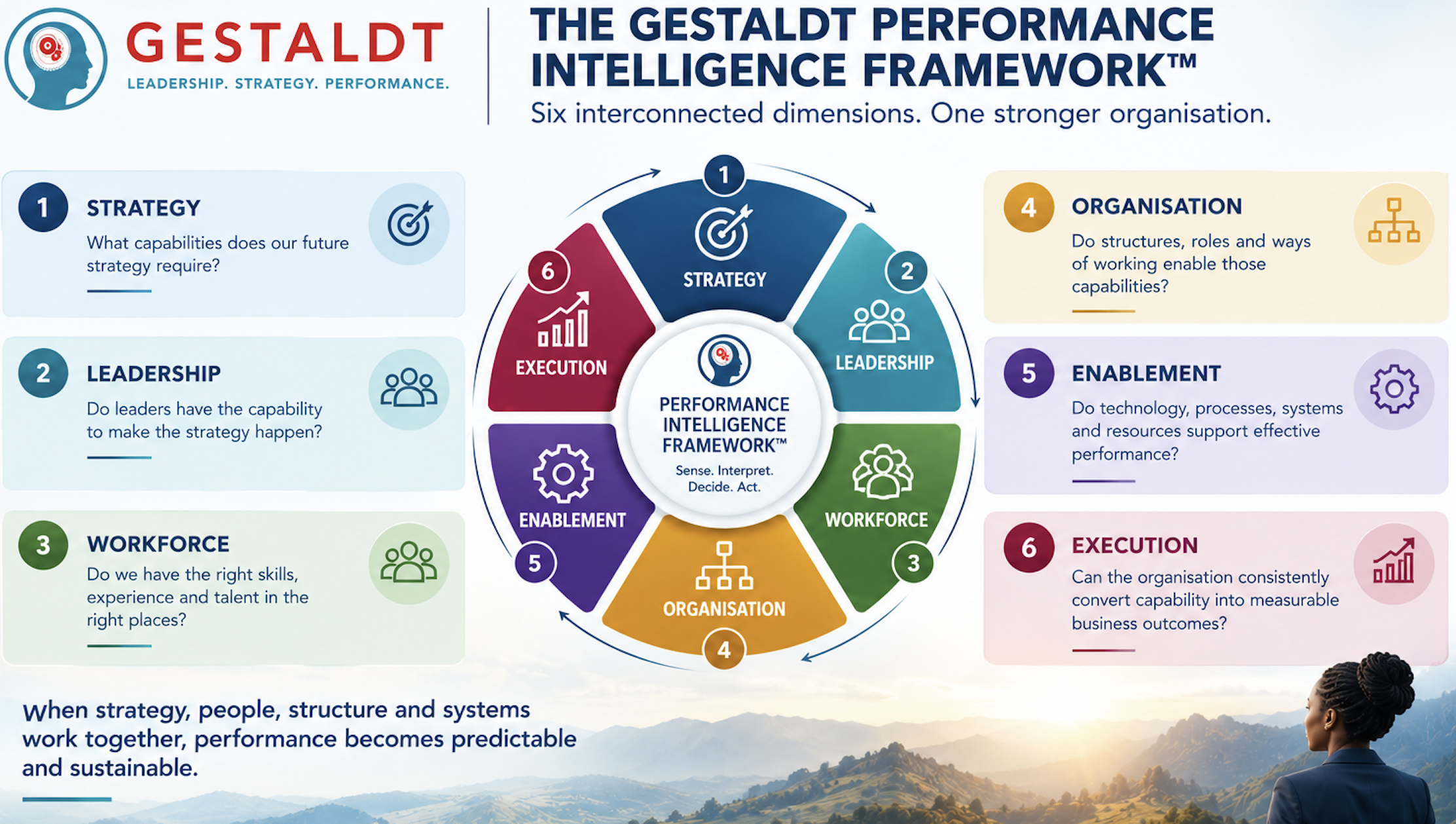
The model is deliberately broader than traditional KPI management.
Because performance does not improve simply because you measure it.
It improves when measurement leads to better decisions, clearer accountability, stronger capability and faster adaptation.
The CEO Performance Blind Spot Test
Score each statement from 1 to 5:
1 = strongly disagree
5 = strongly agree
Our executive dashboard contains meaningful leading indicators.
We can identify emerging performance problems before financial results deteriorate.
Every strategic priority has measurable outcomes.
Every critical outcome has a clearly accountable owner.
Our KPIs measure value rather than activity alone.
Managers understand which metrics they can influence directly.
Performance data regularly triggers executive decisions.
We can distinguish symptoms from underlying causes.
Our performance measures are connected to organisational capability.
We change measures when strategic priorities change.
Your Score
40–50: Performance intelligence is embedded
Your organisation has a strong foundation for proactive performance management.
30–39: Performance visibility is developing
You may have useful measurement, but important blind spots could remain.
Below 30: Performance blind-spot risk
Your organisation may be relying too heavily on lagging results or activity-based measurement.
The score is a diagnostic starting point—not a substitute for a deeper organisational assessment.
From Reporting Performance to Leading Performance
The modern CEO does not need more numbers.
They need better signals.
A performance system should make it easier to see:
where the organisation is heading;
what is changing;
why it is changing;
who needs to act;
what decision is required;
and whether the intervention is working.
That changes the role of performance management completely.
It moves from:
reporting → sensing
measuring → diagnosing
reviewing → deciding
managing activity → creating value
And that shift matters because organisations increasingly operate in environments where yesterday's performance provides only partial guidance about tomorrow's opportunity.
As Mohamed Kande put it, “The future belongs to the bold.”
Bold leadership, however, does not mean reckless leadership.
It means having enough visibility to act before the opportunity—or the problem—becomes obvious to everyone else.
The CEO's Five Questions
At your next executive performance meeting, ask:
1. What is improving?
Not just financially—but operationally, strategically and organisationally.
2. What is deteriorating?
Look for small movements before they become large problems.
3. What leading indicators are changing?
This is where future performance begins to reveal itself.
4. What are we doing about it?
Every significant signal should lead to a decision or deliberate choice not to intervene.
5. What are we not measuring?
This final question is often the most revealing.
Because the biggest performance blind spot may be the thing that isn't on the dashboard.
Conclusion: Don't Wait for the Numbers to Become Obvious
A strong organisation doesn't wait for declining revenue to discover that customers are unhappy.
It doesn't wait for productivity to collapse before examining process friction.
It doesn't wait for strategic initiatives to fail before asking whether people have the capability to execute them.
And it doesn't wait for a crisis before changing direction.
It learns to see earlier.
The future of performance management is not about producing more reports.
It is about creating an organisational system that can sense, interpret, decide and adapt.
Your financial results still matter.
Your KPIs still matter.
Your dashboards still matter.
But the real competitive advantage comes from knowing what those numbers are telling you before they become yesterday's news.
Measure what matters. Detect what is changing. Decide sooner. Act with purpose.
Ready to Identify Your Organisation's Performance Blind Spots?
Gestaldt can help executive teams assess whether their current performance systems provide the visibility, accountability and strategic intelligence required to improve execution.
Request a Gestaldt Performance Intelligence Assessment™
Assess:
Strategic KPIs
Leading and lagging indicators
Executive dashboards
Accountability
Performance culture
Organisational capability
Decision-making
Strategy-to-performance alignment