

Future-Proofing Organisations: Scenario Planning for 2027–2030
Future-proofing organisations requires more than predicting trends—it demands structured scenario planning. Learn how leaders can prepare for 2027–2030 with strategic foresight, digital intelligence, and resilient decision-making frameworks.

The future rarely sends a calendar invite.
One moment business feels predictable, and the next, a technological breakthrough, geopolitical shift, or market disruption changes everything overnight. The organisations that survive—and thrive—aren’t the ones that try to predict the future perfectly. They’re the ones prepared for multiple futures.
Think of scenario planning as building several bridges before the river changes course. Instead of betting everything on one forecast, leaders explore different possibilities and design strategies flexible enough to adapt.
In this guide, you’ll learn how forward-thinking organisations prepare for 2027–2030 using scenario planning, emerging technology insights, and strategic resilience frameworks.
1. Why Scenario Planning Is the New Strategic Superpower
Here’s a hard truth: traditional long-term planning is becoming obsolete.
For decades, companies relied on linear forecasting—projecting current trends into the future. But in an era shaped by AI, climate pressures, and rapid digital disruption, that model breaks down.
Scenario planning, popularised by energy giant Royal Dutch Shell in the 1970s, helps leaders explore multiple plausible futures instead of relying on a single prediction.
According to research by the World Economic Forum, businesses that incorporate scenario planning into strategy processes adapt significantly faster during global disruptions.
Futurist Peter Schwartz explains it well: “Scenarios are not predictions. They are tools to help us understand what might happen.”
Practical Tip:
Create three baseline scenarios for your organisation: optimistic growth, moderate change, and disruptive transformation.
You can explore complementary strategy frameworks in our guide:
Strategic Decision-Making in the Digital Age
https://gestaldt.com/strategic-decision-making-in-the-digital-age/
2. Identifying the Mega Trends Shaping 2027–2030
Before building scenarios, leaders must understand the forces shaping the future.
Consulting experts and the World Economic Forum consistently highlight several mega-trends expected to dominate the late 2020s:
Artificial intelligence integration
Climate adaptation policies
Global supply chain realignment
Demographic shifts and talent shortages
The rise of digital economies
Studies suggest AI alone could add $15 trillion to global GDP by 2030.
Technology entrepreneur Elon Musk once said, “Some people don’t like change, but you need to embrace change if the alternative is disaster.”
Understanding these forces helps organisations construct realistic future scenarios rather than speculative guesses.
Practical Tip:
Assign a “trend radar team” that monitors emerging technologies, policy shifts, and consumer behaviour quarterly.
3. Building Multiple Strategic Scenarios
Once key trends are identified, organisations can design structured future scenarios.
Most effective scenario planning frameworks use three to four possible futures built around two major uncertainties—for example:
Speed of AI adoption
Global economic stability
Institutions like Harvard Business School recommend developing narratives for each scenario describing how markets, technology, and customers might behave.
These narratives help leaders stress-test strategy.
Leadership thinker Roger Martin argues that great strategy isn’t about certainty—it’s about preparing for competing possibilities.
Practical Tip:
For each scenario, ask one key question: “What strategic move would we make today if this future became reality?”
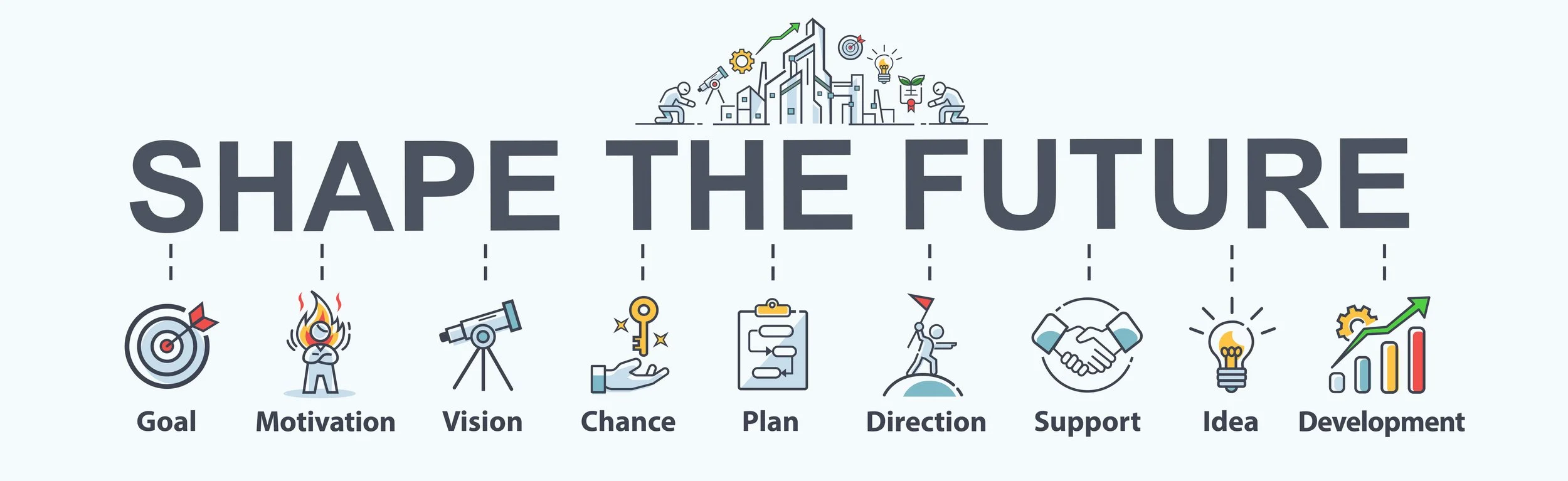
4. Using Digital Tools to Simulate the Future
Here’s where technology supercharges scenario planning.
Modern predictive analytics platforms allow organisations to simulate economic shifts, market demand, and operational risk.
Technology leaders such as IBM and Microsoft are developing AI-powered forecasting tools that analyze massive datasets in real time.
According to Gestaldt Consultants, organisations using advanced analytics for planning are six times more likely to make faster strategic decisions.
As AI researcher Andrew Ng notes, “Artificial intelligence is the new electricity.”
Just as electricity powered the industrial age, AI-powered forecasting will power future strategy.
Practical Tip:
Integrate predictive analytics into quarterly strategic reviews rather than relying solely on annual planning cycles.
5. Building Organisational Resilience
Scenario planning is only valuable if organisations can respond quickly when change happens.
That requires resilience—structures, cultures, and systems designed for adaptability.
Research from Gestaldt Management Consultants shows resilient companies outperform competitors during crises by maintaining operational flexibility and diversified revenue streams.
Leadership author Simon Sinek reminds us: “Leadership is not about being in charge. It is about taking care of those in your charge.”
Resilient organisations prioritise employee well-being, transparent communication, and continuous learning.
Practical Tip:
Develop contingency plans for critical operations—supply chains, workforce capacity, and cybersecurity.
For leadership strategies that support resilience, read:
Leadership 2.0: Augmenting Human Skills with Digital Tools
https://gestaldt.com/leadership-2-0-augmenting-human-skills-with-digital-tools/
6. Turning Scenarios Into Strategic Action
The final step in scenario planning is turning insight into action.
Too many organisations build impressive reports that sit on digital shelves. Effective companies translate scenarios into clear strategic triggers.
For example:
If AI adoption reaches a certain level → increase automation investment
If supply chain disruptions rise → diversify suppliers
If remote work expands → redesign workplace culture
Our consultants report that organisations that embed foresight into strategy cycles are significantly more agile in volatile markets.
Futurist Amy Webb summarises it well: “The future doesn’t just happen—we build it through the decisions we make today.”
Practical Tip:
Attach measurable indicators to each scenario so leadership teams know when to activate specific strategies.
Conclusion: Preparing for the Futures Ahead
The years between 2027 and 2030 will likely bring more change than many organisations experienced in the previous decade.
Scenario planning gives leaders a powerful advantage: the ability to think beyond a single forecast and prepare for multiple realities.
In this article, we explored how scenario planning strengthens strategic foresight, how mega-trends shape possible futures, how digital tools simulate outcomes, and how resilient organisations turn uncertainty into opportunity.
The truth is, the future can’t be predicted with perfect accuracy. But it can be prepared for.
Organisations that embrace foresight today won’t just survive tomorrow’s disruptions—they’ll lead the way into whatever future unfolds.

Supply Chain Resilience: Lessons From Global Disruptions and Local Adaptation
Global disruptions have reshaped supply chains. Discover key lessons and practical strategies South African organisations can use to build resilient, future-ready supply networks.

From global pandemics and geopolitical tensions to energy instability and climate shocks, supply chains have become one of the most exposed fault lines in today’s economy. What was once treated as an operational back-office function is now firmly on the strategic agenda of boards and executive teams.
For South African organisations, the lesson is clear: supply chain resilience is no longer about efficiency alone. It is about continuity, competitiveness, and long-term survival in an increasingly volatile world.
This article explores the key lessons from global supply chain disruptions — and how South African businesses can adapt locally to build resilient, future-ready supply networks.
Why Supply Chain Resilience Is Now a Strategic Priority
Recent global disruptions revealed a hard truth: highly optimised, cost-focused supply chains are often fragile under stress. Just-in-time models, single-source suppliers, and long-distance dependencies amplify risk when shocks occur.
These systemic vulnerabilities mirror the broader uncertainty explored in Global Economic Headwinds: How South African Businesses Can Stay Resilient.
For business leaders, supply chain resilience now underpins:
Revenue protection
Customer trust
Regulatory compliance
Operational continuity
In short, resilient supply chains are a strategic asset — not a cost centre.
Lesson 1: Visibility Beats Optimisation
One of the biggest failures during recent disruptions was a lack of end-to-end visibility. Many organisations simply did not know where their critical inputs originated or where bottlenecks would emerge.
Leading companies are now investing in:
Real-time supply chain analytics
Multi-tier supplier mapping
Early-warning risk indicators
This shift from optimisation to visibility aligns with the foresight-driven thinking discussed in Strategic Foresight 2026: Turning Reflection into Action.
Practical insight: You cannot manage what you cannot see.
Lesson 2: Diversification Is a Resilience Multiplier
Global disruptions exposed the danger of over-reliance on single suppliers, single regions, or single transport routes. Companies with diversified sourcing recovered faster and with less financial impact.
For South African firms, diversification can include:
Dual or multi-supplier strategies
Regional and intra-African sourcing
Blended local and global supply models
This is increasingly relevant as Africa’s trade integration accelerates, creating new regional sourcing opportunities.
Lesson 3: Local Adaptation Is a Competitive Advantage
While global reach matters, local adaptability has emerged as a decisive advantage. South African businesses that invested in local supplier development, regional manufacturing, and domestic logistics proved more resilient during shocks.
This localisation trend connects with the growth opportunities highlighted in South Africa’s Green Economy: Opportunities for Growth, where local production and sustainable infrastructure strengthen both resilience and economic impact.
Key takeaway: Global resilience is built on strong local foundations.
Lesson 4: Supply Chains Are Ultimately Human Systems
Technology enables resilience, but people sustain it. During disruptions, organisations with strong relationships — with suppliers, logistics partners, and internal teams — adapted faster.
Trust, communication, and shared problem-solving proved just as critical as digital tools. This reinforces leadership insights from The Human Side of Transformation: Keeping Purpose Alive Amid Change.
Resilient supply chains are built on:
Collaborative partnerships
Transparent communication
Empowered decision-making at the front line
Lesson 5: Leadership Must Shift From Control to Preparedness
Traditional command-and-control leadership struggles in fast-moving disruptions. Resilient organisations empower teams to make rapid, informed decisions closer to the issue.
This leadership evolution reflects themes in The Evolving Role of Leadership in 2026: From Control to Empowerment.
Preparedness-focused leaders:
Plan for multiple scenarios
Accept uncertainty as normal
Balance speed with accountability

Technology as an Enabler — Not a Silver Bullet
Digital tools play a crucial role in resilience, but only when aligned with strategy. Advanced analytics, AI forecasting, blockchain traceability, and automation can improve responsiveness — but they must support clear decision frameworks.
Bridging this gap between insight and execution mirrors challenges explored in From Strategy to Execution: Closing the Gap in Organisations.
Best practice: Technology amplifies good strategy — it cannot replace it.
Turning Resilience Into Long-Term Advantage
Supply chain resilience should not aim to “return to normal.” The goal is to emerge stronger, faster, and more adaptable than competitors.
Organisations that integrate resilience into core strategy are better positioned to:
Absorb future shocks
Capture new market opportunities
Build trust with customers and partners
These capabilities are essential in the volatile economic environment discussed in From Insight to Impact: Building Resilient Strategies for a Volatile Economy.
Conclusion
Global disruptions have permanently changed how supply chains must be designed and led. For South African organisations, resilience is no longer optional — it is a defining capability for sustainable growth.
By prioritising visibility, diversification, local adaptation, strong relationships, and empowered leadership, businesses can transform supply chains from fragile cost structures into resilient engines of competitive advantage.
In an era of constant disruption, the most resilient supply chains will belong to organisations that plan boldly, adapt locally, and lead with clarity.