

Decision Paralysis in the C-Suite: Why Great Leaders Make Slow Decisions (And How to Regain Strategic Agility)
Slow executive decision-making can cost organisations millions in missed opportunities, delayed execution, and declining competitiveness. Learn why decision paralysis develops, how it affects organisational performance, and the practical steps CEOs can take to build faster, more confident leadership teams.

The Cost of Waiting
A competitor launches a new product. Your organisation has the capability to respond, but approval takes weeks.
A customer requests a customised solution. Sales is ready, operations is willing, but leadership can't reach a decision.
A promising acquisition is identified. Due diligence is complete, yet the executive team delays. By the time a decision is made, the opportunity has disappeared.
These situations are more common than many leaders admit.
Organisations rarely lose their competitive edge because of one poor decision. More often, they lose it because of slow decisions.
In an environment defined by economic uncertainty, technological disruption, and rapidly changing customer expectations, speed has become a strategic advantage. Yet many executive teams are trapped in decision paralysis—where caution, complexity, and competing priorities delay action until opportunities are lost.
At Gestaldt, we have found that decision paralysis is rarely caused by a lack of intelligence or experience. It is usually a symptom of deeper organisational issues: unclear governance, misaligned leadership, risk-averse cultures, and ineffective decision-making processes.
The organisations that thrive are not those that make perfect decisions. They are the ones that make timely, informed, and accountable decisions.
Why Decision Speed Is Now a Competitive Advantage
Business cycles have accelerated dramatically.
Markets change in months rather than years.
Artificial intelligence reshapes industries almost overnight.
Customer expectations evolve continuously.
Regulatory landscapes shift with increasing frequency.
In this environment, organisations that hesitate risk becoming irrelevant.
Strategic agility is no longer a desirable leadership quality—it is an organisational necessity.
Research has consistently shown that organisations with effective decision-making processes outperform their peers in profitability, innovation, and long-term growth. They respond more quickly to market opportunities, allocate resources more effectively, and build greater confidence across their workforce.
Decision speed, however, should never be confused with recklessness. The objective is not faster decisions at any cost, but better decisions made without unnecessary delay.
Seven Hidden Causes of Decision Paralysis
1. Too Many Decisions Reach the Executive Team
Not every decision requires CEO approval.
When executives become involved in operational issues, strategic discussions become crowded with matters that should have been resolved elsewhere.
This creates bottlenecks, delays implementation, and distracts leaders from long-term priorities.
Executive Reflection
Are your executives making strategic decisions—or operational ones?
2. Governance Is Unclear
Who owns the decision?
Who provides input?
Who has final authority?
Without clearly defined governance, decisions circulate endlessly between committees, departments, and executives.
Good governance accelerates action by providing clarity, not bureaucracy.
3. Leaders Are Misaligned
When executives have different interpretations of organisational priorities, decision-making slows.
Instead of evaluating options against shared objectives, discussions become negotiations between competing interests.
Alignment transforms debate into productive decision-making.
4. Fear of Failure Overrides Strategic Thinking
High-performing organisations encourage calculated risk-taking.
Risk-averse organisations avoid difficult decisions altogether.
The result is stagnation.
Leaders must create an environment where informed experimentation is encouraged and learning is valued.
5. Data Overload Creates Analysis Paralysis
Modern organisations have access to unprecedented amounts of information.
The challenge is no longer obtaining data—it is knowing which data matters.
Executives who wait for perfect information often miss the opportunity to act.
The goal is to make decisions using the best available evidence, recognising that uncertainty will always exist.
6. Accountability Is Diffused
When everyone is responsible, no one is responsible.
Without clear ownership, decisions are delayed, implementation weakens, and momentum fades.
Accountability should be explicit at every stage of the decision-making process.
7. Organisational Culture Rewards Consensus Over Progress
Consensus has value, but it should not become a prerequisite for every decision.
Healthy executive teams encourage debate, seek diverse perspectives, and then commit to a clear course of action.
Progress requires confidence, not unanimity.
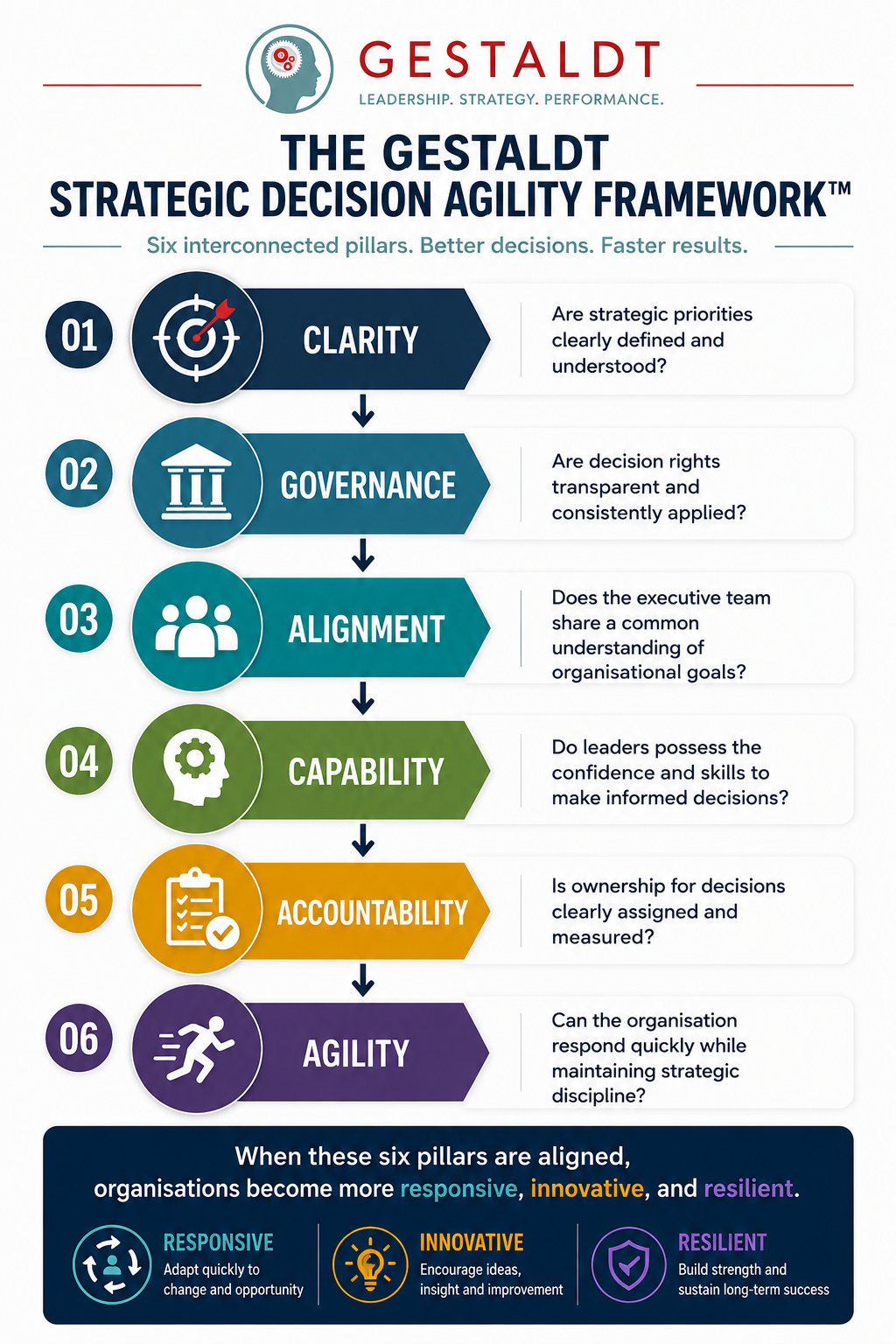
The Gestaldt Strategic Decision Agility Framework™
At Gestaldt, we believe high-quality decision-making is built on six interconnected pillars.
Executive Decision Agility Scorecard
Rate each statement from 1 (Strongly Disagree) to 5 (Strongly Agree).
Strategic priorities are clearly understood.
Decision rights are well defined.
Executive meetings result in timely decisions.
Leaders are comfortable making decisions with incomplete information.
Accountability for implementation is clear.
Governance supports rather than delays execution.
Departments collaborate effectively.
Decision-making is transparent.
We learn from decisions, whether successful or not.
Our organisation adapts quickly to change.
Results
40–50: Your organisation demonstrates strong decision agility.
30–39: Decision-making processes may be slowing performance.
Below 30: Decision paralysis is likely affecting strategic execution and organisational growth.
Case Study: Breaking the Decision Bottleneck
A large services organisation approached Gestaldt after a major transformation programme had stalled. Although the strategy was clear, executive meetings had become increasingly lengthy, decisions were repeatedly revisited, and implementation timelines continued to slip.
Our assessment identified three root causes:
Over-centralised decision-making.
Unclear governance and decision rights.
Inconsistent alignment on strategic priorities.
Gestaldt worked with the executive team to redesign governance structures, clarify accountability, and establish a disciplined decision-making framework.
Within nine months, the organisation reported:
Faster executive decision cycles.
Reduced project delays.
Greater cross-functional collaboration.
Improved confidence in leadership.
Stronger execution of strategic initiatives.
The organisation did not succeed because it made more decisions. It succeeded because it made better decisions, faster.
Five Questions Every CEO Should Ask
Before your next executive meeting, consider these questions:
Which decisions genuinely require executive attention?
Are our governance structures enabling or delaying action?
Do our leaders share the same understanding of strategic priorities?
Are we waiting for perfect information instead of acting on good evidence?
Does our culture reward informed action or excessive caution?
Your answers may reveal hidden constraints on organisational performance.
Strategic Agility Is a Leadership Capability
Markets will continue to change.
Technology will continue to evolve.
Uncertainty will remain.
The organisations that succeed will not be those with the most detailed plans. They will be those whose leaders can make confident, timely, and accountable decisions in the face of complexity.
Strategic agility is not about reacting faster than everyone else. It is about building an organisation where leadership, governance, culture, and execution work together to enable decisive action.
For CEOs, this is no longer simply a leadership skill. It is a strategic advantage.
Ready to Improve Executive Decision-Making?
If your organisation is experiencing delayed execution, prolonged decision cycles, or leadership misalignment, it may be time to evaluate how decisions are made.
Request a Strategic Decision Agility Assessment
Gestaldt's confidential executive assessment examines:
Decision-making effectiveness.
Leadership alignment.
Governance and decision rights.
Strategic clarity.
Organisational agility.
Accountability structures.
Strategy execution capability.
Together, we'll identify the barriers slowing your organisation and develop practical strategies to improve executive effectiveness and organisational performance.