

Why High-Performing Organisations Suddenly Stop Growing: The CEO's Blind Spot
Why do successful organisations suddenly lose momentum? Discover the seven hidden organisational barriers that silently stall growth, reduce performance, and prevent strategy execution—and learn how executive leaders can regain competitive advantage.

Success Can Become Your Greatest Risk
Growth is exciting.
Revenue increases.
New markets open.
The workforce expands.
Customers multiply.
Confidence rises.
Then something changes.
The organisation isn't in crisis—but it isn't accelerating either.
Projects take longer to complete.
Decisions slow down.
Innovation loses momentum.
Departments begin protecting their own priorities.
Top performers quietly leave.
Customer satisfaction starts to decline.
The business still appears healthy from the outside, yet internally, leaders know something isn't right.
For many CEOs, this is the most dangerous stage of organisational growth—not because the problems are visible, but because they are hidden beneath the surface.
The instinctive response is often to develop a new strategy, restructure the organisation, or invest in new technology. Yet in many cases, the real issue isn't the strategy itself. It's the organisation's ability to execute, adapt, and grow in alignment.
At Gestaldt, we've found that sustained growth depends on more than a strong business plan. It requires leadership alignment, a healthy organisational culture, effective governance, and the ability to translate strategic intent into consistent action.
Let's explore the seven hidden barriers that quietly prevent high-performing organisations from reaching their next level of success.

1. Leadership Alignment Is Only Skin Deep
"We're aligned."
Most executive teams believe they are.
Yet when asked individually about the organisation's top priorities, success measures, or strategic risks, their answers often differ.
Alignment is more than agreeing during a strategy session. It means leaders consistently communicate the same vision, make decisions using the same principles, and reinforce the same priorities throughout the organisation.
When alignment is weak, mixed messages filter through the business, creating confusion, duplicated effort, and competing priorities.
Questions Every CEO Should Ask
Can every executive clearly articulate the organisation's top three strategic priorities?
Are leaders making decisions using the same criteria?
Does every business unit understand how its work contributes to the strategy?
Without alignment at the top, execution breaks down across the organisation.
2. Culture Quietly Rejects the Strategy
Organisations rarely fail because of poor strategies.
They fail because everyday behaviours don't support those strategies.
A company may aspire to become more innovative while rewarding risk avoidance.
It may seek greater collaboration while maintaining siloed structures.
It may promote accountability while tolerating inconsistent performance.
These contradictions create friction between intention and execution.
As Peter Drucker famously said:
"Culture eats strategy for breakfast."
A healthy organisational culture doesn't happen by chance. It is intentionally shaped by leadership behaviours, governance structures, and shared values.
Related Reading:The Invisible Fuel of Business Growth: How Leadership Culture Drives Organisational Success
3. Complexity Has Replaced Clarity
As organisations grow, complexity grows with them.
More products.
More meetings.
More reporting.
More approvals.
More initiatives.
Before long, employees spend more time managing processes than creating value.
One of the biggest threats to sustained growth isn't competition—it's organisational complexity.
High-performing organisations simplify relentlessly.
They identify what matters most, eliminate unnecessary work, and focus resources on the initiatives that create the greatest strategic value.
4. Middle Managers Become the Missing Link
Middle managers are often expected to implement strategic change without being meaningfully involved in shaping it.
This creates a disconnect between executive intent and operational reality.
Employees don't execute strategy because executives communicate it.
They execute it because managers translate it into daily priorities.
Organisations that consistently outperform invest heavily in developing middle leadership capability, communication skills, and change leadership.
5. Growth Has Outpaced Leadership Capability
Many organisations invest heavily in systems and technology but overlook leadership capability.
The skills required to lead a 100-person organisation differ significantly from those needed to lead a 5,000-person enterprise.
Leadership development cannot remain static while the organisation evolves.
Future-ready organisations continuously strengthen executive capability in:
Strategic thinking
Decision-making
Change leadership
Innovation
Collaboration
Emotional intelligence
Without leadership growth, organisational growth inevitably slows.
6. You're Measuring Yesterday Instead of Tomorrow
Most executive dashboards focus on lagging indicators.
Revenue.
Profit.
Market share.
Operational costs.
While essential, these metrics reveal what has already happened.
Leading organisations also monitor indicators that predict future performance.
Examples include:
Leadership alignment
Employee engagement
Innovation pipeline
Customer advocacy
Decision-making speed
Organisational agility
Change readiness
These measures provide early warning signs long before financial performance begins to decline.
7. You're Solving Symptoms Instead of Root Causes
Revenue slows.
So marketing budgets increase.
Employee turnover rises.
So salaries increase.
Projects fail.
So governance becomes more bureaucratic.
Often these interventions address symptoms rather than underlying organisational issues.
True transformation begins by identifying root causes.
Leadership.
Culture.
Capability.
Governance.
Execution.
These are the systems that determine long-term organisational performance.
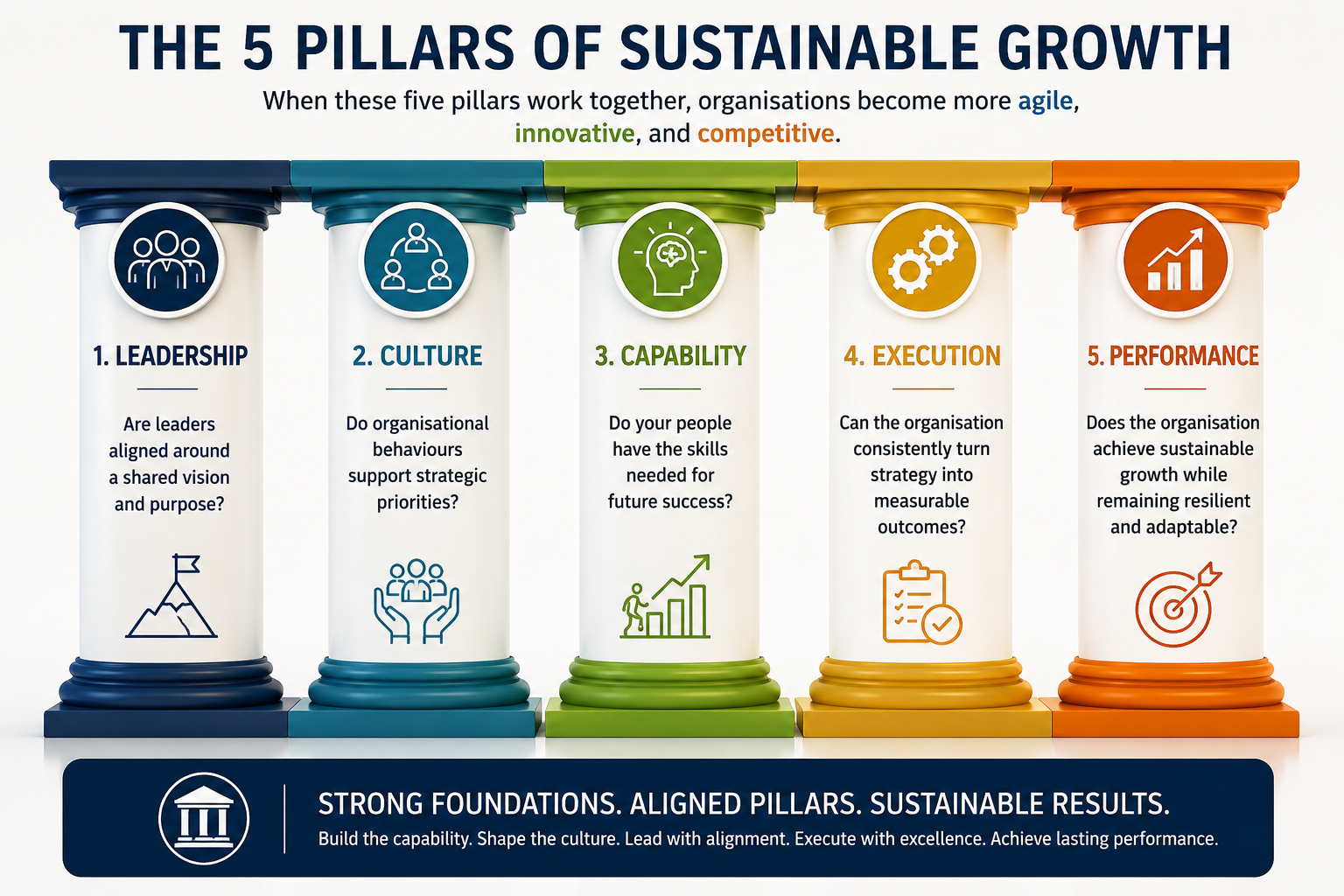
The Gestaldt Growth Performance Model™
At Gestaldt, we believe sustainable business growth depends on five interconnected pillars:
Executive Self-Assessment
Is Your Organisation Quietly Losing Momentum?
Score your organisation from 1 (Strongly Disagree) to 5 (Strongly Agree):
Our executive team consistently communicates the same priorities.
Employees understand how their work contributes to our strategy.
Our culture encourages accountability and innovation.
We execute strategic initiatives on time.
We measure leading indicators, not only financial results.
Leaders adapt quickly to change.
Our middle managers actively drive transformation.
Decision-making is fast and effective.
Leadership capability keeps pace with organisational growth.
Our strategy consistently translates into measurable business results.
Your Score
40–50: Your organisation is well positioned for sustainable growth.
30–39: Warning signs are emerging. Small issues may become significant barriers if left unaddressed.
Below 30: Your organisation may be experiencing hidden execution challenges that require immediate attention.
Sustainable Growth Isn't an Accident
The organisations that outperform their competitors over decades share one common characteristic.
They don't simply develop better strategies.
They build organisations capable of executing them.
For CEOs, the greatest blind spot is often assuming that growth challenges originate in the market.
More often than not, the answers lie within the organisation itself.
Leadership alignment.
Culture.
Capability.
Governance.
Execution.
These are the true drivers of sustainable performance.
Ready to Discover What's Holding Your Organisation Back?
Growth challenges rarely resolve themselves.
The sooner hidden barriers are identified, the sooner meaningful transformation can begin.

Request a Complimentary Executive Growth Diagnostic
In a confidential executive consultation, Gestaldt will help you assess:
Leadership alignment
Strategy execution capability
Organisational culture
Governance effectiveness
Change readiness
Leadership capability
Performance barriers
Together, we'll identify the issues limiting your organisation's growth and develop practical strategies to unlock its full potential.
👉 Schedule your Executive Growth Diagnostic today and take the first step towards sustainable organisational success.

Why Strategy Execution Fails: The 7 Hidden Barriers Most CEOs Never See
Most business leaders don't struggle with strategy—they struggle with execution. Discover the seven hidden barriers that prevent organisations from turning ambitious plans into measurable results, and learn how CEOs can close the gap between strategy and performance.

The Strategy Illusion
Every year, leadership teams invest substantial time and resources into strategic planning. Executive retreats are held, vision statements are refined, objectives are agreed upon, and ambitious targets are set.
Yet months later, many organisations find themselves asking the same question:
"Why aren't we seeing the results we expected?"
The truth is that most organisations don't have a strategy problem. They have an execution problem.
Research consistently shows that the majority of strategic initiatives fail to achieve their intended outcomes. While strategies often look impressive on paper, execution breaks down when organisations fail to align leadership, culture, governance, capabilities, and accountability.
At Gestaldt, we've observed a recurring pattern across industries: the barriers that derail execution are often invisible to leadership until performance begins to suffer.
Here are the seven hidden barriers that prevent strategy from becoming reality.
Barrier 1: Leadership Teams Are Not Truly Aligned
The Silent Killer of Strategic Success
Many executive teams believe they are aligned because they attended the same planning sessions and approved the same strategic objectives.
However, alignment is not agreement.
True alignment means leaders share a common understanding of priorities, outcomes, responsibilities, risks, and decision-making principles.
When executives interpret strategy differently, organisations experience:
Conflicting priorities
Mixed messages to employees
Departmental silos
Slower decision-making
Resource misallocation
The result is confusion throughout the organisation.
Key Question
Can every member of your executive team clearly articulate the organisation's top three strategic priorities in exactly the same way?
If not, execution risks are already emerging.
Related Reading:
Read our article on leadership culture and organisational performance:
The Invisible Fuel of Business Growth: How Leadership Culture Drives Organisational Success
Barrier 2: Culture Is Working Against the Strategy
Strategy Doesn't Fail—Culture Rejects It
One of the most underestimated barriers to execution is organisational culture.
A company may have a brilliant growth strategy, but if its culture discourages innovation, collaboration, accountability, or change, execution stalls.
As management expert Peter Drucker famously observed:
"Culture eats strategy for breakfast."
Many organisations attempt transformation while maintaining behaviours that reward the status quo.
Signs of cultural resistance include:
Fear of failure
Risk avoidance
Low accountability
Resistance to change
Internal politics
Without cultural alignment, even the most sophisticated strategies struggle to gain traction.
Related Reading:
Explore how organisational culture influences performance and growth in:
The Invisible Fuel of Business Growth: How Leadership Culture Drives Organisational Success
Barrier 3: Too Many Priorities Create Strategic Paralysis
When Everything Is Important, Nothing Is Important
Leadership teams often attempt to tackle too many strategic initiatives simultaneously.
Growth initiatives.
Digital transformation.
Culture change.
Talent development.
ESG commitments.
Customer experience improvements.
Operational excellence.
While each initiative may be valuable, pursuing too many priorities creates organisational overload.
Employees become confused about where to focus their efforts.
Resources become diluted.
Momentum disappears.
High-performing organisations understand the power of focus.
They identify a small number of critical priorities and align resources accordingly.
Practical Reality
If your organisation currently has more than five major strategic initiatives competing for attention, execution complexity is likely increasing significantly.
Barrier 4: Accountability Is Unclear
The Ownership Gap
One of the most common execution failures occurs when responsibility is shared by everyone and owned by no one.
Strategic objectives frequently appear on executive dashboards without clear accountability structures.
Questions leaders should ask include:
Who owns this initiative?
What outcomes are expected?
How will progress be measured?
What happens if milestones are missed?
When accountability is unclear:
Decisions are delayed
Deadlines slip
Problems remain unresolved
Progress becomes difficult to track
Successful organisations establish clear ownership and measurable outcomes at every level of execution.
Barrier 5: Middle Management Is Excluded From the Strategy
The Forgotten Layer of Execution
Many strategies fail because executives focus on designing the strategy but neglect the people responsible for delivering it.
Middle managers translate strategy into operational reality.
They shape employee engagement.
They manage performance.
They drive adoption.
Yet they are often informed rather than involved.
This creates a disconnect between strategic intent and operational execution.
The organisations that execute effectively actively engage middle management throughout the strategy lifecycle.
They become champions of change rather than passive recipients of directives.

Barrier 6: Organisations Underestimate Change Fatigue
People Can Only Absorb So Much Change
Today's workforce is navigating unprecedented levels of disruption.
Digital transformation.
Economic uncertainty.
Hybrid work.
Artificial intelligence.
Market volatility.
Leadership changes.
Employees are being asked to adapt continuously.
Many executives underestimate the cumulative impact of change fatigue.
When organisations launch multiple initiatives without considering employee capacity, engagement declines and resistance increases.
Symptoms include:
Lower productivity
Increased turnover
Reduced innovation
Change resistance
Burnout
Effective execution requires organisations to manage change as carefully as they manage strategy.
Related Reading:
Explore how leaders can navigate uncertainty in:
Thriving Amid Uncertainty: How C-Suite Leaders Can Navigate Economic Volatility
Barrier 7: Progress Is Measured Too Late
What Gets Measured Gets Managed
Many organisations rely exclusively on lagging indicators such as:
Revenue growth
Profitability
Market share
Customer retention
While important, these metrics reveal problems after they occur.
Successful strategy execution requires leading indicators that provide early warning signals.
Examples include:
Employee engagement scores
Leadership alignment metrics
Change adoption rates
Customer sentiment
Project milestone completion
By monitoring leading indicators, executives can identify execution risks before they impact business performance.
A Framework for Closing the Execution Gap
At Gestaldt, we believe successful execution requires alignment across five critical dimensions:
The Gestaldt Strategy Execution Framework™
Leadership Alignment
Do leaders share a common understanding of priorities and outcomes?
Culture Alignment
Do organisational behaviours support strategic objectives?
Capability Alignment
Do employees possess the skills required for execution?
Governance Alignment
Are decision-making processes clear and effective?
Accountability Alignment
Are responsibilities clearly defined and measured?
When these five dimensions operate in harmony, strategy moves from aspiration to achievement.
The Cost of Ignoring Execution
Poor execution doesn't simply delay results.
It creates measurable business consequences:
Lost revenue opportunities
Increased operating costs
Talent attrition
Customer dissatisfaction
Competitive disadvantage
Reduced investor confidence
Perhaps most importantly, repeated execution failures erode trust in leadership.
Employees become sceptical.
Stakeholders lose confidence.
Future transformation efforts become increasingly difficult.
The CEO's Challenge
The organisations that outperform their competitors are not necessarily those with the most innovative strategies.
They are the organisations that consistently execute.
The challenge for today's leaders is not creating another strategic plan.
It is identifying the hidden barriers preventing existing strategies from succeeding.
The sooner those barriers become visible, the sooner organisations can unlock sustainable growth.
Ready to Discover What's Blocking Your Strategy?
Many execution challenges remain hidden until performance begins to suffer.
Gestaldt helps executive teams identify the barriers preventing strategy from translating into measurable business results.
Request a Strategy Execution Diagnostic
Our consultants will help you assess:
✔ Leadership alignment
✔ Organisational culture
✔ Governance effectiveness
✔ Change readiness
✔ Accountability structures
✔ Execution capability
Schedule a confidential consultation and discover where your strategy may be breaking down before it impacts performance.