The Organisational Friction Tax: How CEOs Can Unlock Productivity

Your organisation may not have a productivity problem. It may have a friction problem.
Projects take longer than expected. Decisions bounce between departments. Managers spend hours coordinating work that should be straightforward. Talented employees navigate approval layers, duplicated processes and competing priorities before they can deliver meaningful results.
And yet, everyone appears busy.
This is the organisational friction tax: the hidden cost of the obstacles, delays and unnecessary complexity that prevent people from turning effort into value.
Think of your organisation as a high-performance engine. You can increase the fuel supply, hire better drivers and invest in more powerful technology—but if the engine is full of internal resistance, much of that energy is wasted as heat rather than converted into movement.
The same thing happens in business. Adding people, systems, meetings or targets will not necessarily improve performance if the underlying way work gets done is unnecessarily difficult.
For CEOs and executive teams, the opportunity is significant: remove the friction that consumes capacity before spending more to create it.
This article explores seven sources of organisational friction, how to identify their impact and how the Gestaldt Organisational Friction Reduction Framework™ can help leaders create a business that moves faster without sacrificing accountability, quality or control.
1. The Meeting Machine: When Coordination Becomes the Work
If your people spend more time discussing work than doing it, your operating rhythm needs attention.
Meetings are essential for alignment, problem-solving and decision-making. The trouble starts when they become the default response to every uncertainty.
A decision requires another meeting. A project update requires a presentation. A disagreement triggers a committee. Before long, employees spend their days coordinating activity instead of producing outcomes.
Microsoft's 2025 Work Trend Index found that 80% of workers and leaders reported lacking enough time or energy to do their work, while 53% of leaders said productivity needed to increase. Microsoft also reported that employees using its productivity tools experienced interruptions roughly every two minutes during core work hours.
These findings point to a crucial distinction: more communication does not automatically create better coordination.
The goal isn't to eliminate meetings. It's to make sure each meeting has a clear purpose, the right participants and an explicit outcome.
What to change:
Replace routine status meetings with concise written updates.
Reserve meetings for decisions, collaboration and complex problem-solving.
Give every meeting a decision owner and documented actions.
Protect uninterrupted time for work requiring concentration.
Practical tip: Audit your executive calendar for two weeks. Categorise meetings as decide, solve, inform or unnecessary. Eliminate or redesign those that consistently fail to achieve their purpose.
2. The Approval Maze: Why Simple Decisions Take Too Long
When every decision needs three signatures, your organisation may be controlling risk at the expense of progress.
Approval processes often begin with good intentions: protect assets, maintain quality, ensure compliance and prevent costly mistakes.
Over time, additional controls accumulate. Managers become reluctant to make decisions independently. Routine purchases travel through multiple departments. Customer issues wait for permission to be resolved.
The organisation may appear well governed, but the hidden cost is slower execution.
Not every decision deserves the same level of scrutiny. A material acquisition, a regulatory exception and a routine customer-service adjustment have very different risk profiles.
Effective governance distinguishes between them.
Leaders should define decision rights according to the financial exposure, reversibility, strategic significance and regulatory implications of each decision. High-risk decisions may need multiple approvals; low-risk, reversible decisions should usually sit closer to the work.
What to change:
Identify decisions that repeatedly stall.
Establish clear thresholds for delegated authority.
Specify who recommends, decides, executes and advises.
Escalate exceptions rather than routing every routine decision upward.
Practical tip: Choose five decisions that regularly take too long. Measure their current turnaround time, identify unnecessary approval steps and redesign the process while preserving essential controls.
3. The Silo Effect: When Departments Optimise Their Own Results
Your departments can all hit their targets while the organisation misses its most important goal.
Sales wants more customers. Operations wants stability. Finance wants cost control. Technology wants secure, reliable systems. Human Resources wants effective workforce practices.
Each objective may be reasonable. The problem emerges when departments pursue them independently.
Sales promises a delivery date that operations cannot meet. Technology implements a new platform without sufficient preparation for frontline teams. Finance reduces expenditure that customer service depends on.
Local efficiency creates enterprise-wide friction.
The solution isn't to remove functional accountability. It's to make shared outcomes visible and ensure that decisions reflect the entire value chain.
Gallup's 2024 engagement meta-analysis, covering more than 183,000 work units and 3.35 million employees, found that engagement was associated with multiple organisational outcomes, including productivity, profitability, turnover and customer loyalty.
The implication is that performance depends on the conditions in which people work—not simply the targets assigned to them.
What to change:
Establish shared outcomes across departments.
Map handoffs between teams to expose delays and duplicated work.
Resolve competing priorities at the appropriate leadership level.
Reward collaboration that improves end-to-end performance.
Practical tip: Select one customer journey or core business process and map every department involved, from initial request to final outcome. Identify where ownership changes, information disappears or work waits for another team.
4. The Process Trap: When Yesterday's Rules Slow Down Tomorrow's Business
A process can be perfectly compliant, consistently followed and still be unnecessarily complicated.
As organisations grow, they add procedures, forms, checks, systems and reporting requirements. Each addition may solve a legitimate problem.
But few organisations systematically remove outdated requirements.
The result is process accumulation: employees must navigate layers of administration that no longer reflect the original risk or business need.
This creates a dangerous misconception. Because people follow the process, leaders assume the process must be effective.
A better approach is to assess processes by the value they create, the risk they control and the effort they consume.
For example, a customer onboarding process might involve repeated data entry across multiple systems. Automating the existing steps could make the duplication happen faster without solving the underlying problem.
Simplification must come before automation.
What to change:
Identify duplicate data entry and redundant checks.
Remove steps that do not add value or manage a material risk.
Standardise routine work while allowing justified exceptions.
Redesign processes around the customer or business outcome.
Practical tip: Ask the people performing a process to identify the three steps they would remove if they owned the end-to-end result. Test those suggestions against compliance, quality and customer requirements before making changes.
5. The Information Hunt: Why People Can't Find What They Need
Every time an employee searches for information that should be easy to find, your organisation pays a small productivity tax.
The information may exist somewhere—in a shared drive, email thread, project tool, spreadsheet or colleague's memory.
But if employees cannot find the correct version quickly, they waste time searching, checking, recreating or asking others.
Microsoft's Work Trend Index found that 62% of surveyed workers struggled with spending too much time searching for information.
This is not merely an IT issue. It is a knowledge-management and operating-model issue.
When teams store information differently, use inconsistent naming conventions or lack clear ownership, the organisation becomes dependent on individual memory.
That dependency creates risk when people change roles, leave the business or become unavailable.
What to change:
Establish clear ownership for critical business information.
Create agreed sources of truth for policies, procedures and project decisions.
Remove outdated or duplicate documents.
Make knowledge transfer part of normal work rather than an exit activity.
Practical tip: Ask a new employee to find five essential resources without help. Observe where they struggle. Their experience may reveal information gaps that long-serving employees have learned to navigate unconsciously.
6. The Leadership Bottleneck: When Everything Must Go Through the Top
If every important decision requires the CEO's attention, the organisation has built a queue around its most expensive decision-maker.
Some leaders become bottlenecks without intending to.
They want visibility into important work. They want consistency. They want to protect standards. So they become involved in more decisions, attend more meetings and approve more exceptions.
Initially, this can improve control.
Eventually, it slows the business and prevents managers from developing the judgement needed to lead independently.
The answer is not to remove executive oversight. It is to distinguish between decisions that genuinely require executive judgement and those that should be made elsewhere.
Satya Nadella, Microsoft's CEO, has spoken about the importance of reducing the time and energy needed to get work done, including simplifying processes and pushing greater accountability into teams.
The principle applies across industries: effective leadership should increase the organisation's ability to act, not make every action dependent on the leader.
What to change:
Define which decisions belong at executive, management and operational levels.
Give managers authority that matches their accountability.
Agree on escalation thresholds and risk boundaries.
Review whether delegated decisions are producing the intended outcomes.
Practical tip: Track the decisions escalated to the executive team over one month. Identify which genuinely required executive judgement and which could be handled effectively through clearer authority, better information or stronger manager capability.
7. The Measurement Mistake: Tracking Activity Instead of Removing Obstacles
You cannot fix a problem that your performance dashboard was never designed to reveal.
Organisations often measure revenue, costs, project milestones, utilisation and output. These measures matter, but they may not explain why work is becoming harder to complete.
A team can meet its activity targets while waiting days for approvals. A project can report green status while critical dependencies remain unresolved. Employees can appear fully utilised while spending significant time on duplicated administration.
The missing layer is friction measurement.
Leaders need visibility into how easily work moves through the organisation—not just how much activity takes place.
Consider these indicators:
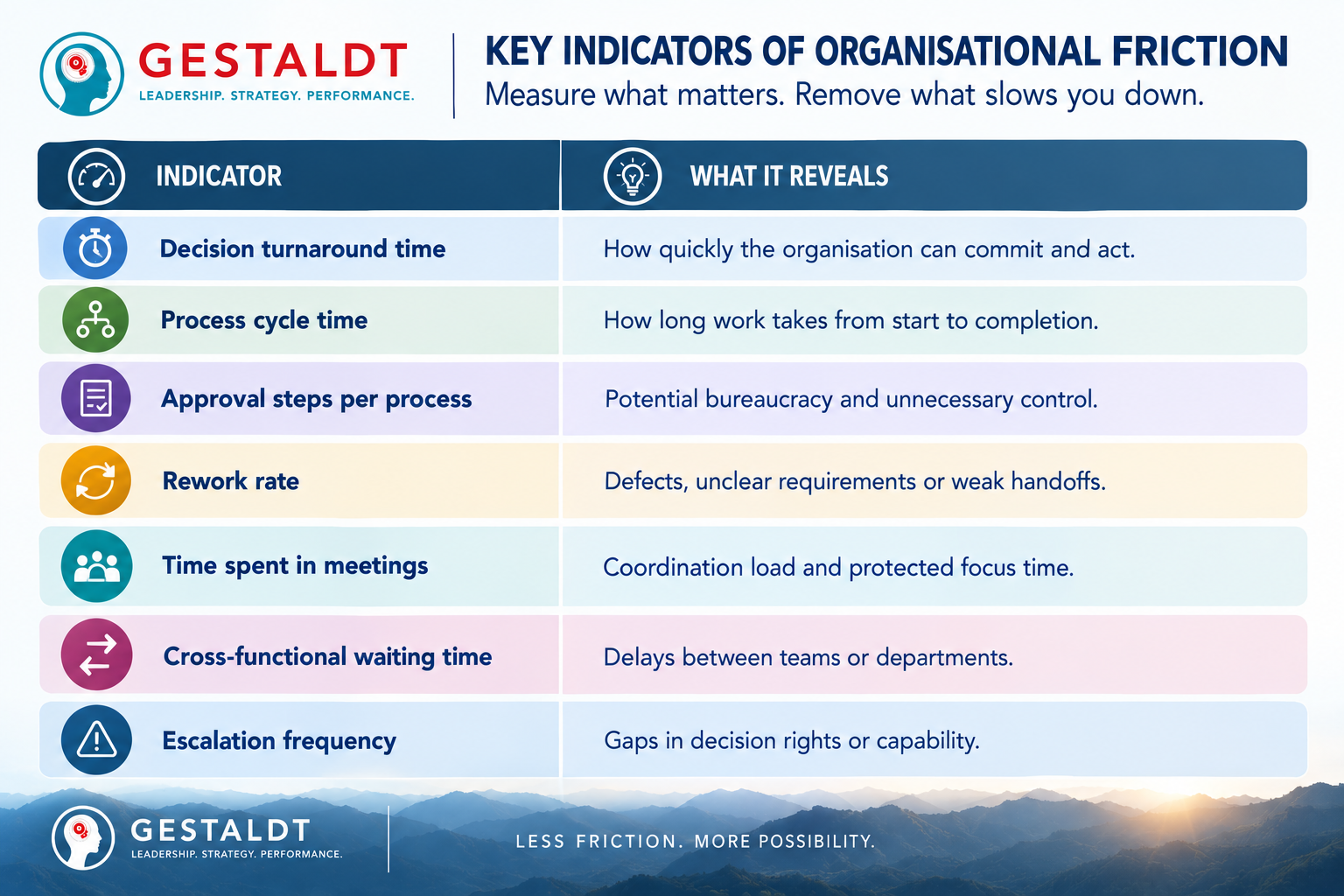
These indicators become especially valuable when paired with business outcomes such as customer satisfaction, quality, retention and profitability.
Gallup's 2024 meta-analysis found that teams in the top quartile of employee engagement had median differences of 18% in sales productivity and 23% in profitability compared with bottom-quartile teams. These are associations between engagement and performance, not proof that any single friction-reduction intervention will produce those gains.
The broader lesson is that how people experience work can be connected to measurable business performance.
What to change:
Establish baseline measures for the most important processes.
Identify where work waits, loops back or requires repeated clarification.
Combine operational measures with employee and customer feedback.
Track whether simplification produces measurable improvements.
Practical tip: Select one high-value process and measure its end-to-end cycle time, waiting time and rework for a month. Use the findings to establish a baseline before redesigning the process.
The Gestaldt Organisational Friction Reduction Framework™
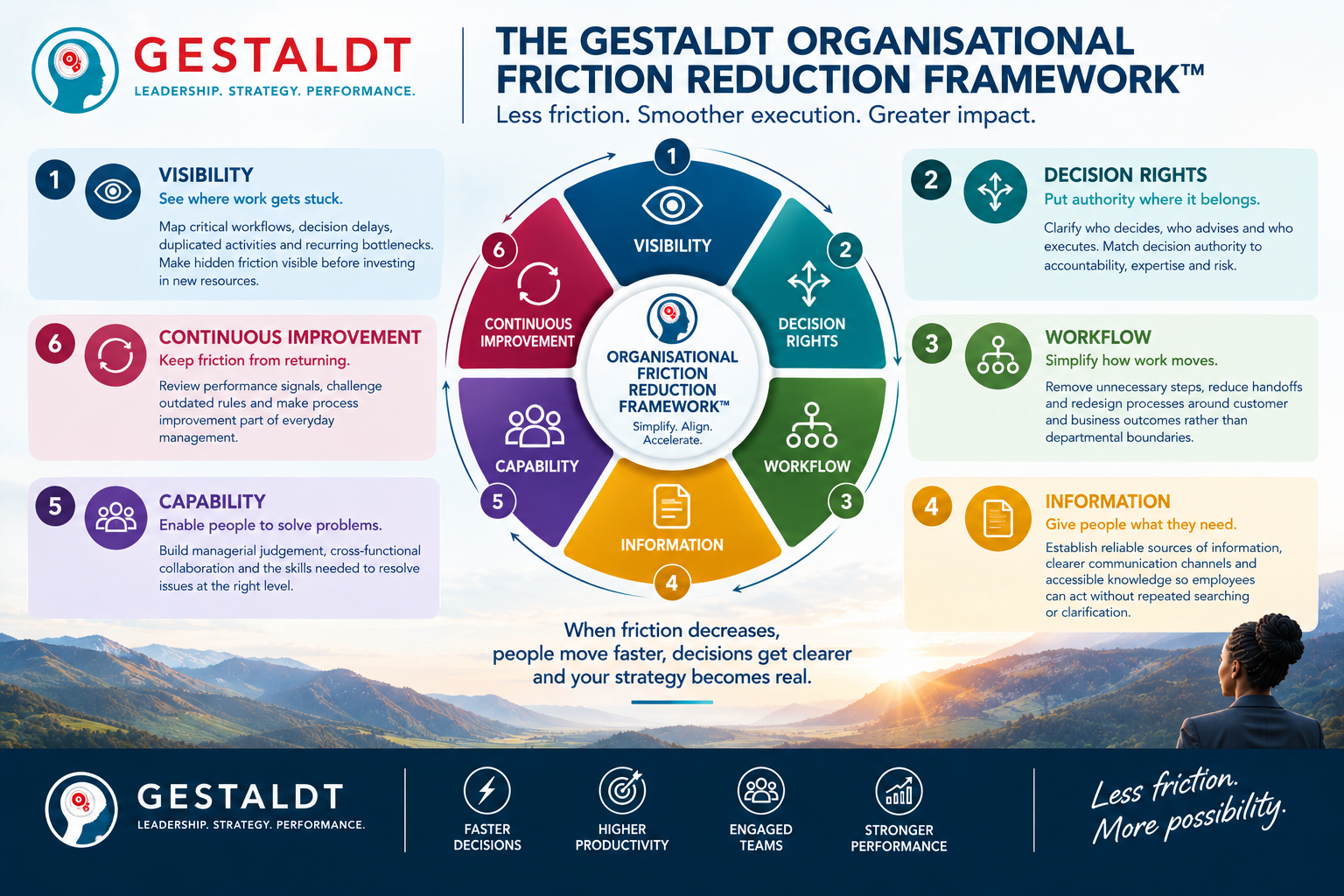
Reducing friction requires more than cutting meetings or removing approval steps. It requires a deliberate redesign of how work flows through the organisation.
The Gestaldt Organisational Friction Reduction Framework™ brings six dimensions together to help leaders identify obstacles, simplify execution and recover capacity.
The CEO's Organisational Friction Diagnostic
Use this short assessment to identify where friction may be limiting performance. Rate each statement from 1 to 5, where 1 means strongly disagree and 5 means strongly agree.
Friction assessment
A Practical 90-Day Plan to Reduce Organisational Friction
Insight only matters when it changes how the organisation works. Rather than launching a company-wide simplification programme immediately, begin with a focused, measurable intervention.
Days 1–30
Diagnose
Find the biggest obstacles
Map one or two critical workflows, gather employee feedback, measure decision delays and identify the friction points with the greatest business impact.
Days 31–60
Redesign
Remove unnecessary complexity
Simplify approvals, clarify ownership, reduce handoffs and improve access to information. Pilot changes with the teams closest to the work.
Days 61–90
Embed
Measure and sustain the gains
Compare cycle time, rework, decision speed and employee feedback against the baseline. Assign owners and establish a regular improvement review.
The aim is not to achieve a particular percentage improvement without evidence. It is to establish a measurable baseline, remove demonstrable obstacles and verify whether performance improves.
Conclusion: Stop Adding Effort to a System That Wastes It
When performance stalls, the instinct is often to push harder. Set more targets. Add more reporting. Introduce another system. Ask people to do more with less.
But sometimes the most powerful intervention is to make work easier to do well.
Organisational friction drains time through unnecessary approvals, fragmented information, disconnected departments, duplicated processes and leadership bottlenecks. Left unchecked, these obstacles turn capable people into coordinators of complexity rather than creators of value.
The answer is not to remove every control or simplify everything indiscriminately. Effective organisations preserve the governance, expertise and collaboration that protect performance while challenging the practices that create unnecessary resistance.
For CEOs, the question is no longer simply whether employees are working hard enough.
It is whether the organisation is making it unnecessarily difficult for them to succeed.
Your next performance breakthrough may not come from doing more. It may come from removing what gets in the way.
Ready to Reduce Organisational Friction?
Gestaldt Consulting Group helps executive teams strengthen leadership effectiveness, organisational design, strategic execution and performance management.
Identify the hidden obstacles slowing your organisation—and build a practical plan to remove them.