The Strategic Resource Allocation Gap: Why Your Budget May Be Funding Yesterday's Strategy

Your strategy says “future.” Your budget may still be saying “last year.”
A company can have an ambitious growth strategy, a capable leadership team and a compelling market opportunity—and still struggle to move forward because its most important resources are pointing in the wrong direction.
Think of your organisation as a fleet of ships. Strategy decides where the fleet is going, but capital, talent, technology and leadership attention determine which ships actually move—and how fast. If those resources remain anchored to yesterday’s priorities, even the best strategy becomes little more than a map on the wall.
This is the strategic resource allocation gap: the distance between what leaders say matters and where the organisation actually puts its money, people, time and attention.
In this article, we explore why that gap develops, how CEOs can detect it, and how to build a more dynamic approach to resource allocation using the Gestaldt Strategic Resource Allocation Framework™.
At a Glance: What CEOs Need to Know
The warning signs are surprisingly common:
Strategic priorities receive limited funding.
Successful legacy businesses continue absorbing disproportionate resources.
Too many initiatives remain alive.
Talent is allocated according to organisational hierarchy rather than strategic importance.
Budgets are reviewed annually while markets change continuously.
Underperforming initiatives survive because nobody wants to admit the original decision was wrong.
Executives spend more time protecting existing resources than reallocating them toward future opportunities.
The problem isn't necessarily that your organisation lacks resources.
It may be allocating them according to the past.
1. Your Budget Reveals Your Real Strategy
Want to know what an organisation truly values? Don't read its strategy document. Follow the money.
Executives can describe digital transformation, customer experience, innovation, expansion or productivity as strategic priorities.
But if most investment continues flowing into established products, legacy systems and mature business units, employees receive a very different message.
That is where resource allocation becomes a strategic issue.
Research analysing 594 publicly listed multi-segment companies found that only 30% were worth more than the sum of their parts. Those stronger capital allocators also achieved investment returns 1.6 percentage points higher than the rest of the sample.
The lesson is important: allocation is not simply a finance exercise. It influences where the organisation builds capabilities, creates growth and ultimately competes.
2026 Global CEO Survey reinforces the pressure. Only 30% of CEOs said they were very or extremely confident about revenue growth over the next 12 months.
Ask the uncomfortable question
For every major strategic priority, ask:
“What percentage of our capital, talent and leadership attention is actually behind this?”
If the answer doesn't reflect the priority's strategic importance, you've found an allocation gap.
Practical tip
Create a simple Strategy-to-Resource Map showing each strategic priority against:
Capital
Talent
Technology
Leadership attention
Management capacity
The discrepancies will often tell you more than another strategy workshop.
2. Stop Rewarding Yesterday's Winners
Past performance feels safe. That's precisely why it can become dangerous.
One of the most common allocation mistakes is funding the businesses that have historically performed best.
It sounds logical:
“This business generates the most cash, so give it more investment.”
But yesterday's strongest performer isn't automatically tomorrow's strongest opportunity.
Leading capital allocators deliberately resist this backward-looking behaviour. Among outperformers, the correlation between cash generated by a business and investment received was 26% lower than among the bottom third of companies studied.
In other words, they were better at separating where value was created from where future value could be created.
That distinction matters enormously in markets being reshaped by AI, changing customer behaviour, new competitors and shifting industry boundaries.
A mature business may deserve protection.
A new capability may deserve investment.
A struggling business may need restructuring.
An emerging opportunity may need funding before its returns become obvious.
Resource allocation must therefore look forward—not simply reward the past.
“The companies that succeed will be those willing to make bold decisions and invest with conviction in the capabilities that matter most.” — Mohamed Kande, PwC Global Chairman
Practical tip
For every significant investment decision, ask two separate questions:
What did this resource produce historically?
and
Where could this resource create the greatest future value?
Never assume the answers are the same.
3. The Hidden Cost of Funding Everything
When every initiative survives, your strategy isn't prioritised. It's diluted.
Most organisations don't deliberately create resource fragmentation.
It happens gradually.
One business unit requests funding.
Another launches a transformation programme.
A new technology initiative appears.
Customer experience becomes a priority.
Then comes AI.
Then another market opportunity.
Then a regulatory requirement.
Soon the organisation has dozens of initiatives competing for the same people, capital and executive attention.
The result?
Everything is technically funded.
Almost nothing is sufficiently resourced.
Research on growth strategy highlights the importance of dynamic allocation of both capital and talent, including the need to eliminate initiatives that aren't contributing to growth.
This is particularly important because executive attention is itself a scarce resource.
CEOs report spending 47% of their time on issues with a horizon of less than one year, compared with only 16% on decisions looking more than five years ahead.
The organisation can therefore become trapped in a paradox:
The more initiatives leaders approve, the less capacity they have to think about the future.
Practical tip
Introduce an initiative capacity limit.
For every major strategic initiative, identify:
Executive owner
Required talent
Required funding
Expected outcome
Critical milestones
Dependencies
Stop criteria
If you cannot resource it properly, don't automatically approve it.
4. Talent Is Capital Too—and It May Be Allocated Poorly
Your most expensive resource may not appear anywhere on the capital budget.
A common mistake is to think about resource allocation almost entirely in financial terms.
But money doesn't execute strategy.
People do.
A strategic priority can have a generous budget and still fail because the organisation hasn't assigned its strongest leadership, specialist expertise or critical capabilities to it.
This is why resource allocation must include talent allocation.
Research on growth outperformance argues that dynamic resource allocation should cover both capital and talent, with scarce talent moved toward opportunities leaders believe can grow rather than allowing resources to remain trapped in low-value activities.
This becomes even more important as technology changes the economics of work.
For example, AI investment may require not just software expenditure but data expertise, process redesign, governance, leadership capacity and employee upskilling.
The real investment is therefore much larger than the technology budget.
Practical tip
For each strategic priority, identify the 10–20 roles or capabilities most critical to success.
Then ask:
“Are these people currently spending enough of their time on this priority?”
If not, your organisation may be underinvesting—even if the financial budget looks healthy.
5. Build a Portfolio, Not a Shopping List
The best investment decision isn't “yes” or “no.” It's knowing which bets deserve more—and which deserve less.
A traditional budgeting process evaluates initiatives individually.
That creates a problem.
Almost every proposal can be made to sound reasonable in isolation.
The business case looks attractive.
The ROI seems acceptable.
The strategic rationale sounds convincing.
So leadership approves it.
Then approves the next one.
And the next.
The organisation ends up with a portfolio full of individually sensible investments that collectively exceed its capacity.
Research recommends comparing investment opportunities against one another rather than simply approving each business case independently.
This creates genuine strategic choice.
A portfolio approach asks:
Which opportunities have the greatest future value?
Which strengthen our competitive position?
Which capabilities will they build?
Which investments are defensive?
Which are experimental?
Which should be accelerated?
Which should be maintained?
Which should be stopped?
That is fundamentally different from asking whether each proposal deserves funding.
Practical tip
Place every major initiative into one of four portfolio categories:
Accelerate — high strategic value and strong evidence.
Build — strategically important but capability or evidence still developing.
Maintain — necessary to protect current performance.
Exit — insufficient value, strategic relevance or future potential.
Your portfolio should tell a coherent strategic story.
6. Make Reallocation a Management Discipline
A budget shouldn't become a prison simply because someone approved it twelve months ago.
Markets don't wait for annual planning cycles.
Customer expectations change.
Competitors launch new products.
Technology shifts.
Costs move.
Regulation evolves.
Capabilities become more or less valuable.
Yet many organisations lock resources into annual plans and then spend the rest of the year explaining why reality doesn't match the budget.
That approach creates inertia.
Research found that outperforming capital allocators regularly revisit priorities and re-concentrate investments as conditions change rather than allowing allocation patterns to become fixed.
This does not mean changing strategy every month.
It means creating a disciplined mechanism for adjusting resource deployment when evidence changes.
And technology is making this increasingly feasible. AI can help organisations monitor performance and allocations continuously, making some resource-allocation decisions more dynamic rather than dependent on periodic planning cycles.
Practical tip
Create a quarterly Resource Reallocation Review.
For each strategic investment, assess:
Continue → Increase → Reduce → Pause → Stop
Require evidence for every change.
This turns reallocation from an emotional executive debate into an institutional capability.
7. The CEO's Real Job: Move Resources Before the Market Forces You To
The hardest allocation decision is often the one that threatens yesterday's success.
Stopping a popular initiative can create political resistance.
Moving talent from one executive's business to another can create conflict.
Reducing funding to a profitable legacy operation can feel reckless.
Yet strategic leadership sometimes means taking resources away from what is working well enough to invest in what could matter more.
Companies shifting more than 50% of capital spending across businesses over a decade created 50% more value than companies that moved resources more slowly.
The principle is powerful:
Strategic agility requires resource agility.
Your organisation cannot become more agile if capital, talent and leadership attention remain permanently fixed.
The CEO therefore has a critical responsibility:
create the conditions in which resources can move toward future value.
That requires governance, transparency and the willingness to make trade-offs.
It also requires psychological safety around stopping investments.
A failed experiment isn't necessarily a leadership failure.
Continuing to fund an initiative that evidence shows no longer deserves resources may be the bigger failure.
Practical tip
At every executive review, ask:
“If we were starting from scratch today, would we allocate the same resources to this?”
If the answer is no, investigate why.
The Gestaldt Strategic Resource Allocation Framework™
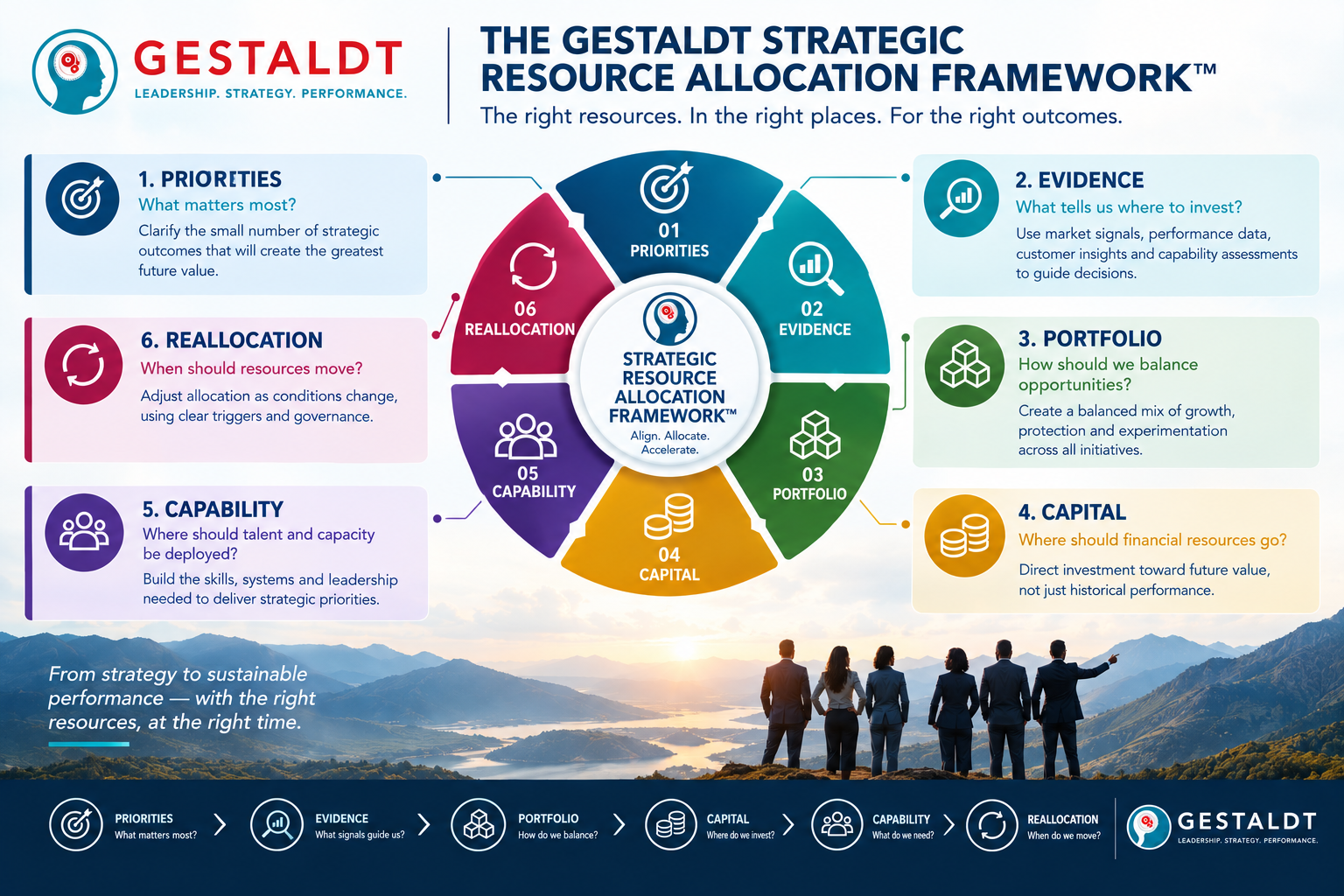
The Strategic Resource Allocation Test
Before your next annual planning cycle, rate each statement from 1 — strongly disagree to 5 — strongly agree.
Our budget clearly reflects our strategic priorities.
We can identify which investments are creating future strategic value.
Capital is not automatically allocated according to historical performance.
Critical talent is deliberately assigned to strategic priorities.
We regularly compare investments against one another.
We have clear criteria for stopping underperforming initiatives.
Strategic resources can be reallocated during the year.
Executive attention is concentrated on the most important opportunities.
Our investment decisions consider future capability requirements.
Leadership can explain what we are deliberately not funding.
Your score
40–50: Strategic allocation strength
Your organisation has a strong foundation for connecting resources to future value.
30–39: Allocation pressure
Resources may still be influenced by historical budgets, organisational politics or competing priorities.
Below 30: Strategic allocation risk
Your organisation may be pursuing a future strategy with yesterday's resource model.
The score is a starting point—not a substitute for a detailed portfolio and capability assessment.
What CEOs Should Do Next
The solution isn't to spend more.
It is to allocate better.
Start with five questions:
Where will our organisation create the most value over the next three to five years?
Are our current resources aligned with those opportunities?
Which legacy commitments are consuming resources without creating sufficient future value?
Which capabilities will we need before the market makes them urgent?
What would we stop funding if we had to free 10% of our resources for a new strategic opportunity?
That last question is particularly revealing.
Because strategy isn't only about deciding what to pursue.
It is deciding what deserves your organisation's scarce resources—and what no longer does.
Conclusion: Your Strategy Is Only as Real as the Resources Behind It
A strategy document can describe the future.
A budget reveals whether the organisation is actually preparing for it.
The strongest organisations don't simply allocate resources once a year. They build the ability to continuously direct capital, talent, technology and leadership attention toward the opportunities that matter most.
They protect what creates value today while deliberately investing in what will create value tomorrow.
They stop confusing historical success with future potential.
And they make reallocation a normal part of strategic management rather than an emergency response.
As Mohamed Kande puts it, the window to capture value is narrowing, and organisations that succeed will be those willing to invest with conviction in the capabilities that matter most.
Your next competitive advantage may not require more resources. It may require a better answer to one deceptively simple question:
Are we putting our best resources behind our most important future?
If the answer is uncertain, now is the time to find out.
Ready to Close Your Strategic Resource Allocation Gap?
Gestaldt Consulting Group helps CEOs and executive teams connect strategy, capital, talent, organisational capability and execution so strategic priorities translate into measurable performance.
Assess Your Strategic Resource Allocation
A confidential executive assessment can examine:
Strategic priorities
Capital allocation
Talent deployment
Initiative portfolios
Capability requirements
Leadership attention
Governance and decision rights
Reallocation mechanisms
Future growth opportunities