Transformation Fatigue Is Becoming a CEO Problem: How to Keep Change From Breaking Your Organisation

Your People May Not Be Resisting Change. They May Be Running Out of Capacity for It.
There is a point in every transformation when the language changes.
At the beginning, people talk about opportunity.
Then they talk about delivery.
Eventually, they start asking:
"What happens to the last transformation we launched?"
That's the moment leaders should pay attention.
A new strategy is announced.
Then a digital transformation.
Then an organisational redesign.
Then a cost programme.
Then an AI initiative.
Then another operating-model change.
Each initiative may make perfect sense individually.
The problem is what happens when they arrive simultaneously.
Employees don't experience transformation as a portfolio of strategically rational initiatives.
They experience it as:
another change.
And when change becomes continuous without sufficient capacity, clarity or visible progress, organisations can develop something far more dangerous than resistance:
transformation fatigue.
McKinsey reported in 2025 that employees were experiencing an average of around 10 planned change programmes a year, five times the level a decade earlier. Its research also found that people were increasingly exhausted and disconnected from leaders as the pace of change accelerated.
Deloitte's 2025 Chief Transformation Officer Study identified transformation fatigue as a top-five execution challenge, cited by 38% of respondents.
The message for CEOs is clear:
The challenge is no longer simply leading change. It is managing the organisation's capacity to absorb change.
Why Transformation Fatigue Is So Dangerous
Transformation fatigue rarely looks like open rebellion.
It is quieter than that.
People stop challenging ideas.
They attend workshops without enthusiasm.
They agree in meetings and revert to old behaviours afterwards.
Managers become overloaded.
Employees prioritise business-as-usual.
Transformation teams struggle to secure resources.
Initiatives technically continue—but momentum disappears.
Eventually, executives conclude:
"Our people are resistant to change."
That diagnosis can be dangerously wrong.
The organisation may not lack willingness.
It may lack capacity.
Research from Eagle Hill's 2025 change-management survey found that 63% of US employees had experienced workplace change during the previous year, while 34% said those changes had not been worth the organisational effort. Only 25% agreed their organisation managed change rollouts effectively.
This creates a critical distinction:
Change resistance asks, "Why won't people change?"
Transformation fatigue asks, "How much change can this organisation realistically absorb?"
That is a much more strategic question.
The Six Hidden Causes of Transformation Fatigue
1. Your Organisation Has More Change Than It Has Capacity
Here's the first problem.
Executives look at transformation from the portfolio level.
Employees experience it from the workload level.
The executive sees:
AI transformation
Cost optimisation
Customer experience
Operating-model redesign
The employee sees:
New systems
New processes
New reporting
New targets
New meetings
New responsibilities
The organisation may have enough money to fund all four initiatives.
But does it have enough leadership attention, employee bandwidth, skills and management capacity to execute them simultaneously?
Deloitte's research found that lack of resource bandwidth was the leading execution challenge, cited by 62% of respondents, followed by insufficient skills at 54%.
The CEO Question
How much organisational capacity are we consuming with our transformation portfolio?
Practical Tip
Create a change capacity map.
For every major initiative, estimate:
Executive time
Managerial time
Employee time
Required skills
Technology demands
Change-management requirements
Then compare the total demand with available capacity.
You may discover that your transformation strategy is mathematically impossible.
2. Everything Is a Priority—and Therefore Nothing Is
This is where transformation portfolios become dangerous.
One initiative is critical.
Another is strategic.
Another is urgent.
Another is mandatory.
Another is "too important to delay."
Eventually, employees cannot distinguish between what genuinely matters and what leadership simply wants to happen.
That creates priority dilution.
The result?
People spread their energy across too many initiatives and make insufficient progress on any of them.
PwC's 2025 CEO research found that 42% of CEOs identified resource constraints among the top three barriers to achieving corporate strategy.
The solution isn't working harder.
It is choosing.
Practical Tip
Ask your executive team:
"If we could successfully complete only three major changes this year, which three would create the greatest strategic value?"
Then stop calling everything else a priority.
3. Leaders Are Asking the Organisation to Change Without Changing How They Lead
This is one of the most overlooked causes of fatigue.
Leadership announces transformation.
But leadership behaviours remain unchanged.
Executives still make decisions slowly.
Managers remain measured against old targets.
Departments continue protecting their own priorities.
Meetings continue operating the same way.
Budgets continue reinforcing the old organisation.
Then leaders wonder why employees haven't changed.
The organisation has received a transformation message—but experienced business as usual.
Transformation requires leadership behaviour to change first.
Practical Tip
For every transformation, define five executive behaviours that must change.
For example:
Faster decisions
Greater cross-functional collaboration
More delegation
More transparent communication
Stronger accountability
Then measure leaders against them.
4. The Middle of the Organisation Is Carrying the Transformation
Here's the uncomfortable bit.
Transformation is often announced by executives and experienced most intensely by managers.
Managers translate strategy.
They answer employee questions.
They handle resistance.
They implement new processes.
They maintain performance.
They attend transformation meetings.
They manage competing priorities.
And they are expected to do all of this while delivering their existing responsibilities.
Deloitte's 2025 Human Capital Trends research found that while 73% of organisations recognise the importance of reinventing the manager role, only 7% said they were making great progress.
That gap matters.
If managers become exhausted, transformation slows down.
Practical Tip
Treat managers as a transformation capability, not merely a communication channel.
Give them:
Decision authority
Change-leadership skills
Clear priorities
Time
Resources
Executive access
Practical tools for managing uncertainty
5. Employees Cannot See What Is Changing—and Why
People can tolerate difficult change when they understand its purpose.
They struggle much more when change feels arbitrary.
Consider the difference between:
"We are implementing a new operating model."
and:
"Our current structure means customers move between five teams before receiving an answer. The new model will give one team end-to-end ownership."
The second explanation creates meaning.
The first creates another project.
Eagle Hill's 2025 research found that employees saw strong leadership and transparency as important ingredients in making workplace change work.
Practical Tip
Every transformation initiative should answer five questions:
Why are we changing?
What happens if we don't?
What will be different?
What will remain the same?
How will we know it worked?
If leaders cannot answer those questions clearly, employees will create their own answers.
6. Transformation Has Become a Collection of Projects Instead of a Change in How the Organisation Operates
This is perhaps the biggest issue of all.
A transformation office tracks projects.
Milestones are completed.
Systems go live.
Workstreams close.
Reports are produced.
But the organisation eventually returns to old habits.
Why?
Because transformation was treated as a programme rather than an organisational capability.
McKinsey's recent research makes a similar point: sustainable transformation depends on embedding new ways of working into everyday management rather than treating transformation as a finite collection of initiatives.
The real test is therefore not:
"Did we complete the transformation programme?"
It is:
"Does the organisation now operate differently?"
The Gestaldt Sustainable Transformation Framework™
At Gestaldt, we believe sustainable transformation rests on six interconnected pillars:
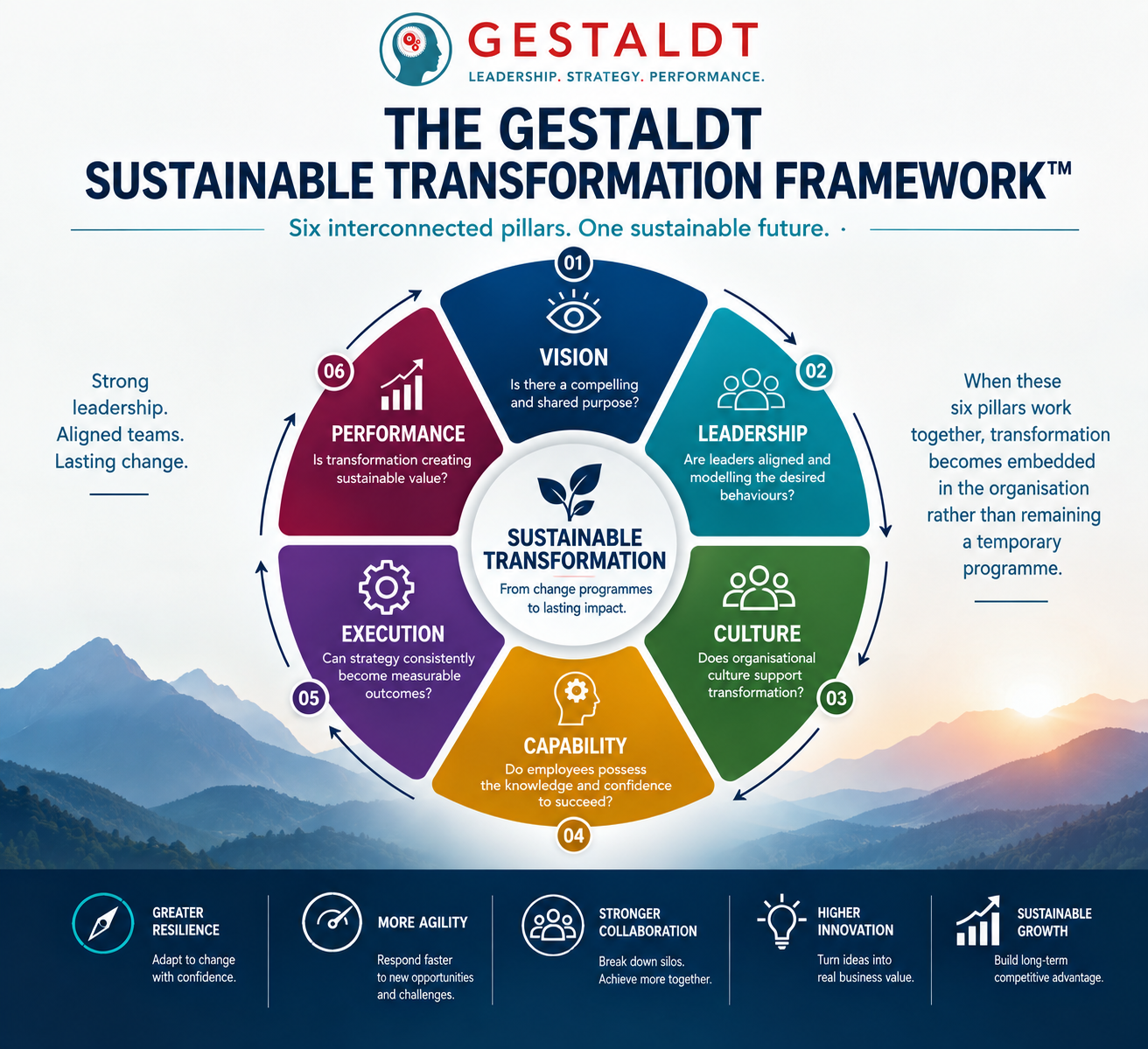
The Gestaldt Sustainable Transformation Framework™ connects Vision, Leadership, Culture, Capability, Execution, and Performance to help organisations turn change initiatives into lasting business value.
The Transformation Fatigue Test
Before launching another major initiative, ask your executive team to score the following from 1 to 5.
Strategic clarity
Our organisation understands why the change is necessary.
Priority
Employees know which transformation initiatives matter most.
Leadership
Executives consistently model the behaviours required by the transformation.
Capacity
Employees and managers have sufficient time and resources to absorb the change.
Capability
People have the skills required to operate successfully in the future state.
Communication
Employees understand what is changing, why and what it means for them.
Manager readiness
Managers are equipped to lead their teams through the change.
Governance
Decision rights and accountability are clear.
Measurement
Transformation progress is measured through business outcomes, not just project milestones.
Sustainability
New behaviours and processes are embedded into everyday management.
Interpreting the score
40–50 — Strong transformation capacity
Your organisation has a solid foundation for sustained change.
30–39 — Transformation risk
There are capability or capacity gaps that could slow execution.
Below 30 — High fatigue risk
Launching additional initiatives without addressing the underlying constraints could increase resistance, disengagement and execution failure.
The CEO's Transformation Paradox
CEOs are under pressure to transform faster.
Technology is accelerating.
Competition is changing.
Customer expectations are shifting.
AI is redefining work.
Economic conditions remain uncertain.
So leadership naturally responds:
"We need to move faster."
But there is a paradox.
Moving faster does not necessarily produce faster transformation.
If the organisation cannot absorb the change, acceleration can create:
More initiatives → more overload → less adoption → weaker execution → slower results.
The answer isn't always to slow down.
It is to become more selective, sequenced and disciplined about where change energy is invested.
Stop Measuring Transformation by Activity
A busy transformation can be a failing transformation.
Executives often measure:
Number of projects launched
Workshops completed
Employees trained
Systems implemented
Milestones achieved
Those are activity measures.
They don't necessarily demonstrate organisational change.
Instead, measure:
Decision speed
Adoption
Customer outcomes
Productivity
Revenue
Cost
Employee capability
Leadership behaviour
Process performance
Strategic outcomes
The question should always be:
"What is measurably different because of this transformation?"
Sequence Change Instead of Stacking Change
One of the most powerful things a CEO can do is create change sequencing.
Instead of:
AI + restructuring + ERP + cost reduction + culture transformation + new strategy
all at once—
ask:
What has to happen first?
Perhaps leadership alignment comes first.
Then operating-model redesign.
Then technology.
Then capability building.
Then performance optimisation.
The sequence will vary by organisation.
But sequencing matters because one change can create the conditions required for another.
Practical Tip
Build a 12–18 month transformation dependency map.
Identify which initiatives:
Enable others
Compete for resources
Depend on capabilities not yet available
Can be combined
Should be stopped
This turns transformation from a collection of projects into an integrated system.
The Most Important Transformation Is Often the One You Stop
Executives are generally rewarded for launching initiatives.
Stopping them requires a different kind of leadership.
A mature transformation portfolio should contain three categories:
Accelerate
High-value initiatives with strong organisational support.
Redesign
Important initiatives where capacity, capability or sequencing is weak.
Stop
Initiatives that consume significant organisational energy without sufficient strategic value.
Stopping the wrong work can create more transformation capacity than adding more resources.
From Change Fatigue to Change Capability
The objective shouldn't be to eliminate change.
That is impossible.
The objective is to build an organisation that becomes better at changing.
That requires:
Leadership that creates clarity.
Culture that supports experimentation.
Managers who can translate strategy into action.
Employees who have the capability and confidence to adapt.
Governance that removes unnecessary friction.
Execution systems that reinforce new behaviours.
Performance measures that reward the future rather than the past.
That is the difference between an organisation that merely survives transformation and one that develops a genuine transformation capability.
Five Questions Every CEO Should Ask Before Launching Another Transformation
1. What are we already asking the organisation to change?
You cannot manage capacity if you don't know the total change load.
2. What should we stop?
Transformation requires trade-offs.
3. Do managers have the capacity to lead this?
If not, the initiative is already at risk.
4. What behaviour must change at executive level?
Transformation cannot be delegated entirely downward.
5. What will be measurably different 12 months from now?
If you cannot answer this, the transformation may be too vague.
The Future Belongs to Organisations That Can Change Without Breaking
Transformation is not going away.
If anything, the pace will increase.
McKinsey's research argues that the traditional change-management toolkit needs to evolve as organisations face multiple transformations simultaneously.
Deloitte similarly describes transformation as increasingly becoming an always-on organisational capability, rather than an occasional programme.
That changes the CEO's responsibility.
The question is no longer:
"How do we successfully complete this transformation?"
It is:
"How do we build an organisation capable of continuously transforming?"
That is a much bigger leadership challenge.
And a much greater source of competitive advantage.
Is Your Organisation Experiencing Transformation Fatigue?
If your organisation is dealing with:
Too many competing initiatives
Exhausted managers
Declining enthusiasm for change
Repeated transformation programmes
Slow adoption
Change resistance
Weak executive sponsorship
Poor cross-functional execution
Capability gaps
Transformation initiatives that never seem to finish
the answer may not be another change programme.
It may be time to redesign how your organisation transforms.
Request a Gestaldt Sustainable Transformation Assessment
Gestaldt can help your executive team assess:
Transformation capacity
Executive alignment
Change portfolio
Leadership capability
Organisational culture
Manager readiness
Strategic priorities
Governance
Execution capability
Performance measurement
The objective isn't to make your organisation change faster.
It is to help your organisation change better—and make the change stick.