The Cost of Strategic Drift: How CEOs Lose Competitive Advantage Without Realising It

Your Strategy May Not Be Wrong. It May Simply Be Falling Behind.
A company can be profitable, growing and operationally busy—and still be moving in the wrong direction.
That is the danger of strategic drift.
Think of it like steering a ship through changing currents. The captain may keep the wheel pointed in the same direction, but if the current shifts, the vessel gradually moves off course. Nothing dramatic happens at first. There is no obvious crisis.
Then, one day, the destination is no longer where the organisation is heading.
For CEOs, this is one of the most dangerous strategic blind spots because drift rarely announces itself.
Customers change gradually.
Competitors reposition quietly.
Technology alters expectations incrementally.
New business models emerge at the edges.
Capabilities become outdated one decision at a time.
Meanwhile, the organisation continues executing yesterday's assumptions exceptionally well.
And that is precisely the problem.
Research from PwC's 2026 Global CEO Survey found that 42% of CEOs say their companies have started competing in new sectors over the past five years, while companies generating more revenue from new sectors report stronger profitability and growth confidence. PwC also found that more cautious companies are growing more slowly and reporting lower profit margins.
The question is no longer simply:
"Is our strategy working?"
The more important question is:
"Is our strategy still relevant to the environment we are operating in?"
In this article, we explore how strategic drift develops, why successful organisations are particularly vulnerable to it, and how CEOs can build a system that detects and corrects drift before it becomes a performance crisis.
1. The Most Dangerous Strategy Is the One That Still Looks Successful
Here's the uncomfortable truth: past success can make strategic drift harder to see.
When a strategy has delivered strong results for several years, leadership teams naturally develop confidence in it.
Revenue is growing.
Margins are healthy.
Customers remain loyal.
Employees understand the operating model.
Investors are satisfied.
So why change?
Because yesterday's success is evidence of what worked yesterday.
It is not proof that the same assumptions will create tomorrow's advantage.
Strategic drift occurs when the organisation's strategy gradually becomes disconnected from changes in its external environment.
The danger is that conventional performance metrics are often lagging indicators.
Revenue may still be strong while:
customer preferences are changing;
competitors are entering adjacent markets;
technology is altering cost structures;
new business models are emerging;
talent expectations are shifting;
regulation is changing;
margins are beginning to come under pressure.
By the time financial performance visibly deteriorates, the underlying strategic drift may have been developing for years.
PwC's research illustrates the scale of this challenge: 42% of CEOs surveyed in 2025 believed their companies would not remain viable for more than ten years if they continued on their current path.
Practical tip
At every quarterly executive meeting, ask:
"What has changed outside our organisation that could make our current strategy less effective?"
Do not ask only what is going well.
Ask what is becoming different.
2. Success Can Become Your Biggest Strategic Blind Spot
The organisations most vulnerable to strategic drift are often the ones that have been successful for a long time.
Why?
Because success creates assumptions.
A company may assume:
customers will continue buying in the same way;
competitors will remain positioned where they are;
its existing capabilities will remain valuable;
its current business model will continue producing attractive margins;
its market boundaries will remain stable.
These assumptions become embedded in budgets, structures, incentives and leadership thinking.
Eventually, the strategy becomes less of a conscious choice and more of an organisational habit.
This is particularly dangerous when the external environment changes faster than the organisation's ability to rethink itself.
PwC's 2026 CEO research describes a business environment shaped by AI, geopolitics, economic uncertainty and changing industry boundaries. More than four in ten CEOs say their organisations have already begun competing in new sectors.
The implication is significant:
Competitive advantage is increasingly determined by how quickly organisations can recognise when the basis of competition is changing.
Practical tip
Create a Strategic Assumption Register.
List the five to ten assumptions your current strategy depends on.
For each one, ask:
Is this assumption still true?
What evidence supports it?
What evidence challenges it?
What would happen if it became false?
That simple exercise can expose strategic risk long before the financial statements do.
3. Strategic Drift Starts at the Edges—Not in the Boardroom
By the time something becomes obvious to the CEO, it may already be obvious to the customer.
Strategic drift is rarely detected through annual strategic planning alone.
The signals often appear much earlier in places such as:
customer complaints;
changing buying behaviour;
emerging competitors;
declining conversion rates;
unusual employee turnover;
new technologies;
changing supplier economics;
declining customer loyalty;
unexpected moves from adjacent industries.
The challenge is that these signals often sit in different parts of the organisation.
Marketing sees one trend.
Operations sees another.
Technology sees something else.
Sales hears changing customer demands.
Finance notices margin pressure.
No one connects the dots.
This is why strategic leadership increasingly requires systems thinking rather than isolated departmental analysis.
PwC explicitly recommends that CEOs develop a systems-level view of changing customer needs and competitive environments rather than relying on isolated signals.
Practical tip
Establish a quarterly Strategic Signal Review.
Ask every executive:
"What are you seeing that could materially change our business within the next three years?"
Then look for patterns across functions.
The objective isn't to predict the future perfectly.
It is to notice meaningful signals early enough to respond.
4. When Everything Is a Priority, Strategic Drift Accelerates
This is where many organisations quietly lose their strategic edge.
Leadership teams recognise that the world is changing, so they respond by adding initiatives.
AI transformation.
Digital transformation.
Customer experience.
New markets.
Operational efficiency.
Talent development.
Innovation.
Sustainability.
Cost optimisation.
The organisation becomes extremely busy responding to change—but surprisingly unclear about what matters most.
This creates a paradox:
The organisation becomes more active while becoming less strategic.
Resources are spread across too many priorities. Executive attention becomes fragmented. Employees struggle to distinguish critical initiatives from merely important ones.
PwC's research found that one of the barriers to reinvention is limited resource reallocation. Around half of CEOs reported moving 10% or less of financial and human resources between projects or business units from one year to the next.
In other words, organisations may say they are reinventing while continuing to allocate most of their resources according to the old strategy.
That's not reinvention.
That's strategic drift with a larger project portfolio.
Practical tip
For every major strategic initiative, ask:
"If this becomes a top priority, what are we willing to stop funding?"
If the answer is "nothing," you probably don't have prioritisation.
You have accumulation.
5. Build a Strategic Drift Early-Warning System
You don't need perfect foresight. You need earlier visibility.
At Gestaldt, we recommend thinking about strategic drift through six connected dimensions.
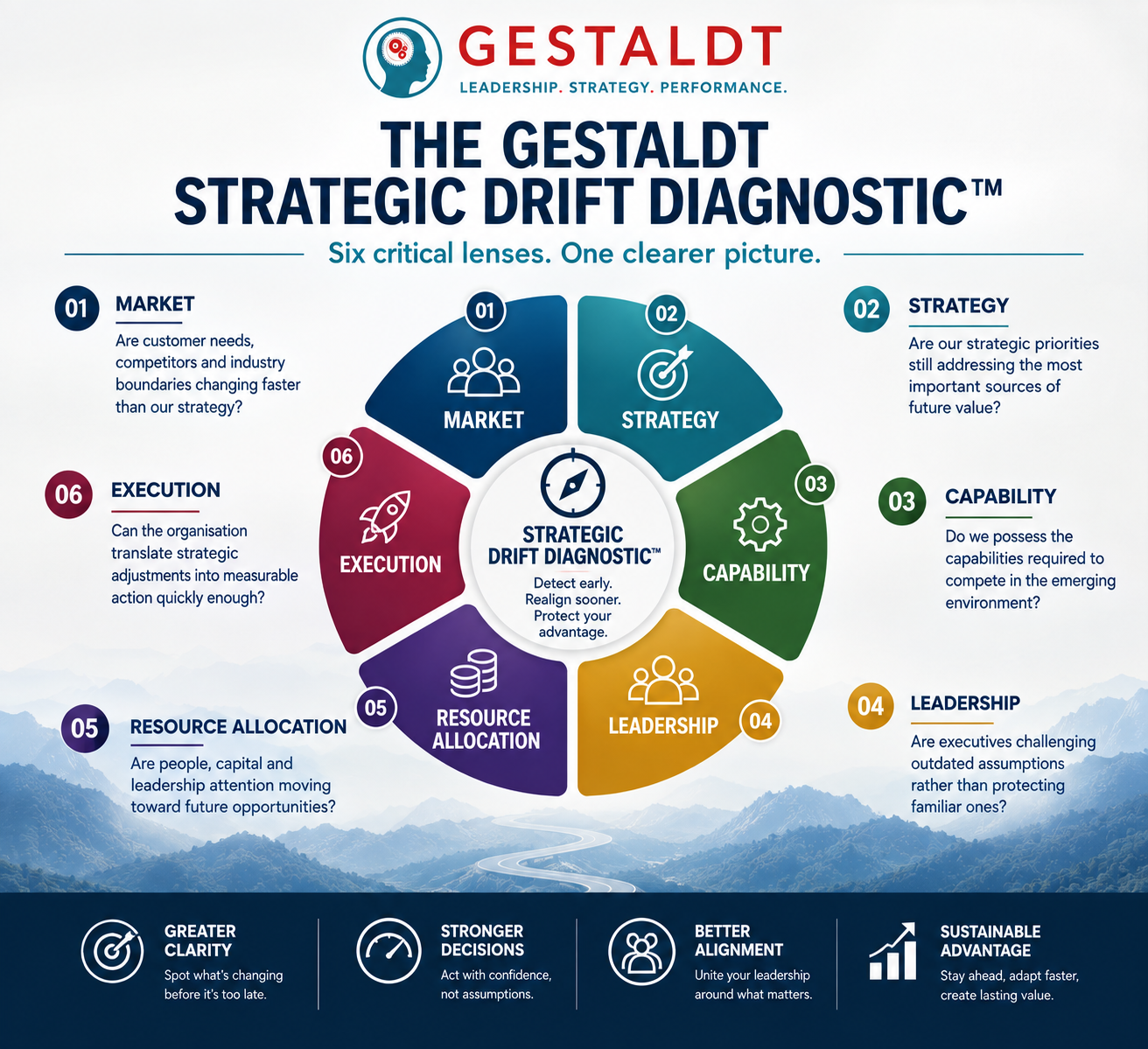
The Gestaldt Strategic Drift Diagnostic™ is a six-part executive framework designed to help organisations identify early signs of strategic drift. The infographic places six critical lenses—Market, Strategy, Capability, Leadership, Resource Allocation, and Execution—around a central diagnostic model. Each pillar poses a key question to help leaders assess whether the organisation is keeping pace with changing markets, capabilities, priorities, leadership assumptions, resources, and execution requirements. The framework highlights four intended outcomes: greater clarity, stronger decisions, better alignment, and sustainable competitive advantage.
These dimensions matter because strategic drift is rarely caused by strategy alone.
A strategy may be directionally correct but undermined by outdated capabilities.
Or leadership may recognise the need for change but fail to reallocate resources.
Or the organisation may identify a new opportunity but lack the execution capability to pursue it.
Strategic resilience comes from connecting all six.
Practical tip
Score each dimension from 1 to 5.
24–30: Strategic position appears resilient
18–23: Emerging strategic drift
Below 18: Significant strategic realignment may be required
The score is not a substitute for executive judgement. It is a conversation starter.
6. The CEO's Job Is Not to Predict the Future—It's to Keep the Organisation Adaptable
The strongest CEOs aren't necessarily those who predict disruption correctly. They're the ones who build organisations capable of responding when assumptions change.
This distinction matters.
Nobody knows exactly how AI, geopolitics, regulation, customer behaviour or economic conditions will evolve.
Trying to predict everything creates false confidence.
Building strategic adaptability creates resilience.
That means leadership teams need mechanisms for:
challenging strategic assumptions;
reallocating resources;
testing new opportunities;
developing future capabilities;
accelerating decisions;
stopping initiatives that no longer create value;
connecting external intelligence to executive decision-making.
Mohamed Kande, PwC Global Chairman, captured the challenge well:
“Business leaders around the world ... know they must re-invent how they create, deliver and capture value.”
That is the heart of the issue.
Strategic leadership is no longer about creating a five-year plan and defending it.
It is about creating enough direction to move decisively—and enough adaptability to change course when the evidence demands it.
Practical tip
Introduce a Quarterly Strategic Reset.
Do not rewrite the entire strategy.
Instead, review:
Keep: What remains strategically sound?
Change: What assumptions need updating?
Stop: What no longer creates sufficient value?
Start: What emerging opportunity deserves investment?
This creates strategic discipline without turning the organisation into a permanent planning exercise.
The CEO Strategic Drift Test
Before your next executive strategy session, ask your leadership team these ten questions:
Can we clearly explain what has changed in our competitive environment over the last 12 months?
Which assumptions underpin our current strategy?
Which of those assumptions are becoming weaker?
Are customer expectations changing faster than our organisation?
Are competitors entering spaces we previously considered outside our market?
Are we reallocating resources toward future opportunities?
Which capabilities will become strategically important over the next three years?
Which current initiatives should we stop?
How quickly can our executive team change strategic priorities when evidence changes?
If we continued executing our current strategy for another five years, what could make it fail?
The final question is the one most leadership teams avoid.
It is also one of the most valuable.
From Strategic Drift to Strategic Agility
Strategic drift does not mean an organisation has failed.
It means the environment has moved.
The real leadership failure is refusing to notice.
Organisations that remain competitive over time build mechanisms that allow them to continuously sense, challenge, decide and adapt.
This is where strategic alignment, organisational capability and execution become inseparable.
Your strategy must evolve.
Your leadership must evolve with it.
Your capabilities must evolve behind it.
And your organisation must be able to execute the new direction before the opportunity disappears.
For organisations already working on strategy execution, this connects directly with Gestaldt's existing thinking on From Strategy to Execution: Closing the Gap in Organisations and Organisational Design for Growth.
A Final Question for the C-Suite
Your organisation doesn't need to abandon everything that made it successful.
But it does need to distinguish between what should be protected and what must evolve.
That is the leadership challenge.
Strategic drift happens quietly.
Competitive advantage can disappear gradually.
And by the time the numbers make the problem obvious, the organisation may already be playing catch-up.
The best time to challenge strategic assumptions is not when performance collapses.
It is while performance is still strong enough to give you choices.
The future belongs to organisations that can recognise change early, make courageous choices and turn those choices into coordinated action.
Don't wait for strategic drift to become a crisis. Detect it while you still have time to act.
Ready to Test Your Organisation for Strategic Drift?
Gestaldt can help your executive team assess whether your current strategy, capabilities, leadership, resource allocation and execution model remain aligned with the environment ahead.
Request a Gestaldt Strategic Drift Diagnostic™
A confidential executive assessment can examine:
Strategic assumptions
Market and competitive shifts
Executive alignment
Resource allocation
Organisational capability
Strategic decision-making
Execution readiness
Future growth opportunities