

The Cost of Strategic Drift: How CEOs Lose Competitive Advantage Without Realising It
Strategic drift can quietly erode competitive advantage while business performance still looks healthy. Learn how CEOs can detect drift early and realign strategy before growth stalls.

Your Strategy May Not Be Wrong. It May Simply Be Falling Behind.
A company can be profitable, growing and operationally busy—and still be moving in the wrong direction.
That is the danger of strategic drift.
Think of it like steering a ship through changing currents. The captain may keep the wheel pointed in the same direction, but if the current shifts, the vessel gradually moves off course. Nothing dramatic happens at first. There is no obvious crisis.
Then, one day, the destination is no longer where the organisation is heading.
For CEOs, this is one of the most dangerous strategic blind spots because drift rarely announces itself.
Customers change gradually.
Competitors reposition quietly.
Technology alters expectations incrementally.
New business models emerge at the edges.
Capabilities become outdated one decision at a time.
Meanwhile, the organisation continues executing yesterday's assumptions exceptionally well.
And that is precisely the problem.
Research from PwC's 2026 Global CEO Survey found that 42% of CEOs say their companies have started competing in new sectors over the past five years, while companies generating more revenue from new sectors report stronger profitability and growth confidence. PwC also found that more cautious companies are growing more slowly and reporting lower profit margins.
The question is no longer simply:
"Is our strategy working?"
The more important question is:
"Is our strategy still relevant to the environment we are operating in?"
In this article, we explore how strategic drift develops, why successful organisations are particularly vulnerable to it, and how CEOs can build a system that detects and corrects drift before it becomes a performance crisis.
1. The Most Dangerous Strategy Is the One That Still Looks Successful
Here's the uncomfortable truth: past success can make strategic drift harder to see.
When a strategy has delivered strong results for several years, leadership teams naturally develop confidence in it.
Revenue is growing.
Margins are healthy.
Customers remain loyal.
Employees understand the operating model.
Investors are satisfied.
So why change?
Because yesterday's success is evidence of what worked yesterday.
It is not proof that the same assumptions will create tomorrow's advantage.
Strategic drift occurs when the organisation's strategy gradually becomes disconnected from changes in its external environment.
The danger is that conventional performance metrics are often lagging indicators.
Revenue may still be strong while:
customer preferences are changing;
competitors are entering adjacent markets;
technology is altering cost structures;
new business models are emerging;
talent expectations are shifting;
regulation is changing;
margins are beginning to come under pressure.
By the time financial performance visibly deteriorates, the underlying strategic drift may have been developing for years.
PwC's research illustrates the scale of this challenge: 42% of CEOs surveyed in 2025 believed their companies would not remain viable for more than ten years if they continued on their current path.
Practical tip
At every quarterly executive meeting, ask:
"What has changed outside our organisation that could make our current strategy less effective?"
Do not ask only what is going well.
Ask what is becoming different.
2. Success Can Become Your Biggest Strategic Blind Spot
The organisations most vulnerable to strategic drift are often the ones that have been successful for a long time.
Why?
Because success creates assumptions.
A company may assume:
customers will continue buying in the same way;
competitors will remain positioned where they are;
its existing capabilities will remain valuable;
its current business model will continue producing attractive margins;
its market boundaries will remain stable.
These assumptions become embedded in budgets, structures, incentives and leadership thinking.
Eventually, the strategy becomes less of a conscious choice and more of an organisational habit.
This is particularly dangerous when the external environment changes faster than the organisation's ability to rethink itself.
PwC's 2026 CEO research describes a business environment shaped by AI, geopolitics, economic uncertainty and changing industry boundaries. More than four in ten CEOs say their organisations have already begun competing in new sectors.
The implication is significant:
Competitive advantage is increasingly determined by how quickly organisations can recognise when the basis of competition is changing.
Practical tip
Create a Strategic Assumption Register.
List the five to ten assumptions your current strategy depends on.
For each one, ask:
Is this assumption still true?
What evidence supports it?
What evidence challenges it?
What would happen if it became false?
That simple exercise can expose strategic risk long before the financial statements do.
3. Strategic Drift Starts at the Edges—Not in the Boardroom
By the time something becomes obvious to the CEO, it may already be obvious to the customer.
Strategic drift is rarely detected through annual strategic planning alone.
The signals often appear much earlier in places such as:
customer complaints;
changing buying behaviour;
emerging competitors;
declining conversion rates;
unusual employee turnover;
new technologies;
changing supplier economics;
declining customer loyalty;
unexpected moves from adjacent industries.
The challenge is that these signals often sit in different parts of the organisation.
Marketing sees one trend.
Operations sees another.
Technology sees something else.
Sales hears changing customer demands.
Finance notices margin pressure.
No one connects the dots.
This is why strategic leadership increasingly requires systems thinking rather than isolated departmental analysis.
PwC explicitly recommends that CEOs develop a systems-level view of changing customer needs and competitive environments rather than relying on isolated signals.
Practical tip
Establish a quarterly Strategic Signal Review.
Ask every executive:
"What are you seeing that could materially change our business within the next three years?"
Then look for patterns across functions.
The objective isn't to predict the future perfectly.
It is to notice meaningful signals early enough to respond.
4. When Everything Is a Priority, Strategic Drift Accelerates
This is where many organisations quietly lose their strategic edge.
Leadership teams recognise that the world is changing, so they respond by adding initiatives.
AI transformation.
Digital transformation.
Customer experience.
New markets.
Operational efficiency.
Talent development.
Innovation.
Sustainability.
Cost optimisation.
The organisation becomes extremely busy responding to change—but surprisingly unclear about what matters most.
This creates a paradox:
The organisation becomes more active while becoming less strategic.
Resources are spread across too many priorities. Executive attention becomes fragmented. Employees struggle to distinguish critical initiatives from merely important ones.
PwC's research found that one of the barriers to reinvention is limited resource reallocation. Around half of CEOs reported moving 10% or less of financial and human resources between projects or business units from one year to the next.
In other words, organisations may say they are reinventing while continuing to allocate most of their resources according to the old strategy.
That's not reinvention.
That's strategic drift with a larger project portfolio.
Practical tip
For every major strategic initiative, ask:
"If this becomes a top priority, what are we willing to stop funding?"
If the answer is "nothing," you probably don't have prioritisation.
You have accumulation.
5. Build a Strategic Drift Early-Warning System
You don't need perfect foresight. You need earlier visibility.
At Gestaldt, we recommend thinking about strategic drift through six connected dimensions.
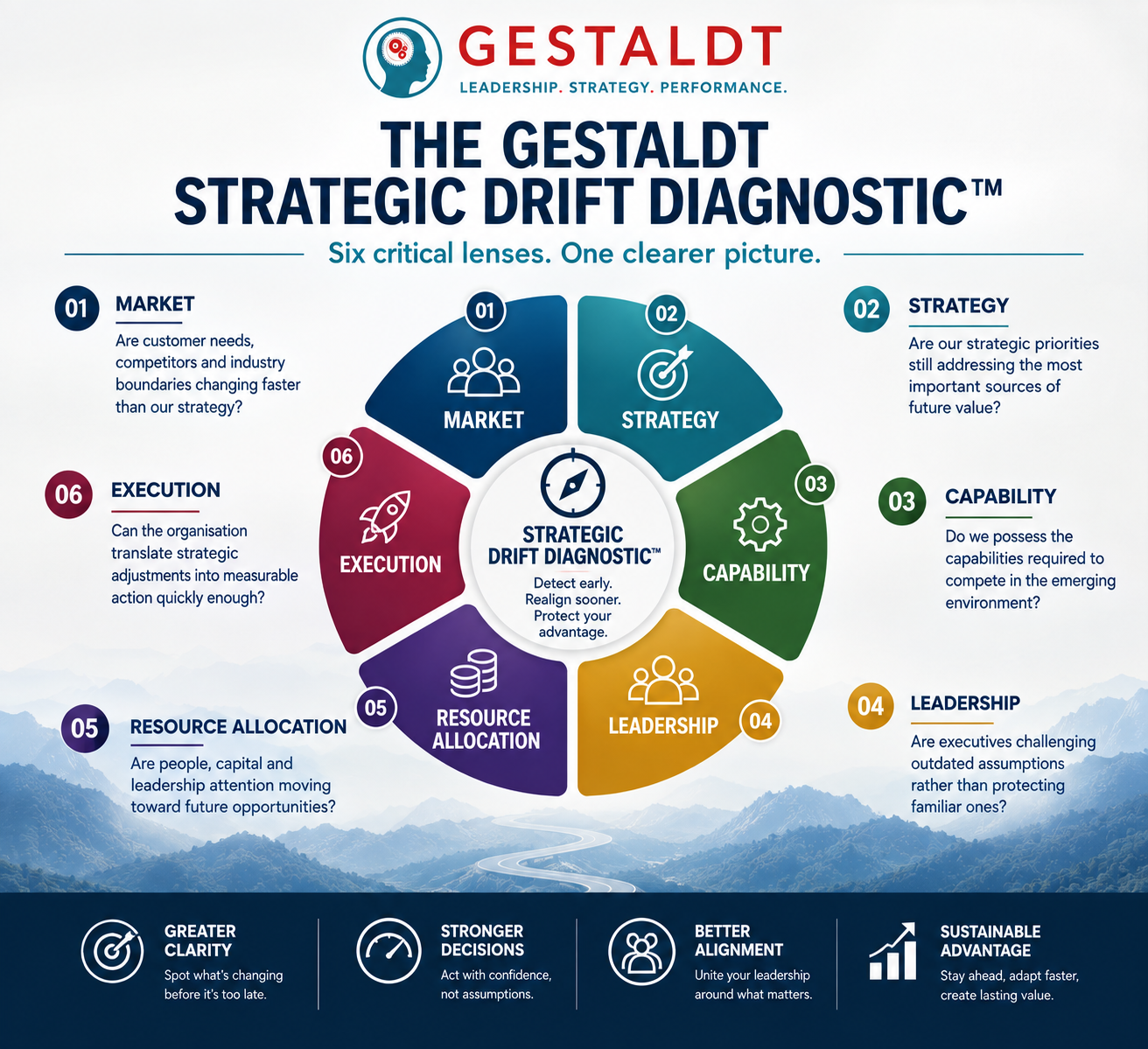
The Gestaldt Strategic Drift Diagnostic™ is a six-part executive framework designed to help organisations identify early signs of strategic drift. The infographic places six critical lenses—Market, Strategy, Capability, Leadership, Resource Allocation, and Execution—around a central diagnostic model. Each pillar poses a key question to help leaders assess whether the organisation is keeping pace with changing markets, capabilities, priorities, leadership assumptions, resources, and execution requirements. The framework highlights four intended outcomes: greater clarity, stronger decisions, better alignment, and sustainable competitive advantage.
These dimensions matter because strategic drift is rarely caused by strategy alone.
A strategy may be directionally correct but undermined by outdated capabilities.
Or leadership may recognise the need for change but fail to reallocate resources.
Or the organisation may identify a new opportunity but lack the execution capability to pursue it.
Strategic resilience comes from connecting all six.
Practical tip
Score each dimension from 1 to 5.
24–30: Strategic position appears resilient
18–23: Emerging strategic drift
Below 18: Significant strategic realignment may be required
The score is not a substitute for executive judgement. It is a conversation starter.
6. The CEO's Job Is Not to Predict the Future—It's to Keep the Organisation Adaptable
The strongest CEOs aren't necessarily those who predict disruption correctly. They're the ones who build organisations capable of responding when assumptions change.
This distinction matters.
Nobody knows exactly how AI, geopolitics, regulation, customer behaviour or economic conditions will evolve.
Trying to predict everything creates false confidence.
Building strategic adaptability creates resilience.
That means leadership teams need mechanisms for:
challenging strategic assumptions;
reallocating resources;
testing new opportunities;
developing future capabilities;
accelerating decisions;
stopping initiatives that no longer create value;
connecting external intelligence to executive decision-making.
Mohamed Kande, PwC Global Chairman, captured the challenge well:
“Business leaders around the world ... know they must re-invent how they create, deliver and capture value.”
That is the heart of the issue.
Strategic leadership is no longer about creating a five-year plan and defending it.
It is about creating enough direction to move decisively—and enough adaptability to change course when the evidence demands it.
Practical tip
Introduce a Quarterly Strategic Reset.
Do not rewrite the entire strategy.
Instead, review:
Keep: What remains strategically sound?
Change: What assumptions need updating?
Stop: What no longer creates sufficient value?
Start: What emerging opportunity deserves investment?
This creates strategic discipline without turning the organisation into a permanent planning exercise.
The CEO Strategic Drift Test
Before your next executive strategy session, ask your leadership team these ten questions:
Can we clearly explain what has changed in our competitive environment over the last 12 months?
Which assumptions underpin our current strategy?
Which of those assumptions are becoming weaker?
Are customer expectations changing faster than our organisation?
Are competitors entering spaces we previously considered outside our market?
Are we reallocating resources toward future opportunities?
Which capabilities will become strategically important over the next three years?
Which current initiatives should we stop?
How quickly can our executive team change strategic priorities when evidence changes?
If we continued executing our current strategy for another five years, what could make it fail?
The final question is the one most leadership teams avoid.
It is also one of the most valuable.
From Strategic Drift to Strategic Agility
Strategic drift does not mean an organisation has failed.
It means the environment has moved.
The real leadership failure is refusing to notice.
Organisations that remain competitive over time build mechanisms that allow them to continuously sense, challenge, decide and adapt.
This is where strategic alignment, organisational capability and execution become inseparable.
Your strategy must evolve.
Your leadership must evolve with it.
Your capabilities must evolve behind it.
And your organisation must be able to execute the new direction before the opportunity disappears.
For organisations already working on strategy execution, this connects directly with Gestaldt's existing thinking on From Strategy to Execution: Closing the Gap in Organisations and Organisational Design for Growth.
A Final Question for the C-Suite
Your organisation doesn't need to abandon everything that made it successful.
But it does need to distinguish between what should be protected and what must evolve.
That is the leadership challenge.
Strategic drift happens quietly.
Competitive advantage can disappear gradually.
And by the time the numbers make the problem obvious, the organisation may already be playing catch-up.
The best time to challenge strategic assumptions is not when performance collapses.
It is while performance is still strong enough to give you choices.
The future belongs to organisations that can recognise change early, make courageous choices and turn those choices into coordinated action.
Don't wait for strategic drift to become a crisis. Detect it while you still have time to act.
Ready to Test Your Organisation for Strategic Drift?
Gestaldt can help your executive team assess whether your current strategy, capabilities, leadership, resource allocation and execution model remain aligned with the environment ahead.
Request a Gestaldt Strategic Drift Diagnostic™
A confidential executive assessment can examine:
Strategic assumptions
Market and competitive shifts
Executive alignment
Resource allocation
Organisational capability
Strategic decision-making
Execution readiness
Future growth opportunities
Assess Your Strategic Resilience

The Role of Purpose in Enterprise: How Meaning Creates Competitive Advantage
Discover how purpose-driven organisations create competitive advantage through stronger culture, greater innovation, enhanced customer loyalty, and sustainable business growth.

Why do some companies inspire fierce customer loyalty, attract top talent effortlessly, and outperform competitors over the long term? The answer often has less to do with products and profits—and more to do with purpose.
Imagine an organisation as a ship navigating unpredictable waters. Strategy determines the route, operations keep the vessel moving, and technology powers the engine. But purpose? Purpose is the compass. It provides direction when conditions change, guides decision-making during uncertainty, and keeps everyone moving toward a shared destination.
In an era defined by rapid technological disruption, evolving consumer expectations, and increasing demands for corporate accountability, purpose has become more than a mission statement hanging on a boardroom wall. It has become a strategic asset.
This article explores how purpose-driven organisations create competitive advantage, strengthen culture, enhance innovation, attract talent, and build long-term resilience in a constantly changing business environment.
1. Purpose Is No Longer a Corporate Luxury—It's a Strategic Necessity
Customers can copy your products. Competitors can replicate your pricing. But purpose is far harder to duplicate.
For decades, businesses focused primarily on profitability as their defining objective. While profit remains essential, modern stakeholders increasingly expect organisations to contribute positively to society while generating financial returns.
Purpose provides a clear answer to a fundamental question:
Why does the organisation exist beyond making money?
When employees, customers, investors, and communities understand and believe in that answer, businesses gain a powerful differentiator.
Research from Deloitte has consistently shown that purpose-driven organisations tend to achieve higher levels of growth, innovation, and employee engagement than their peers.
As leadership expert Simon Sinek famously said:
"People don't buy what you do; they buy why you do it."
Purpose creates emotional connections that transactional relationships cannot.
Practical Tip:
Review your organisation's mission statement. If it focuses only on products, services, or profits, consider redefining it around the value you create for people and society.
2. Purpose Attracts and Retains Top Talent
The best employees aren't just looking for a pay cheque—they're looking for a reason to care.
Workplace expectations have evolved dramatically. Today's professionals increasingly seek employers whose values align with their own.
Purpose-driven organisations often experience:
Higher employee engagement
Lower turnover
Greater job satisfaction
Stronger employer branding
Improved workforce loyalty
Younger generations entering the workforce particularly prioritise meaningful work and social impact when evaluating employers.
When employees understand how their contributions support a larger mission, motivation becomes intrinsic rather than purely financial.
As management thinker Peter Drucker observed:
"Culture eats strategy for breakfast."
Purpose fuels culture by giving employees a shared sense of significance.
Practical Tip:
Help employees connect their daily responsibilities to broader organisational goals through regular communication and recognition programs.
Related Reading:
/continuous-learning-organisations – Building a Culture of Lifelong Development
3. Purpose Drives Innovation Through Shared Vision
Innovation thrives when people are united by a cause bigger than themselves.
Many organisations mistakenly view innovation solely as a technology issue. In reality, innovation often begins with clarity of purpose.
Purpose acts as a decision-making filter:
Which opportunities should we pursue?
Which problems should we solve?
Which customers should we serve?
Which innovations align with our mission?
When teams share a common purpose, collaboration improves and creativity becomes more focused.
Harvard Business Review research has repeatedly highlighted that organisations with strong cultures and clearly defined missions are more likely to foster innovation.
As former Apple CEO Steve Jobs stated:
"The people who are crazy enough to think they can change the world are the ones who do."
Purpose inspires ambitious thinking.
Practical Tip:
Evaluate innovation projects against your organisation's core purpose to ensure strategic alignment.
Related Reading:
/innovation-in-business – Innovation Strategies for Sustainable Growth
4. Purpose Strengthens Customer Loyalty and Brand Trust
Customers increasingly buy from brands that reflect their beliefs—not just their budgets.
Consumer behaviour is changing. People are becoming more conscious about where they spend their money and which brands they support.
Purpose-driven organisations often benefit from:
Stronger customer relationships
Increased brand advocacy
Higher customer retention
Enhanced reputation
Greater resilience during crises
Trust is becoming one of the world's most valuable business assets.
A meaningful purpose helps build that trust by demonstrating authenticity and commitment beyond short-term profits.
As Richard Branson explains:
"Doing good is good for business."
Customers reward businesses that consistently demonstrate values they believe in.
Practical Tip:
Ensure your purpose is reflected in customer experience, marketing, and operational decisions—not just corporate communications.

5. Purpose Creates Resilience During Economic Uncertainty
When markets become volatile, purpose helps organisations stay grounded.
Economic downturns, geopolitical tensions, supply chain disruptions, and technological shifts create uncertainty for businesses worldwide.
Purpose-driven organisations often navigate these challenges more effectively because they have a clear framework for decision-making.
Purpose provides:
Strategic consistency
Organisational alignment
Long-term focus
Stronger stakeholder support
Improved adaptability
During difficult periods, employees and customers are more likely to remain committed to organisations they believe in.
Research suggests that companies with strong stakeholder relationships frequently recover faster from crises than those focused solely on short-term financial outcomes.
Practical Tip:
Use your organisational purpose as a guiding principle when making difficult strategic decisions during uncertain times.
Related Reading:
/supply-chain-resilience – Building Resilient Systems in Uncertain Times
6. Purpose and Profit Are Partners, Not Opponents
One of the biggest myths in business is that organisations must choose between doing good and doing well.
The most successful enterprises understand that purpose and profitability can reinforce one another.
Purpose can create value by:
Attracting customers
Improving employee retention
Enhancing innovation
Strengthening reputation
Reducing operational risks
Building investor confidence
The rise of ESG investing, impact investment, and stakeholder capitalism demonstrates growing recognition that long-term value creation extends beyond quarterly earnings.
As investor Larry Fink has noted:
"Purpose is not the sole pursuit of profits but the animating force for achieving them."
Purpose helps organisations create sustainable success rather than temporary gains.
Practical Tip:
Incorporate both financial and purpose-driven metrics into strategic planning and performance reviews.
Related Reading:
/impact-investment-africa – Aligning Purpose, Profit, and Social Value in African Contexts
7. Embedding Purpose Into Organisational Culture
Purpose only becomes powerful when it moves from words on paper to actions in practice.
Many organisations define a purpose but struggle to bring it to life.
Purpose becomes meaningful when it influences:
Leadership behaviour
Recruitment decisions
Performance management
Customer interactions
Product development
Strategic investments
Leaders play a crucial role in demonstrating purpose through consistent actions.
Employees quickly recognise the difference between authentic commitment and corporate rhetoric.
As Brené Brown explains:
"Integrity is choosing courage over comfort."
Purpose requires organisations to consistently align actions with values.
Practical Tip:
Embed purpose into leadership development, onboarding processes, and employee recognition programs.
Related Reading:
/inclusive-leadership-strategies – Inclusive Leadership: Practical Ways to Lead Diverse Teams
The Future of Enterprise Belongs to Purpose-Driven Organisations
As businesses navigate economic uncertainty, technological transformation, shifting workforce expectations, and increasing social accountability, purpose is becoming one of the most important competitive advantages available.
Purpose provides direction when strategies evolve.
It inspires innovation when challenges arise.
It builds trust when competitors struggle to differentiate.
And it creates meaning that attracts employees, customers, and investors alike.
The organisations that thrive in the coming decade will not simply be those that generate profits. They will be those that clearly understand why they exist, whom they serve, and the positive impact they seek to create.
Because in today's marketplace, purpose is no longer separate from success.
It is increasingly the foundation of it.

Sustainability Meets Profit: How ESG Drives Competitive Advantage in Emerging Markets
Discover how ESG strategies turn sustainability into profit in emerging markets. Learn how environmental, social, and governance practices drive competitive advantage, attract investors, and fuel long-term growth.

What if the biggest growth opportunity in emerging markets isn’t cheap labor or untapped consumers—but sustainability?
For years, ESG was treated like a compliance checklist. Today, it’s more like a compass guiding companies toward resilience and long-term profit. In fast-growing economies, where volatility and opportunity collide, businesses that embed environmental, social, and governance principles into their core strategy aren’t just “doing good”—they’re outperforming.
In this article, you’ll learn how ESG creates measurable competitive advantage in emerging markets, backed by data, real-world examples, and practical steps you can implement right away.
1. ESG Is No Longer a “Nice-to-Have” — It’s a Growth Engine
Here’s the reality: investors are watching.
According to the World Bank, emerging markets will drive over 65% of global economic growth by 2030. At the same time, global sustainable investments surpassed $30 trillion, as reported by the Global Sustainable Investment Alliance.
Capital flows where risk is managed—and ESG reduces risk.
Larry Fink, CEO of BlackRock, famously stated: “Climate risk is investment risk.”
Why this matters:
Companies with strong ESG performance often enjoy lower cost of capital, higher valuations, and stronger investor confidence.
A study by MSCI found that companies with high ESG ratings showed lower volatility during market downturns.
Practical Tip:
Start by conducting a simple ESG materiality assessment to identify which sustainability factors matter most to your stakeholders.
2. Environmental Innovation Cuts Costs and Unlocks New Revenue
Sustainability doesn’t drain profits—it protects margins.
Take Unilever. Its Sustainable Living Brands have grown 69% faster than the rest of the business and delivered 75% of company growth in recent years.
In emerging markets, resource scarcity is common. Efficient energy use, water management, and waste reduction translate directly into cost savings.
According to the International Finance Corporation, climate-smart investments in emerging markets could generate over $23 trillion in opportunities by 2030.
As Paul Polman, former CEO of Unilever, said: “Businesses cannot succeed in societies that fail.”
Practical Tip:
Audit your top three operational expenses and explore renewable energy, circular supply chains, or waste reduction programs to cut costs and enhance brand perception.
3. Social Impact Builds Brand Trust in Volatile Markets
In emerging markets, trust is currency.
Companies operating in regions with regulatory instability or economic inequality must earn legitimacy beyond compliance.
Look at Safaricom in Kenya. Its mobile money platform, M-Pesa, transformed financial inclusion for millions, strengthening both social impact and profitability.
According to Edelman’s Trust Barometer, 81% of consumers say trust influences purchasing decisions.
Indra Nooyi, former CEO of PepsiCo, once said: “Performance with purpose is the new competitive advantage.”
Why this works:
Social initiatives reduce reputational risk, increase customer loyalty, and improve employee engagement.
Practical Tip:
Align one core product or service with a measurable social outcome—such as financial inclusion, education access, or community development.
4. Strong Governance Attracts Global Capital
Here’s the unglamorous truth: governance makes or breaks investment deals.
Emerging markets often struggle with regulatory unpredictability. Transparent governance structures send a powerful signal to international investors.
The Organisation for Economic Co-operation and Development highlights that firms with strong governance frameworks enjoy greater access to foreign investment.
Warren Buffett of Berkshire Hathaway put it bluntly: “It takes 20 years to build a reputation and five minutes to ruin it.”
Companies with clear board oversight, anti-corruption policies, and transparent reporting often outperform peers in emerging economies.
Practical Tip:
Adopt globally recognized reporting standards such as IFRS Sustainability Disclosure Standards or align reporting with investor expectations to increase credibility.
5. ESG Strengthens Resilience in High-Risk Environments
Emerging markets can be unpredictable—currency swings, supply chain disruptions, climate shocks.
ESG-ready companies are better prepared.
Research from Gestaldt Market Research shows that companies integrating sustainability into operations experience improved long-term performance and risk mitigation.
For example, businesses investing in renewable energy are less exposed to fossil fuel price volatility.
As Al Gore, former U.S. Vice President and climate advocate, stated: “Sustainability is the new growth strategy.”
Practical Tip:
Map your top five business risks and evaluate how ESG integration can reduce exposure.
6. ESG Differentiation Wins Competitive Positioning
Standing out in crowded emerging markets isn’t easy.
But sustainability creates distinction.
According to Nielsen, 73% of global consumers say they would change consumption habits to reduce environmental impact.
Brands that communicate authentic ESG commitments often capture premium pricing and stronger loyalty.
Consider how Patagonia built a fiercely loyal customer base through environmental activism and transparency.
Simon Sinek famously said: “People don’t buy what you do; they buy why you do it.”
Practical Tip:
Develop a transparent ESG storytelling strategy. Share measurable outcomes—not just promises.

Internal Resources to Expand Your Strategy
Deepen your approach with these related guides:
Learn how to build resilience in Risk Management Frameworks for Emerging Economies
Discover innovation insights in SME Innovation Labs: How Small Firms Can Build Big Ideas with Limited Budget
Conclusion: The Future of Profit Is Sustainable
The old narrative said sustainability costs money. The new reality? Sustainability creates value.
In emerging markets—where volatility meets opportunity—ESG is not just ethical positioning. It’s strategic positioning.
Environmental efficiency reduces costs. Social trust builds loyalty. Governance transparency attracts capital. Together, they form a powerful competitive moat.
The companies that win tomorrow won’t just chase short-term margins—they’ll build long-term resilience.
Sustainability and profit aren’t rivals. They’re partners.
And in emerging markets, that partnership might just be your greatest competitive advantage.

10 Ways SMEs Can Compete with Giants in 2025
Discover 10 practical strategies SMEs can use in 2025 to compete with large corporations through agility, innovation, and customer-centric growth.

The business landscape in 2025 is fierce, with multinational corporations holding deep pockets and vast resources. But here’s the good news—small and medium-sized enterprises (SMEs) don’t have to sit on the sidelines. Agility, innovation, and a people-first approach can help SMEs punch well above their weight.
Think of David versus Goliath: size matters, but strategy wins the battle. This article explores ten powerful ways SMEs can outsmart the giants and carve out a competitive edge.
1. Leverage Agility as a Superpower
Unlike large corporations weighed down by bureaucracy, SMEs can pivot quickly. In 2025, speed in decision-making and execution is a crucial differentiator.
Pro tip: Regularly review market shifts and be ready to adjust your offerings faster than big players.
2. Double Down on Customer Experience
Customers today want personalisation, not a one-size-fits-all approach. SMEs can deliver tailored service that giants struggle to replicate.
Stat: According to Gestaldt Marketing Consultants, 74% of consumers say customer experience is a key factor in their purchasing decisions.
3. Embrace Niche Markets
Rather than competing everywhere, SMEs can thrive by dominating a specialised niche. Focus on solving unique problems for a specific audience.
Example: African fintech start-ups are winning by targeting underbanked communities overlooked by traditional banks.
4. Harness Technology & AI Tools
Affordable AI platforms in 2025 allow SMEs to automate customer service, analyse data, and even predict trends. Giants have scale, but SMEs have speed in adopting tech.
Pro tip: Start small with AI-driven chatbots or predictive analytics to streamline operations.
5. Build Strategic Partnerships
SMEs can expand reach by collaborating with other businesses, start-ups, or even larger firms. Partnerships reduce costs and open new markets.

6. Leverage Digital Marketing Smartly
Digital channels level the playing field. SMEs can use hyper-targeted campaigns, influencer collaborations, and social media storytelling to attract loyal customers.
Stat: HubSpot reports that companies using blogs see 55% more website visitors than those that don’t.
7. Attract & Retain Top Talent with Culture
Giants can offer bigger salaries, but SMEs can attract talent with flexibility, growth opportunities, and purpose-driven work.
Quote: “Culture eats strategy for breakfast.” – Peter Drucker.
8. Prioritise Sustainability
Consumers increasingly choose brands that align with their values. SMEs can integrate eco-friendly practices faster than larger competitors burdened by legacy systems.
9. Be Financially Lean and Creative
SMEs must embrace lean models, reducing waste and focusing on high-ROI activities. Creative financing options like crowdfunding are also more accessible in 2025.
10. Tell an Authentic Story
People buy into people. SMEs can connect through authenticity, something giants often lose in corporate layers. Storytelling builds trust, brand loyalty, and emotional connection.
Conclusion: Competing on Your Own Terms
In 2025, SMEs don’t need to outspend or outmuscle the giants. By leveraging agility, authenticity, technology, and customer-centric strategies, they can not only compete but win. The playing field may not be equal, but the opportunities are real for businesses bold enough to seize them.