
When Ambition Outruns the Organisation
Your organisation has an ambitious growth strategy. The executive team has identified new markets, approved digital transformation initiatives, committed to operational improvements, and set demanding performance targets.
The budget has been allocated. Project teams have been appointed. Employees understand that expectations are rising.
Yet, several months later, progress is slower than anticipated. Projects compete for the same people. Managers struggle to balance daily operations with transformation work. Decisions remain outstanding, deadlines move, and executives begin questioning why a capable organisation is struggling to deliver.
What went wrong?
The problem may not be the strategy itself. It may be the organisation's capacity to execute it.
Think of your organisation as an orchestra preparing to perform a demanding composition. The music may be excellent, and every musician may be talented. But if the orchestra lacks sufficient rehearsal time, the instruments are poorly coordinated, and the conductor introduces too many changes at once, the performance will suffer.
Business execution works in much the same way. Strategic ambition must be matched by the people, capabilities, leadership attention, operational systems, and time required to deliver results.
When those elements fall out of balance, organisations develop an execution capacity gap: the difference between what leadership expects the organisation to deliver and what it can realistically execute to the required standard.
This gap is easy to overlook because organisations rarely lack activity. Employees attend meetings, managers monitor projects, and executives review progress reports. Yet activity can increase while meaningful progress remains limited.
Research published in Harvard Business Review has highlighted the scale of the execution challenge, reporting that two-thirds to three-quarters of large organisations struggle to execute strategy effectively. The finding is not a universal failure rate for every organisation, but it underscores the difficulty of translating strategic intent into results. Harvard Business Review
For CEOs and executive teams, the implication is important: setting more ambitious targets will not necessarily improve performance if the organisation lacks the capacity to deliver them.
This article examines six factors that contribute to the execution capacity gap and introduces a practical approach to helping organisations align strategic ambition with execution capability.
1. The Ambition Trap: When Strategic Priorities Exceed Organisational Capacity
Your organisation may not need a bigger strategy. It may need a more realistic assessment of what it can deliver.
Growth creates opportunities, and ambitious leaders naturally want to pursue them.
A new customer segment promises additional revenue. Digital transformation offers greater efficiency. A restructuring programme could reduce costs. A new product could strengthen market positioning.
Individually, these initiatives may make excellent business sense.
The difficulty emerges when leadership approves all of them without adequately assessing their combined demands.
Consider an organisation pursuing five major initiatives simultaneously. Each initiative has an executive sponsor, an approved budget, and an agreed delivery timeline.
On paper, the portfolio looks manageable.
In practice, all five initiatives may depend on the same technology specialists, operational managers, financial resources, and senior decision-makers.
The organisation has effectively made several competing commitments against a shared pool of resources.
This creates a fundamental distinction between strategic attractiveness and execution feasibility.
An initiative can be commercially attractive without being immediately deliverable. Its potential value does not automatically mean the organisation has the capacity to pursue it successfully now.
Leaders must therefore evaluate proposed initiatives in relation to the organisation's existing commitments, critical capabilities, operational obligations, and available management attention.
This does not mean avoiding ambition. It means creating the conditions in which ambition can be translated into results.
How CEOs can close the gap
Start by assessing the organisation's strategic portfolio as a whole rather than reviewing each initiative in isolation.
For every major initiative, determine:
What business outcome is expected?
Which people and capabilities are required?
How much leadership attention will delivery demand?
Which existing commitments depend on the same resources?
What operational risks could arise during implementation?
What would need to change if the initiative were delayed?
These questions help executives identify commitments that look reasonable individually but become unrealistic when combined.
Practical tip: Create a single register of major strategic initiatives. Record their expected benefits, delivery timelines, resource requirements, dependencies, and accountable executives. Review the portfolio collectively before approving additional commitments.
The objective is to ensure that strategic ambition reflects the organisation's actual ability to deliver.
2. The Initiative Overload Effect: Why Doing More Can Produce Less
What if your organisation's biggest productivity problem is the number of initiatives it is trying to complete?
When business performance falls short, the instinctive response is often to introduce another initiative.
Sales targets are missed, so leadership launches a new sales improvement programme. Operational costs rise, so another efficiency project begins. Employee engagement declines, so management introduces a culture transformation initiative.
Each intervention may address a legitimate concern.
However, the cumulative effect can be counterproductive.
Employees must absorb new processes, attend additional meetings, learn unfamiliar systems, and divide their attention between competing demands. Managers spend increasing amounts of time coordinating initiatives instead of removing obstacles to delivery.
Meanwhile, existing projects remain active because nobody wants to abandon work that has already consumed time, money, and political capital.
This creates a cycle in which new priorities are added but old commitments are rarely removed.
The organisation becomes increasingly occupied with change without necessarily becoming more effective at achieving it.
Research and commentary published by Harvard Business Review have examined this challenge, highlighting how excessive initiatives can overwhelm employees and dilute the effort required to deliver strategic results. Harvard Business Review
The lesson is not that organisations should pursue fewer initiatives under all circumstances. It is that the number of simultaneous commitments must be appropriate to the available execution capacity.
The hidden cost of too many initiatives
Initiative overload can create several interconnected problems.
Fragmented attention: Employees repeatedly switch between projects, reducing the time available for focused work.
Delayed delivery: Initiatives compete for shared resources, creating queues and dependencies.
Reduced ownership: Managers struggle to provide sufficient attention to every commitment.
Change fatigue: Employees experience continuous demands for adaptation without enough time to consolidate previous changes.
Weaker accountability: When everything is urgent, leaders find it harder to distinguish between essential outcomes and secondary activities.
These problems reinforce one another. Delays increase pressure, pressure encourages additional monitoring, and additional monitoring consumes more time.
The result is a self-reinforcing cycle of activity without sufficient progress.
How CEOs can restore strategic focus
Leadership teams should periodically examine whether every active initiative still deserves the resources it receives.
A useful approach is to classify initiatives into four groups:
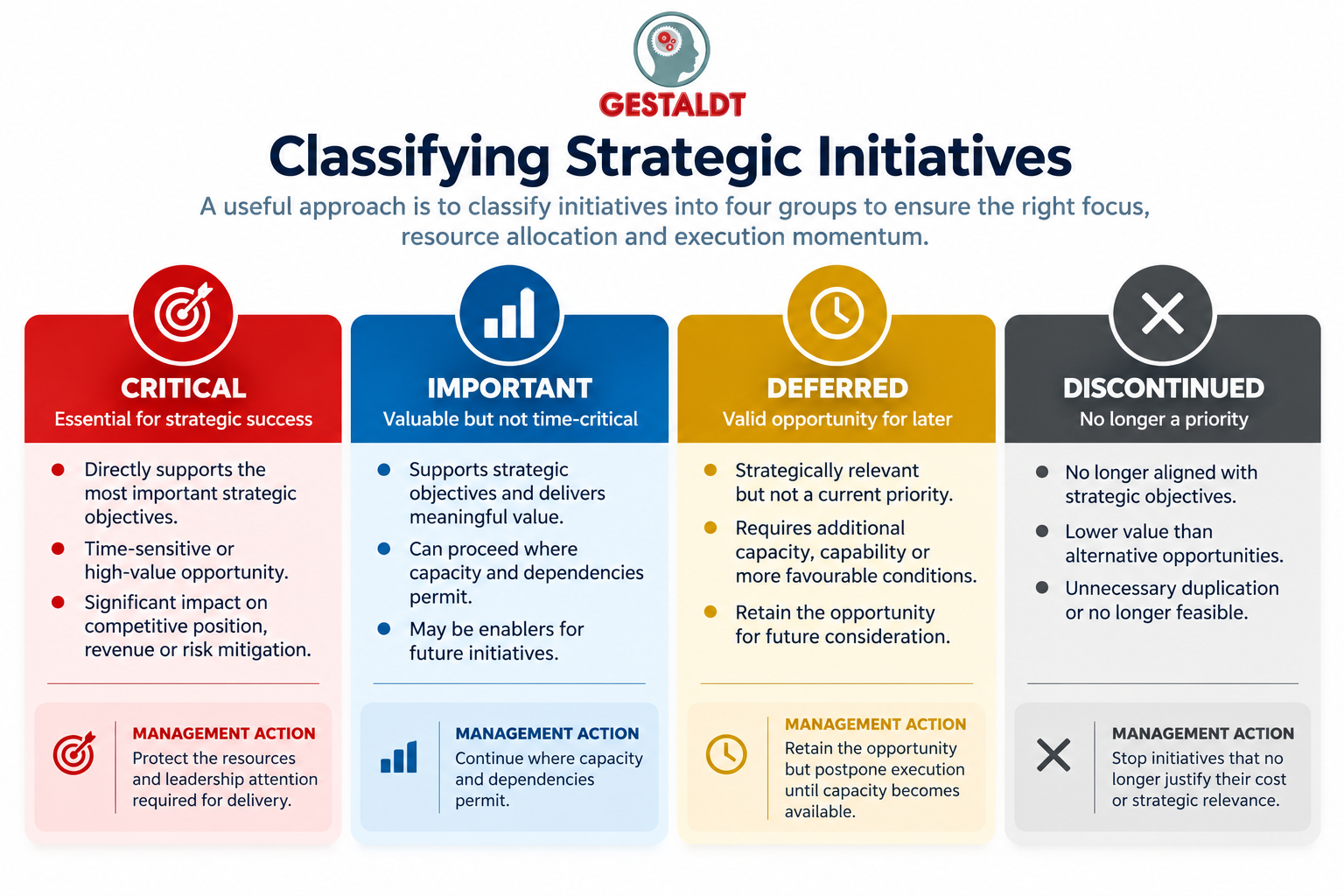
This exercise requires discipline.
Discontinuing an initiative does not automatically mean it was a mistake to start it. Markets change, assumptions prove incorrect, and strategic priorities evolve.
The real mistake is continuing to invest in work that no longer represents the best use of organisational resources.
Practical tip: Ask your executive team to identify one active initiative that could be paused, simplified, or discontinued without materially compromising the organisation's strategic objectives. Reallocate the released capacity to a higher-value commitment.
Sometimes, the most important strategic decision is deciding what not to do.
3. The Leadership Attention Deficit: When Executives Become the Constraint
Your organisation may have enough employees to execute its strategy but insufficient leadership attention to coordinate the work effectively.
Leadership capacity is often treated as an unlimited resource.
Executives are expected to oversee operations, review financial performance, manage stakeholders, develop talent, resolve conflicts, sponsor transformation, and make strategic decisions.
At the same time, they must remain responsive to unexpected events.
Each responsibility competes for attention.
When too many initiatives require executive involvement, decision-making slows. Projects wait for approvals, managers escalate routine issues, and important strategic questions compete with operational emergencies.
Eventually, senior leaders become a bottleneck.
This problem is particularly damaging when decision-making authority is unclear. Managers who could make reasonable decisions independently may hesitate because they fear acting without executive approval.
The result is an organisation in which work progresses according to the availability of a small number of senior decision-makers.
The problem is not necessarily that executives are ineffective. It may be that the operating model requires too much direct intervention from them.
Leadership attention must be allocated deliberately
Effective CEOs distinguish between decisions that require executive judgement and decisions that can be made elsewhere.
Strategic choices involving major investments, material risks, changes in business direction, or significant stakeholder consequences may require senior-level involvement.
Routine operational decisions should generally be made by the people closest to the work, provided they have the necessary information, authority, and competence.
This requires clear decision rights and a shared understanding of accountability.
It also requires executives to resist the temptation to remain involved in every important activity.
Delegation is not simply the transfer of tasks. It is the deliberate allocation of decision-making authority, responsibility, and appropriate oversight.
How CEOs can increase leadership capacity
Begin by examining how executive attention is currently distributed.
Consider the following questions:
Which decisions repeatedly return to the executive team?
Which meetings consume significant leadership time without producing clear outcomes?
Which initiatives lack an active and accountable sponsor?
Where are managers waiting for guidance that could be provided through clearer principles?
Which strategic priorities receive too little executive attention because operational issues dominate the agenda?
These questions reveal whether the leadership system supports execution or unintentionally constrains it.
Practical tip: Track executive escalations and decision delays for 30 days. Identify recurring issues that could be resolved through clearer authority, better information, stronger management capability, or simpler governance.
The goal is not to reduce executive involvement indiscriminately. It is to ensure that leadership attention is concentrated where it creates the greatest value.
4. The Capability Mismatch: Why Available Resources Are Not Always Usable Capacity
Having enough people does not necessarily mean having enough capability to execute the strategy.
An organisation may employ hundreds or thousands of people and still lack the specific expertise needed for a major transformation.
A digital initiative might require data engineering skills that are in short supply. An expansion programme might depend on experienced commercial leaders. A restructuring project might demand change-management capabilities that existing managers have not developed.
In each case, the organisation has a workforce, but not necessarily the right capabilities in the right places at the right time.
This distinction is essential when assessing execution capacity.
Traditional resource planning often focuses on headcount, budgets, and estimated working hours. These measures are useful, but they do not tell the whole story.
Execution depends on whether the organisation possesses the capabilities required to perform specific tasks to the necessary standard.
Nor is capacity simply the number of hours employees can theoretically contribute.
Employees must also manage operational responsibilities, customer demands, unexpected problems, learning requirements, and collaboration across teams.
A workforce operating at full utilisation may have little flexibility to absorb additional strategic work.
Why capability gaps emerge
Several factors can contribute:
Skills shortages: The organisation lacks critical expertise.
Misallocated talent: Capable employees are assigned to lower-value activities while strategically important initiatives remain understaffed.
Role ambiguity: Employees are unsure who owns key deliverables or decisions.
Insufficient development: Managers are expected to lead new initiatives without the necessary preparation.
Operational overload: Skilled employees cannot contribute to strategic work because daily responsibilities consume their available time.
Addressing these problems requires more than recruiting additional employees.
In some cases, targeted recruitment is necessary. In others, the organisation may achieve better results by redeploying talent, developing existing employees, simplifying work, or engaging specialist support.
The correct response depends on the nature of the capability gap.
Build a capability-led execution plan
For each strategic initiative, identify the capabilities required to deliver the intended outcome.
Then assess the difference between what is required and what is currently available.
A simple capability assessment might include:
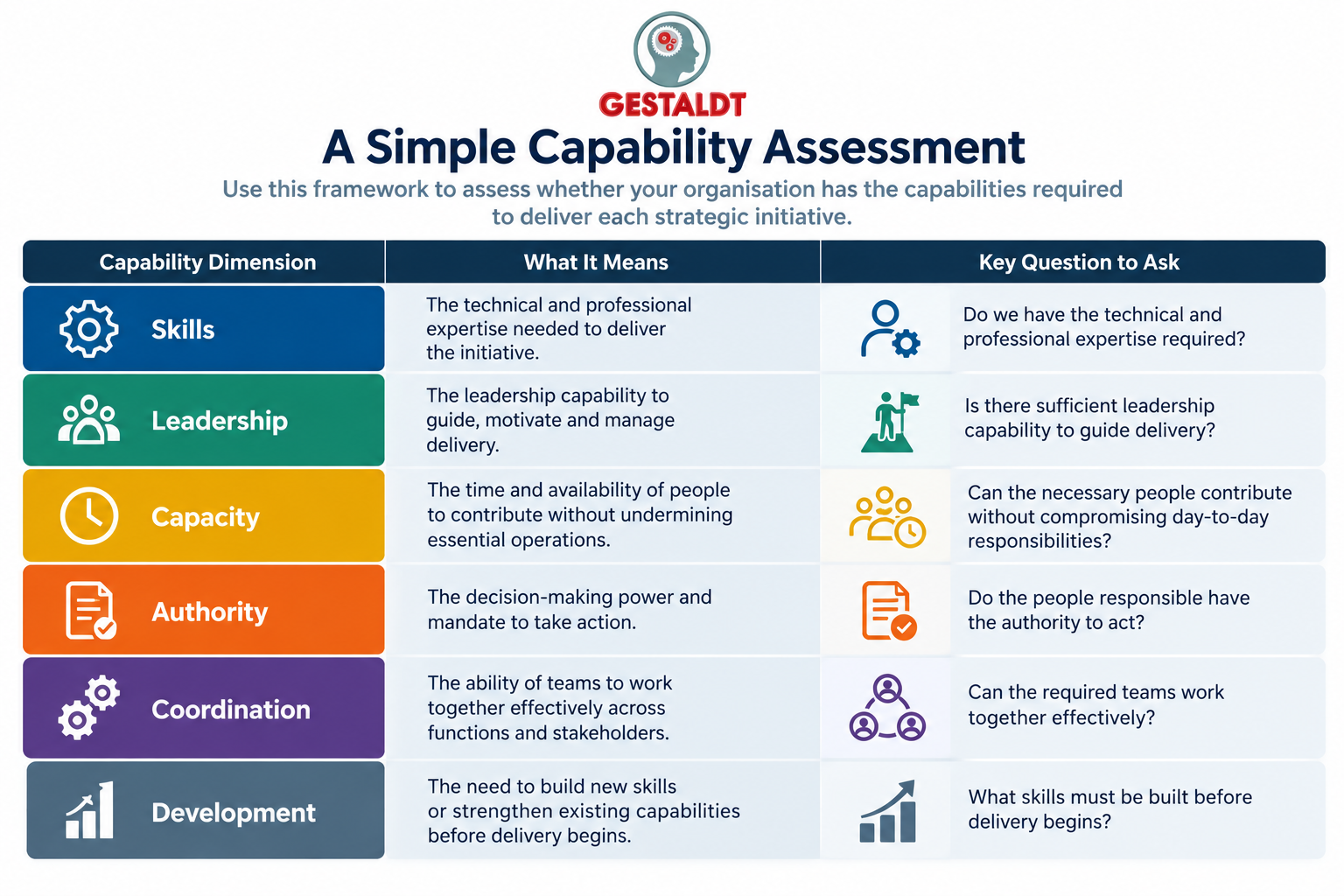
This approach helps leaders identify constraints before they become project delays.
Practical tip: Select your three most important strategic initiatives and map the critical capabilities each requires. Identify scarce skills, overloaded individuals, and capability gaps. Decide whether to recruit, develop, redeploy, simplify, or defer before finalising delivery commitments.
The objective is to ensure that the organisation's capabilities are aligned with its strategic ambitions.
5. The Sequencing Advantage: Why the Order of Execution Matters
Even the right initiatives can produce poor results when they are implemented in the wrong order.
Imagine an organisation introducing a new digital platform, restructuring its operating model, changing performance management processes, and expanding into a new market at the same time.
Each initiative has a credible business rationale.
However, the digital platform may be required to support the new operating model. The restructuring may affect the employees responsible for implementing the technology. The expansion may depend on processes that have not yet been stabilised.
If leadership ignores these dependencies, the initiatives may disrupt one another.
Teams could spend months adapting to changes that are subsequently modified by another project. Employees may receive conflicting instructions, and managers may struggle to determine which work takes precedence.
The organisation ends up paying for avoidable complexity.
Strategic execution therefore requires more than selecting the right initiatives. It requires deciding what should happen first, what can happen concurrently, and what must wait.
Sequence initiatives around value and dependency
A useful starting point is to distinguish between foundational initiatives and those that depend on them.
Foundational initiatives establish capabilities, systems, governance, or operating conditions that enable later work.
For example, an organisation seeking to use artificial intelligence across multiple departments may first need to address data quality, information governance, cybersecurity, workforce skills, and process design.
Launching multiple AI applications before these foundations are sufficiently mature could create fragmented systems, duplicated expenditure, and inconsistent results.
Sequencing allows the organisation to build the necessary foundations while managing risk and preserving delivery momentum.
It also makes resource planning more realistic because teams can move from one major commitment to another as capacity becomes available.
Use explicit sequencing criteria
Leadership teams should assess initiatives against several factors:
Strategic value: How directly does the initiative contribute to the organisation's most important objectives?
Dependencies: Which other initiatives must be completed or stabilised first?
Readiness: Are the necessary capabilities, resources, and governance arrangements available?
Risk: What could go wrong if implementation begins now?
Urgency: What are the consequences of delaying the initiative?
Capacity: Can the organisation execute it without undermining other critical commitments?
These criteria make sequencing a deliberate strategic decision rather than an informal negotiation between competing executives.
Importantly, sequencing does not always mean implementing initiatives one after another. Some activities can proceed concurrently when they have independent resources and manageable dependencies.
The objective is to avoid unnecessary competition for capacity while preserving opportunities for progress.
Practical tip: Map the dependencies between your major strategic initiatives. Identify which projects enable others, which can proceed independently, and which currently compete for the same scarce resources. Use this map to develop a realistic sequence of execution.
Better sequencing can improve the use of existing capacity without requiring a larger budget.
6. The Execution Capacity System: How CEOs Can Match Ambition With Delivery
The execution capacity gap cannot be closed through a one-off planning exercise. It requires an ongoing management discipline.
Organisations operate in changing environments.
Customer expectations evolve, competitors introduce new offerings, technology creates opportunities, and economic conditions influence investment decisions.
A strategic portfolio that was realistic six months ago may no longer be appropriate today.
New opportunities can emerge while existing initiatives experience unexpected delays. Employees may leave, critical capabilities may become unavailable, and operational demands may increase.
For these reasons, execution capacity should be managed continuously.
This means connecting strategic priorities, resource allocation, capability planning, initiative sequencing, and performance monitoring within a coherent management system.
Without that connection, each function may make locally reasonable decisions that create problems for the organisation as a whole.
Introducing the Gestaldt Execution Capacity Management Framework™
The Gestaldt Execution Capacity Management Framework™ can be positioned as a practical approach for helping executive teams assess the relationship between strategic commitments and organisational delivery capability.
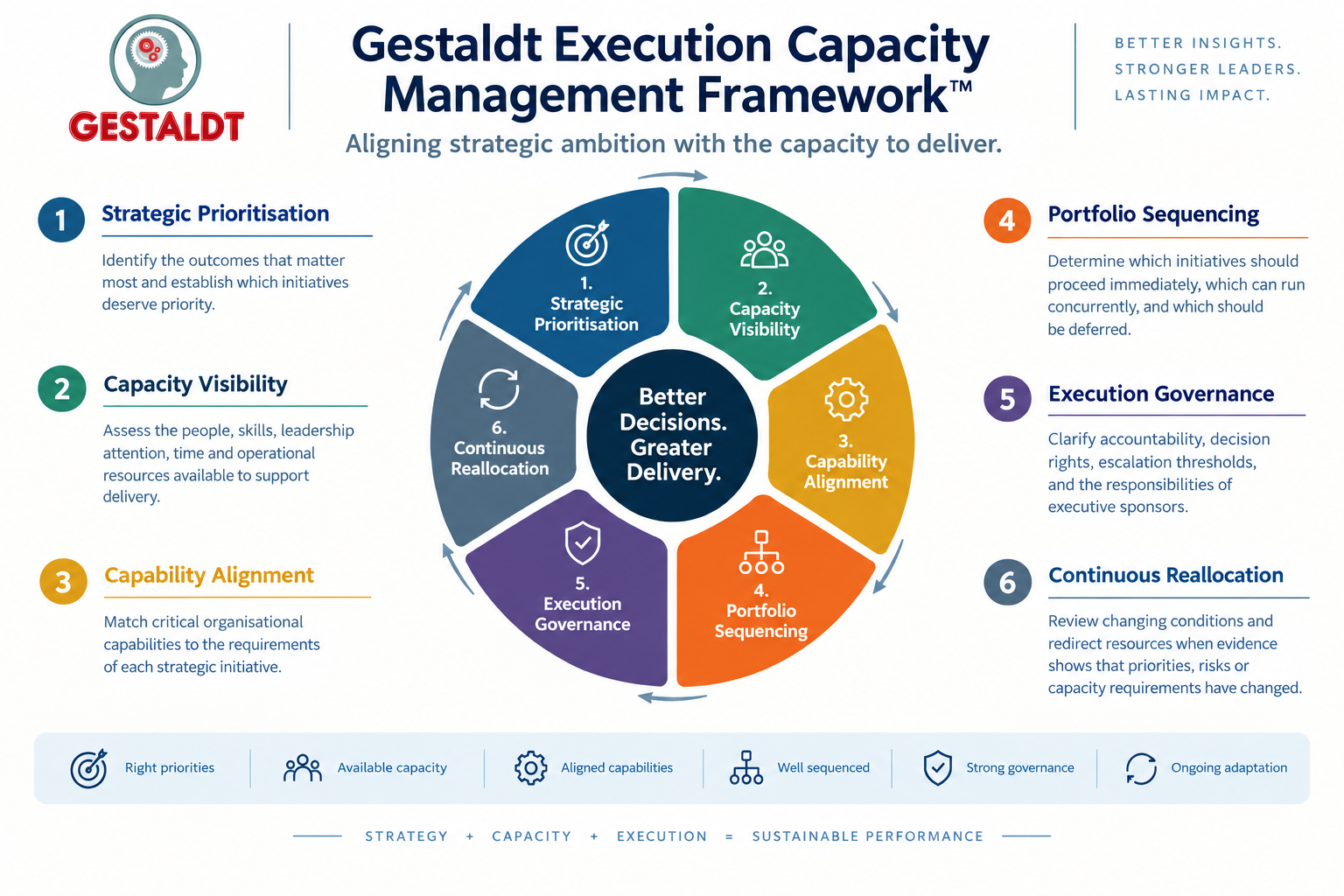
Together, these disciplines help leaders move beyond static strategic plans towards a more responsive approach to execution management.
The framework should be treated as a management model to be applied and refined in practice, rather than as an independently validated scientific instrument.
Measure capacity and outcomes together
A useful execution dashboard should combine forward-looking indicators of delivery capacity with measures of business performance.
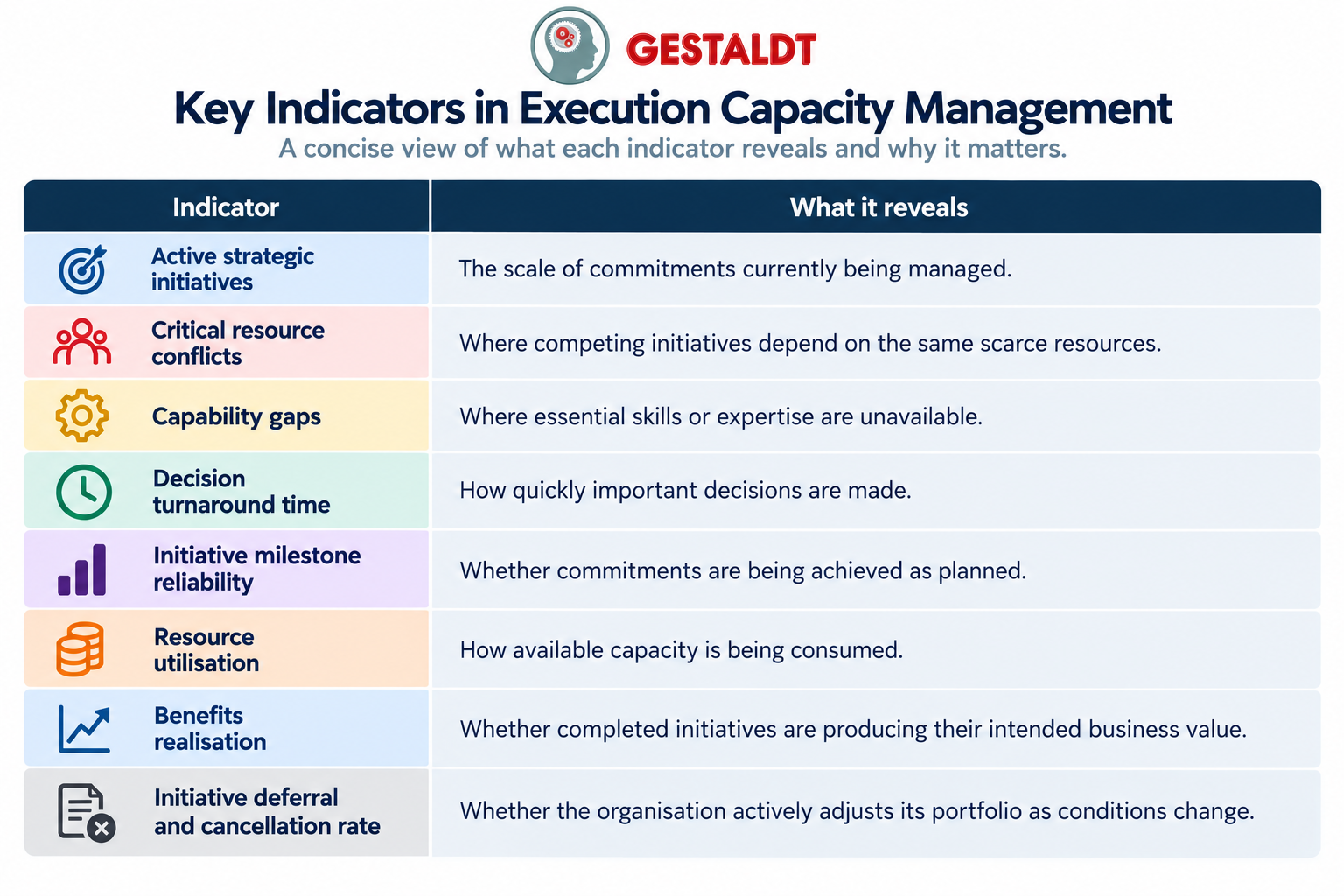
IndicatorWhat it revealsActive strategic initiativesThe scale of commitments currently being managed.Critical resource conflictsWhere competing initiatives depend on the same scarce resources.Capability gapsWhere essential skills or expertise are unavailable.Decision turnaround timeHow quickly important decisions are made.Initiative milestone reliabilityWhether commitments are being achieved as planned.Resource utilisationHow available capacity is being consumed.Benefits realisationWhether completed initiatives are producing their intended business value.Initiative deferral and cancellation rateWhether the organisation actively adjusts its portfolio as conditions change.
These measures should be interpreted together.
For example, high resource utilisation is not necessarily a sign of strong performance. If employees are fully occupied but projects repeatedly miss deadlines, the organisation may have insufficient flexibility to respond to changing demands.
Likewise, completing milestones does not automatically mean an initiative has delivered meaningful value.
The Project Management Institute's research on project success reinforces the importance of evaluating outcomes in relation to the value created for stakeholders, rather than relying solely on traditional delivery measures. Its 2024 research reported that 48% of projects were considered successful, while 40% fell into an intermediate category and 12% were classified as outright failures. These findings reflect the study's definitions and research sample; they should not be interpreted as universal rates for every organisation or project. Project Management Institute
For executives, the lesson is clear: capacity management should ultimately support business outcomes, not become another administrative reporting exercise.
Practical tip: Establish a monthly executive review of strategic capacity. Examine delivery progress, resource conflicts, emerging capability gaps, and expected business benefits. Require each material change in the portfolio to have a clear rationale, an accountable owner, and an assessment of its impact on other commitments.
The aim is to make the organisation's commitments responsive to its actual capacity and evolving strategic needs.
A Practical 90-Day Plan to Close the Execution Capacity Gap
Understanding the execution capacity gap is only the beginning. Leaders must translate that understanding into changes in how work is prioritised, resourced, and delivered.
A focused 90-day programme provides a practical starting point.
Days 1–30: Diagnose the Gap
Objective: Establish a realistic picture of current commitments and available capacity.
Begin by consolidating the organisation's major strategic initiatives into a single portfolio.
For each initiative, document:
The intended business outcome.
The accountable executive.
The delivery timeline.
The critical capabilities and resources required.
The major dependencies and risks.
The current delivery status.
The evidence supporting its expected business value.
Then identify where initiatives compete for the same people, budgets, leadership attention, or operational capacity.
Interview managers and employees involved in delivery. Their experience can reveal constraints that are not visible in executive reports.
Expected output: A consolidated strategic portfolio, an initial capacity assessment, and a prioritised list of execution constraints.
Days 31–60: Rebalance the Portfolio
Objective: Align strategic commitments with realistic execution capacity.
Use the diagnostic findings to reassess the active portfolio.
Determine which initiatives should be accelerated, continued, redesigned, deferred, or discontinued.
Resolve conflicting resource requirements. Clarify ownership and decision-making authority. Identify critical capability gaps and decide how they will be addressed.
Where appropriate, simplify project scope or divide complex initiatives into smaller, manageable stages.
Avoid treating every delay as a reason to add resources. Sometimes, the better solution is to remove unnecessary work, clarify priorities, or change the sequence of delivery.
Expected output: A prioritised and resourced portfolio with clearer accountabilities, realistic milestones, and agreed management actions.
Days 61–90: Embed Capacity Management
Objective: Make execution capacity a permanent part of strategic management.
Introduce a regular executive review of strategic commitments and delivery capability.
Track the indicators that matter most. Compare actual progress with the original baseline. Identify whether resource conflicts are declining, decisions are becoming more timely, and initiatives are delivering their intended outcomes.
Use the findings to refine the portfolio and strengthen the management practices that support execution.
The first 90 days should establish a repeatable process, not promise a predetermined improvement in performance.
Actual results will depend on the organisation's starting position, the scale of its constraints, the quality of implementation, and the nature of its strategic commitments.
Expected output: A repeatable execution capacity management process supported by clear ownership, relevant measures, and evidence-based portfolio decisions.
Take the CEO's Execution Capacity Diagnostic
The scores should be used to initiate discussion, not to declare an organisation effective or ineffective.
A low score in one critical area may be more important than a high overall score. For example, unclear accountability or a severe shortage of essential skills could undermine execution even when other management practices are well developed.
The most useful next step is to investigate the underlying evidence and agree on targeted corrective action.
Conclusion: Strategy Must Be Matched by the Capacity to Deliver
The difference between strategic ambition and business performance is not always explained by poor planning, weak leadership, or insufficient resources.
Sometimes, the problem is that the organisation has committed to more than it can realistically deliver.
When strategic initiatives exceed available capacity, employees become stretched, leaders become bottlenecks, projects compete for resources, and important objectives lose momentum.
Closing the execution capacity gap requires a more disciplined approach to strategic management.
Leaders must assess the combined demands of their initiatives, distinguish genuine priorities from competing requests, allocate leadership attention deliberately, address capability gaps, and sequence work according to value and readiness.
They must also recognise that execution capacity changes over time. A strategy that was achievable under one set of conditions may require adjustment as the business evolves.
This is why execution capacity cannot be treated as a planning assumption. It must become an ongoing management consideration.
As Michael Porter, the Harvard Business School professor known for his work on competitive strategy, famously wrote, "The essence of strategy is choosing what not to do."
The principle is particularly relevant when organisational capacity is constrained. Effective strategy requires not only identifying attractive opportunities but also making difficult choices about where to concentrate effort.
For CEOs and executive teams, the challenge is not simply to ask whether the organisation has an ambitious strategy.
It is to ask whether the organisation has the capacity, capabilities, leadership, and operating discipline to turn that strategy into meaningful results.
Because sustainable performance does not come from asking an organisation to do everything. It comes from enabling it to do the right things exceptionally well.