The Organisational Intelligence Gap: Turning Insight Into Action

Your organisation may already possess the insight it needs to make better decisions. The problem is that the insight never reaches the people who can act on it.
A customer-facing employee notices a recurring complaint. A regional manager sees demand shifting. An operations team identifies a process failure. A finance executive spots an emerging cost pattern.
Each signal contains valuable information.
Yet weeks later, the executive committee may still be debating the problem, working from outdated reports or asking for analysis that someone elsewhere in the business has already completed.
This is the organisational intelligence gap: the distance between what an organisation knows, what its leaders understand and what the business actually does with that knowledge.
Think of your organisation as a nervous system. Its frontline teams are the sensory receptors, its data systems carry the signals, its leaders interpret what those signals mean, and its operating model determines how quickly the body responds. When information gets trapped in departments, distorted by reporting layers or ignored because it challenges established assumptions, the entire system becomes slower and less responsive.
In a volatile business environment, that delay can be costly.
The advantage does not necessarily belong to the organisation with the most data, the largest analytics team or the most sophisticated technology. It may belong to the organisation that recognises meaningful signals earlier, interprets them accurately and converts them into action faster.
This article explores seven reasons organisations struggle to turn knowledge into action, how CEOs can close the gap, and how the Gestaldt Organisational Intelligence Framework™ can help connect frontline insight, executive decisions and measurable business results.
1. The Frontline Signal Problem: Your Employees See Things Executives Don't
The people closest to your customers may understand a problem long before it appears on an executive dashboard.
Frontline employees often see changes first: repeated customer frustrations, unusual purchasing behaviour, workarounds that expose broken processes, and competitor activity that hasn't reached formal reports.
Yet frontline knowledge doesn't always travel upward.
Employees may assume leaders already know. Managers may filter uncomfortable information. Reporting systems may capture only predefined categories. By the time a signal reaches the executive committee, its original context may have disappeared.
This creates a dangerous imbalance: executives possess formal authority but may lack the most current understanding of what is happening across the business.
The answer isn't to bypass management or turn every observation into an escalation. It is to build reliable channels through which meaningful signals can be captured, assessed and acted upon.
What leaders should change:
Create simple ways for employees to report recurring customer and operational problems.
Give teams feedback on what happened to the issues they raised.
Look for patterns across locations, departments and customer segments.
Encourage respectful challenge when evidence contradicts established assumptions.
Practical tip: At your next executive meeting, ask each leader to bring one important insight from frontline employees that has not yet appeared in a formal performance report.
2. The Data Deluge: Why More Information Can Produce Less Clarity
Your business can be drowning in data while starving for insight.
Most organisations already have dashboards, reports, surveys, forecasts, customer platforms and operational systems.
The challenge is that information arrives in different formats, at different times and with different definitions. One department reports activity; another reports outcomes. One dashboard shows monthly performance; another highlights daily exceptions.
Executives are left to reconcile the information before they can even begin deciding what it means.
Microsoft's 2025 Work Trend Index found that 48% of employees and 52% of leaders described their work as fragmented and chaotic. Its research also reported that Microsoft 365 users were interrupted, on average, every two minutes during core working hours by meetings, emails or notifications.
These findings describe a broader challenge for knowledge work: information availability does not guarantee attention, understanding or sound judgement.
The solution is not another dashboard by default. It is a clearer distinction between information leaders need to know, signals requiring investigation and evidence demanding immediate action.
What leaders should change:
Identify the decisions each executive dashboard is intended to support.
Establish consistent definitions for key performance measures.
Separate critical exceptions from routine updates.
Reduce duplicate reporting and reconcile conflicting data sources.
Provide interpretation alongside metrics, not just charts.
Practical tip: Take one executive report and ask its users to identify the three decisions it helps them make. If they cannot name them, redesign the report around a specific decision rather than adding more metrics.
3. The Interpretation Gap: Data Doesn't Explain Itself
Two executives can look at the same numbers and reach completely different conclusions.
Revenue declines by 8%. Is the problem weaker demand, lost customers, pricing, supply constraints or a deliberate shift towards higher-margin business?
A service backlog grows. Is the cause inadequate staffing, poor forecasting, a process defect or an increase in demand?
The number tells you what happened. It doesn't automatically tell you why.
Organisational intelligence requires leaders to combine data with context, domain expertise, customer insight and competing explanations. Without that discipline, executives risk treating symptoms rather than causes.
The danger is especially pronounced when senior leaders favour information that confirms an existing belief. A familiar explanation can feel more convincing than an unfamiliar one, even when the evidence points elsewhere.
A survey, based on 4,454 CEOs across 95 countries and territories, found that only 12% reported that AI had delivered both cost and revenue benefits, while 56% said they had yet to see significant financial benefits from AI.
The finding highlights an important lesson for leaders: having access to powerful technology or abundant data is not the same as translating it into business value.
What leaders should change:
Distinguish observed facts from interpretations and assumptions.
Ask what alternative explanations could account for the same result.
Combine quantitative measures with customer and employee evidence.
Test important assumptions before committing significant resources.
Record what evidence would change the decision.
Practical tip: For every major performance problem, require the team to present three things: what the evidence shows, what they believe is causing it, and what additional evidence would confirm or challenge that explanation.
4. The Executive Echo Chamber: When Bad News Gets Edited Out
The higher information travels, the more polished—and sometimes less useful—it can become.
Managers want to demonstrate control. Department heads want to protect their teams. Executives want to reassure the board. Nobody wants to be the person who brings an unresolved problem into the room.
As a result, information can become progressively sanitised.
Missed milestones become minor delays. Customer complaints become isolated incidents. Capability gaps become training opportunities. A failing initiative remains labelled “on track” because nobody has formally changed its status.
This is not always deliberate deception. It can emerge from organisational culture, incentives and the understandable desire to avoid blame.
But when leaders receive a filtered version of reality, they make decisions based on an incomplete picture.
Psychological safety matters here—not as permission to avoid accountability, but as the ability to raise concerns, challenge assumptions and acknowledge mistakes without fear of humiliation or retaliation.
What leaders should change:
Ask questions that invite dissent rather than demand reassurance.
Separate early warning from personal blame.
Reward timely disclosure of material risks.
Track unresolved issues and whether corrective action is effective.
Invite perspectives from people outside the immediate reporting line.
Practical tip: Introduce a standing agenda item at executive reviews: “What are we most likely to be wrong about?” Rotate the responsibility for presenting the strongest evidence against the team's current assumptions.
5. The Siloed Insight Problem: When Each Department Holds Half the Answer
The most valuable insight may exist between departments rather than inside any single one.
Customer service sees complaints. Sales sees objections. Finance sees margin pressure. Operations sees fulfilment delays. Technology sees system failures.
Individually, these signals may look unrelated.
Together, they may reveal a much bigger problem—for example, a new product promise that sales teams are making before operations can reliably deliver it, driving both customer dissatisfaction and rising service costs.
When information remains trapped within functional boundaries, organisations lose the ability to recognise these connections.
This is why organisational intelligence depends on more than data integration. It requires shared accountability, common definitions and collaboration around end-to-end business outcomes.
A research on AI alignment highlights the importance of coordinating executives, employees and other stakeholders when transforming business models and workflows. It also stresses that alignment across the leadership team is critical to capturing value from enterprise-wide initiatives.
The principle extends well beyond AI: insight becomes more useful when different perspectives can be brought together around a common problem.
What leaders should change:
Build cross-functional reviews around customer journeys and business outcomes.
Share relevant data across teams, with appropriate access controls.
Establish common definitions for important measures.
Assign joint ownership to problems that cross departmental boundaries.
Give teams the authority to resolve issues that cannot be solved within one function.
Practical tip: Choose one recurring customer or operational problem and bring together representatives from every function that touches it. Map the issue from beginning to end, then identify which insights become visible only when the functions compare evidence.
6. The Decision Conversion Gap: When Insight Never Becomes Action
A brilliant analysis has no business value if nobody changes what they do.
Many organisations are competent at producing information but less disciplined about converting it into action.
A report identifies a risk. Leadership requests further analysis. The analysis produces recommendations. The recommendations are discussed. A decision is deferred. Months later, the original risk has become a performance problem.
The gap isn't necessarily a lack of intelligence. It is a failure to connect insight with decision rights, ownership, resources and follow-through.
A survey found that CEOs who reported both cost and revenue benefits from AI were two to three times more likely to say they had embedded AI extensively across products and services, demand generation and strategic decision-making. The survey also found that organisations with strong AI foundations were three times more likely to report meaningful financial returns.
Although these findings concern AI, the wider management lesson is relevant: value depends on embedding capability into how the organisation actually operates, not simply experimenting with a tool or producing an insight.
What leaders should change:
Link each material insight to a clear decision or investigation.
Assign one accountable owner to every agreed action.
Specify the resources, authority and deadline required.
Define how success will be measured.
Review whether the action produced the expected outcome.
Practical tip: At the end of every major insight or performance review, record five items: signal, decision, owner, deadline and expected outcome. Revisit them at the next review and close the loop.
7. The Organisational Learning Gap: Why the Same Problems Keep Returning
A business that repeatedly solves the same problem hasn't fully learned from it.
A customer complaint is resolved, but the underlying process remains unchanged. A project overruns, but the next project repeats the same planning mistake. A technology rollout struggles, yet lessons from the previous implementation never reach the next team.
This happens when organisations treat problem-solving as an event rather than a learning process.
Closing the loop requires more than documenting lessons. It means identifying what should change in the system, assigning responsibility for that change and checking whether the problem recurs.
It also means recognising that not every failure reflects poor performance. Some failures produce useful information about an assumption, market or process. The important distinction is between a well-designed experiment that generates learning and a preventable mistake that continues because nobody acts on the evidence.
What leaders should change:
Conduct brief, structured reviews after significant decisions and projects.
Identify systemic causes rather than stopping at individual errors.
Share lessons across teams that could benefit from them.
Update processes, training and decision criteria where necessary.
Monitor whether recurring problems decline over time.
Practical tip: Maintain a short Organisational Learning Register with four fields: recurring issue, root cause, corrective change and evidence of improvement. Review it quarterly to determine whether lessons have changed actual business practice.
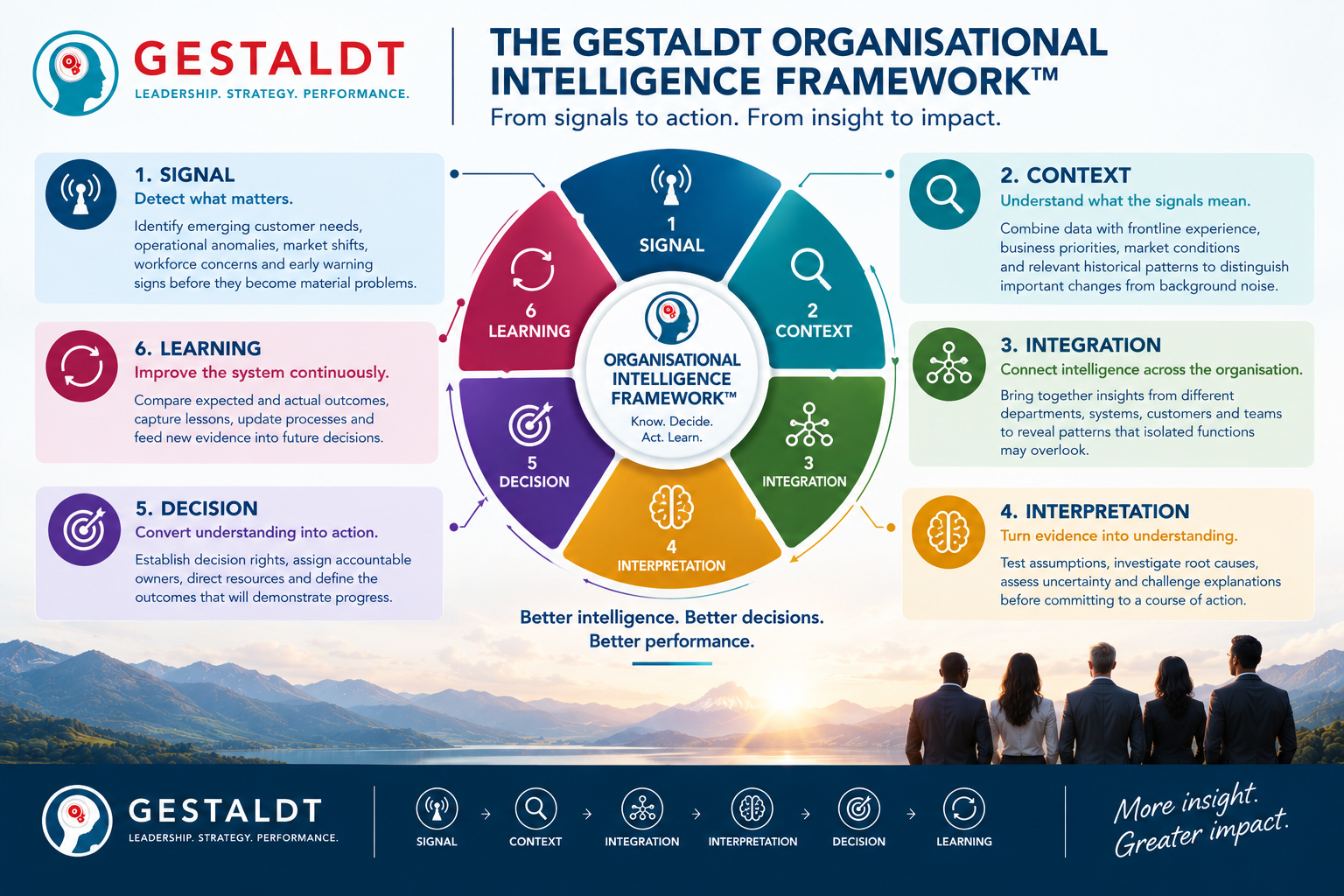
The Gestaldt Organisational Intelligence Framework™
Organisational intelligence is not about collecting every possible piece of information. It is about building a repeatable system that converts meaningful signals into sound decisions, coordinated action and measurable learning.
The CEO's Organisational Intelligence Diagnostic
How effectively does your organisation convert information into action? Rate each statement from 1 (strongly disagree) to 5 (strongly agree).
Intelligence maturity check
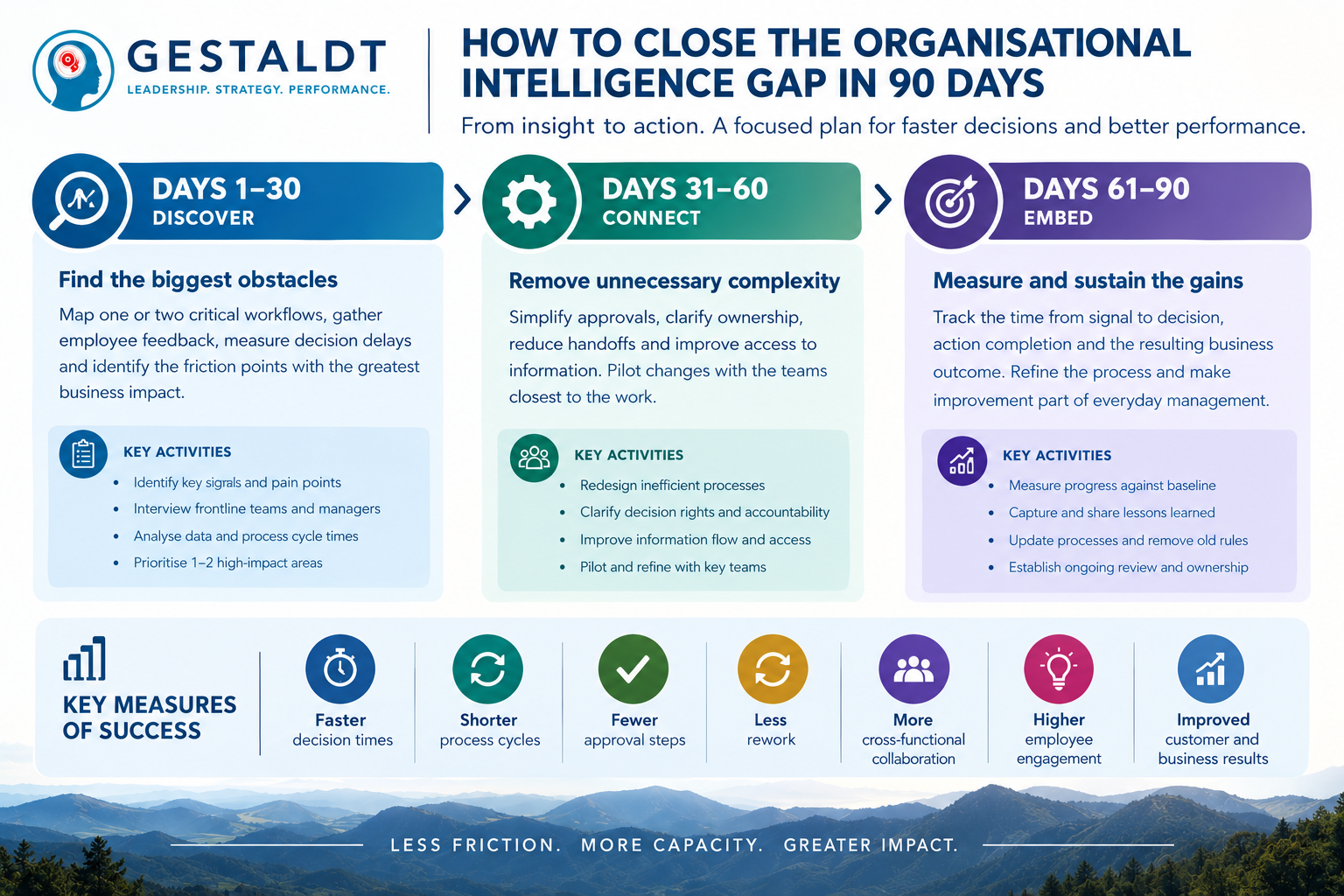
How to Close the Organisational Intelligence Gap in 90 Days
You don't need to overhaul every information system or introduce a new analytics platform to begin. Start with one important business problem and improve the way intelligence moves through the organisation.
Conclusion: The Advantage Belongs to Organisations That Learn and Act
In a world of expanding data, rapid technological change and increasingly complex markets, information alone is no longer enough.
Organisations need to recognise meaningful signals, understand their context, connect insights across functions and give capable people the authority to act. They must also learn from the consequences of their decisions rather than repeatedly solving the same problems.
The strongest organisational intelligence systems are not necessarily the most technologically sophisticated. They are the ones that consistently connect what the organisation knows with what it decides, what it does and what it learns.
Companies that succeed will be those willing to make bold decisions and invest with conviction in the capabilities that matter most.
That requires more than insight. It requires the leadership discipline to turn insight into action.
Your organisation may already know more than it realises. The next competitive advantage could come from learning how to use that knowledge better.
Ready to Strengthen Your Organisational Intelligence?
Gestaldt Consulting Group helps CEOs and executive teams align leadership, strategy, organisational capability and execution to improve business performance.
Identify where valuable insight gets lost—and build a system that turns organisational knowledge into measurable results.