
Your organisation may have a responsibility problem that looks remarkably like a performance problem.
The strategy is clear. The executive team has approved the priorities. Business units have received their targets. Managers understand their responsibilities, and employees are working hard.
Yet a critical strategic initiative is falling behind.
Sales believes Operations has not delivered the necessary capacity.
Operations argues that Finance has delayed the investment.
Finance maintains that the business case is incomplete.
Human Resources points to capability gaps.
The transformation office reports the delay.
Everyone can explain their contribution. Everyone can identify a dependency. Everyone can describe what another function needs to do.
But nobody can clearly answer one question:
Who is accountable for ensuring that the intended business result is achieved?
This is the Organisational Accountability Gap: the disconnect between distributing responsibilities across an organisation and establishing clear ownership of the outcomes those responsibilities are intended to produce.
Think of an organisation as an orchestra.
Every musician may be highly skilled. Each understands the notes and performs their individual part. But without shared timing, coordinated interpretation and clear direction, the performance can still fall apart.
The problem is not necessarily individual competence.
It is the absence of effective coordination around a common result.
The same challenge exists in business.
An organisation can have well-defined departments, job descriptions, reporting lines and performance indicators while still struggling to deliver outcomes that depend on several functions working together.
For CEOs, this creates a serious strategic risk.
An organisation can be full of responsible people and still lack accountability for results.
Research supports the importance of addressing this distinction.
In their influential Harvard Business Review article, Who Has the D? How Clear Decision Roles Enhance Organizational Performance, Paul Rogers and Marcia Blenko examine how unclear decision roles undermine organisational effectiveness.
Meanwhile, research published in the Journal of Applied Psychology has found that role ambiguity is associated with poorer employee attitudes and performance-related outcomes.
These findings reinforce an important leadership principle: people perform more effectively when they understand what is expected, where their authority begins and ends, and how their contribution connects with organisational results.
However, accountability is not simply a matter of assigning blame or increasing performance pressure.
It is a management system.
It requires clarity of outcomes, appropriate authority, access to resources, coordinated responsibilities, reliable information and consistent executive follow-through.
This article explores six causes of the Organisational Accountability Gap and introduces the proposed Gestaldt Strategic Accountability and Performance Ownership Framework™, a practical approach to strengthening accountability across strategy, leadership and operations.
1. The Responsibility Illusion: When Job Descriptions Replace Outcome Ownership
A manager can fulfil every responsibility in a job description while the organisation still fails to achieve its strategic objectives.
This is one of the most overlooked weaknesses in organisational design.
Many businesses define accountability primarily through departmental responsibilities.
Finance manages financial controls.
Human Resources manages people processes.
Operations manages service delivery.
Sales manages customer acquisition.
Technology manages systems and infrastructure.
These responsibilities are necessary.
They create functional specialisation, establish professional standards and clarify management expectations.
But strategic outcomes rarely fit neatly within a single departmental boundary.
Why functional responsibility is not enough
Consider an organisation pursuing a strategic objective to improve customer retention.
Sales may be responsible for customer relationships.
Operations may be responsible for service reliability.
Technology may manage customer systems.
Finance may approve customer investment programmes.
Human Resources may support employee capability development.
Each function contributes to customer retention.
Yet none may be explicitly accountable for coordinating the complete set of activities required to improve it.
The result is fragmented execution.
Departments focus on their assigned responsibilities while the strategic outcome remains under-managed.
Distinguish responsibility from accountability
The terms are related but should not be treated as interchangeable.
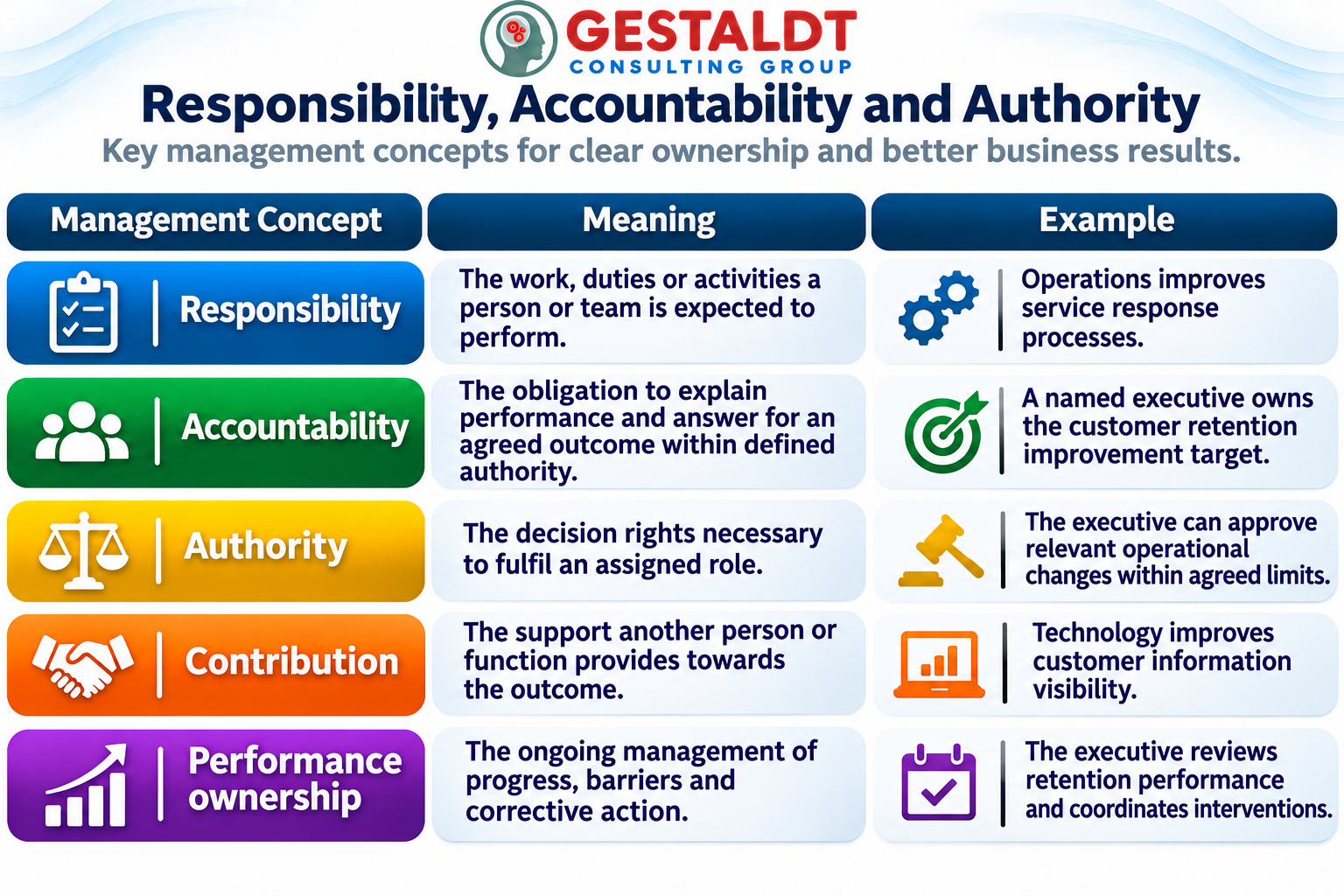
A strategic outcome may require many contributors.
However, there should be clarity about who integrates those contributions and remains answerable for the overall result.
This does not mean one person can personally control every factor influencing performance.
It means that someone is responsible for coordinating the response, identifying risks, escalating constraints and explaining progress against agreed outcomes.
The CEO's challenge
Executives should examine whether their management structures define accountability around activities or business results.
A department may report that all its assigned tasks are complete.
That information is useful.
But it does not necessarily establish whether the organisation has achieved the intended strategic improvement.
Practical tip: Select five critical strategic outcomes and identify one accountable executive for each. Then distinguish that person's outcome ownership from the responsibilities of contributing functions.
The executive principle: Completing assigned work is not the same as delivering the intended business result.
2. The Shared Accountability Trap: When Collaboration Becomes Collective Avoidance
The phrase “we are all accountable” sounds collaborative. In practice, it can conceal a lack of ownership.
Modern organisations depend on cross-functional collaboration.
Growth requires coordination between commercial, operational and financial functions.
Digital transformation involves technology, people, processes and leadership.
Customer experience depends on multiple interactions across the organisation.
Consequently, executives frequently establish joint objectives.
This is appropriate.
The difficulty emerges when shared objectives are introduced without clear decision ownership and performance integration.
Why shared accountability can become ambiguous
Imagine a company launching a strategic initiative to reduce customer onboarding time.
Sales must improve information quality.
Compliance must simplify verification procedures within regulatory requirements.
Technology must automate selected processes.
Operations must redesign workflows.
Each function receives a portion of the initiative.
When onboarding performance fails to improve, each department reports that its own work is progressing.
The initiative has contributors, but no effective integrator.
The organisation may then experience repeated meetings, conflicting priorities and unresolved dependencies.
Separate collective contribution from single-point outcome ownership
Effective collaboration requires both.
Collective contribution means several functions have defined obligations towards a shared result.
Single-point outcome ownership means a named leader is responsible for integrating those contributions, monitoring progress and escalating unresolved barriers.
The accountable leader does not need unlimited authority over every department.
However, the role must have an agreed mechanism for securing cooperation and resolving conflicts.
A practical accountability model
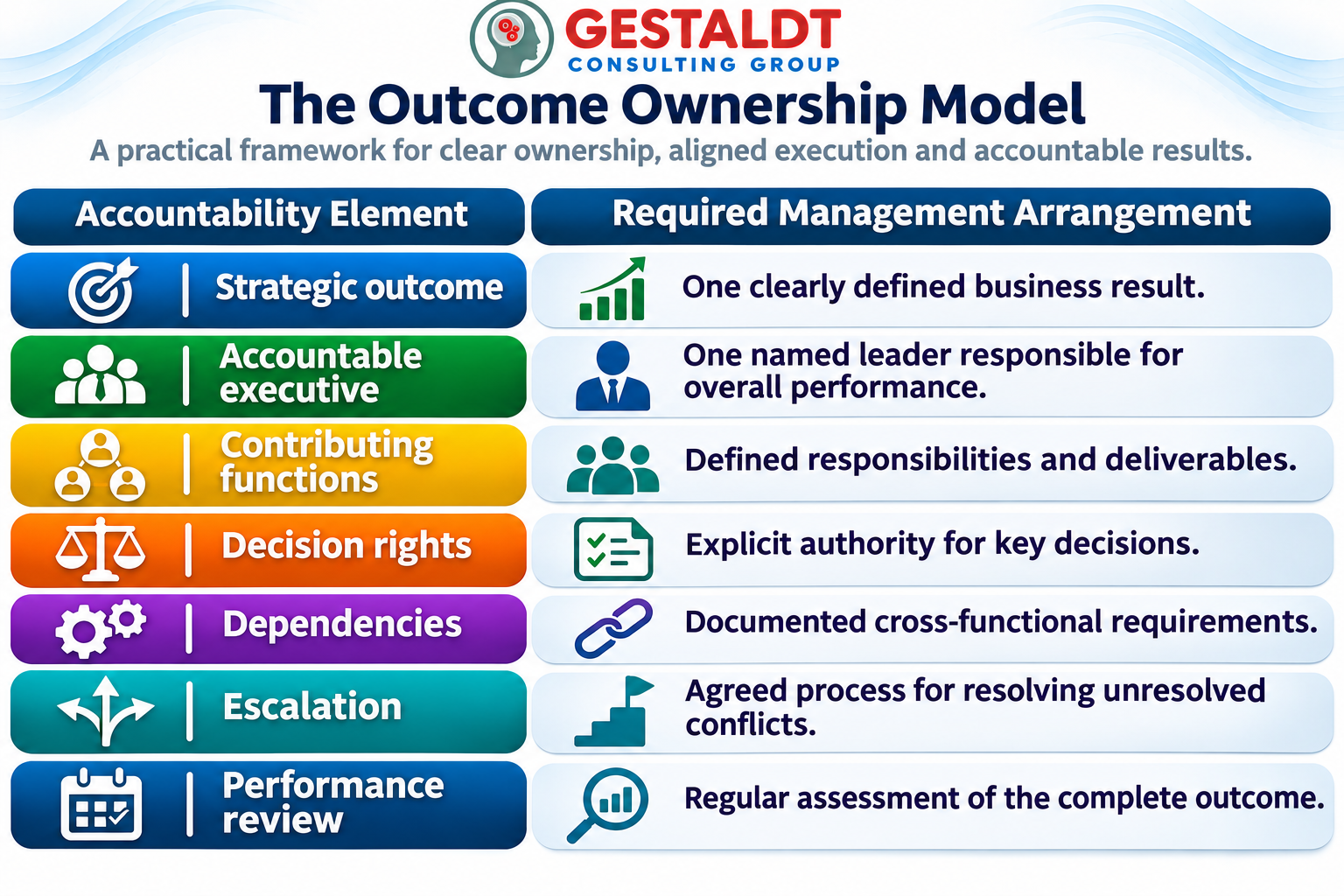
This approach preserves collaboration without allowing accountability to disappear into a committee.
It also reduces the risk that departments optimise their own performance while the organisation underperforms.
Practical tip: For every major cross-functional initiative, create a one-page outcome ownership agreement identifying the accountable leader, contributors, decision rights, dependencies and escalation process.
The executive principle: Shared effort is essential. Ambiguous ownership is not.
3. The Authority–Accountability Mismatch: When Managers Own Results but Cannot Make Decisions
Holding someone accountable for an outcome without giving them the authority to influence it is not empowerment. It is organisational frustration.
Many managers face a difficult contradiction.
They are expected to deliver performance improvements but cannot make the decisions required to achieve them.
A business unit leader may be accountable for profitability but lack authority over important cost decisions.
An operations manager may own service quality but require executive approval for routine process changes.
A transformation leader may be responsible for implementation milestones but have no effective mechanism for resolving cross-functional resource conflicts.
The organisation assigns accountability without creating the conditions necessary for success.
Why authority matters
Accountability requires more than a performance target.
Managers need sufficient authority to make relevant decisions, allocate resources within agreed limits, coordinate contributors and escalate constraints.
Without these mechanisms, performance ownership becomes largely symbolic.
This is closely connected to the Decision Velocity Gap explored in the previous Gestaldt Insights article.
When decision rights are unclear or unnecessarily centralised, managers cannot respond effectively to operational conditions.
They become dependent on approval processes that may be disconnected from the urgency of execution.
Test the alignment between authority and accountability
Executives should examine four questions:
What outcome is the manager expected to deliver?
Which decisions materially influence that outcome?
Does the manager possess the necessary authority?
If not, is there a reliable mechanism for obtaining timely decisions?
The answers reveal whether the organisation's accountability model is practical.
A management alignment matrix
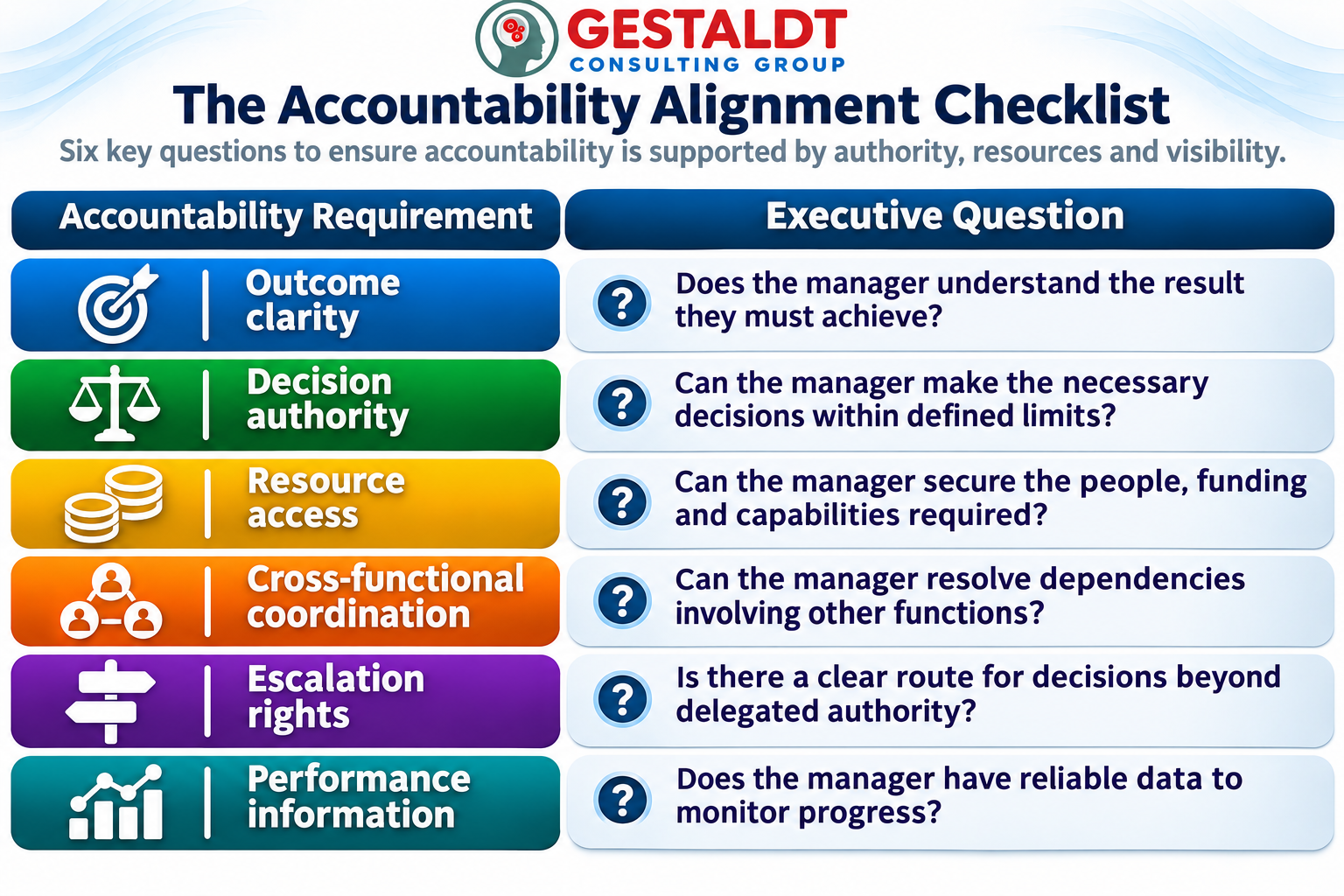
Where these conditions are missing, simply demanding stronger accountability is unlikely to solve the underlying problem.
Accountability must be matched with control and influence
Executives should also distinguish between outcomes managers can control directly and those they can only influence.
For example, a sales executive may influence revenue through commercial activity but cannot fully control macroeconomic demand.
Accountability should therefore incorporate appropriate performance measures, assumptions and contextual judgement.
Practical tip: Review the accountability of your ten most important management roles. Identify where performance expectations exceed decision authority, resource access or realistic managerial influence.
The executive principle: Accountability becomes credible when expectations, authority and organisational support are aligned.
4. The Silo Performance Problem: When Departments Win but the Organisation Loses
What happens when every department achieves its targets, but the business misses its strategic objectives?
This question exposes a fundamental weakness in many performance management systems.
Organisations frequently measure functions independently.
Procurement is rewarded for reducing purchasing costs.
Operations is measured on production efficiency.
Sales is evaluated on revenue growth.
Finance focuses on cost control.
Human Resources reports recruitment and development indicators.
Each measure may be reasonable.
But departmental targets can create unintended consequences when they are not aligned with enterprise outcomes.
Local optimisation can damage overall performance
Consider a manufacturing company seeking to improve profitability and customer service.
Procurement reduces material costs by selecting lower-priced suppliers.
However, the new suppliers deliver less consistently.
Production experiences interruptions.
Customer orders are delayed.
Sales faces increased complaints.
The procurement function achieves its cost-reduction target.
Yet the organisation experiences higher disruption costs and weaker customer performance.
The problem is not necessarily poor effort.
It is a performance system that rewards a local result without adequately considering its wider consequences.
Connect functional KPIs to strategic outcomes
A stronger accountability system distinguishes between functional indicators and shared enterprise measures.
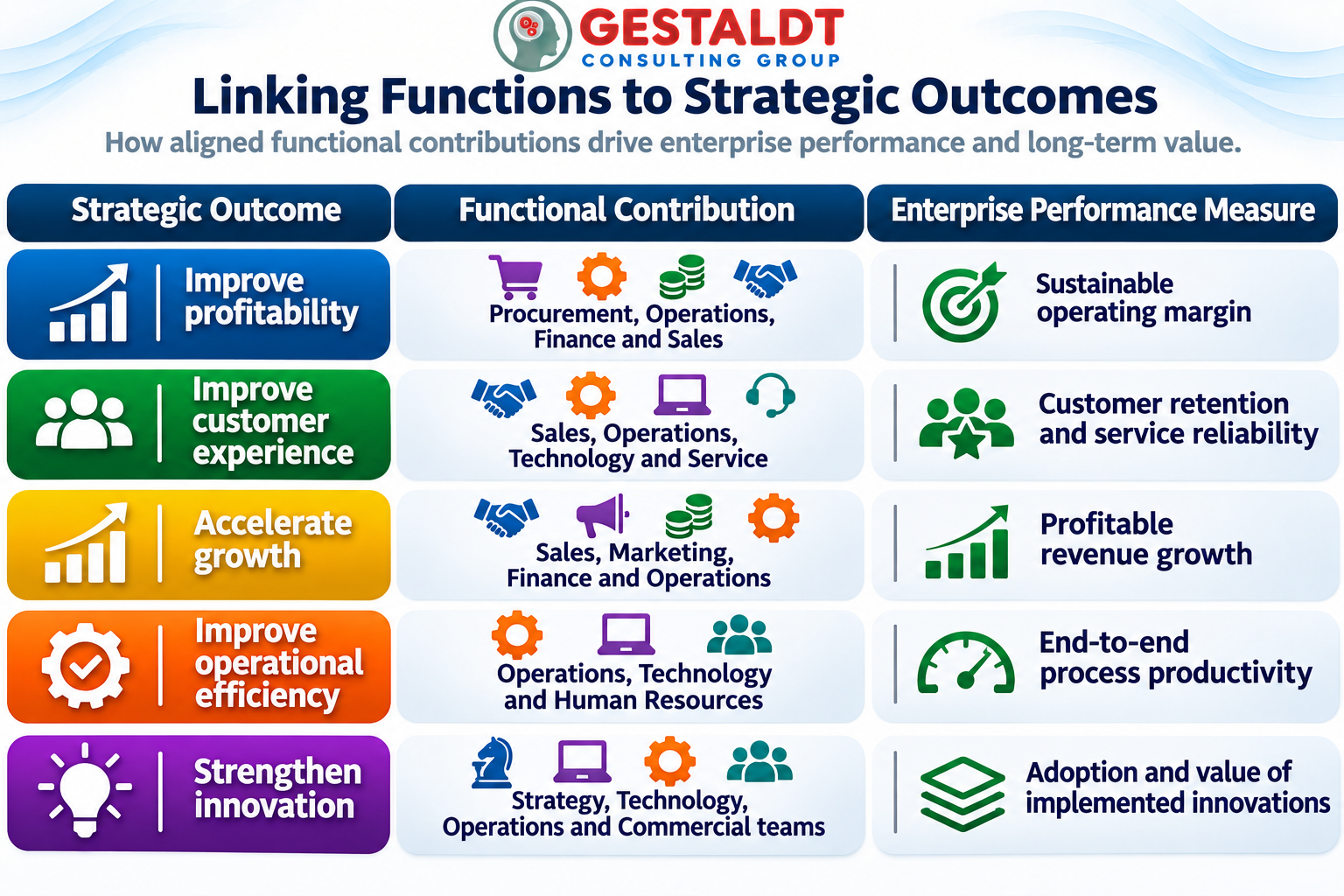
The objective is not to eliminate departmental KPIs.
It is to ensure that they support the outcomes the organisation is trying to achieve.
Introduce enterprise-level performance conversations
Executive meetings should examine the interaction between functional performance and strategic results.
For example:
Are cost savings creating operational risks elsewhere?
Are revenue targets being achieved at the expense of profitability?
Are productivity improvements reducing customer service quality?
Are departmental resource decisions delaying strategic initiatives?
These questions help leaders identify where apparently successful functional performance may be undermining the wider business.
Practical tip: Review your executive scorecard and identify three instances where departmental KPIs could encourage conflicting behaviour. Introduce shared outcome measures or balancing indicators where appropriate.
The executive principle: A department should not be considered successful when its performance improvement creates a greater loss elsewhere in the organisation.
5. The Performance Conversation Gap: When Reporting Replaces Accountability
A dashboard can tell executives that performance is deteriorating. It cannot, by itself, ensure that anyone takes corrective action.
Many organisations have invested heavily in performance reporting.
Executives receive dashboards, monthly scorecards, project updates and operational reports.
These systems provide visibility.
However, visibility is not the same as accountability.
An organisation may repeatedly report the same underperforming indicators without making meaningful decisions to improve them.
The performance meeting becomes an exercise in explaining results rather than changing them.
Why reporting alone is insufficient
Consider a strategic initiative that has missed its milestones for three consecutive months.
Each month, the dashboard records the delay.
The responsible manager explains the reasons.
The executive committee acknowledges the update.
But no decision is made about resource constraints, priorities or corrective action.
The organisation has a reporting process.
It does not have an effective accountability process.
Move from performance reporting to performance intervention
A strong accountability conversation should address five questions.
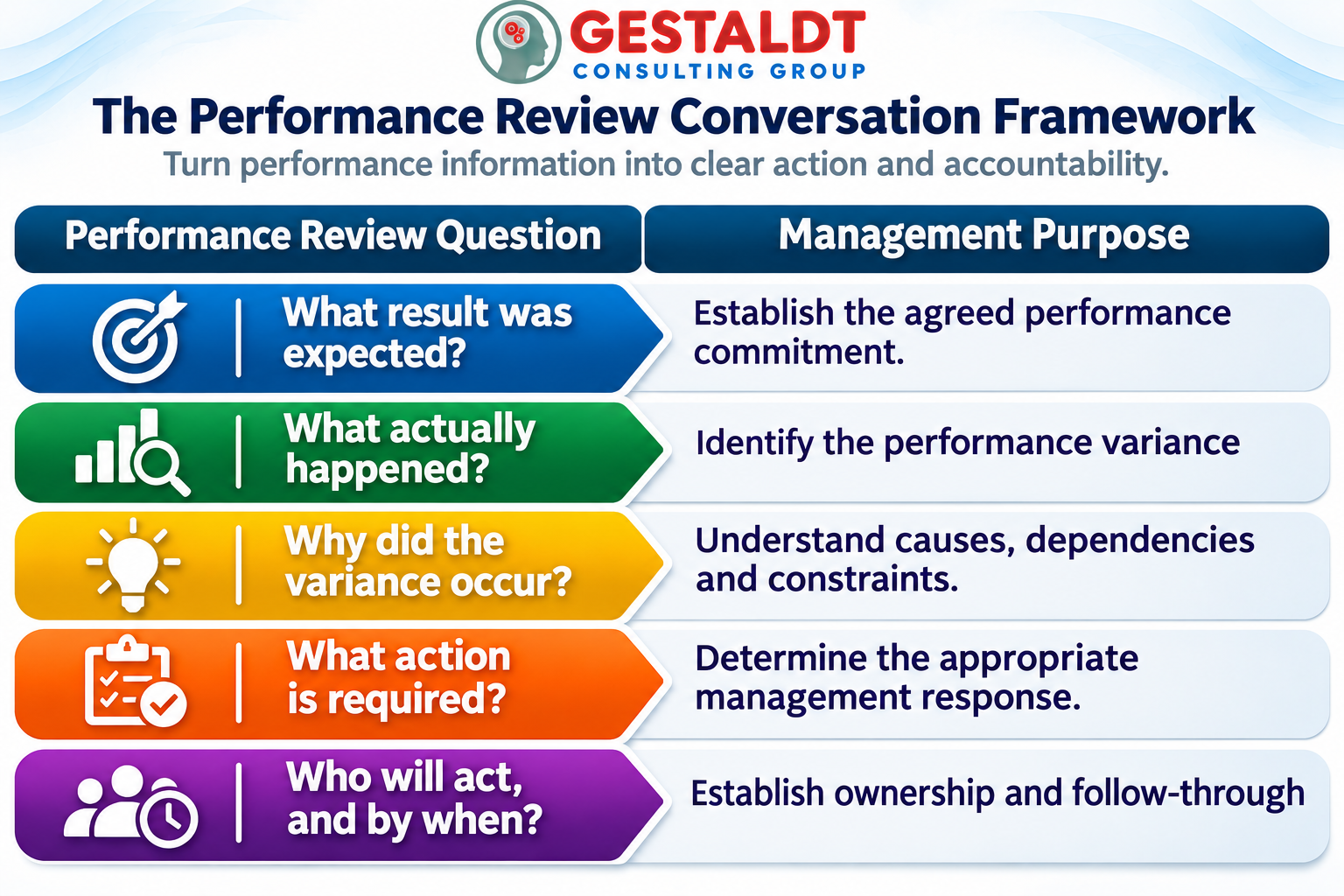
This creates a direct connection between information and intervention.
It also encourages managers to distinguish between factors within their control and constraints requiring executive support.
Accountability is not blame
A productive accountability culture should support candour.
Managers must be able to report emerging risks and performance problems without automatically being punished for delivering unwelcome information.
Otherwise, the organisation may encourage defensive reporting, delayed escalation or unrealistic forecasts.
Strong accountability combines clear expectations with fair assessment, support and consequences proportionate to the circumstances.
Practical tip: Change the final agenda item in every executive performance review from “Matters arising” to “Decisions, corrective actions, accountable owners and deadlines.”
The executive principle: Reporting explains performance. Accountability ensures that performance information leads to action.
6. The Follow-Through Failure: When Commitments Are Made but Not Sustained
The real test of accountability begins after the meeting ends.
Executive teams frequently make commitments.
A leader agrees to resolve a resource conflict.
A department undertakes to improve a process.
A project sponsor promises to address implementation barriers.
A business unit commits to a recovery plan.
The commitments are recorded.
But as new priorities emerge, follow-through weakens.
Deadlines move without explanation.
Responsibilities change.
Actions remain incomplete.
The same issues return to executive meetings.
Over time, employees learn that commitments are negotiable and that unresolved actions may simply disappear into the next reporting cycle.
Why follow-through breaks down
Several factors contribute:
Too many commitments. Leaders accept more actions than their available capacity allows.
Unclear ownership. Multiple people are assigned responsibility without a named accountable owner.
Weak tracking. Actions are recorded but not systematically reviewed.
Changing priorities. New demands displace existing commitments without explicit reprioritisation.
Limited consequences. Repeated non-delivery does not trigger appropriate intervention.
Unresolved dependencies. Managers cannot complete actions because required support is unavailable.
These are management system problems as much as individual behaviour problems.
Create an accountability rhythm
A practical accountability cycle should connect commitments with regular review.
Commit: Define the result, owner and deadline.
Enable: Confirm authority, resources and dependencies.
Monitor: Track progress and emerging risks.
Intervene: Resolve barriers and adjust the plan where necessary.
Verify: Confirm whether the agreed outcome was achieved.
Learn: Identify improvements for future execution.
The cycle should be proportionate to the significance of the commitment.
Routine operational actions may require simple tracking.
Major strategic outcomes may need structured executive oversight.
Protect accountability through prioritisation
Organisations should also avoid treating every commitment as equally important.
When managers are overloaded, executives must make deliberate trade-offs.
This connects directly with the Execution Capacity Gap explored earlier in the Gestaldt Insights series.
An organisation cannot demand reliable accountability while continually adding priorities without considering available capacity.
Practical tip: Introduce a single executive action register for critical strategic commitments. Review overdue actions, unresolved dependencies and decisions requiring escalation at every executive governance meeting.
The executive principle: Accountability is demonstrated through sustained follow-through, not the initial acceptance of responsibility.
Introducing the Gestaldt Strategic Accountability and Performance Ownership Framework™
The Organisational Accountability Gap cannot be closed by rewriting job descriptions or demanding greater individual effort.
It requires a management system that connects strategic outcomes with ownership, authority, resources, performance information and corrective action.
The proposed Gestaldt Strategic Accountability and Performance Ownership Framework™ brings these requirements together through six interconnected dimensions.
The Six Dimensions of Strategic Accountability
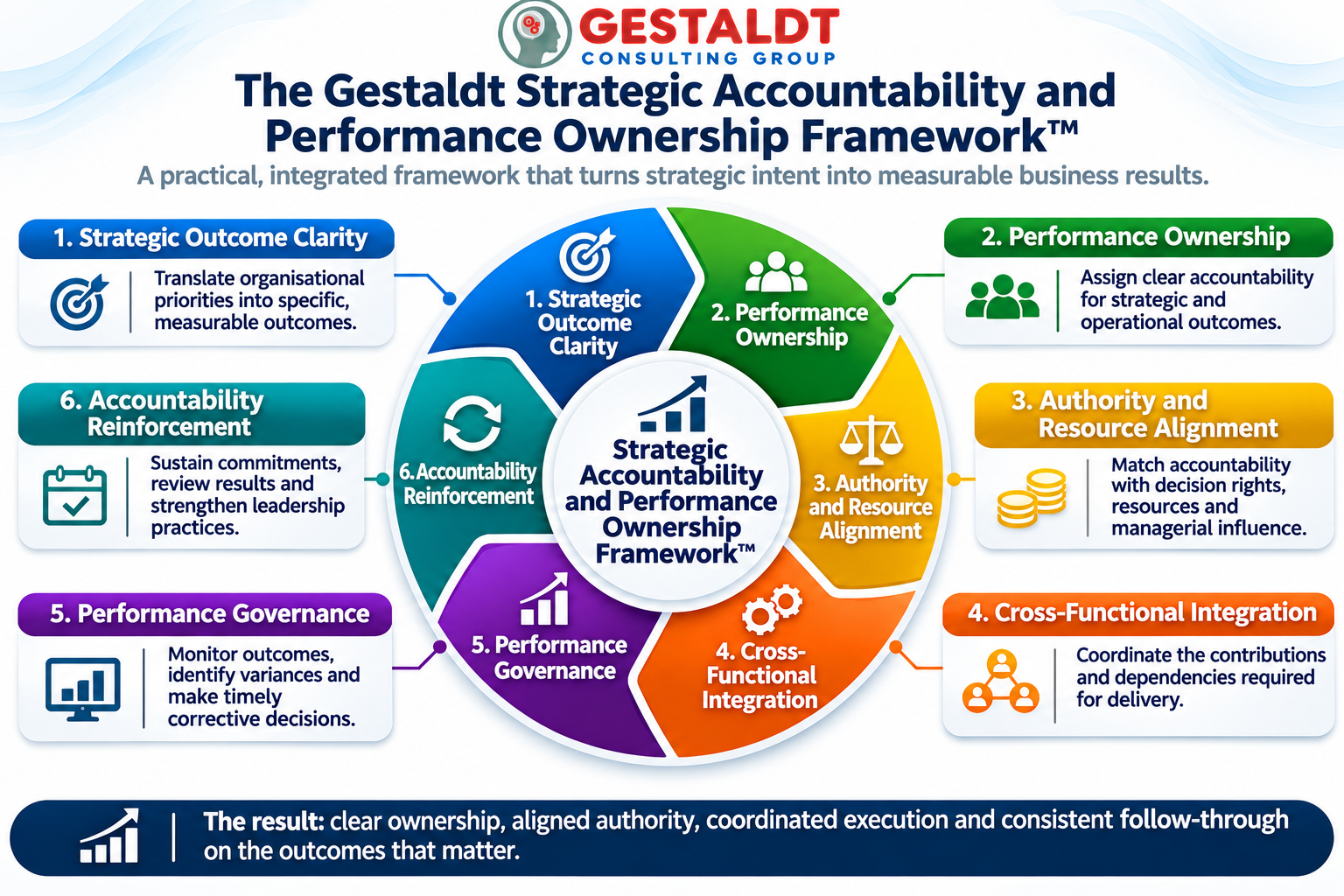
The framework is a proposed executive management model rather than a scientifically validated assessment instrument.
Its purpose is to help leadership teams identify where accountability becomes fragmented between strategy formulation and operational execution.
How the Framework Works
Strategic Outcome Clarity establishes what the organisation needs to achieve.
Performance Ownership identifies who is answerable for the outcome.
Authority and Resource Alignment ensures that the accountable leader has appropriate decision rights and support.
Cross-Functional Integration connects the departments and capabilities required for delivery.
Performance Governance enables timely intervention when results deviate from expectations.
Accountability Reinforcement ensures that commitments are sustained and lessons inform future performance.
Together, these dimensions create a continuous accountability cycle.
The objective is not to centralise every responsibility or make one person personally responsible for every external influence.
It is to ensure that every critical strategic outcome has clear ownership, coordinated support and an effective mechanism for achieving results.
The CEO's Strategic Accountability Diagnostic
Take the 10-question diagnostic to assess whether your organisation has the clarity, authority and management discipline required to turn strategic priorities into measurable business results.
Interpreting the Results
The score bands are illustrative and intended to guide executive discussion. They are not scientifically validated thresholds.
The individual weaknesses identified may be more important than the total score.
For example, an organisation may have strong performance reporting but poor decision authority.
Another may have clearly assigned owners but inadequate resources.
Both may experience significant accountability gaps.
A 90-Day Executive Roadmap to Strengthen Organisational Accountability
Improving accountability does not require an immediate restructuring of the entire organisation.
A focused 90-day programme can establish clearer ownership, stronger governance and more consistent follow-through.
Days 1–30: Identify Accountability Gaps
Objective: Understand where critical outcomes lack clear ownership.
Select five to ten strategic outcomes that materially affect organisational performance.
Review their current accountability arrangements.
Identify:
Who is accountable for each outcome.
Which functions contribute.
What decisions the accountable leader can make.
What resources are required.
Which dependencies create barriers.
How performance is monitored.
What happens when targets are missed.
Interview relevant executives and operational managers to identify differences between formal accountability structures and actual management practices.
Expected output: A strategic accountability map identifying ownership gaps, unclear authority and unresolved dependencies.
Days 31–60: Redesign Outcome Ownership
Objective: Establish practical accountability for priority business results.
Assign named accountable executives.
Clarify supporting functional responsibilities.
Align decision rights and escalation arrangements.
Review whether performance indicators encourage enterprise-wide results or conflicting departmental behaviour.
Establish clear commitments, milestones and resource requirements.
Introduce outcome ownership agreements for major cross-functional priorities.
Expected output: A revised accountability model connecting strategic outcomes with accountable leaders, decision authority and supporting functions.
Days 61–90: Embed Accountability into Governance
Objective: Make outcome ownership part of routine executive management.
Integrate accountability measures into executive performance dashboards.
Introduce structured performance intervention discussions.
Track critical commitments and corrective actions.
Review overdue decisions and unresolved cross-functional dependencies.
Ensure that performance reviews distinguish between execution failures, capability gaps and constraints outside managerial control.
Use early findings to refine accountability arrangements.
Expected output: A repeatable executive accountability process supporting stronger strategy execution and measurable performance improvement.
The first 90 days should establish greater clarity and management discipline. Sustained improvement will depend on consistent leadership behaviour and ongoing refinement.
The Executive Accountability Dashboard: What CEOs Should Measure
Accountability should be visible through measurable management practices and business outcomes.
A useful executive dashboard should not simply identify who is responsible for activities.
It should show whether critical outcomes have clear owners, whether commitments are being honoured and whether performance problems are being resolved.
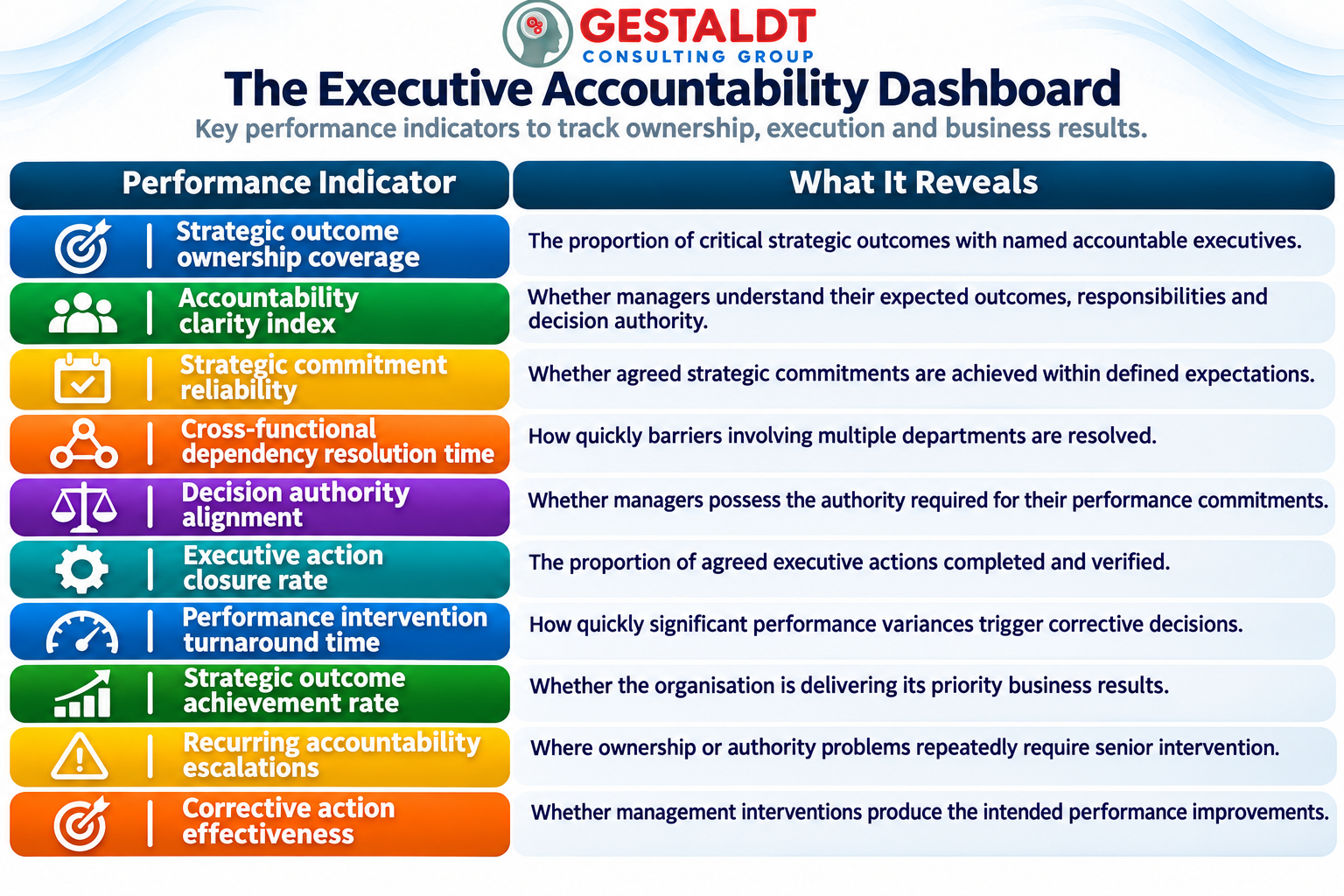
These indicators should be interpreted together.
For example, a high action closure rate may appear positive.
However, if the actions completed do not improve strategic outcomes, the organisation may be measuring administrative compliance rather than meaningful accountability.
A Simple Strategic Ownership Calculation
A practical starting measure is strategic outcome ownership coverage.
Strategic Outcome Ownership Coverage (%) = (Critical Outcomes with Named Accountable Owners ÷ Total Critical Outcomes) × 100
Suppose an organisation has identified 20 critical strategic outcomes.
Sixteen have named accountable executives with documented ownership responsibilities.
The coverage rate is:
(16 ÷ 20) × 100 = 80%
This means that 20% of the organisation's critical strategic outcomes still lack formally documented accountability.
The calculation is illustrative.
It does not prove that the 16 assigned owners have sufficient authority, resources or capability.
It simply provides a starting point for examining accountability completeness.
Executives should therefore combine ownership coverage with measures of decision authority, performance achievement and follow-through.
The Hidden Cost of Fragmented Accountability
Accountability gaps can create significant organisational costs.
These costs may not appear as a distinct category in financial statements.
Instead, they emerge through delayed initiatives, duplicated work, unresolved problems, missed opportunities and underperforming investments.
Consider a hypothetical organisation implementing a strategic customer retention programme.
The initiative requires coordination between Sales, Operations, Technology and Customer Service.
The programme is expected to generate an additional R8 million in annual contribution through improved customer retention.
However, unclear ownership delays implementation by three months.
Assuming the expected benefits would have accrued evenly after implementation, the delay could defer approximately:
R8 million ÷ 12 × 3 = R2 million in expected contribution
This is an illustrative opportunity-cost estimate, not a verified financial loss.
The actual impact would depend on the timing of benefits, customer behaviour, operating conditions and whether delayed benefits are subsequently recovered.
Nevertheless, the example illustrates an important principle.
Fragmented accountability can affect not only management efficiency but also the timing and value of strategic outcomes.
For CEOs and CFOs, this reinforces the need to treat accountability design as a business performance issue rather than merely an organisational structure issue.
From Individual Accountability to Enterprise Performance Ownership
The strongest accountability systems balance individual ownership with organisational collaboration.
They do not assume that assigning a name to a target is sufficient.
Instead, they establish a complete management arrangement around each important outcome.
That arrangement includes:
Clarity: What result must be achieved?
Ownership: Who is answerable for the outcome?
Authority: What decisions can that person make?
Capability: Does the organisation possess the skills and resources required?
Coordination: Which functions must contribute?
Governance: How will progress and barriers be managed?
Follow-through: How will commitments and outcomes be verified?
These elements are interconnected.
Ownership without authority creates frustration.
Authority without accountability creates risk.
Accountability without capability creates unrealistic expectations.
Collaboration without ownership creates ambiguity.
Reporting without intervention creates the appearance of control without meaningful improvement.
The executive challenge is to bring these elements into alignment.
Conclusion: Accountability Is the Bridge Between Strategic Intent and Business Results
Organisations do not fail to execute strategy simply because employees lack commitment.
Execution can also break down because responsibility is fragmented, decision rights are unclear, performance measures encourage conflicting behaviour and management commitments are not consistently followed through.
The Organisational Accountability Gap emerges when businesses distribute work without establishing effective ownership of the outcomes that matter.
Closing that gap requires a shift in executive thinking.
Instead of asking only:
Who is responsible for completing this activity?
Leadership teams must also ask:
Who owns the business result, what authority do they have, and how will we ensure the outcome is achieved?
This shift changes the nature of performance management.
It moves the organisation from task completion towards outcome ownership.
From departmental optimisation towards enterprise performance.
From reporting problems towards resolving them.
And from assigning responsibility towards creating the conditions for accountable execution.
For CEOs, this is not simply an administrative improvement.
It is a strategic leadership responsibility.
Because strategy does not succeed when everyone knows what they are supposed to do. It succeeds when the organisation knows who owns the result—and gives them the means to deliver it.
Is Your Organisation Managing Responsibilities or Delivering Results?
Clear job descriptions do not automatically create clear accountability. And busy management teams do not necessarily produce strong organisational performance.
At Gestaldt Consulting Group, we focus on helping organisations strengthen the connection between strategic priorities, leadership effectiveness, organisational capability, execution governance and measurable business results.
Where strategic initiatives are delayed by unclear ownership, conflicting departmental priorities or weak follow-through, a structured accountability assessment can help identify the underlying constraints.
Turn Strategic Responsibility Into Measurable Performance
Are your most important business outcomes supported by clear ownership, appropriate decision authority and consistent executive follow-through?
Connect with Gestaldt Consulting Group to explore how stronger strategic accountability and performance governance can support more effective strategy execution.
Explore Gestaldt Consulting Group
Better Insights. Stronger Leaders. Lasting Impact.