

The Accountability Crisis: Why Organisational Performance Stalls Even When Everyone Is Busy
Your organisation isn't failing because people aren't working hard. It's failing because accountability is unclear. Learn why accountability breaks down, how it impacts organisational performance, and the leadership practices that create high-performing organisations.

Everyone Is Working Hard—So Why Isn't the Organisation Moving Faster?
Walk through almost any organisation and you'll find people who are busy.
Meetings are full.
Calendars are packed.
Projects are underway.
Emails never stop.
Performance dashboards are updated weekly.
Yet despite all this activity, many organisations struggle to achieve meaningful progress.
Strategic initiatives are delayed.
Customer issues persist.
Innovation slows.
Budgets overrun.
Deadlines are missed.
When leaders investigate, the explanation is often the same:
"We need people to be more accountable."
But accountability isn't something leaders can demand. It is something organisations must design.
The highest-performing organisations don't rely on heroic individuals to deliver results. They create systems where ownership is clear, expectations are understood, decisions are made with confidence, and people are empowered to act.
At Gestaldt, we believe accountability is one of the strongest predictors of sustainable organisational performance. When accountability is embedded in leadership, culture, governance, and execution, organisations move faster, collaborate better, and achieve better outcomes.
Why Accountability Has Become a Strategic Priority
Today's organisations operate in an environment of constant change.
Artificial intelligence is reshaping industries.
Customer expectations continue to rise.
Hybrid work has changed how teams collaborate.
Economic uncertainty requires faster, more confident decision-making.
In this environment, organisations cannot afford ambiguity.
When accountability is weak, decision-making slows, priorities become confused, and strategic initiatives lose momentum.
Strong accountability creates clarity, trust, and confidence throughout the organisation.
Seven Reasons Accountability Breaks Down
1. Ownership Is Unclear
Many strategic initiatives have multiple stakeholders but no single owner.
When responsibility is shared without clarity, progress slows.
Every major initiative should have one accountable leader.
2. Priorities Constantly Change
Employees cannot be accountable for moving targets.
When leadership frequently changes priorities, focus disappears and accountability weakens.
Consistency creates confidence.
3. Leaders Avoid Difficult Conversations
Accountability requires honest feedback.
Avoiding underperformance sends a message that expectations are optional.
High-performing organisations address issues early, respectfully, and constructively.
4. Decision Rights Are Undefined
When people don't know who can approve, decide, or escalate, work stalls.
Clear governance removes uncertainty and empowers action.
5. Success Measures Are Vague
Employees cannot deliver what hasn't been clearly defined.
Objectives should be measurable, visible, and linked to organisational strategy.
6. Culture Rewards Activity Instead of Outcomes
Being busy should never be confused with creating value.
Organisations should celebrate results, collaboration, innovation, and learning—not simply effort.
7. Leaders Model Inconsistent Behaviour
Employees notice when executives fail to uphold the standards they expect from others.
Leadership credibility is the foundation of accountability.
People follow what leaders do more than what they say.
The Gestaldt Accountability Framework™
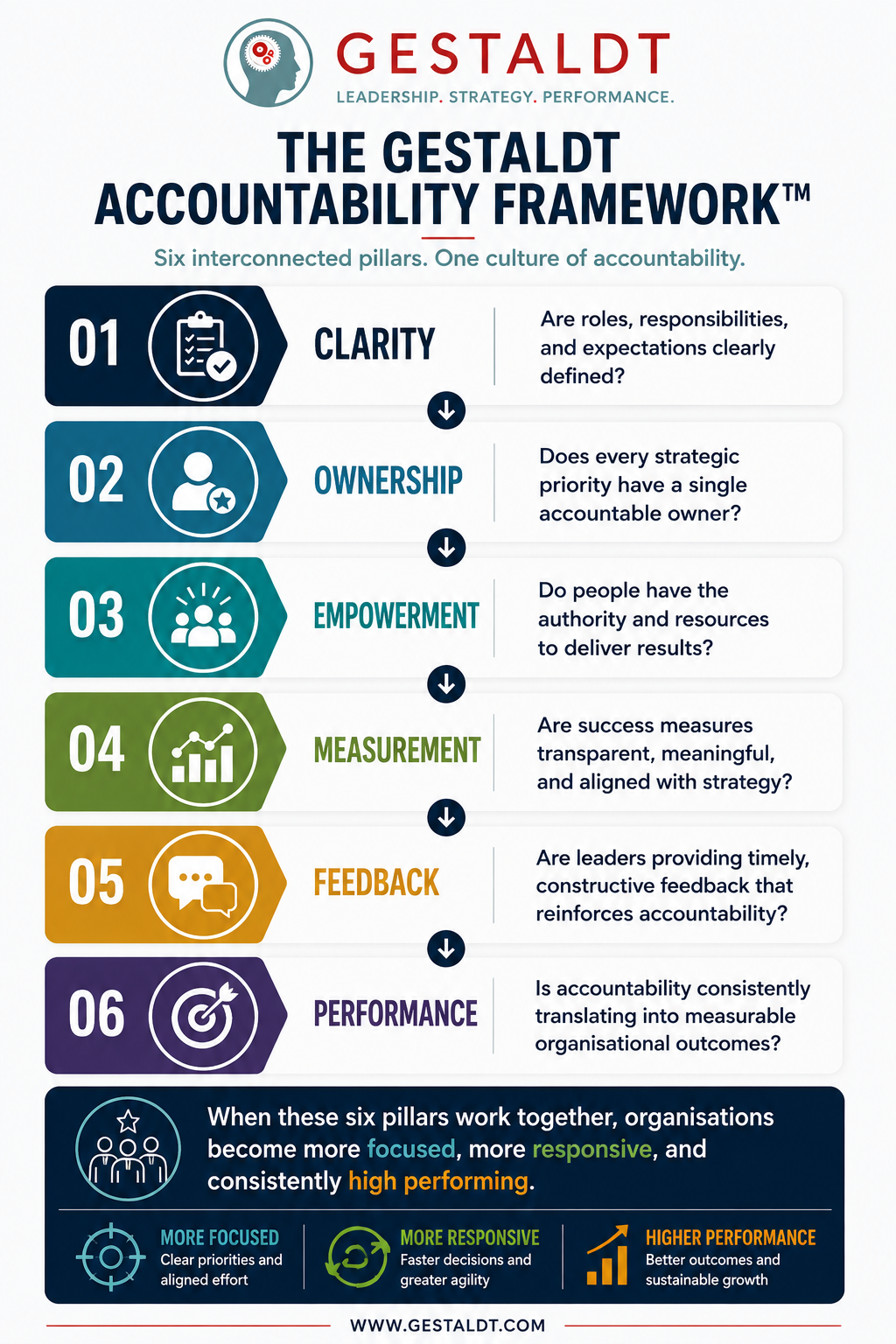
Executive Accountability Scorecard
Rate each statement from 1 (Strongly Disagree) to 5 (Strongly Agree).
Everyone understands their role in delivering strategy.
Major initiatives have clear owners.
Leaders make expectations explicit.
Employees have authority to make appropriate decisions.
Performance measures are aligned with business priorities.
Feedback is timely and constructive.
Accountability is applied consistently at every level.
Leaders model the behaviours they expect.
Teams collaborate effectively to achieve outcomes.
We celebrate results rather than activity.
Results
40–50: Accountability is a strategic strength.
30–39: Some accountability gaps may be limiting execution.
Below 30: Organisational performance is likely being affected by unclear ownership and inconsistent leadership.
Executive Case Study
A growing professional services firm approached Gestaldt after repeatedly missing strategic milestones despite having a highly capable workforce.
Our assessment revealed:
Overlapping responsibilities across senior leaders.
Inconsistent performance measures.
Delayed decisions due to unclear ownership.
A culture where teams were busy but not always aligned.
Using the Gestaldt Accountability Framework™, we helped redesign governance, clarify decision rights, and introduce organisation-wide accountability practices.
Within nine months, the organisation reported:
Faster delivery of strategic initiatives.
Improved cross-functional collaboration.
Clearer executive accountability.
Higher employee engagement.
Greater confidence in leadership.
The transformation was not driven by asking people to work harder. It was achieved by creating clarity about who was responsible for what.
Five Questions Every CEO Should Ask
Does every strategic initiative have one accountable owner?
Are our leaders modelling accountability every day?
Can employees explain how their work contributes to organisational strategy?
Are performance measures focused on outcomes or activity?
Would our customers notice if accountability improved?
These questions often reveal whether accountability is embedded in the organisation—or simply expected.
Accountability Is the Engine of Execution
Strategies succeed because people take ownership.
Transformation succeeds because leaders remain accountable.
Culture strengthens because expectations are consistently reinforced.
Organisations become resilient because accountability creates confidence, trust, and disciplined execution.
The organisations that outperform their competitors are not necessarily those with the smartest people or the largest budgets. They are those where accountability is woven into every aspect of leadership and organisational life.
Ready to Strengthen Accountability Across Your Organisation?
If your organisation is experiencing slow execution, unclear ownership, or inconsistent performance, it may be time to examine how accountability is designed—not just discussed.
Request an Organisational Accountability Assessment
Gestaldt's confidential assessment evaluates:
Leadership accountability.
Role clarity.
Decision rights.
Governance effectiveness.
Performance measurement.
Feedback culture.
Strategy execution.
Organisational alignment.
Together, we'll identify the barriers limiting accountability and develop practical strategies that improve execution, strengthen leadership, and accelerate organisational performance.
👉 Request Your Organisational Accountability Assessment Today

Executive Team Alignment: Why Your Leadership Team Is Holding Your Business Back (And How to Fix It)
Even the strongest business strategy can fail if the executive team isn't aligned. Discover the hidden signs of executive misalignment, the impact on organisational performance, and the practical steps CEOs can take to build a leadership team that drives sustainable growth.

The Most Expensive Problem in Business Isn't Strategy—It's Executive Misalignment
Imagine sitting in a board meeting where every executive agrees with the strategy. The presentation is polished, the objectives are clear, and the budget has been approved. On paper, the organisation appears united.
Six months later, progress has stalled.
Projects are delayed, departments are working at cross-purposes, and employees are receiving conflicting messages from different leaders. Customer complaints are increasing, innovation has slowed, and the organisation is struggling to deliver the very strategy everyone supported.
What happened?
The strategy didn't fail.
The leadership team did.
One of the greatest misconceptions in business is that alignment means agreement. In reality, executive alignment is about far more than consensus. It is about shared purpose, consistent decision-making, mutual accountability, and the ability to lead the organisation as one cohesive team.
At Gestaldt, we have seen organisations invest heavily in strategy, technology, and transformation programmes, only to achieve disappointing results because their executive teams were not operating in alignment.
If your organisation is experiencing slower growth, declining engagement, or inconsistent execution, the problem may not be your strategy—it may be the way your leadership team works together.
Why Executive Alignment Matters More Than Ever
Today's executives are expected to lead through unprecedented complexity.
Economic uncertainty.
Artificial intelligence.
Digital transformation.
Regulatory change.
Hybrid work.
Talent shortages.
Customer expectations that evolve almost daily.
These pressures require leadership teams that can make fast, informed decisions while maintaining strategic focus.
When executive teams are aligned, organisations respond with confidence and agility. When they are not, uncertainty spreads throughout the business.
Research consistently shows that organisations with aligned leadership teams are more likely to execute strategy successfully, retain top talent, and outperform competitors. Alignment improves decision quality, strengthens collaboration, and builds trust across every level of the organisation.
The Hidden Cost of Executive Misalignment
Misalignment rarely announces itself with dramatic conflict. More often, it appears in subtle but costly ways.
Decisions Take Too Long
Simple decisions require multiple meetings because leaders lack clarity or confidence. Opportunities are missed while competitors move faster.
Departments Compete Instead of Collaborate
Functional leaders optimise their own objectives rather than organisational outcomes. Silos develop, reducing efficiency and innovation.
Employees Receive Mixed Messages
When executives communicate different priorities, employees become confused about what matters most, leading to inconsistent execution.
Accountability Becomes Blurred
Without shared ownership, responsibility shifts between teams and initiatives lose momentum.
High Performers Become Frustrated
Talented employees are often the first to leave environments where leadership appears fragmented or indecisive.
The financial cost of these issues is significant, but the cultural cost can be even greater.
Seven Warning Signs Your Executive Team Is Out of Alignment
1. Meetings Produce Discussion Instead of Decisions
If strategic meetings end with more questions than answers, alignment may be lacking.
2. Priorities Change Constantly
Employees struggle to understand what is truly important because leadership messages continue to evolve.
3. Business Units Operate Independently
Departments optimise their own performance rather than contributing to shared organisational goals.
4. Strategic Initiatives Lose Momentum
Projects begin with enthusiasm but gradually lose executive sponsorship and organisational focus.
5. Conflict Remains Unresolved
Healthy debate strengthens leadership teams. Avoiding difficult conversations weakens them.
6. Leadership Behaviours Are Inconsistent
When executives model different values and expectations, organisational culture becomes fragmented.
7. Employees Lack Confidence in Leadership
Trust declines when leaders appear disconnected or unable to make timely decisions.
Why High-Performing Leaders Still Become Misaligned
Executive misalignment is rarely caused by incompetence.
More often, it develops as organisations grow and become more complex.
Common causes include:
Rapid organisational growth
Mergers and acquisitions
Leadership transitions
Conflicting performance metrics
Poor governance
Inadequate communication
Unclear decision rights
Without intentional effort, even experienced leadership teams drift apart over time.
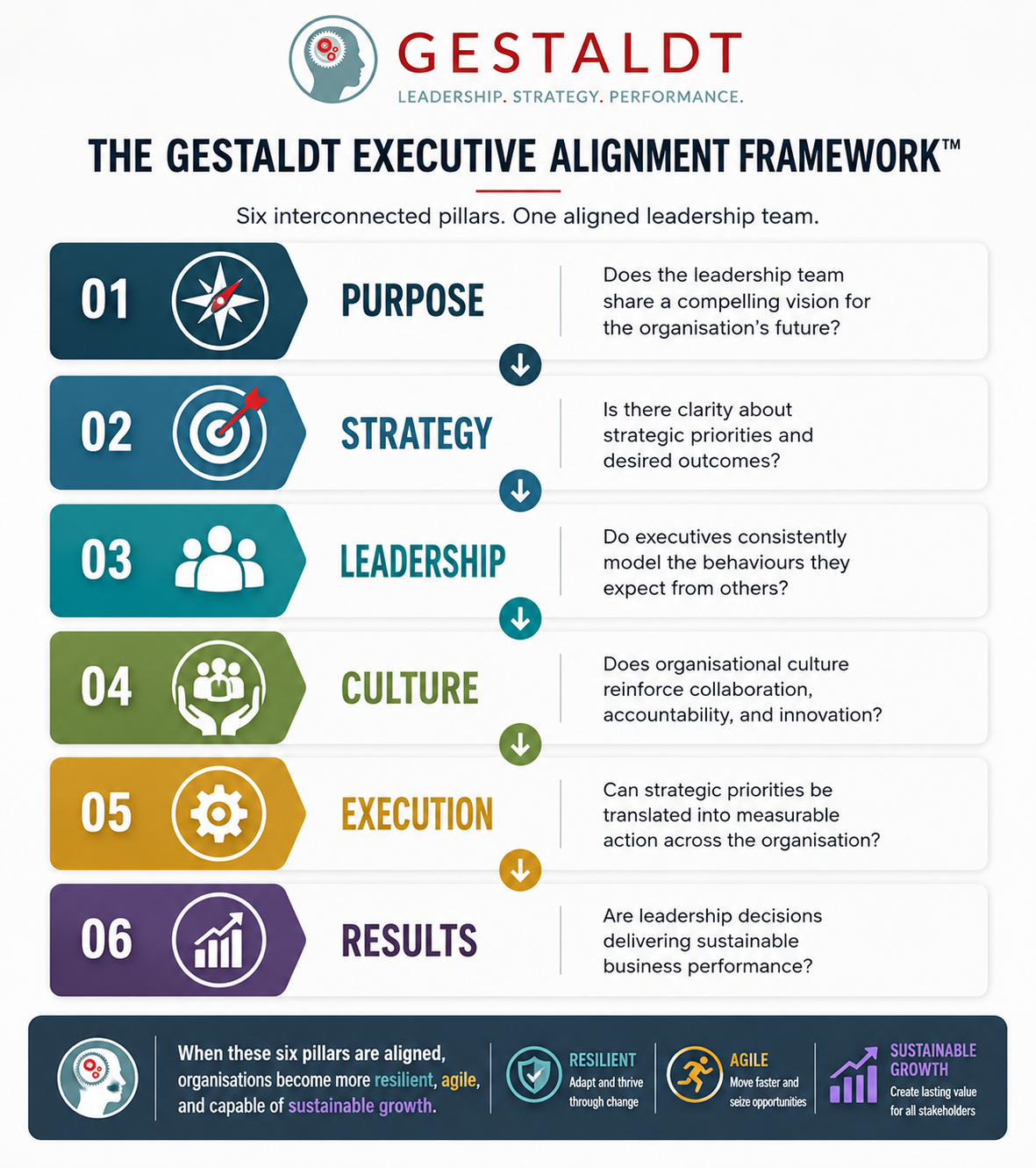
The Gestaldt Executive Alignment Framework™
At Gestaldt, we believe executive alignment is built on six interconnected pillars.
Executive Alignment Self-Assessment
Rate each statement from 1 (Strongly Disagree) to 5 (Strongly Agree).
Our executive team communicates a consistent vision.
Strategic priorities are understood across the organisation.
Leaders make decisions quickly and collaboratively.
Accountability for strategic initiatives is clear.
Departments work together effectively.
Leadership behaviours reflect organisational values.
Conflict is addressed constructively.
Employees trust senior leadership.
Meetings result in timely decisions.
Our strategy is consistently translated into action.
Scoring
40–50: Your executive team demonstrates strong alignment.
30–39: Alignment gaps may be affecting performance.
Below 30: Executive misalignment is likely limiting organisational effectiveness and growth.
A Real-World Example
A national organisation engaged Gestaldt after several years of declining performance despite repeated strategic planning exercises.
An executive alignment assessment revealed:
Different interpretations of strategic priorities
Confeting departmental objectives
Inconsistent communication
Weak accountability structures
Working with the executive team, Gestaldt facilitated leadership alignment sessions, clarified governance, and introduced shared performance measures.
Within twelve months, the organisation experienced:
Faster strategic decision-making
Improved collaboration across business units
Greater employee confidence in leadership
More consistent execution of strategic initiatives
The strategy had not changed.
The leadership team had.
Five Questions Every CEO Should Ask
Before approving another strategic initiative, ask your executive team:
Can every executive explain our strategy in the same way?
Do our behaviours reinforce the culture we want to build?
Are decisions made quickly and consistently?
Do we hold one another accountable for outcomes?
Would our employees describe us as one leadership team?
The answers often reveal whether alignment is a strength—or a hidden risk.
Alignment Is a Competitive Advantage
Organisations don't outperform competitors because they have the smartest executives.
They outperform because their leaders work together with clarity, trust, and discipline.
Executive alignment accelerates strategy execution, strengthens culture, improves decision-making, and creates the conditions for sustainable growth.
In today's rapidly changing business environment, alignment is no longer a leadership aspiration. It is a strategic necessity.
Ready to Strengthen Your Executive Team?
If your organisation is experiencing slower decision-making, inconsistent execution, or competing priorities, the issue may not be your strategy—it may be executive alignment.
Request an Executive Alignment Assessment
Gestaldt's confidential assessment helps executive teams evaluate:
Leadership alignment
Strategic clarity
Governance effectiveness
Decision-making
Accountability
Team dynamics
Organisational culture
Strategy execution capability
Together, we'll identify the barriers limiting your leadership team's effectiveness and develop practical strategies to improve organisational performance.