
The Capability Gap: Why Your Strategy May Be Asking More of Your Organisation Than It Can Deliver
Diverse Black and white C-suite leadership team assessing the capabilities required to execute a strategic growth roadmap, including leadership, workforce, technology, organisational design and execution readiness.
Your Strategy Is Only as Strong as the Capabilities Behind It
A brilliant strategy can look impressive on a boardroom screen and still fail spectacularly in the real world.
Why?
Because strategy creates demand.
Your organisation must supply the capability to meet it.
Imagine putting a powerful engine into a vehicle without upgrading the transmission, tyres, brakes or fuel system. The engine may be exceptional, but the vehicle cannot safely convert that power into performance.
That is what happens when strategy outruns organisational capability.
A company decides to enter new markets—but doesn't have leaders with international experience.
It launches an AI strategy—but employees lack the skills to redesign workflows.
It promises customer-centricity—but incentives still reward internal efficiency.
It targets rapid growth—but its managers are already overloaded.
It invests in transformation—but nobody has the capability to embed the new way of working.
This is the capability gap: the distance between what the strategy requires and what the organisation is currently capable of delivering.
And it is becoming a more urgent CEO issue.
PwC's 2026 Global CEO Survey found that 22% of CEOs say their businesses are highly exposed to a lack of key skills, while nearly a quarter say talent shortages are already inhibiting performance.
The strategic question, therefore, is not simply:
"Do we have a good strategy?"
It is:
"Do we have the organisational capability to make this strategy real?"
1. Your Strategy May Be Ahead of Your Organisation
Here's the first warning sign: the strategy sounds achievable until you ask who will actually deliver it.
Consider a business with an ambitious three-year strategy.
It wants to:
expand into new markets;
digitise customer experiences;
introduce AI;
improve operational productivity;
develop new products;
strengthen innovation;
become more data-driven.
On paper, it sounds compelling.
Then leadership asks:
Who has the skills to do this?
Suddenly, the gaps become visible.
The organisation may lack:
digital leadership;
data capabilities;
commercial skills;
change leadership;
product development expertise;
strategic project management;
cross-functional collaboration;
experienced middle managers.
This is why capability assessment should happen before major strategic commitments are made—not after implementation begins.
McKinsey describes execution as requiring four critical elements, including capabilities, alongside accountability, coordination and motivation. Its research notes that 44% of organisations lose momentum during redesign efforts and roughly one-third fail to deliver after implementation.
Practical Tip
For every major strategic priority, create a simple question:
"What capabilities must be true for this strategy to succeed?"
Then compare that requirement with your current reality.
That gap is your starting point.
2. The Skills Gap Is Bigger Than Training Can Fix
Sending employees on courses won't automatically close a strategic capability gap.
This is where organisations often get stuck.
A capability gap is not simply:
"Our people need more training."
It may actually involve five different problems:
Knowledge — People don't know what to do.
Skill — They know what to do but can't consistently perform it.
Experience — They haven't applied the capability in sufficiently complex situations.
Systems — The organisation's processes and technology make the desired behaviour difficult.
Leadership — Leaders aren't reinforcing or modelling the new capability.
Deloitte's 2025 Global Human Capital Trends research found that 66% of managers and executives said their most recent hires were not fully prepared for their roles, with experience identified as the most common weakness.
That finding matters because experience cannot always be solved by putting someone through a classroom programme.
People need opportunities to apply knowledge under real-world conditions.
They need feedback.
They need increasingly difficult assignments.
They need leaders who create space for learning.
Practical Tip
When you identify a capability gap, ask five questions:
Is this a knowledge problem?
Is it a skill problem?
Is it an experience problem?
Is it a system or process problem?
Is leadership reinforcing the capability?
The answer determines the intervention.
3. Your Middle Managers May Be the Hidden Capability Constraint
The executive team can approve transformation—but middle management determines how much of it actually happens.
Middle managers translate strategy into daily behaviour.
They decide what gets prioritised.
They allocate attention.
They coach employees.
They resolve conflicts.
They interpret leadership messages.
They make countless decisions that never reach the executive committee.
Yet this layer can become a capability bottleneck as organisations grow.
Deloitte's 2025 research found that 73% of organisations recognise the importance of reinventing the manager role, but only 7% say they are making great progress.
That is a striking gap between recognition and action.
The modern manager increasingly needs to do more than supervise work.
They need to:
develop people;
make decisions amid ambiguity;
lead change;
collaborate across functions;
use technology intelligently;
manage performance;
communicate strategic priorities;
build trust.
Deloitte's research identifies judgement as a particularly important capability for managers operating in increasingly complex environments.
Practical Tip
Don't assess managers solely on current-role performance.
Ask:
"What complexity will this manager need to handle two levels above their current role?"
Then develop accordingly.
4. AI Is Exposing Capability Gaps That Were Already There
AI doesn't just create new skills requirements. It reveals weaknesses in the way organisations work.
An organisation may purchase sophisticated AI technology and discover that employees don't know how to integrate it into their workflows.
Or leadership may announce an AI strategy without redesigning roles.
Or teams may use AI individually while the organisation has no governance, data foundations or operating model to scale it.
PwC's 2026 research found that 14% of workers surveyed use GenAI daily at work, while 22% of CEOs say their businesses are highly exposed to a lack of key skills.
The implication is important:
Technology adoption and capability development cannot be separated.
Gestaldt similarly argues that AI is changing strategy work itself, increasing the importance of skills such as data analysis, creativity, judgement and the ability to translate insights into strategic choices.
So the question isn't:
"How do we train people to use AI?"
It is:
"How does AI change the capabilities our organisation needs?"
That is a much bigger question.
Practical Tip
For every significant technology investment, create a Capability Impact Map:
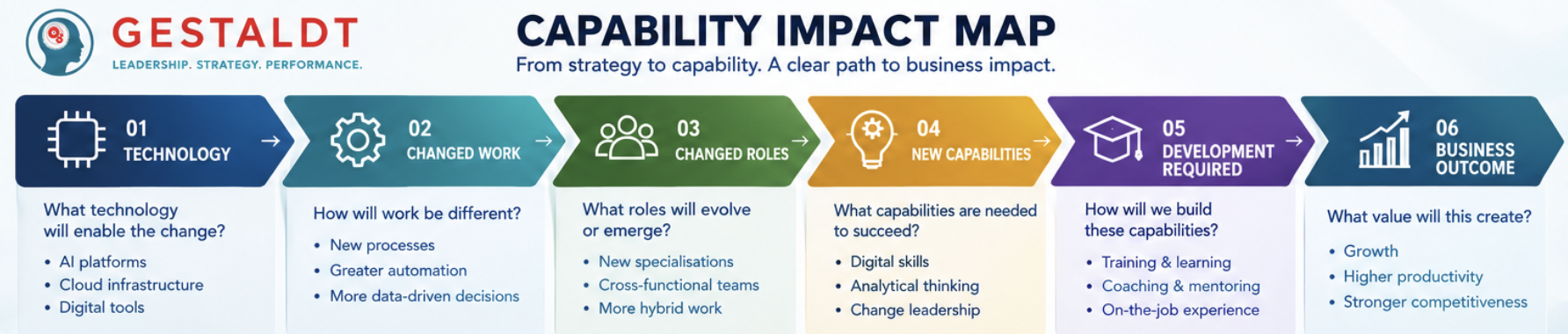
This prevents technology investment from becoming disconnected from organisational readiness.
5. Stop Hiring Your Way Out of Every Capability Problem
Sometimes the answer is new talent. Sometimes it isn't.
When leaders discover capability gaps, recruitment is often the first response.
Hire specialists.
Bring in consultants.
Acquire new talent.
Create a new department.
These can all be appropriate.
But excessive reliance on external hiring can create another problem: the organisation never develops its own capability.
McKinsey's research on strategic workforce planning highlights the value of treating talent with the same strategic discipline applied to financial capital. Its analysis found that S&P 500 companies that excel at maximising return on talent generate 300% more revenue per employee than the median firm.
The broader lesson is that workforce capability should be deliberately designed.
A mature capability strategy combines:
Build — develop existing employees;
Buy — recruit scarce expertise;
Borrow — use partners or external specialists;
Automate — use technology to reduce unnecessary work;
Redesign — change the work itself.
Practical Tip
Before opening a recruitment requisition, ask:
"Should we build, buy, borrow, automate or redesign this capability?"
That one question can significantly improve workforce decisions.
6. Build Capability Around the Strategy—Not Around the Organisation Chart
Your future capability requirements may have very little to do with today's departments.
Traditional workforce planning starts with roles.
CEO.
Finance.
Marketing.
HR.
Operations.
Technology.
But strategy starts with outcomes.
Suppose the organisation's future strategy depends on:
faster innovation;
stronger customer analytics;
international expansion;
digital products;
AI-enabled operations.
Those capabilities may cut across every function.
That means capability building must also cross functional boundaries.
Deloitte's 2025 Human Capital Trends report frames this challenge around three fundamental questions: whether the right work is being done, whether the organisation can access and develop the necessary workforce, and whether the organisation and culture enable performance.
That is a useful shift in perspective.
Instead of asking:
"What people do we need?"
Ask:
"What must the organisation become capable of doing?"
Then work backwards into roles, skills, structures and development.
Practical Tip
Create a Future Capability Map for the next three years.
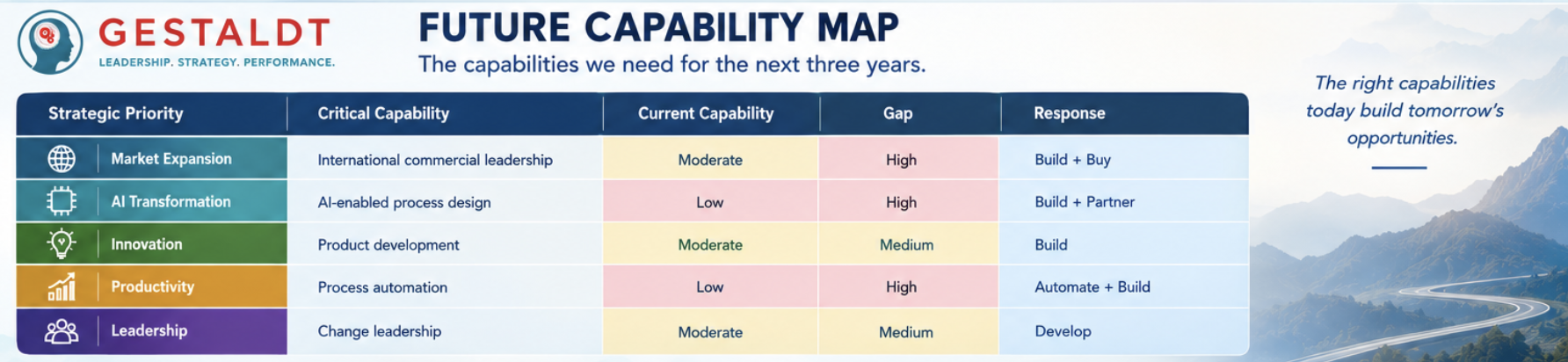
This makes capability a strategic conversation rather than an HR exercise.
The Gestaldt Capability Alignment Framework™
At Gestaldt, we believe capability should be directly connected to strategy.
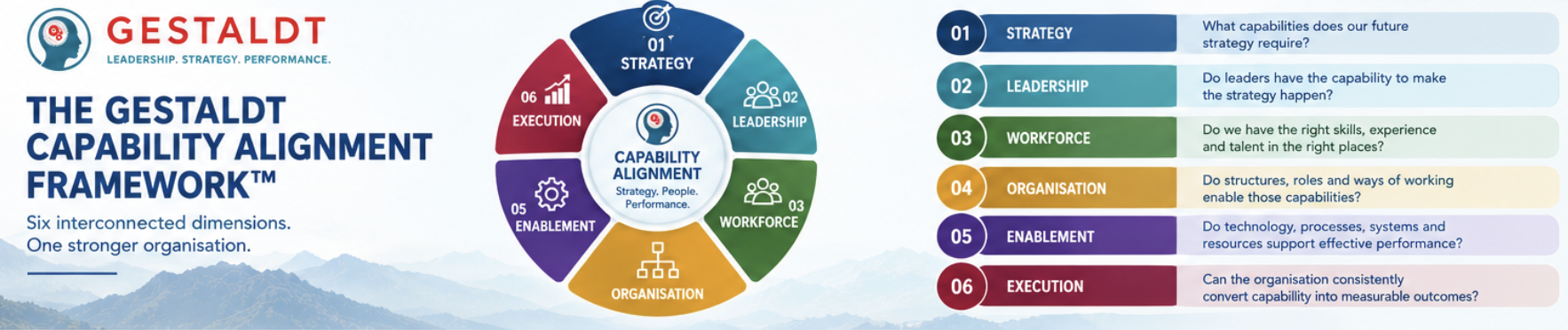
The critical insight is that capability does not sit inside the training department.
It sits across the organisation.
Strategy defines the demand.
Leadership sets the direction.
People provide the capability.
Organisation creates the conditions.
Systems enable performance.
Execution converts it into value.
The CEO Capability Gap Test
Before approving your next major strategic initiative, rate each statement from 1 (strongly disagree) to 5 (strongly agree).
We know which capabilities our future strategy requires.
We have assessed our current capability against those requirements.
We know where our most critical gaps are.
Our executive team has the capability to lead the next phase of growth.
Our middle managers are prepared for increasing complexity.
Employees have meaningful opportunities to build future-critical experience.
Our organisation structure supports the capabilities we need.
Technology and systems enable rather than restrict performance.
Our workforce strategy is directly connected to business strategy.
We can measure whether capability development is improving business outcomes.
Your Score
40–50: Capability aligned
Your organisation has a relatively strong foundation for translating strategy into execution.
30–39: Capability pressure
Important gaps may begin constraining execution as strategic demands increase.
Below 30: Capability risk
Your strategy may be demanding capabilities the organisation is not yet equipped to deliver.
The score is not a substitute for detailed assessment. It is a starting point for an executive conversation.
The Real Question Isn't "Do We Have Good People?"
It's:
"Do we have the right capabilities for where we are going?"
An organisation can have talented people and still have a capability problem.
It can have strong leaders and still lack digital expertise.
It can have experienced managers and still lack change leadership.
It can have thousands of employees and still be critically dependent on a handful of specialists.
Capability is therefore not about headcount.
It is about strategic capacity.
And that distinction becomes increasingly important as technology, customer expectations and competitive environments change.
As Tony Gambell of McKinsey puts it:
“You really do need people to execute.”
That sounds simple.
But it contains a powerful strategic truth.
The organisation cannot execute a capability it doesn't possess.
From Capability Gap to Competitive Advantage
The good news is that capability gaps are not permanent.
They can be diagnosed.
Prioritised.
Built.
Acquired.
Redesigned.
And measured.
The organisations that do this well don't simply respond to capability gaps when they become urgent.
They anticipate them.
They ask:
What will our strategy require from us next?
Then they begin building those capabilities before the market forces them to.
That is the difference between reacting to the future and preparing for it.
And it is why capability building belongs in the CEO's strategy agenda—not at the bottom of the HR agenda.
Is Your Strategy Outpacing Your Organisation?
If your organisation is pursuing growth, transformation, digitalisation, AI adoption, market expansion or operational change, a capability assessment can reveal whether your people, leadership, structure and systems are ready to deliver.
Gestaldt's Human Resources Consulting offering includes strategic talent management, organisational development, leadership effectiveness, succession planning, organisational design, change management, learning and development, and workforce strategy.
Request a Gestaldt Capability Alignment Assessment™
Assess:
Future-critical capabilities
Leadership readiness
Workforce skills and experience
Organisational structure
Capability gaps
Technology and process enablement
Strategic workforce priorities
Execution readiness
Assess Your Organisational Capability
Organisational Resilience: The CEO's Blueprint for Building a Business That Thrives Through Disruption
Economic uncertainty, digital disruption, and changing workforce expectations are redefining business success. Discover how CEOs can build organisational resilience through leadership, culture, governance, capability, and strategic execution.
Resilience Is No Longer About Survival—It's About Sustainable Advantage
Not long ago, resilience was associated with crisis management. Organisations built contingency plans for unlikely events and hoped they would never need them.
Today, disruption is no longer the exception—it is the operating environment.
Economic volatility, technological advances, geopolitical tensions, cybersecurity threats, supply chain disruptions, climate-related events, and changing employee expectations have transformed the business landscape. The question is no longer whether disruption will occur, but how prepared organisations are to respond.
Some organisations emerge stronger from uncertainty. Others lose momentum, talent, customers, and market share.
The difference is rarely luck.
It is organisational resilience.
Resilient organisations do more than recover. They adapt, innovate, and continue creating value while others are reacting. They build leadership teams capable of making confident decisions, cultures that embrace change, governance that accelerates action, and capabilities that prepare people for an uncertain future.
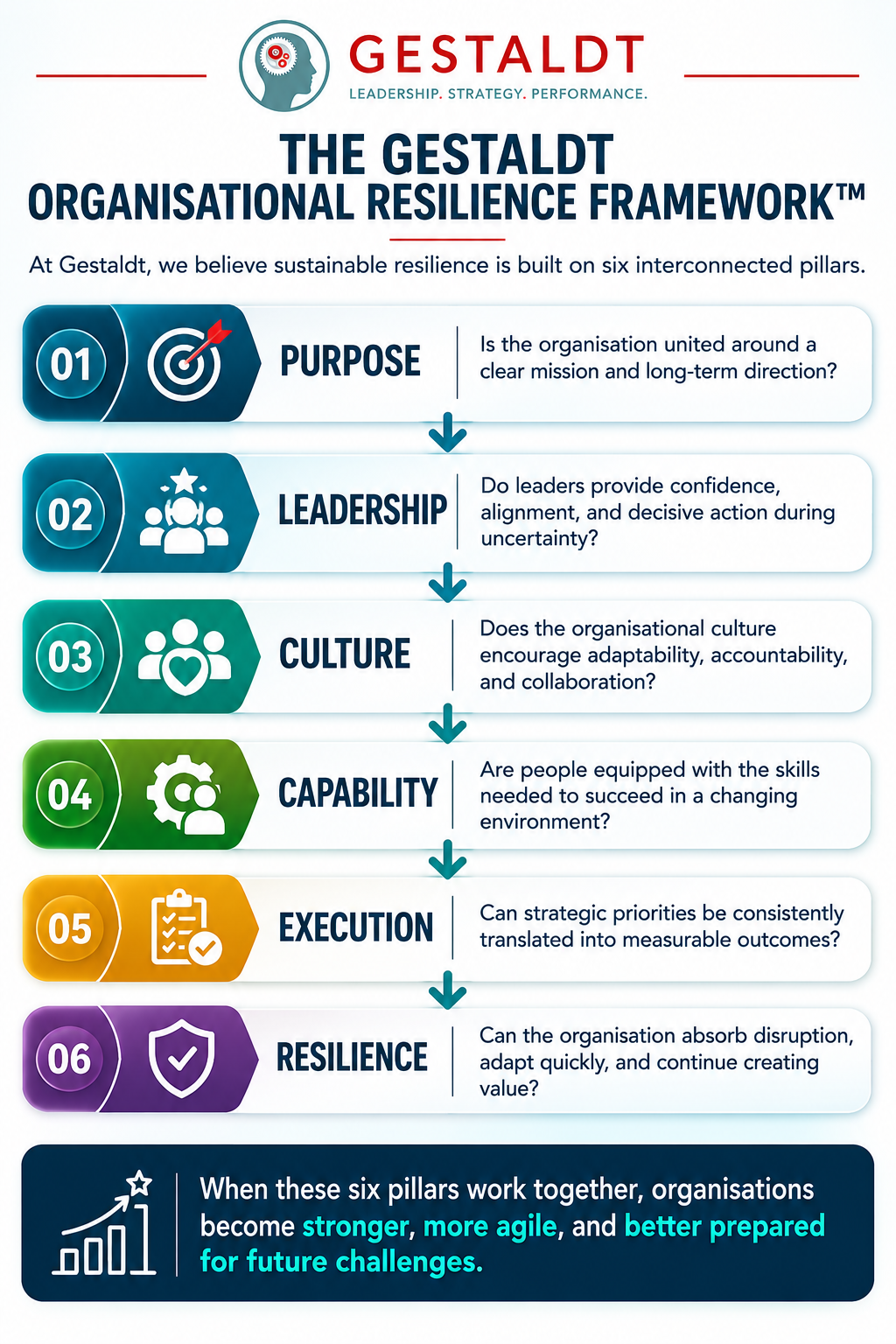
At Gestaldt, we believe resilience is not a programme or a policy. It is an organisational capability that must be intentionally designed, developed, and sustained.
Why Resilience Has Become a Strategic Priority
The pace of change has accelerated beyond traditional planning cycles.
Business models evolve faster.
Customer expectations change continuously.
Technology reshapes entire industries.
Employees expect greater flexibility, purpose, and development.
Boards are demanding greater oversight of organisational risk and long-term sustainability.
In this environment, organisations that rely solely on annual strategic planning risk falling behind.
Resilient organisations embed adaptability into the way they lead, decide, collaborate, and execute.
The Seven Characteristics of Highly Resilient Organisations
1. Leadership Creates Confidence During Uncertainty
Employees look to leaders for clarity, consistency, and confidence when uncertainty increases.
Resilient leaders communicate openly, make informed decisions despite incomplete information, and provide direction without pretending to have every answer.
Leadership behaviour shapes organisational resilience more than any policy.
Related Reading:Executive Team Alignment: Why Your Leadership Team Is Holding Your Business Back (And How to Fix It)
2. Culture Encourages Adaptability
A resilient culture values learning over blame.
Employees feel safe to challenge assumptions, test new ideas, and respond quickly when circumstances change.
Cultures built on trust and accountability recover faster because people focus on solving problems rather than protecting themselves.
Related Reading:The Invisible Fuel of Business Growth: How Leadership Culture Drives Organisational Success
3. Strategy Remains Flexible
Long-term vision should remain stable.
Execution should remain adaptable.
Resilient organisations regularly review assumptions, monitor external trends, and adjust priorities without abandoning their strategic direction.
Flexibility is a sign of disciplined leadership—not indecision.
4. Governance Enables Fast Decisions
In times of disruption, slow governance becomes a competitive disadvantage.
Decision rights should be clear, escalation pathways defined, and accountability transparent.
Governance exists to accelerate informed decisions, not create unnecessary bureaucracy.
5. Capability Is Continuously Developed
Skills become outdated more quickly than ever before.
Resilient organisations invest in leadership development, digital capability, change management, and continuous learning.
Preparing people for future challenges is more effective than reacting after disruption occurs.
6. Execution Remains Disciplined
Resilience is not achieved through planning alone.
It depends on consistent execution.
High-performing organisations translate strategic priorities into measurable action while maintaining focus, accountability, and momentum.
Related Reading:Why Strategy Execution Fails: The 7 Hidden Barriers Most CEOs Never See
7. Performance Is Measured Beyond Financial Results
Revenue and profitability remain essential.
However, resilient organisations also monitor:
Leadership effectiveness
Employee engagement
Innovation capacity
Customer trust
Decision-making speed
Change readiness
Organisational agility
These indicators provide early warning signs long before financial performance is affected.
The Gestaldt Organisational Resilience Framework™
Executive Resilience Scorecard
Rate each statement from 1 (Strongly Disagree) to 5 (Strongly Agree).
Leaders communicate consistently during uncertainty.
Strategic priorities remain clear during change.
Employees embrace innovation and continuous improvement.
Decision-making is timely and well governed.
Learning and capability development are ongoing priorities.
Cross-functional collaboration is strong.
Strategic initiatives are executed effectively.
The organisation adapts quickly to market changes.
We measure organisational health beyond financial results.
We are confident in our ability to respond to future disruption.
Results
40–50: Your organisation demonstrates strong resilience.
30–39: Opportunities exist to strengthen organisational adaptability.
Below 30: Your organisation may be vulnerable to future disruption.
Executive Case Study
A diversified services organisation approached Gestaldt after experiencing repeated disruptions caused by changing market conditions and internal restructuring.
Although financial performance remained stable, executive leaders recognised growing signs of organisational fatigue:
Slower decision-making.
Declining employee engagement.
Increased turnover among key talent.
Difficulty executing strategic initiatives.
Gestaldt conducted an organisational resilience assessment and identified weaknesses in leadership alignment, governance, and capability development.
Working closely with the executive team, we introduced a resilience roadmap that strengthened leadership communication, clarified decision rights, and embedded continuous learning across the organisation.
Within twelve months, the organisation experienced:
Faster responses to market opportunities.
Improved executive collaboration.
Higher employee engagement.
Greater confidence in strategic execution.
Increased organisational agility.
Resilience became a competitive advantage rather than a defensive capability.
Five Questions Every CEO Should Ask
How quickly can our organisation adapt when conditions change?
Do our leaders inspire confidence during uncertainty?
Are we investing enough in future capability?
Does our governance accelerate or delay strategic decisions?
Would our employees describe our organisation as adaptable?
The answers reveal how prepared your organisation is for tomorrow's challenges.
The Future Belongs to Resilient Organisations
No organisation can predict every disruption.
But every organisation can improve its ability to respond.
Resilience is not built in moments of crisis. It is built through deliberate leadership, strong culture, effective governance, capable people, disciplined execution, and a commitment to continuous improvement.
Organisations that invest in resilience today will be better positioned to innovate, grow, and create lasting value tomorrow.
Ready to Strengthen Your Organisation's Resilience?
If your organisation is navigating uncertainty, preparing for transformation, or seeking sustainable growth, resilience should be at the centre of your leadership agenda.
Request an Organisational Resilience Assessment
Gestaldt's confidential assessment evaluates:
Leadership resilience.
Executive alignment.
Organisational culture.
Governance effectiveness.
Capability development.
Strategy execution.
Organisational agility.
Change readiness.
Together, we'll identify the strengths that will carry your organisation forward and the barriers that may be limiting future performance.

Future-Proofing Organisations: Scenario Planning for 2027–2030
Future-proofing organisations requires more than predicting trends—it demands structured scenario planning. Learn how leaders can prepare for 2027–2030 with strategic foresight, digital intelligence, and resilient decision-making frameworks.

The future rarely sends a calendar invite.
One moment business feels predictable, and the next, a technological breakthrough, geopolitical shift, or market disruption changes everything overnight. The organisations that survive—and thrive—aren’t the ones that try to predict the future perfectly. They’re the ones prepared for multiple futures.
Think of scenario planning as building several bridges before the river changes course. Instead of betting everything on one forecast, leaders explore different possibilities and design strategies flexible enough to adapt.
In this guide, you’ll learn how forward-thinking organisations prepare for 2027–2030 using scenario planning, emerging technology insights, and strategic resilience frameworks.
1. Why Scenario Planning Is the New Strategic Superpower
Here’s a hard truth: traditional long-term planning is becoming obsolete.
For decades, companies relied on linear forecasting—projecting current trends into the future. But in an era shaped by AI, climate pressures, and rapid digital disruption, that model breaks down.
Scenario planning, popularised by energy giant Royal Dutch Shell in the 1970s, helps leaders explore multiple plausible futures instead of relying on a single prediction.
According to research by the World Economic Forum, businesses that incorporate scenario planning into strategy processes adapt significantly faster during global disruptions.
Futurist Peter Schwartz explains it well: “Scenarios are not predictions. They are tools to help us understand what might happen.”
Practical Tip:
Create three baseline scenarios for your organisation: optimistic growth, moderate change, and disruptive transformation.
You can explore complementary strategy frameworks in our guide:
Strategic Decision-Making in the Digital Age
https://gestaldt.com/strategic-decision-making-in-the-digital-age/
2. Identifying the Mega Trends Shaping 2027–2030
Before building scenarios, leaders must understand the forces shaping the future.
Consulting experts and the World Economic Forum consistently highlight several mega-trends expected to dominate the late 2020s:
Artificial intelligence integration
Climate adaptation policies
Global supply chain realignment
Demographic shifts and talent shortages
The rise of digital economies
Studies suggest AI alone could add $15 trillion to global GDP by 2030.
Technology entrepreneur Elon Musk once said, “Some people don’t like change, but you need to embrace change if the alternative is disaster.”
Understanding these forces helps organisations construct realistic future scenarios rather than speculative guesses.
Practical Tip:
Assign a “trend radar team” that monitors emerging technologies, policy shifts, and consumer behaviour quarterly.
3. Building Multiple Strategic Scenarios
Once key trends are identified, organisations can design structured future scenarios.
Most effective scenario planning frameworks use three to four possible futures built around two major uncertainties—for example:
Speed of AI adoption
Global economic stability
Institutions like Harvard Business School recommend developing narratives for each scenario describing how markets, technology, and customers might behave.
These narratives help leaders stress-test strategy.
Leadership thinker Roger Martin argues that great strategy isn’t about certainty—it’s about preparing for competing possibilities.
Practical Tip:
For each scenario, ask one key question: “What strategic move would we make today if this future became reality?”
4. Using Digital Tools to Simulate the Future
Here’s where technology supercharges scenario planning.
Modern predictive analytics platforms allow organisations to simulate economic shifts, market demand, and operational risk.
Technology leaders such as IBM and Microsoft are developing AI-powered forecasting tools that analyze massive datasets in real time.
According to Gestaldt Consultants, organisations using advanced analytics for planning are six times more likely to make faster strategic decisions.
As AI researcher Andrew Ng notes, “Artificial intelligence is the new electricity.”
Just as electricity powered the industrial age, AI-powered forecasting will power future strategy.
Practical Tip:
Integrate predictive analytics into quarterly strategic reviews rather than relying solely on annual planning cycles.
5. Building Organisational Resilience
Scenario planning is only valuable if organisations can respond quickly when change happens.
That requires resilience—structures, cultures, and systems designed for adaptability.
Research from Gestaldt Management Consultants shows resilient companies outperform competitors during crises by maintaining operational flexibility and diversified revenue streams.
Leadership author Simon Sinek reminds us: “Leadership is not about being in charge. It is about taking care of those in your charge.”
Resilient organisations prioritise employee well-being, transparent communication, and continuous learning.
Practical Tip:
Develop contingency plans for critical operations—supply chains, workforce capacity, and cybersecurity.
For leadership strategies that support resilience, read:
Leadership 2.0: Augmenting Human Skills with Digital Tools
https://gestaldt.com/leadership-2-0-augmenting-human-skills-with-digital-tools/
6. Turning Scenarios Into Strategic Action
The final step in scenario planning is turning insight into action.
Too many organisations build impressive reports that sit on digital shelves. Effective companies translate scenarios into clear strategic triggers.
For example:
If AI adoption reaches a certain level → increase automation investment
If supply chain disruptions rise → diversify suppliers
If remote work expands → redesign workplace culture
Our consultants report that organisations that embed foresight into strategy cycles are significantly more agile in volatile markets.
Futurist Amy Webb summarises it well: “The future doesn’t just happen—we build it through the decisions we make today.”
Practical Tip:
Attach measurable indicators to each scenario so leadership teams know when to activate specific strategies.
Conclusion: Preparing for the Futures Ahead
The years between 2027 and 2030 will likely bring more change than many organisations experienced in the previous decade.
Scenario planning gives leaders a powerful advantage: the ability to think beyond a single forecast and prepare for multiple realities.
In this article, we explored how scenario planning strengthens strategic foresight, how mega-trends shape possible futures, how digital tools simulate outcomes, and how resilient organisations turn uncertainty into opportunity.
The truth is, the future can’t be predicted with perfect accuracy. But it can be prepared for.
Organisations that embrace foresight today won’t just survive tomorrow’s disruptions—they’ll lead the way into whatever future unfolds.

Leadership 2.0: Augmenting Human Skills with Digital Tools
Leadership 2.0 is where emotional intelligence meets digital intelligence. Discover how modern leaders use AI, data, and collaboration tools to amplify human potential—not replace it.

The corner office doesn’t look like it used to. Today’s leaders aren’t just steering teams—they’re navigating algorithms, dashboards, remote cultures, and digital ecosystems. Blink, and you’ll miss the shift.
Think of Leadership 2.0 as upgrading from a paper map to GPS. The destination—growth, innovation, impact—hasn’t changed. But the tools? They’ve gone digital. The leaders who thrive aren’t the ones who know everything. They’re the ones who know how to combine human intuition with smart technology.
In this guide, you’ll discover how to blend emotional intelligence with artificial intelligence, use data without losing your humanity, and build resilient teams in a tech-powered world.
1. From Gut Instinct to Data-Driven Confidence
Ever made a decision based purely on “a feeling”? We all have. But in today’s landscape, instinct alone won’t cut it.
Leadership 2.0 doesn’t replace intuition—it strengthens it with evidence. According to a Gestaldt report, data-driven organisations are 25 times more likely to acquire customers and 20 times more likely to be profitable.
Tools like CRM systems, analytics dashboards, and AI forecasting platforms allow leaders to validate their instincts. Companies such as Microsoft have embedded real-time analytics into everyday workflows, enabling leaders to make faster, more accurate calls.
As leadership expert John C. Maxwell famously said, “A leader is one who knows the way, goes the way, and shows the way.” In 2026, knowing the way means understanding your data.
Practical Tip:
Start small. Identify one recurring decision—like marketing performance or team productivity—and introduce a data dashboard to guide it.
For deeper insights on strategic thinking, explore our guide on Strategic Decision-Making in the Digital Age.
2. AI as Your Co-Pilot, Not Your Replacement
Here’s the big question: Is AI coming for leadership roles? Not quite.
Artificial intelligence isn’t here to take the wheel—it’s here to act as a co-pilot. Platforms powered by OpenAI and Google are helping leaders automate repetitive tasks, draft communications, analyze patterns, and brainstorm solutions in minutes.
Research from PwC suggests AI could contribute up to $15.7 trillion to the global economy by 2030. That’s not a wave you ignore—that’s one you surf.
Satya Nadella, CEO of Microsoft, said it best: “Every company is a software company.” Today, every leader must become digitally fluent.
Practical Tip:
Use AI tools to draft strategy outlines or summarise reports—but always add your human judgment before finalising decisions.
3. Digital Empathy: The New Leadership Superpower
Technology connects us—but it can also distance us. That’s where digital empathy comes in.
Remote and hybrid teams are now the norm. A Gallup study shows that employees who feel connected to their leaders are 3.7 times more likely to be engaged at work. Yet connection through screens requires intentionality.
Leaders using platforms like Zoom and Slack must go beyond task management. Tone, responsiveness, and recognition matter more than ever.
Psychologist and author Daniel Goleman emphasizes that emotional intelligence accounts for nearly 90% of what sets high performers apart from peers with similar technical skills.
Practical Tip:
Schedule monthly one-on-one video check-ins focused purely on well-being—not performance metrics.
You might also like our article on Building Emotional Intelligence in Remote Teams.

4. Continuous Learning: Upgrade or Get Left Behind
The half-life of skills is shrinking. Fast.
The World Economic Forum reported that 50% of all employees will need reskilling by 2025. Leaders can’t afford to be static while the world evolves.
Organizations like World Economic Forum consistently highlight adaptability as a top leadership trait. Digital tools—online courses, webinars, AI-driven learning platforms—make continuous education accessible and scalable.
As entrepreneur Elon Musk puts it, “Some people don’t like change, but you need to embrace change if the alternative is disaster.”
Practical Tip:
Block one hour per week for structured learning—whether it’s a digital course, industry newsletter, or tech workshop.
For more, read our internal piece on Why Lifelong Learning Is a Leadership Imperative.
5. Collaboration Without Borders
Remember when collaboration meant gathering around a conference table? Those days feel like ancient history.
Today, cross-border teams operate seamlessly thanks to cloud platforms. Research from Harvard Business Review shows that diverse teams are 35% more likely to outperform competitors.
Global companies such as IBM leverage digital collaboration tools to connect talent across continents in real time.
Leadership strategist Simon Sinek explains, “Leadership is not about being in charge. It is about taking care of those in your charge.” Digital tools simply expand the circle of care.
Practical Tip:
Adopt one shared project management platform and ensure full transparency across departments.
6. Cybersecurity Awareness: The Responsibility No One Talks About
Here’s a reality check: leadership now includes protecting digital assets.
Cybercrime damages are projected to hit $10.5 trillion annually by 2025, according to Cybersecurity Ventures. A single breach can shatter trust overnight.
Even tech giants like Meta have faced intense scrutiny over data security concerns. Leaders must understand digital risk—not just delegate it to IT.
Security expert Bruce Schneier often notes that security is a process, not a product. The mindset shift starts at the top.
Practical Tip:
Participate in at least one cybersecurity awareness session alongside your team each year.
Conclusion: The Human Edge in a Digital World
Leadership 2.0 isn’t about replacing humanity with machines. It’s about amplifying human strengths—creativity, empathy, strategic thinking—through digital tools.
We explored how data sharpens intuition, AI enhances productivity, emotional intelligence strengthens digital connection, continuous learning fuels adaptability, collaboration crosses borders, and cybersecurity protects trust.
At the end of the day, technology is just that—technology. The real differentiator is still you.
The future belongs to leaders who aren’t afraid to evolve. So lean into the tools, sharpen your human edge, and step confidently into the next era of leadership.

AI and Business: Practical Use Cases for South African Enterprises
AI is reshaping South African business. Explore practical AI use cases that improve decision-making, automate operations, and build resilience at scale.

Artificial intelligence is no longer a futuristic concept reserved for tech giants. Across South Africa, AI is quietly reshaping how organisations operate, compete, and create value. From automating routine tasks to improving decision-making and customer engagement, AI has moved from experimentation to execution.
For business leaders, the real question is no longer whether to adopt AI — but where to apply it for tangible impact. In a constrained and volatile economic environment, practical use cases matter more than hype.
This article explores how South African enterprises can apply AI in realistic, high-value ways that drive efficiency, resilience, and growth.
Why AI Has Become a Strategic Imperative
AI adoption is accelerating globally, but local realities shape how it should be deployed in South Africa. Skills shortages, infrastructure constraints, and economic pressure mean organisations must focus on use cases that deliver measurable returns.
This pragmatic approach aligns with the resilience-focused thinking outlined in From Insight to Impact: Building Resilient Strategies for a Volatile Economy.
When used strategically, AI helps organisations:
Improve productivity without increasing headcount
Enhance decision quality through data-driven insights
Respond faster to market and customer changes
AI becomes a competitive enabler — not just a technology upgrade.
Use Case 1: Smarter Decision-Making Through Predictive Analytics
Many South African organisations sit on large volumes of underutilised data. AI-powered analytics can turn this data into predictive insights, helping leaders anticipate trends rather than react to them.
Practical applications include:
Sales forecasting and demand planning
Credit risk and fraud detection
Scenario modelling for strategy and investment
This foresight-driven capability complements the strategic planning mindset explored in Strategic Foresight 2026: Turning Reflection into Action.
Practical tip: Start with one decision area where better prediction directly improves outcomes.
Use Case 2: Automating High-Volume, Low-Value Work
AI-driven automation is especially valuable in environments with cost pressure and skills gaps. Robotic Process Automation (RPA) and AI-enabled workflows reduce manual effort while improving accuracy.
Common applications include:
Invoice processing and reconciliations
Customer onboarding and compliance checks
HR administration and payroll queries
This aligns closely with workforce transformation priorities discussed in Talent, Skills & Automation: Preparing Your Workforce for the Next Decade.
Key insight: Automation should free people to focus on judgement, creativity, and relationships — not replace them.
Use Case 3: Enhancing Customer Experience at Scale
AI-powered chatbots, recommendation engines, and sentiment analysis tools are transforming customer engagement across sectors — from banking and retail to telecoms and professional services.
In the South African context, AI can:
Provide 24/7 customer support at lower cost
Personalise services based on behaviour and preferences
Detect service issues before customers escalate
Stronger customer trust and responsiveness support the leadership principles highlighted in The Human Side of Transformation: Keeping Purpose Alive Amid Change.
Use Case 4: Strengthening Supply Chain and Operations
AI plays a critical role in building operational resilience. Machine learning models can detect disruptions early, optimise inventory, and improve supplier performance.
Applications include:
Demand forecasting and inventory optimisation
Predictive maintenance in manufacturing and utilities
Supplier risk monitoring
These capabilities reinforce lessons from Supply Chain Resilience: Lessons From Global Disruptions and Local Adaptation.
Bottom line: AI helps organisations move from reactive operations to proactive control.
Use Case 5: Supporting Leadership and People Decisions
AI is increasingly used to augment — not replace — leadership judgement. People analytics platforms help leaders understand engagement, performance, and retention risks.
Practical uses include:
Identifying skills gaps and reskilling priorities
Predicting employee turnover
Supporting fairer, data-informed talent decisions
This leadership augmentation reflects the evolution described in The Evolving Role of Leadership in 2026: From Control to Empowerment.

Key Enablers for Successful AI Adoption
Technology alone does not guarantee success. South African organisations that extract real value from AI focus on three enablers:
1. Clear Business Use Cases
AI must solve a defined business problem — not exist as a standalone innovation project.
2. Skills and Change Management
Employees must understand how AI supports their work. This reinforces trust and adoption, especially during transformation.
3. Governance and Ethics
Responsible AI use builds confidence with regulators, employees, and customers — particularly in data-sensitive industries.
These execution challenges echo themes from From Strategy to Execution: Closing the Gap in Organisations.
AI in the South African Context: Opportunity with Responsibility
AI adoption also presents an opportunity to address structural challenges — from productivity gaps to skills development. When deployed responsibly, AI can support inclusive growth rather than deepen inequality.
Organisations that align AI strategy with purpose and long-term value creation are better positioned for sustainable success.
Conclusion
AI is not a silver bullet — but it is a powerful accelerator when applied with intent. For South African enterprises, the greatest value lies in practical use cases that improve decisions, automate inefficiencies, and strengthen resilience.
The organisations that win with AI will not be those chasing the latest technology trend, but those that integrate AI thoughtfully into strategy, culture, and execution.
In a decade defined by uncertainty, AI becomes most powerful when it helps people think better, act faster, and lead with confidence.

Talent, Skills & Automation: Preparing Your Workforce for the Next Decade
Automation and skills disruption are reshaping work. Discover how organisations can prepare talent, re-skill teams, and align automation for the next decade.

If strategy is the blueprint of the future, talent is the workforce that builds it. And right now, that workforce is standing at the intersection of rapid automation, widening skills gaps, and shifting employee expectations.
For South African organisations, the next decade will not be defined by technology alone — but by how effectively leaders prepare people to work with technology. Automation is accelerating, AI is reshaping roles, and skills are expiring faster than ever before.
The organisations that thrive will be those that rethink talent, invest in skills, and design automation strategies that elevate — not replace — their people.
Why Talent Strategy Is Now a Business-Critical Issue
Automation and digital transformation are no longer future trends — they are current realities. According to the World Economic Forum, nearly 50% of employees will require reskilling by 2030 due to automation and AI adoption.
This urgency mirrors the broader uncertainty explored in From Insight to Impact: Building Resilient Strategies for a Volatile Economy, where adaptability is emerging as a defining organisational capability.
Talent strategy today directly influences:
Productivity and innovation
Employee engagement and retention
Organisational resilience
In short, talent is no longer an HR issue — it’s a leadership mandate.
The Skills Shift: From Static Roles to Dynamic Capabilities
Traditional job descriptions are becoming obsolete. The future workforce is built around capabilities, not fixed roles.
High-value skills for the next decade include:
Digital literacy and data fluency
Critical thinking and problem-solving
Adaptability and learning agility
Emotional intelligence and collaboration
This human-centred shift aligns closely with insights from The Human Side of Transformation: Keeping Purpose Alive Amid Change.
Practical insight: Skills expire faster than strategies — continuous learning must become embedded, not optional.
Automation as an Enabler, Not a Threat
One of the biggest leadership missteps is framing automation as a cost-cutting exercise rather than a capability-building opportunity.
Smart organisations use automation to:
Eliminate repetitive, low-value tasks
Free employees for higher-impact work
Improve decision-making through data
This balanced approach reflects the leadership evolution discussed in The Evolving Role of Leadership in 2026: From Control to Empowerment.
Key mindset shift: Automation should amplify human potential — not diminish it.
Preparing Leaders for a Hybrid Human-Digital Workforce
The future workforce will be hybrid — humans and machines working side by side. That requires leaders who are comfortable managing both complexity and change.
Effective leaders in this environment:
Build trust during transition
Communicate clearly about automation impacts
Reskill teams before disruption hits
These leadership capabilities are essential during periods of uncertainty, as explored in Leadership in Crisis: How to Maintain Trust and Morale Under Pressure.

Reskilling at Scale: Small Steps, Big Impact
Large-scale reskilling doesn’t require massive budgets — it requires focus.
High-impact approaches include:
Micro-learning and modular training
Internal mentorship and peer learning
Cross-functional project exposure
This execution-focused mindset connects directly with From Strategy to Execution: Closing the Gap in Organisations.
Practical tip: Prioritise skills that support strategic priorities — not generic training.
The South African Context: Opportunity in Transition
South Africa faces a dual challenge: high unemployment alongside acute skills shortages. Organisations that invest in talent development contribute not only to their own resilience, but to broader economic stability.
Future-ready workforce strategies also support:
SME competitiveness
Digital inclusion
Sustainable growth
These themes echo opportunities outlined in Designing the Future: Strategic Priorities for South African Leaders in 2026.
From Workforce Planning to Workforce Design
The next decade demands a shift from workforce planning to workforce design. This means:
Designing roles around outcomes
Building flexible talent pools
Aligning automation with purpose and culture
Organisations that integrate talent, skills, and automation into a single strategy are better positioned to weather disruption and capture opportunity.
Conclusion
The future of work isn’t about choosing between people and technology — it’s about designing systems where both thrive together.
By investing in skills, embracing automation thoughtfully, and leading with empathy and clarity, organisations can build a workforce that is resilient, adaptable, and ready for the next decade.
In an era of constant change, the most competitive advantage remains timeless: people who are equipped, empowered, and engaged.

Designing the Future: Strategic Priorities for South African Leaders in 2026
South African leaders face a transformative 2026 shaped by economic volatility, digital acceleration, evolving talent demands, and rising sustainability pressures. This article explores the strategic priorities leaders must focus on to build resilience, strengthen execution, and design a future-ready organisation capable of thriving in a rapidly changing environment.

As 2026 approaches, South African executives stand at a defining moment. The combination of global economic uncertainty, local policy transitions, shifting market dynamics, and rapid technological disruption is reshaping what strategic competitiveness looks like. Leaders who once focused on short-term operational efficiency are now being challenged to redesign their organisations for long-term resilience, agility, and purposeful growth.
South Africa’s business landscape is changing fast—but with the right priorities, leaders can position their organisations to thrive rather than simply adapt. This article explores the most critical strategic priorities leaders must embrace in 2026, offering practical guidance and future-focused insights.
1. Build organisational resilience for a volatile economy
South Africa’s economic environment will remain uneven in 2026, influenced by energy constraints, policy shifts, global supply chain realignments, and persistent cost pressures. Leaders must therefore move beyond reactive planning and embrace structural resilience, including:
Key actions
Scenario-based strategy: Prepare for best-, mid-, and worst-case outcomes around energy availability, interest rate movements, and regulatory changes.
Cost discipline with strategic intent: Protect liquidity while investing in high-impact areas like technology and capability building.
Revenue diversification: Enter new markets, digitise products, and build service-based income streams that stabilise earnings.
Businesses that embed resilience not only survive disruptions—they turn uncertainty into competitive advantage.
2. Prioritise digital transformation with measurable outcomes
In 2026, technology is no longer a support function—it is the heart of competitive strategy. But the real differentiator will be execution discipline, not technology itself.
Key actions
Digitise core operations to reduce inefficiencies and improve customer experience.
Adopt AI and automation where they deliver measurable value, not hype-driven experimentation.
Strengthen cybersecurity, especially as digital ecosystems and remote work expand.
Invest in data intelligence to improve forecasting, decision-making, and personalised offerings.
South African organisations that scale digital capabilities effectively will unlock efficiency, speed, and strategic clarity.
3. Lead with purpose, values, and human-centred transformation
After years of economic pressure and social uncertainty, employees expect more transparent, ethical, and empathetic leadership. In 2026, culture becomes a non-negotiable strategic asset.
Key actions
Embed a clear organisational purpose linked to societal contribution—not just profit.
Strengthen internal communication to maintain trust during transformation.
Develop leaders at all levels, not only executives, through mentorship, coaching, and skills development.
Build cultures of empowerment, shifting from control to collaboration and accountability.
Purpose-driven organisations consistently outperform their peers—and the expectation for authenticity is rising.
4. Embrace sustainability and South Africa’s emerging green economy
South Africa is accelerating towards renewable energy, circular models, and climate-resilient practices. Whether driven by regulation, investor pressure, or cost efficiency, sustainability will shape competitive advantage.
Key actions
Assess climate risk exposure across the value chain.
Pursue energy independence solutions, such as hybrid solar systems.
Develop green products and services aligned with shifting consumer and investor expectations.
Report transparently on ESG performance, reducing reputational and regulatory risk.
Leaders who invest early in sustainability will unlock new markets and reduce long-term operating costs.
5. Strengthen organisational agility for faster execution
Slow execution is one of the biggest barriers to growth in South African organisations. In 2026, competitive advantage goes to leaders who can adapt, align, and execute rapidly.
Key actions
Simplify decision-making structures to reduce bureaucracy.
Adopt agile operating models that allow teams to move quickly and cross-functionally.
Use real-time data to adjust strategy dynamically.
Focus on capability building, not only structural change.
A strategy is only as strong as its execution—and execution requires clarity, ownership, and speed.
6. Strengthen partnerships across ecosystems
No organisation can succeed in isolation. The future of South Africa’s economy will be shaped by collaboration, not competition alone.
Key actions
Partner with startups to accelerate innovation.
Build cross-industry alliances to solve systemic challenges such as energy supply and infrastructure bottlenecks.
Engage government and regulators proactively, influencing policy that supports growth.
Co-create solutions with customers and communities, improving relevance and impact.
Ecosystem-driven strategies are becoming the backbone of long-term competitiveness.
7. Focus on talent retention, skills development, and future capabilities
As demand rises for digital, technical, and leadership capabilities, South Africa faces a widening talent gap. Leaders must proactively build future-ready workforces.
Key actions
Upskill employees in digital literacy, critical thinking, and data-enabled decision-making.
Invest in leadership development pipelines that support succession and organisational continuity.
Enhance employee experience, especially in hybrid-work environments.
Reward performance fairly, with transparent pathways for growth.
Organisations that invest in people will gain a sustainable competitive edge.
Conclusion: Designing a future with intent, clarity, and resilience
2026 will reward leaders who are both visionary and practical—those who can read the signals of change, set clear priorities, and execute with discipline. South African organisations sit at a pivotal moment: the next two years will define whether they emerge stronger, more innovative, and more resilient.
By focusing on the strategic priorities outlined above—resilience, digital transformation, purpose-driven culture, sustainability, agility, partnerships, and talent—leaders can shape a future that is not only competitive but also meaningful.
The organisations that thrive in 2026 will be those that design the future deliberately—balancing insight with action, and ambition with execution.

The Evolving Role of Leadership in 2026: From Control to Empowerment
Leadership in 2026 is shifting from control to empowerment. Discover how emotional intelligence, trust, and digital collaboration are redefining what it means to lead — and how forward-thinking leaders can thrive in the next era.

Gone are the days when leadership meant calling the shots from the corner office. In 2026, the world’s best leaders aren’t commanding — they’re connecting.
Leadership today is undergoing a profound transformation. Think of it like shifting from driving a car manually to guiding a self-driving vehicle — the leader’s role moves from control to calibration, from directing every move to ensuring the system stays aligned.
As organisations prepare for 2026, empowerment has replaced control as the cornerstone of effective leadership. It’s no longer about authority but about enabling people, fostering trust, and driving collaboration. In this article, we’ll explore what this new era of leadership looks like, why it matters, and how leaders can adapt to thrive in the years ahead.
1. From Command-and-Control to Empower-and-Enable
Traditional leadership structures were built on hierarchy and compliance. But in the hybrid, hyper-connected workplaces of 2026, agility outperforms authority.
According to the 2025 Global Human Capital Trends report, 82% of organisations now prioritise empowerment and trust-based leadership models over traditional control structures. This shift has proven to boost innovation, morale, and employee retention.
💡 Tip: Replace rigid approval processes with decision-making autonomy at team levels. Empowered employees move faster — and think smarter.
2. Emotional Intelligence: The New Core Competency
In the AI-driven age, emotional intelligence (EQ) has become the defining skill that separates good leaders from exceptional ones. Leaders who lead with empathy, active listening, and authenticity inspire greater loyalty and creativity.
Harvard Business Review found that teams led by emotionally intelligent managers experience 20% higher engagement and 30% lower turnover. As automation takes over routine work, human connection becomes the true competitive advantage.
💡 Tip: Begin each team meeting with check-ins that focus on people, not just projects. It builds trust — the foundation of empowerment.
3. Leading Through Trust and Transparency
In times of uncertainty, control creates resistance; trust creates alignment. Leaders in 2026 must communicate transparently — sharing not only the “what” but the “why” behind decisions.
Gestaldt’s Future of Leadership study revealed that 95% of employees are more likely to stay with an organisation when leadership communicates openly and honestly about business direction. Transparency fuels empowerment, while secrecy breeds disengagement.
💡 Tip: Use data dashboards and all-hands meetings to keep teams informed about company performance and strategic goals.

4. Empowerment as a Driver of Innovation
Empowered employees are innovators. When leaders remove unnecessary barriers, teams take ownership — and creativity flourishes.
Case in point: Microsoft’s cultural shift under Satya Nadella. By replacing a culture of control with one of “learn-it-all” curiosity, Microsoft reignited its innovation engine and saw its market value triple within a decade.
💡 Tip: Encourage teams to experiment and reward learning from failures. Empowerment without psychological safety leads to hesitation, not innovation.
5. The Digital Dimension of Empowered Leadership
Technology is not just a tool — it’s a leadership amplifier. Digital platforms enable transparency, collaboration, and real-time feedback. Leaders who leverage these tools can empower distributed teams while maintaining clarity and cohesion.
Gartner predicts that by 2026, 75% of high-performing leaders will use digital engagement analytics to understand team dynamics and performance in real time. Empowerment now includes enabling technology that allows teams to self-manage effectively.
💡 Tip: Adopt collaborative platforms like Microsoft Teams, Miro, or Notion to create transparent workflows and visible progress.
6. The Future: Collective Leadership Over Heroic Leadership
The age of the “heroic leader” is fading. The future belongs to collective leadership — networks of empowered individuals aligned around a shared purpose.
As management thinker Margaret Heffernan notes, “Leadership is no longer about one person knowing everything — it’s about everyone contributing their best.” This philosophy creates resilient, adaptive organisations that can navigate complexity with confidence.
💡 Tip: Establish cross-functional leadership councils or innovation task forces where decision-making is shared across disciplines.
Conclusion: Leadership for the Next Decade
The evolving role of leadership in 2026 is defined not by control but by connection. Empowered leaders trust their teams, value emotional intelligence, and use technology to enhance collaboration rather than micromanage it.
As Simon Sinek reminds us, “Leadership is not about being in charge. It’s about taking care of those in your charge.” In this new era, success will belong to leaders who trade authority for authenticity and command for empowerment.
By embracing this shift, organisations won’t just survive the next wave of transformation — they’ll lead it.